Showing posts with label 11-speed. Show all posts

Tuesday, June 24, 2025

Remember "House?"

 In the medical drama "House," caustic genius Dr. Gregory House diagnosed mysterious afflictions that suddenly struck down the patient of the week, for eight seasons of often nauseating entertainment. The nasty genius used his mega mind, extensive education, and long experience to slice through the confusion and bring us the answer.

After the previous medical drama ER made patient -- and even doctor -- survival far less likely, viewers were trained not to expect a happy ending. House delivered pretty often, but sometimes the patient died. Also, House would be wrong several times in the episode before delivering the right diagnosis within a few minutes of the end. After you watch a few, you realize that early certainties never pan out. "Do this!" House snaps at his team. We look at the clock and go, "Nah, that ain't it."

Without all of the good-looking actors, life and death stakes, and medical bills that would bankrupt a medium sized city, bike repair has become like episode after episode of House. A patient comes in with weird symptoms or what looks like a simple problem at first. We diagnose and treat. It fails. We try something else. Thing is, no one has bike medical insurance, so we the greasy healers are the ones who stand to lose a lot of money on these false starts.

Bike shops have no medical associations in which we share our experiences and publish papers in a journal. We don't know what other mechanics are doing. Online videos show either idealized versions of various procedures or selected experiences of individuals who may be amateurs and inexperienced. And if the video doesn't cover the exact model in the exact year that you're dealing with, the information might not help at all. On top of that, who has time to spend hours trolling through search results in hope of finding a tutorial that might not even be out there.

Forums may yield some useful knowledge, but are just as likely to attract experienced misinformation or loud, confident, and wrong newbies. You have to sift carefully to find cases that fit what's in front of you on your work stand.

The manufacturers really don't care if you can fix anything. They just want you to buy it. Ancestral sources like Sutherland's and Sheldon Brown can't keep up. We're thrown back on our experience and education -- such as it may be -- to analyze the problem.

With every added cog in the cassette, mechanical shifting gets more and more temperamental. As the manufacturers abandon what used to be the state of the art, replacement parts for that number of speeds are made more cheaply. This includes shifters and derailleurs. You had fancy ten-speed when it was the best? You're just part of the rabble now. Eleven speed is rapidly going the same way.

Any repair could turn into a frustrating mystery these days. I like a challenge, but most of this crap is just an affront. Parts are disappearing for the old, reliable, simple bikes, while tech support barely exists for the new, throwaway bikes. I get it: to a racer, the entire bike is as consumable as chains, tires, and tubes used to be. As long ago as the 1980s, racing was already turning into a massive science experiment. It has only gotten more so. Rider and machine need a complex support system to eke out those hundredths of a second per kilometer.

Advancements in racing technology through the 1970s improved quality for all riders, because we all used similar mechanisms, shaped slightly differently for variations like racing versus touring, and, later mountain biking. As disciplines diverged, particularly off-road, there was a lot less cross-pollination.

People here used to complain from time to time about the level of detail I would go into, but less time was wasted diving right in as opposed to dithering around trying to figure out how to avoid it. Lately, though, it seems that diving in doesn't assure solid results. Too many things have to work too perfectly together.

The road bike that's giving me fits right now was built on a bare frame in 2017. The owner rides hard. He raced a couple of short seasons, mostly just a nearby training series, but it's a competitive series. He rides with people who never go easy. Over the years, we have replaced gear cables and housings as necessary to restore precise shifting, along with chains and cassettes. This time, though, I can't get it to behave.

The brifter seemed to be worn out. It needed too much lever travel to engage, which meant that it didn't have enough left to climb to the low gear cog. I changed the brifter. It was crisper, but still did not have the reach. The chain gauged pretty new. We'd already changed all cables and housings with tried and true 5mm. The bottom bracket cable guide can't be removed because the bolt that threads into an insert in the BB is rusted in, and the insert itself is broken loose from the bottom bracket shell. It's been that way for years. It shouldn't matter as long as the guide stays in position. Cable tension should hold it.

I rigged a brifter in parallel, using full-length housing, to test the derailleur itself. It shifts the full range. So something in the cable system is eating lever travel. I can see motion where the cable housing enters the upper end of the downtube. There's a bit more waggle where the housing exits the chainstay near the derailleur. Is that enough to cause the problem? Parts are all original, and very simple. But the hole in the downtube could be worn. After all this, is the answer something simultaneously stupid and difficult?


Possibilities on the whiteboard: Maybe I should drill out the frame and run full-length housing. That's a one-way trip, though. How about using carbon-compatible epoxy to shim up the frame hole? But I don't want to glue the cable stop into the frame. That might make future cable changes even more time consuming.

I tried every combination of cable housing, including 4mm, 5mm, and mixing widths in case the flex characteristics of the 4mm handled the bends better than the 5mm we can get now. I'm happy to say that 4mm did nothing to help. Eventually, I put on a new brifter, new cassette, and the 5mm housing we had installed first when we thought it would be the routine repair we had completed successfully several times over the bike's life. I got it to hit every gear from the 39, and every gear but the Ned -- the full cross 53-28 -- from the big ring.

Given the option of taking the bike with the gears we could get or making permanent modifications to install full-length housing, the rider opted to take the bike as it is. He even said that it hadn't been getting the Ned for a while, and he was fine with that. We'll see how things go.

Nothing is a sure cure anymore. Every fix is temporary. Who needs another metaphor for life when we just want reliable machinery? I hop on my primitive bike, day after day, and just go. I can change a cable on the side of the road in about 15 leisurely minutes. If I get a flat, I put in a new inner tube, pump it up, and ride on.

Sunday, April 06, 2025

And on to the next dream...

 After finishing the e-bike stretch cruiser it was time to replace the shifters and crank on a beautiful late-1990s Dean. The bike might actually date from right after the turn of the century. We've been seeing it in the workshop nearly every spring or summer for a long time. I built those wheels more than ten years ago. Maybe so long ago that we looked up parts in a printed catalog and placed orders by phone.


The picture above shows the bike after its recent changes. Originally, it had a Campagnolo Chorus crank, Record 10-speed brifters, and Centaur derailleurs. I vaguely recall that we had already upgraded it from 9-speed to ten-speed by the turn of the century, but we did work on a number of Campy-equipped bikes. Campagnolo actually provided instructions for changing some internal parts in a brifter to change the number of speeds. And, of course, the internals were completely repairable. But the shifter bodies and so many internal parts on this bike were now so worn that repair would have cost a lot more than a new set of brifters.

A lot of years had passed, but Campagnolo had always been the leader in backwards compatibility. You can buy quite a few parts for a 25-year-old shifter, although some of them are being phased out. During that 25 years, the parts fit models that spanned more than eight years, which is phenomenal in the post-Shimano era of technological hyperactivity.

The rider wanted lower gearing than the 53-42 chainrings on his existing crankset. Campy's 135mm bolt circle limits how small a ring you can fit, and they have to match that proprietary bolt pattern. Back when Campy's BCD was 144, other manufacturers copied it. Then Shimano and the Japanese makers brought in the 130 bolt circle diameter, and the industry shifted to that. This meant that you could put on the 53-39 combination that became the de facto standard for road cranks for years. You could even get a 38 for the inner ring, but few did.

When compact road cranks came in, they used the 110mm BCD that mountain bike chainrings were using. Mountain bikes still used triple chainrings. Road compact cranks were designed for just two rings up front. While the young and strong would combine the new little 50-tooth big ring with an 11-tooth cog for the hardest one on the cassette, the 50-34 combination that was most common served as sort of a secret granny gear for riders who were starting to feel a little faded as age took its toll.

So many years had passed before the owner of the Dean felt the need to gear down that a nice compact double for ten-speed was tricky to find. I also recommended trying to match the aesthetic of the old steel frame rather than sticking some aerospace monstrosity on there. I suggested, and he agreed, to get a Velo Orange Grand Cru Drillium crankset. It was actually a little more retro than the bike, but it's also fairly affordable and distinctive compared to the monotonous hellscape of soulless modern componentry.

It's actually made by IRD. But Velo Orange has their Grand Cru badge applied to it, and they deserve support for being such a friend to the retro rider.


The owner dropped the bike off in late March, 2024. I was able to get the brifters and bottom bracket right away. The crank was shown as out of stock for a month or so. The customer was willing to wait. That ETA got kicked down the road a month or two at a time, all the way to the end of the year. We nearly lost the job entirely, but I had contacted Velo Orange directly by that time, to confirm that they were still going to have the cranks at all. We got the customer to hang on. The crank finally arrived a week or two ago. We were still in ski mode, so I didn't start the job right away. We were also buried in the stretch cruiser project, which had been plagued with its own spec problems, but those had resolved more quickly.

As I dug into the Dean, I discovered that the slop in the shifters had been masking slop in the derailleurs. They were very floppy. That led me to look at what we could get for Campy 10-speed derailleurs.

Nothing. That's what we can get for Campy 10-speed derailleurs. Not a zippin' thing. Zippity doodah. Zilch. Nada. Campagnolo has abandoned their faithful long-term customers actually worse than Shimano. Shimano at least still makes some 10-speed road derailleurs for mechanical shifting, with brifters to match, for those who are addicted. For the friction shifters, the truly free, we can buy whatever derailleur we like the looks of and can afford. But for the brifter-dependent, the company that launched the industry into technofascism still has a little lifeline hanging out for the laggards still nursing their older stuff.

Funny: fascism was actually invented in Italy, and the Italian company was the slowest to adopt technofascism. But they're racing to catch up now. Be sure to shell out massive bucks for their 12-speed electronic stuff. It's kind of nice to see them back to duking it out for pro team spec, but the game has no soul anymore, so what are we really winning?

Way way back, in the 1970s and early 1980s, you could actually get every part of a Campagnolo derailleur, separately, to replace what might have gotten bent or cracked in a crash or a workshop mishap. It was treacherously easy to strip the threads on a front derailleur swing arm when tightening the cable anchor bolt. Good thing you could buy just the arm, install it, and pledge to use a lighter touch after that. You could also crack the clamp band, tightening the derailleur on the seat tube. Again: press the rivet out, replace the band, put on the new one and be more sensitive, you clod. Do you caress your lover with those awkward, loutish hands?

Well yes, yes I did, which explains my long spells of monkish solitude, but anyway... You can't get parts to rebuild a derailleur anymore. Long gone, though I do recall seeing them as late as the early 21st Century. I'll have to dig into my archive of Quality catalogs. QBP's print catalogs used to provide such complete tech information that we could figure out a lot of repairs and compatibility puzzles just from what they included about each product.

I had recommended that the customer stick with Campy because of their legendary durability and product support. Seems like I should have investigated them a little more deeply before charging ahead with this job. The customer and I were both trying to extend the life of existing parts rather than junk stuff and start over. Now, if he isn't satisfied with how this thing shifts, we have no option that doesn't cost him a chunk of change to take a different tack.


These shifters seem less substantial than they used to be, and the upshift thumb lever impedes removing the rubber hood to mount the brifter or run cables.

They also only fit 4mm shift cable housing, which means that we can't fit them with the easier-running 5mm which cures so many shifting problems.

Just like Shimano, Campy declares that their shifting systems and drive trains have to be completely matched, 11-speed with 11-speed, 12-speed with 12-speed, end to end. While I would be inclined to test them, trying to graft in 11-speed derailleurs with these 10-speed brifters, the lowest priced front derailleur retails for about $60, and they don't even list an 11-speed rear derailleur. So then we're experimenting with a 12-speed rear derailleur costing more than $200. Or we go on the hunt for good used, and new old stock.

If we talk him into friction barcons, he either eats the cost of the 10-speed brifters and buys some nice brake levers on top of the barcon price, or he uses the brifters as brake levers only, which looks kind of weird and accentuates our defeat at the hands of the technofascists. And all of this is just so that we can graft in whatever derailleurs he wants to try. Whatever derailleurs he wants to try includes pretty much anything on the market if he shifts in friction. They just have to have the gear range and chain capacity to match what he has. And friction shifters will be much more forgiving of the slop in the old derailleurs. He could just keep running those until they totally flop off.

I'm insanely loyal to old machines that I've grown to love. Aided by my own mechanical knowledge, friction shifters, and access to parts, I will keep my own stuff going for decades. I provide the same service to any customers or friends who want to cultivate and maintain the ancestral riding skills. It bums me out deeply when a customer decides to euthanize an old bike because they fall for the lure of the new and exotic, or just decide that something old isn't worth spending money on. I can't afford to rescue any of them, let alone all of them. And I always feel guilty if my enthusiasm for bike immortality and persistence in the face of a challenge leaves them with a result that they're not delighted with.

The industry makes it increasingly hard. Any of us interested in the deathless bike need to pay constant attention to keep track of something that might have been replaceable that has now turned into a vital organ to be preserved. Friction shifting can cover a lot of situations, but it can't work around systems that the industry completely abandons, like certain chainring sizes, or cassettes for proprietary freehub bodies. I'm looking at you again, Campy. While it's contemptible on one level that the entire rest of the industry adopted Shimano's Hyperglide spline pattern, it does create a de facto cassette standard that makes mix and match a lot easier.

I do have a Campy-equipped carcass in the shop basement that might yield donor organs, but it might be 9- or even 8-speed. It's that old. I have defended it against many a clutter purge over the years. Vindication would be sweet. I'm not into losing to the industry and the throwaway mentality.

Thursday, August 30, 2018

Hydraulic Fracturing

El Queso Grande texted me on Tuesday night to say that the workshop was slammed and that several sets of hydraulic disc brakes awaited my healing touch. The repair shop continues to challenge my intellect while depressing me in general. I keep thinking that if I was a real mechanic type, sucking on a Gauloise and not giving a shit about actually riding, I could simply take pride in fixing whatever was dumped in front of me. Or if I was young and smitten with the technology -- or not young and still smitten with the technology -- I would still feel like I worked in the candy store. 

Given the choice I'd take the Gauloise. It reflects my attitude toward the consumerism and the subcultural tribalism that has fractured riding. Less than once a year something comes through the shop that I might actually desire. In truth, all I really desire is to keep my personal bikes rolling in their present form, and be able to replace each as necessary with something as close as possible when the time comes.

Just as the perfect metaphor for consumer goods marketing is cocaine, the perfect metaphor for any service occupation is sex work. Certainly in my case, I now have to handle a lot of fluids I don't want to, and stick things in places I'd rather they didn't go.

I mean brake fluid and internal cable routing, of course.

Speaking of internal cable routing, a local rider was in a crash when last Sunday's group road ride literally ran into a couple of dogs on a back back road in Ossipee. Riders have snapped forks hitting a squirrel, but this guy managed to get halfway over a Jack Russell terrier before the chainring stopped everything. The rider was banged up but able to continue the ride to get back to Wolfe City. (We haven't heard a report on the dog.) He brought me the bike to check over. His wheels needed truing. His bar tape was shredded on one side. We would check any frame and fork carefully after a crash, but with carbon fiber the stakes are higher. Because carbon is an all-or-nothing material, any crack is a serious crack.

Everything seemed remarkably good. Maybe it would have been worse if he'd hit a squirrel. I put the wheels back on and ran it through the gears. The front derailleur was rubbing the chain on the big ring. The rear derailleur was imprecise. I snugged the cables up. Things were better, but not quite perfect enough. Drive trains with 10 and 11 speeds are very sensitive to minor inaccuracies. Electronic shifting avoids the problems of cable-actuated mechanical systems, but introduces its own set of problems.

With internal cable routing, you don't get to see much of the cable. This creates the mistaken impression that the cable is protected, when it is really just inaccessible. Everything looks so clean, so aerodynamic. But what you really have are a bunch of little holes into the interior of your frame. It's a Roach Motel for dirt. Dirt makes shifting unreliable.

I turned the bike up in the work stand to check the bottom bracket cable guides. They're the Achilles heel of internal cable routing systems.
At the very bottom of the bike, closest to the ground, the cables emerge from their little tunnels to be routed to the front derailleur through a short little tube, and to the rear derailleur through a longer sewer. Any attempt to clean this area will simply drive little dirt ninjas deeper into the interior of your frame. Your best chance is to change the cables completely, which is a time consuming and finicky task with internal routing.

I blew dirt away with a lateral burst of air from the compressor. Depending on Bernoulli to help me out, I have used directed air on numerous occasions to suck dirt away rather than blow it in. But under the bottom bracket you have openings in at least two directions at odd angles, so you can't really blast away with any method. Or you can try the shop vac.

The shifting seemed acceptable after all that.

The day had started with one brake job after another. The owner of the first bike had taken his wheel out and then squeezed the lever. He'd managed to pry the pads apart and put the wheel in, but said that the brakes didn't work. Every brake job gets written up as a bleed these days, but after I reset the pistons and cleaned the pads and rotor it seemed to be working fine. The gears were a different story. The bike is a Rockhopper 29er, just old enough to have external cables, but they're in full-length housing. The SRAM rear derailleur didn't want to fold up enough to drop the chain onto the hardest cog. Fine silty dirt and a few crashes have stiffened up the pivots so that the return spring can't retract the parallelogram completely. And fully housed cables aren't really better protected from contamination; the housing seems to produce more drag than shelter.

Next up was a double bleed on a Specialized Stumpjumper 6-Fattie that really emphasizes the evolution of mountain bikes into motorless motorcycles. On the plus side, it had SRAM brakes that take the Bleeding Edge tool, which does seem to make the process somewhat easier. I think I only had to redo the rear brake once. The pads were worn an ambiguous amount, so I put in new ones, which stiffened up the lever feel even more. Because I never get to work without interruption, meticulous procedures take even longer.

One interruption came from a customer who had brought his Orbea Orca to have a skipping problem checked out. The chain was so worn, it skipped on the derailleur pulleys. Changing chain and cassette seemed to set things right, but then he rode it and had more problems. I explained that we would ordinarily have started with cables and housing, but that the chain issue had seemed obvious, and cables and housing would have meant stripping off his sexy bar wrap. I'll sacrifice what's necessary to get a job done, but since the look of the bike was obviously important to him I didn't want to shred the cosmetics unnecessarily. Then, as we were examining the bike in the parking lot, we turned it over and found a crack in one chainstay. This was probably not the cause of the chain problems, because the ding from which it originated was small and fairly fresh. The bike did not flex or make scary noises. He's pursuing replacement through Orbea, and came in to discuss riding position and fit issues. That's never a short conversation.

The last brake bleed had to wait until this morning. The bike came from Bikes Direct to the Repair Shop. I assembled it in early July. The rear brake calipers are already a rust pit.

The bike has SRAM Guide R brakes, nominally the same as the ones that behaved reasonably well on the previous day's Stumpjumper, but these have conventional bleed ports. That calls for a slightly more cumbersome procedure, but I've done it before. The wrinkle this time is that the rider and his buddy tried to bleed the system themselves before giving up and bringing us not only their original problem but the results of whatever they had done.

The lever was whacked out. We had to reposition a couple of parts just to set it up according to the instructions to begin the actual bleeding. I'm not sure how they got things as jammed up as they did, but I could not get fluid to go through the system no matter what I did. I finally faced the fact that I was going to have to open up the lever to see why the piston did not want to move.
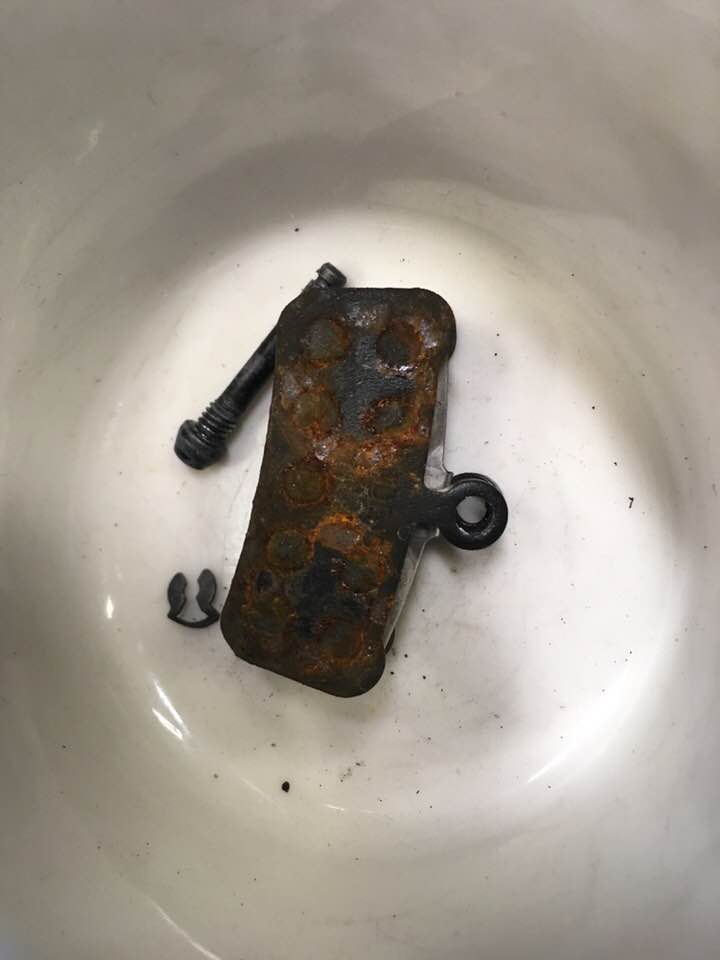
This isn't all the parts. The real business was still stuck inside the lever body.
Supposedly, when you take out a spring clip and a washer, you can reach in with the tippy tips of needle nose pliers and extract that piston. I couldn't get it to budge. I tried everything, even things that will put your eye out if you do them wrong. Eventually I was able to poke something through from the brake line end of the lever and push the piston out, but it's a very stiff fit. And between whatever they did, and what I had to do to get it out, it ain't going back in.

Of course all parts for this lever are out of stock for at least three weeks.

So there went a couple of irreplaceable hours of my life. I spend most of my time now working on equipment I would never advise anyone to buy, for a riding style that doesn't interest me in the least.

Motorless motorcycles.

If anyone ever did all the maintenance that the fine print tells them they should, they would never have time to ride. But biking is supposed to be cheap. The biggest expense is the bike, right? They're cheap to fix. There's no motor. How hard can it be?

The owner of the Stumpjumper asked me, "Is it a real pain in the ass to work on these things?"

"Yes," I said. "Everything takes longer, so we're making less money, and it's still expensive for the rider. So how's the ride?"

"It's great!" he said. "Wonderful!"

"Well there you have it then."

Even from supposedly reputable brands, low end bikes are shockingly shoddy. The upper end is staggeringly expensive not only to purchase but to maintain, if you really use it hard. Even if you want to settle for fewer features but well made componentry, it's a treasure hunt to find parts, and you'll need to know how to do your own work.

Biking has no use for elder statesmen. Expertise is only good for a short time. Does anyone in mountain biking today care what the pioneers of the sport think? Only if those pioneers repeat currently popular opinion. You're only as good as your last ride.

Wednesday, May 20, 2015

Move the finish line

 As you may recall, Jake the Satanic Serpent absolutely refused to shift into the lowest gear on the rear cassette. Based on the noises from the inaccessible interior and the way it acted like it had too much and too little cable tension at the same time, I wondered if the cables had been run correctly when the bike was built. If they had somehow gotten tangled with each other, running a guide sleeve to install new cables would simply replicate the error.

With a bit of time to think about it I realized I could feel for any interference by shifting to the mid range on the rear and feeling the exposed section of cable below the chain stay as I shifted the front. There was nary a twitch.

Jake seemed strangely well-behaved today, even before I started adjusting things. The rear derailleur shifted pretty smoothly through ten of eleven cogs. But that last step, onto the lowest gear, was like a wall.

The limit screws on the rear derailleur were backed out far enough that it would start to shift into the spokes if I pulled cable tension by hand or simply shoved the derailleur over. The problem lay in the ratchet of the brifter itself. It could not pull any more cable. The rear derailleur cable was led properly, but the eleventh cog calls for tension at an angle that reduces the cable pull by just enough to prevent the shift.

If the derailleur won't go to low gear, low gear must come to the derailleur. A 1mm spacer was too thick for the lock ring threads to engage, but I had a .7mm spacer left over from someone else's weird problem. It was just enough to get the shifting to work across all rear gears from both front rings, in today's barometric pressure, relative humidity, wind speed and direction, with brand new cables and housing and everything clean.

That's as good as it gets with a lot of this ultra-modern stuff.

Jake's unfortunate owner is taking up these problems with the shop where he got the bike. I fully expect them to tell him I'm full of shit and the bike is fine.

If it comes back again, choking on silt, I'm going to drill bigger cable exit holes in the down tube by the BB. Maybe I'll cut a few big inspection ports in it, too.

Barcons, man. Eight speeds. Maybe nine. If he really wants to be competitive in 'cross, finicky brifters are just the beginning. He's going to have to turn into one of these neurotics with four different sets of sewup wheels. If that's not where he wants to go, why put up with this shit? Ah, but I ask myself that question many times a day in bike season. People believe the industry's marketing bullshit. They only have a choice of pseudo-racer tweakitude or some other very specific category. Even the all-around roadish bike has to be "a gravel bike" so it can be another freaking category.
                                       
                                                                            ******

High-dollar tickets often start with the words, "my friend gave me this bike." Or it might be, "my friend sold me his old bike when he got a new one," but there's always a friend. Friendship can apparently survive a lot.

The next bike after the Serpent was a Giant full suspension mountain bike, archaeologically dated to about 2004. The guy who brought it in initially just wanted to buy toe clips, a bottle cage and bar ends and install them himself. Cool, no problem. But as I looked over the bike to answer his questions I saw a few things and he began to open up about problems he had experienced with it. It wasn't shifting right. The old Avid BBDB cable disk brakes needed pads in the rear. The right crank arm was floppy loose.

Between the floppy crank arm on the drive side and the fact that the bottom bracket was crawling out of the frame, it's no wonder the bike did not shift right.

Luck was with this guy. The ISIS splined crank arm was not damaged from being ridden loose. I was able to examine the BB cartridge and crank it back in, before graunching down on the crank arm bolts with all the power of a mighty breaker bar.

Note: splined crank arms require frequent reapplications of high torque. They do not stay tight the way contemptible old stone-age square taper axles and crank arms do. Not to say you don't need to check those at somewhat regular intervals, especially after removal and reinstallation, but the square taper interface is supposed to be a press fit. Splined axles are not a press fit. So the bolt has to be tight tight tight.

Notice that the industry has basically abandoned the splined cartridge in favor of the cranks with the BB axle swaged into one side or the other of the crankset itself. This has led to its own set of problems, of course.

Once I had the Giant's BB back in the frame and the crank arms firmly attached I could start adjusting the gears. On the front derailleur I found another moving finish line: Someone had steadily shifted the limit screws on the front derailleur to chase the crank as it moved further and further out. Yep. Don't fix the underlying problem. Just move the derailleur.

Chaos is upon us. You can't look at the whole pile, only at what is right in front of you. Straighten one out, move it along. Grab the next one.

Saturday, May 16, 2015

Satanic Serpent

Jake the Satanic Serpent came back to the workshop about three weeks ago because the shifting had gone crunchy again after another abusive mud wallow.

"Gloucester isn't until late September," said the owner. "I don't plan on riding it until a couple of weeks before that." He was referring to the big cyclocross race in Gloucester, Mass. in the fall. He said he would be riding his road bike for the spring and summer, so not to rush the 'cross bike.

I gratefully triaged around the Satanic Serpent, grappling with more urgent repairs for people who wanted their bikes now, not four months from now. I knew the urgent work would let up at some point in the summer so I could spend the hours of brain-frying quality time the Kona would demand.

Today the Serpent's owner called requesting the bike be ready for him to ride tomorrow. And he didn't call first thing in the morning, either. It was mid afternoon and I was still finishing a repair for someone who expected it today. So at 3:30 p.m. I started on the grungy 'cross bike.

The rear shifting was all out of whack. Mere silt and grime could account for all the symptoms. With every cog the industry adds to a cassette the shifting gets more sensitive to minuscule variations in cable tension. And somehow the rider had managed to get a kink in the rear derailleur cable about an inch above the anchor bolt. This would actually come into play when shifting to the lowest gear.

The first time around I had left one piece of 4mm cable housing -- the section from the brifter to the inline adjuster -- because it was under the tape. Reevaluating the cable routing I decided to replace it with a longer section of 5 mm to move the inline adjuster from a high position near the bar to a low position. The high position had almost eliminated a kink where the housing entered the adjuster, but a much lower position would eliminate it entirely. And the new housing would be 5mm with brass ferrules, so the cable should slide more easily through it.

With all the usual rigamarole, I removed the old cable, leaving a guiding sheath in place through the down tube.  I untaped the bars far enough to remove the 4mm housing and slid the old cable out of the brifter. I measured new housing, cut it, and slid the cable through it. Fed the cable through the guiding sheath. Pulled the sheath. Slid on the little chafe-guard that covers the cable where it emerges from the down tube. Ran the cable to the rear derailleur and anchored it. Then messed, messed, messed with the tension. And messed with it some more. Couldn't get it to shift up the cassette to lower gears. More tension...until it finally lifts, one cog at a time, click...click...click...and will not shift into low gear no matter what. Check the limit screw, okay. More tension. More tension. More tension. It makes the last shift.

Hit the return lever. Nothing. Three clicks to get it to drop one cog. Ratchet ratchet ratchet it down to the bottom. Ease off some tension. It sort of works through nine cogs, just gets ten. Eleven? Absolutely not. Big ring, small ring, makes no difference. It either shifts pretty badly or really badly.

I pulled the cable again to make further refinements to the housing to get the smoothest curve with no tight bends or kinks. That didn't help. Changed the chain from a KMC to a brand-name Shi-no, just in case the derailleur and cassette were particularly loyal. Another waste of time.

From the beginning, the cables have had a raspy sound and feel as they pass into and out of the down tube. The entry and exit holes are just big enough for the cable. I can't shine a light and paste an eyeball up there to see what might be snagging things in the interior. Really skinny fiber optic cameras cost some serious coin.

By 6 p.m. I was ready to use a fire ax to open it up. I called the customer about twenty minutes later to tell him he could ride it this way if he really wanted to use it now, and bring it back midweek and forget about it for a while. I need to be able to spend several hours with this piece of crap, figuring out where the drag is coming from.

By 6:30 I headed out into the cloudy evening to trudge home.

Friday, April 10, 2015

George's rocket

When Big G finished building up his new Specialized Roubaix last week, he put it on the scale in the shop.

Drum roll...

Twenty-two pounds. Carbon fiber and bla de bla,and the friggin' tank weighs twenty-two pounds.

Mind you, 22 pounds is a perfectly respectable weight for a top quality butted steel racing bike from the 1980s. In other words, thanks to tinfoil chains, cog-packed clusters and temperamental, expensive brifters, we have achieved equality with a simpler machine powered by the same engine 30 years ago.

I know: more gears! Convenient shifting! And with the simple investment of at least a thousand more dollars in crank, handlebars, stem and wheels the bike could be an easy two pounds lighter. Still temperamental, but the fancy ones always put you through hell. You have to decide for yourself whether the ride is worth it.

Planning to commute on his new steed, Big G has been checking out all the bag options. Frame packs, enormous, projecting seat packs, anything that doesn't require a rack. He's got a messenger bag on order. That would not be my first choice for a 25-mile open road ride to work. But then this whole acquisition went entirely where I will never go. All this baggage, of course, gets added to the basic curb weight of the bike.

I understand wanting a light bike. Last summer I got a frame pack to increase the cargo capacity of my own road bike. It's a nice break when I know I'm sticking mostly to pavement. But if you only ride a light bike it will eventually feel heavy to you. And when it comes to transportation I really like the secure feeling I get from wider tires, fenders, lights and a good tool kit.

Wednesday, April 01, 2015

Housing crunch

And so my season begins. Local rider brings in the bike he got somewhere else because the shifting went bad on him during his abusive first ride.

Kona Jake the Snake cyclocross bike. New 105 11-speed. "I read that it's hard to adjust," he said. "So I brought it to you."

"I kept twisting the barrel adjusters the whole ride," he went on. "It was never right." He added that the ride group wallowed through a lot of mud and snow.

The way the internal cable routing was done, the shift cables can't be cross routed. That would have helped with the angle up front. Either way, longer housing will feed it more smoothly into the stops. The in-line barrel adjusters need to be moved closer to the handlebars because the housing can't be led to the opposite sides of the head tube. All this could have been done by an imaginative mechanic during assembly. Now it will cost him a couple of shift cables and some new housing. As they're done now, the plastic ferrules on the constrictive 4mm housing are already kinking after about 50 miles.

This kind of rescue operation after some other mechanic's ethical lapse or simple inexperience really makes me tired. I could just dial it in as closely as I can and tell him he'll have to live with it, but I want to see if it can be improved. In terms of ultra modern bike componentry, that means, "be made to work more or less adequately for as much as a couple of months."

I already noticed that the housing for the rear cable disc brake aims upward, where it will surely collect water. So that'll be rusting in within months. But it's got eleven speeds. And carbon forks. Oo, baby. Value added.

Something sounds raspy in the impenetrable interior of the cable path through the frame. The bike came with the same weird, brown cables that Big G's Roubaix had, with some shreddy coating on them. On this bike, wads of scuffed-off coating are wedged like old snake skin at friction points in the system. Who knows how much of that is binding the new cable inside the down tube where no one can get at it.

With new cables and better-aligned housing, the shifting still won't dial in. But as you slog through the mud in your three or four working gears out of 22 (I'm being optimistic), you can rest assured your bike looks really sharp and is aerodynamically its most efficient, thanks to the internal cable routing.

As so often happens, you have to do the job to see if the job can be done. So after the extra rigamarole of a routine internal cable change I'm only a little better off than I was before. I'll know after more fiddling whether I can raise this annoying piece of crap to an acceptable level of function.

Wednesday, March 25, 2015

They got George! Those BASTARDS!

Big G sent me an email the other night. He needed to tell me he had ordered himself a Specialized Roubaix road bike.

After all we've been through, dealing with the mysterious creaks, cracks and pops of carbon frames, and all the headaches of brifters and the Chain of the Month Club, Big G signed himself up for all of it. At what point did he cease to mean it when he said, "I'm so glad I don't own one of these?"

With so many more elegant ways to achieve a light bike that would also be simple and durable over the long haul, he chose to buy off the rack and shackle himself to this year's "state of the art." Hell, it's not even this year. It's more like six months at best.

The bike arrived today. The box looked like it had been drop-kicked all the way from Taiwan, but the bike appears unblemished. Unblemished except by the details of its own design, that is. So it's a matter of opinion. Big G won't be in until Friday. The bike will await him, in its exploded box. I got him something with which to toast his assimilation into the cult of the modern:

It's always hard when you find out your compadre has been replaced by an alien pod. The fact that he could do it with no warning shows they implanted the spores in him a long time ago. Oh, buddy, if only I'd known the struggle you didn't even know you were having...

Ah well. Too late! He's gone to the dark side. I can only help him return if he wants to be helped. Meanwhile I get to bust his balls without mercy. Got a problem there big guy? Waaaa ha ha ha ha!

I know I should be more gung-ho about the bike industry's excrescences. They're supposed to be the latest and greatest, and Enhance your Cycling Experience. Thing is, I was enjoying my cycling experiences a ton back in the 1980s, when all I wanted was enough income to buy more time to spend riding the stuff I already owned. I've made a few changes where I saw real improvements, but the rest of it is expensive horseshit. That being said, riding a bike is still great. Find someone who can help you sift through the horseshit. Even if you get stuck with some ultra-modern (temporarily) crap, the activity itself is still worthwhile. We can get you onto better stuff if you decide you want it. Or we can keep feeding you the industry's latest dump. It's all good. It still beats driving.

Monday, March 31, 2014

Job security or death knell?

The Internet brings me word of the proliferation of 11-speed drive trains and hydraulic disc brakes for road bikes among the many technological bounties showering from the broken sewer pipe of the bicycle industry and its chief driver of costs and complications, Shimano.

As if ten-speed chains did not wear out fast enough. While I chuckle on my own behalf as I ride my 8-speed steed (24, actually, with its hideously outmoded triple crank), I also tear my hair as I consider that most of my time is spent helping customers who have no intention of replacing their old bikes keep them going.

It's like working in rehab. The poor riders come in addicted to their conveniently-located shifting. It used to be state-of-the-art. Now it's relegated to the cheap models. The bike industry wants these dupes to buy newer bikes with more speeds. But they can't afford the stronger drugs you're peddling. And they don't need them.

If you get tagged by some irritable idiot in a pickup truck, does it matter whether your bike had 11 cogs or eight in the rear? Does it matter whether you had electronic shifting and hydraulic disc brakes or barcons and old cantilevers? Will the new bikes ride any better over potholed road edges than the old ones did?

Component manufacturers shove their innovations down through the price points because they need a lot of suckers to buy in to finance the few people who really benefit even slightly from the capabilities of the new machinery. I guarantee that racers will race on whatever they can get. THEY don't drive the innovation unless you can tell them one of two things: it's an advantage other competitors won't be able to get or it's what everyone else has, so they need it to start from an equal footing. But if everyone has it, everyone has it. That was true when it was toeclips and downtube shifting on steel framed bikes and it's true now with exotic frame materials and far more expensive and temperamental drive trains. No one has the technological edge for long. Meanwhile, the innovations warp values throughout the industry and cycling in general.

Now we need another shelf facing in the parts department for 11-speed chains. We have to stock 11, 10, 9, and 8-7-6-5, as well as a few models of 1/2"X1/8" and a 3/16" for good measure. The poor schmucks who want a nice bike and get stuck buying an 11-speed swell the ranks of the Chain of the Month Club even if they've never heard of it. And most people haven't.

"Got this great new bike! Of course my genitals still get numb on a long ride, I still breathe hard and huck up a lung on steep climbs and angry motorists still try to kill me, but thank heaven I have that one more cog!"

Riders may love cycling and still not want to shell out for a new bike very three years. Even among racers -- a small percentage of the cycling population -- there are many who may lust for the newer stuff but simply can't afford it. They'll get the best they can and thrash it and themselves to death.

Far more numerous than the real racers are the citizen riders with their myriad motivations, who buy the best bike they can, with every intention of using it for many years. The bike industry betrays them with its constant debatable "improvements."

As far as I can see the bike industry divides the customer base into two broad categories: the exploited and the neglected. At this they're no worse than many other industries, but when will that stop being the basis of acceptability?

Where's the big noise about improving riding conditions on every road in the country? Where's the huge investment in public image and education that would really increase consumer demand? Does the bike industry believe that will take care of itself or do they actually believe it's not worth the investment? They'll just keep throwing ideas at different rider groups and aim for the center of the biggest flocks until there are no more. As a rider I don't feel supported by them. As a professional mechanic I don't feel supported by them. As a small retailer I emphatically don't feel supported by them.