Sunday, October 23, 2011

Shot from the Saddle

 This picture falls under the heading "why I live here." Rural life presents many inconveniences, but they are the reason the area remains relatively undeveloped.  This picture shows the Ossipee River from the bridge at Effingham Falls. I stopped to take it on Tuesday morning when I went out to try to get a shot for Rantwick's foliage contest.
 On Friday I stopped on my way out the rail trail to look out over Lake Wentworth. The Olympus camera I carry is such a great light collector that it makes the dusk look more like a cloudy afternoon. Some ducks were impersonating loons out on the lake, swimming and diving in the big bird's signature style, but then quacking to each other after they surfaced as if enjoying the joke. They were too far out to be sure. Maybe they were multilingual loons instead.
 The rail trail, showing the notorious rails.
This little twig off the other side of the path was putting out its best colors.

I resumed the ride out toward the far end of the path as dusk deepened. The dynamo light continues to do a great job. The hub dynamo is much better than the tire-driven model. The tire-driven model did a fantastic job when everything was fresh and new, but it was extremely sensitive to alignment. I have not found a new application for it yet.

I tried to shoot a video of the headlight in operation once the night got really dark. Unfortunately the low resolution of the camera made it grainy and unimpressive.

October brings a feeling of solitude. Summer's crowds are long gone. I rode several miles out the path without seeing anyone. When I reached my car where Cotton Valley Road turns to dirt and the pavement takes a hard left to go up Cotton Mountain the area was deserted. I thought it might be a good opportunity to strip right down and put on dry underwear and jeans. No one was around. Only the  mysterious creatures that make weird screeching noises showed any sign of life. I was alone. Who would be out in the chilly night when most people were home having supper?

Of course this triggered an instant rush hour. I had to laugh. Fortunately I was not caught putting on a headlight strip tease. Unbelievable how many people suddenly needed to pass through that one obscure rural crossroads at just that moment.

Soon I was alone again at least long enough to finish the change and drive away.

Friday, October 14, 2011

Foliage and stuff

Monday was nice. The cellist mentioned that we hadn't taken a spin through South Effingham in a while.  I forgot to shoot any pictures on our way out. Most of the ones I grabbed on the way back either came out fuzzy from camera motion or the color was muted because the sun was so strong. It's hard to capture the full sensory experience of a nice day's ride in a few quick photos. And if you're taking the time to produce really good photos, you're not having that great uninterrupted ride.
 New England pastoral scenery.
 The tornado swath from 2008 is growing in. The damaged area was logged to salvage the timber, evening up the edges of the scar in some places.
This is actually a climb. Here it is, October, and we're riding in shorts and a jersey.

We got another couple of nice days before the rain moved in. Rain, fog, darkness and rural highways all put together definitely kill my enthusiasm for bike commuting. They make nice visual effects with the fall colors, though. And they really make you appreciate a snug house and a new woodstove in the living room.

Tuesday, October 04, 2011

Driving While Intoxicated

Your point of view changes when you get in the car.  Your sense of speed changes. Your sense of responsibility changes.

The car is an intoxicant. It makes some people aggressive. It makes others stupid. Use becomes a habit, then a dependency. May cause drowsiness. Side effects include weight gain, shortness of breath, tunnel vision and in some cases injury or death.

Try to quit. See how hard it is.

As with many strong substances, it has its uses as well as its risks. Some people seem to manage its effects better than others. Its power is insidious. It must always be used with caution. Excessive use always leads to increased risk of dependency.


Friday, September 30, 2011

Click! What?

I appear to have updated my template. I was doing a bit of housekeeping in the ol' HTML. Thanks to the new Blogger interface something must have crawled under the mouse when I was saving the changes I had intended to make. Oh well. The content all seems to be there. Maybe this new setup will make it easier to put interesting features up here. I can't worry about it right now. I have to get some sleep.

Sunday, September 25, 2011

Gratifying wizard fix

A customer had a mysterious shifting problem on his cyclocross bike. He has some mechanical knowledge. He has raced for years, so he has switched between racing and training wheel sets many times on different bikes.

On the cross bike he could not seem to get the gears to work on the race wheel. They were dialed perfectly for the training wheel. Ten-speed cassettes have to fit so much into the space originally designed for eight that manufacturers can't block each other out with proprietary spacing the way they had done when they had more room for those shenanigans. So why wouldn't one ten-speed wheel work as well as another?

He had already explored cable tension. That adjustment failed to dial in the lower gears on the race wheel. Unfortunately he only brought the bike with the wheel that worked when he first presented it to me to solve the problem. It wasn't broken, so I couldn't fix it. I did have a flash of inspiration as I stared at it.

To work with a ten-speed cassette on a road frame the wheel has to have a freehub body the proper width and an axle that measures 130 mm over the locknuts. That is all. What if the race wheel was spaced very slightly differently, so the limit screws of the derailleur still allowed it to span the whole cog set, but the start and end points were about half a cog off? I suggested he measure from the axle end to the outer face of the cog set on each wheel.

Guess what? The discrepancy was .6 millimeters. Six tenths of a millimeter. It was, in fact, enough to cause the annoying shifting problem.

Here's the tricky part. Spacers to fit that particular region start at one whole millimeter. Who has ever needed less than that? The industry yet again fails to catch up with itself as it pumps out temperamental sifting systems that can be disrupted by small tolerance issues and does not readily provide the curative shims.

A 1 mm spacer at least got the shifting in range of cable tension adjustment. The racer will have to remember to dial in the tension from one wheel to the other. This is fairly common. Meanwhile I have a .7 mm bottom bracket shim on order that should fit over the freehub body and reduce the discrepancy essentially to nil.

Perhaps I'm not so old and useless that I need to crawl out on the ice floe yet. It's often hard to stay interested in my job anymore. When it's just a parade of greasy, abused junk I take scant comfort in the "job security." Real satisfaction is so much more satisfying.

Thursday, September 22, 2011

Expertise lives everywhere

Back in the 1990s there was a brief surge of interest in "buying American." This trend in patriotic consumerism seems strongest during recessions, when citizens suddenly care who is getting paid to make the things they buy. This does not stop them from chiseling the retailer mercilessly, by the way.

"Buy American" is back. The 21st Century version is more potent, the same as all the partial solutions rigidly demanded as complete philosophies in society and politics during the last few years.

When I posted a comment on someone's Facebook link pointing out that buying only American items would eliminate the vast majority of bicycles and their parts and accessories, he replied with a link to American bicycle products that contained few surprises. Least surprising is the fact that Buy American consumers are perfectly happy to buy a frame made in America, festooned with parts from all over Asia.

Even many American cars are stuffed with foreign parts. My Dodge van had a Mitsubishi engine. The Pontiac Vibe was a joint venture between GM and Toyota.  And Toyotas (to name but one foreign brand) are made in several of the United States.

While it is true that customers putting money into American companies on American soil will keep that money in somewhat tighter circulation in the domestic economy, it does not assure that American products will meet every need or be the best in their category. If the primary attraction is an American flag on it, that lowers the bar considerably. Look at how long the Big Three bike makers -- Huffy, Murray and Columbia -- pumped out truly reprehensible crap in their American factories until finally moving offshore before the turn of the century.

Matters get more complicated when the American worker, wages eroded by decades of pressure from other economic factors, has to flock to places like Wal Mart to find products they can afford. Consumers want to consume. If the goal of life is to make as much money as possible and get as much crap as possible for it, price is a factor. In fact, if you simply need to outfit yourself with clothes and appliances on a very tight budget, price is a factor.

Value is not the same as price. Whenever possible I buy a better-made item because it will work better and last longer than a flimsy, cheap one. I appreciate being able to shop from a world-wide selection. When the American product is the better choice I will choose it. The economic anomalies that have made it cheaper to ship things all the way across the Pacific Ocean to this country will continue to give a pricing advantage to certain items. That decision is controlled at the top management level. Company owners send jobs overseas. Take it up with them in strong language.

In olden times one might argue that you got better product support from a company that wasn't spread out across half the globe. These days, product support is a bad joke in nearly every industry. You call a support number or send an email assuming you will spend a long time in a telephone labyrinth or get a reply email from someone who signs the name Chad or Cynthia, but whose use of English betrays that it is not their first language.

The bicycle is a world traveler and a world citizen. It knows no boundaries any more than birds and animals do. It is a human creation shaped by contributors from many lands.

To consumers I say, "Insist on good stuff." To manufacturers I say, "Make good stuff." The rest will take care of itself.

Wednesday, September 14, 2011

An American Bicycle


 A man brought in this 1950s Columbia for us to pack so he can ship it to someone who bought it from him on eBay. He has brought in reproductions before, but never the real item.
 This type of bike has never interested me except as a historical curiosity.
 I love the suspension fork.
 
Then there's the headlight

The Delta Super Rocket Ray: guaranteed to make the owner of this bike the second largest purchaser of D-size batteries in the country. I'm not sure who would be the largest purchaser of D batteries, but I tend to reserve the top spot because there's always something greater.


 FIVE Star Superb.

 Place tushie here
Place friend here.
 
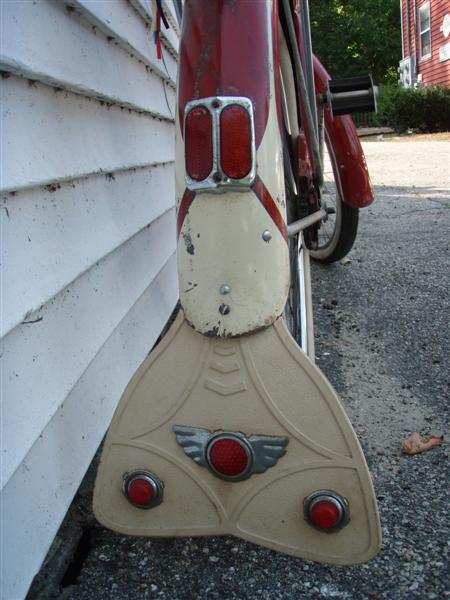
 Adios! Admire my mud flap.

This bike sums up the American attitude toward pedal powered transportation pretty well: it's gaudy, impractical, and you'll only want to ride it a short distance. It's built like a 1950s car. The sheet metal is a gauge never seen on later Muffies. Mufolumbias, actually. The paint, the chrome and the machining show care and investment that also had diminished by the next decade and disappeared in the decade after that. When better bikes were built in this country they borrowed from European designs. Meanwhile the old-school American method rolled on with Huffy, Columbia and Murray. Schwinn had their own twist on it.

While I was down in the back parking lot doing this photo shoot, two brothers on Surly Long Haul Truckers came in the other door to see if we could take care of a minor shifting issue on one of the bikes. The older brother, Scott, couldn't get the indexing to work even though the barcon shifter still clicked. The shifter can be switched to friction. Sometimes the switch gets bumped just enough to move it from the index position. It still clicks but the clicks don't line up with the gears.

Younger brother Jim keeps his shifters in friction. Scott said he would practice that. Meanwhile, we got the shifter working so they could continue their tour. I may see them on my commute this morning. Their route comes up this way.