Showing posts with label recumbents. Show all posts

Monday, October 28, 2019

The season of cabbage and caffeine

As bike commuting mileage drops, and other activities don't seem to fill in like they used to, I shift from using brown rice under a lot of my slapped-together meals, to using sautéed shredded cabbage instead. Shred it fine, and cook it over medium-high heat in a little oil (your choice) with some onion and seasonings you think you'll like. In another pan I cook up whatever meat and vegetables I would have slapped onto -- or mixed with -- the rice. Separate pans work out best for the quantities I try to make, because I make enough to get a supper and two or three lunch-size portions of leftovers. A grab and go container for lunch helps speed me through my typical morning stumble toward the door.

As daylight drops, my energy drops with it. During full bike commute season, I limit my morning coffee to avoid having to stop en route to release excess fluid. I might or might not have a little jolt in the afternoon. Once we get well into October I feel like crawling into a burrow. I certainly don't feel like vaulting out of bed. I'll drain the morning pot of coffee and definitely seek it in the afternoon. Any of y'all who can get by on spring water and meditation have my admiration, but that's it. I'm sure it's great.

The growing season ends with New England's well-known psychedelic splurge as deciduous trees withdraw chlorophyll from the leaves they are about to shed.


At summer's end, we get a rush at work, of people who waited until summer was over so that they could avoid the rush. We also get people who were holding off as long as they could, to keep riding in the prime season. Thus cash flow drops precipitously, but wrench work and brain teasers actually intensify.

This recumbent had tire and drive train problems. Once I got it back together, I found it basically unrideable.
Everything was hooked up right. I just couldn't get it to balance well at all. It resisted that first pedal stroke to establish forward motion, and wanted to flop over immediately. This was true in any gear. It was super twitchy. It was actually a late summer arrival, but I never had time to include it in a blog entry.

Then came someone's swamp buggy.
We'd replaced the chain previously. It hadn't skipped on a test ride, but it did skip when the owner rode it in the swamp. He brought it straight back to have the cassette replaced.

The owner of this Trek Y bike from the 1990s had a hankering to try riding again. He's a classic Van Winkle. Van Winkles are the people who have been asleep for twenty years and awaken to find the world much different than the one they dozed off from.
It doesn't help that he bought the bike used from a shop owner who was a trendoid. The bike had all the cool shit from 1998, including the Rapid Rise rear derailleur. I did learn from Sheldon Brown's website that, prior to Campagnolo's invention of the parallelogram derailleur, all spring-loaded derailleurs were "low normal," meaning that they used the return spring to pull the chain toward the low (largest) rear cog rather than down toward the smallest cog. It should tell you something that Campy's introduction of the high normal parallelogram derailleur established the design that the entire industry followed until Suntour introduced the slant parallelogram derailleur in the 1960s. Even after that, the basic parallelogram remained more common until well into the 1970s. According to Sheldon Brown, other companies didn't jump on until the expiration of Suntour's original patent in 1984, but I know that Shimano was already making slant parallelogram derailleurs before that. But they've always been aggressive competitors, not above pushing the envelope of decency, not to mention legality. They got slapped for it in the 1990s when it became too egregious to ignore. Nice guys finish last.

A happy couple of tourists brought their matched Sevens in for examination and any necessary repairs. They do well with their regular home care, so the bikes needed little. I did change the bridge wires on the rear cantilever brakes, changing the stock ones that were too short for longer ones that provided a firmer lever feel.

Another tourist, coming out of a long layoff, brought his vintage 1980s Trek for a full overhaul and upgrades to prepare for a long haul continental wander, perhaps next summer. He has laid out a route that would keep him in a 72-degree average daytime temperature the whole way along a meandering route that works with both latitude and altitude to hit the desired temperature. We discussed all his options, from total replacement with a Long Haul Trucker to full restoration on the Trek. Because the Trek was an old friend, and some of us are sentimental that way, we went that way.

The bike had been fitted with new wheels. The crank had been replaced because the original one broke. The bike had been built for 27-inch wheels, and the shop he went to had replaced them with 700c. The crank was a TruVativ, and rather cheesy.

I've put 700c wheels on bikes designed around 27-inch, but only with caliper brakes. You just get a longer brake if the one that's on there does not have sufficient range to lower the pads to the smaller rim diameter. I hoped that we could replace his old brakes with something more accommodating.
The mountain bike era began using brakes like these Dia Compes. Technology advanced rapidly with higher demand, leading to brake arms that allowed for pad height adjustment as well as every other angle in alignment. But you're limited by the immovable placement of the post itself. If it's low enough, you can use a modern brake to get the pad in range with good alignment to the rim. You can see here that the mechanic who made the wheel swap years ago just angled the pads down because that was all he could do. He didn't built the guy a decent 27-inch wheel, even though there were rims available. Do it cheap, don't do it right. Right?

I ordered some linear pull brakes and the drop bar levers designed to go with them, hoping that the range of vertical adjustment would make it work. I also built the guy some 36-spoke wheels with wider rims to replace these 32s with Mavic MA2s. The MA2 was a nice enough rim in its day, but narrow for a wider touring tire. I've been getting good service out of Sun CR18s. Not only does the wider rim support the tire better, it moves the braking surface closer to the brake arm. I hoped that the combination of factors would allow the use of 700c wheels.

I could have gotten 27-inch rims for the new wheels, but the selection of rubber in 27-inch isn't as good. It's a crap shoot these days. When I geared up for touring around 1980, and when this guy did just a few years later, 27-inch seemed like the better choice for touring in North America, because 700c had not taken over. Performance clinchers themselves were fairly new technology. We figured that you could probably find a 27X1 1/4  just about anywhere at that time. Now, though, you're more likely to find a dedicated bike shop in the hinterlands, and 700c has become the road/hybrid/gravel norm. You can't plan for every contingency.

I also dug up an old mountain bike crank for the bike, with nice forged arms and 5-bolt chainrings. Things were coming together. But the brakes weren't going to work. Those mounting posts were just too high. With the pads all the way down, they still had to be angled down to get anywhere near the rim. And it wasn't near enough.

After consultation, the customer decided to go with a Surly Long Haul Trucker frame, onto which I would put all of the upgrade and restoration parts. The crank I found for him is the same model I have been using since 1992, when it started out on my Stumpjumper, then moved to the Gary Fisher frame with which I replaced the Specialized, and later went onto the Surly Cross Check I've been riding since 2000. It's one of the few accidentally durable things made by Shimano. It probably helps that I'm not much of a sprinter. Even chasing a truck draft I seldom get out of the saddle.

Into this whole lineup of touring bikes came a near-neighbor of mine (less than 4 miles apart is right next door in rural areas) with his 1970s Raleigh Competition. He's another person who "used to work in a bike shop" and is still enjoying the swag.
It's all Campagnolo Gran Sport, with the less-common three-bolt crank.

The handlebars, a solid 40+ years old, are bent down slightly on one side. That's a bad sign, considering that the handlebar industry recommends replacement every three years. We all know that expiration dates are mainly designed to get you to buy more stuff, but I have seen older handlebars snap off next to the stem after two or three decades. When they outright droop it's a good hint that you might want to renew that particular critical piece. Other than that, the job is just a straightforward  overhaul and some tires from this century.

Into the midst of all this archaeology come the day-to-day weird jobs like this John Deere pedal car with the cranks falling out.

Hell has nine circles. So does this thing.

The pulling threads on the right side are twice as deep as normal, for no discernible reason. But the fun doesn't end there. The threads were also buggered in a way that made it impossible to get the crank puller to thread in at all. This is after I had to remove absolutely every piece of shrouding from the fully enclosed drive train to undo every nut and bolt to take tension off the chain.

I removed the left crank arm and slid the BB out through the right side, since it was falling out that side already. Then I braced the right crank arm in the vise so I could gently and precisely persuade the  axle to drop out of the crank arm, using a drift and a small sledgehammer.

The BB is mounted to a bolted-on bracket that was attached backwards to the frame, so that the BB cartridge couldn't be installed the right way around. Normal use would unscrew it from the frame. I unbolted the mounting bracket and reinstalled it the right way around. The people who assembled this thing clearly did not understand its bike-derived components at all. And I don't know how they ever got the chain on it, because I had to add a half-link just to get it onto the sprockets.

Speaking of not understanding bike parts, this has been the year for people putting the pedals in the wrong crank arms. When it won't go in straight and it's binding up like a bastard, why do you keep graunching on it? But they do. Then I get to extract the pedals -- if they haven't fallen out of the stripped-out holes already -- and either re-tap or replace the crank arms. One of those cases came in just last week. It's one of those repairs where you can't really give an estimate without trying to fix it first, to see if there's enough metal left to tap.

Still in the crank and pedal department, one of the local riders is a lad -- now an adult -- who spends hours a day riding all over town on whatever mountain bike he is putting to the test at the moment. He isn't an official product tester, but he definitely puts them all through the wringer of long, continuous use. He's not a jumper or a sprinter. He just goes. And goes. And goes. When he finally brings a bike in because the gears skip or the shifting is funky, we'll discover something like the bottom bracket shell completely broken loose from the seat tube. Worn-out chains are just par for the course. It's the special touches that elevate it from the mundane. This time, his chain had fallen off the front, and neither he nor his father could get it back on. Something was jammed up. Well I guess so.

He was "just riding along." The crank arm bolts are tight. Something inside ain't right.

And there it is:
The axle is snapped right off. At least it's a simple fix. We plugged in a new BB cartridge and off he went again.

Trainee David wanted to adjust the bearings in his XT pedals before an upcoming 'cross race. I helped him figure out how to get in there.

Modern bike componentry comes in two forms: stuff you can't take apart, and stuff you can take apart that will make you wish you hadn't. This is the latter. Of course you can find chirpy forum posts about how easy and fun it is, from people who claim to do it every one month/six months/year, but it's seldom more obvious that no manufacturer actually wants you to fix anything than when you try. The left pedal has some irreducible slop in it, either from a worn (not readily available) bushing or from the loss of an equally unavailable rubber seal. The rubber seal shouldn't be structural. None of the forum chirpers refer to it as load bearing. But David's has vanished somewhere in the vastness of the New England cyclocross circuit, and now the pedal clicks and wiggles no matter how tight the adjustable bearings are. The metal bushing is present, and looks about the same as the one in the right pedal. The pedal shaft itself is a bit worn, possibly from riding too long with a loose bearing. But the right pedal bearings were equally loose before we adjusted them, and that pedal is tight and smooth now. The only obvious difference is the lack of the rubber seal in the left one. And you can spend hours poking around on the Internet to see if anyone really knows, without ever finding out for sure.

The Campy Gran Sport pedals on the old Raleigh are classic cup and cone bearings. Campagnolo Record pedals were so securely closed that they would run smoothly for years. On that level of Campy, pedals and bottom brackets had a reverse threaded section that expelled dirt as you rode. They didn't do it on the lower models, but you're still not dealing with microscopic bearings sitting in an almost imaginary race. Step-in pedals have higher cornering clearance and other added values for the competitive rider. We've all been trained to beat things up and wear them out rather than keep them going through years of appreciative, moderate use. Repair attempts these days are usually just a preamble to justify replacement. You keep it up as long as you can afford it.

These are the darkest nights, even though they are not the longest. The trees have not entirely gone bare, so the forest shadows are dense black. These are the spookiest nights as well. Half naked trees raise bony arms against what you can see of the sky. Any wind makes the branches creak and rattle like a marching skeletal army, while dry leaves skitter like rats on the forest floor you can barely discern even with a good light. The sight of another person sparks a moment of misgiving rather than sociability. What's anyone doing out here now? Only a weirdo would be out in the woods in the dark. You guzzle some caffeinated courage before heading out on the lonely ride toward home.

Thursday, July 26, 2018

Suspended at work

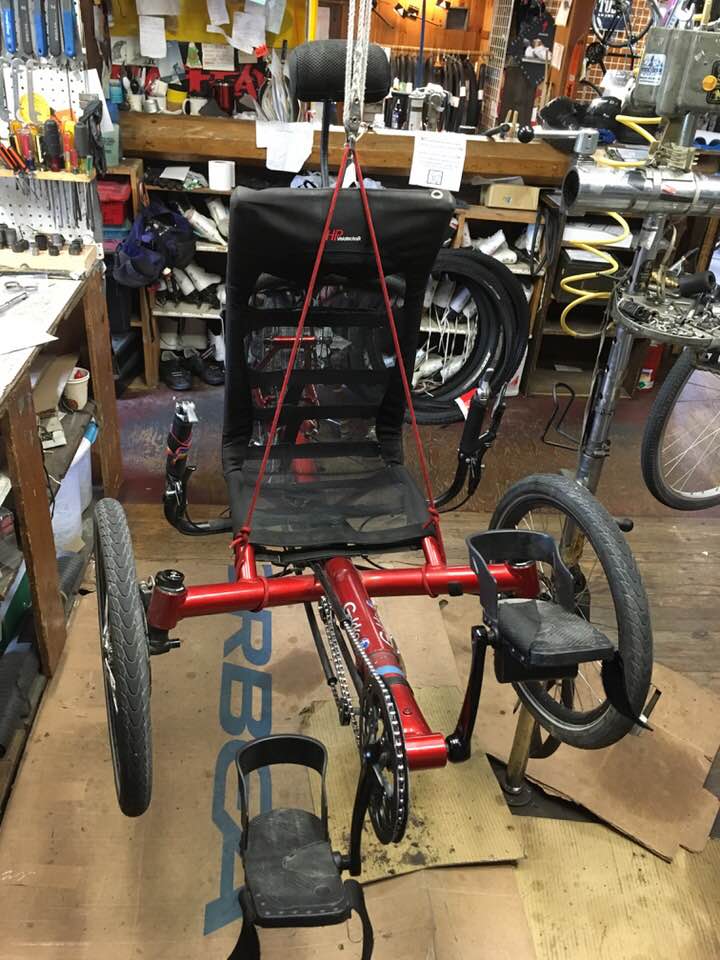
Some things don't fit the work stand. There are several recumbent trikes in the area, but they don't come in often enough for me to have devised a foldable trike stand, or to need a permanent one. So I rigged a three-point lifting sling and used the e-bke hoist to raise this one to a comfortable working height.

The fact that it swings around imprecisely suits the feeling I get from working on it. There are no quick jobs on a trike. If it needed a chain, we'd have to graft together three or four of them. If you want to take the front wheels off, you have to remove the brake calipers. So everything is either okay or major surgery.

This particular trike has a SRAM Dual Drive rear hub, but doesn't have the official SRAM shifter for it. The internal gearing is controlled by a Shimano barcon. For some reason, it has a click in the second gear position, so you can adjust the hub properly...I think. The website for the company has no manuals for this old model, so I have not been able to dig up authoritative guidance. But this particular trike gets ridden only on basically flat ground at low speeds.

In other unusual requests, a customer appeared in the back stairwell during a slightly busy moment last Thursday with what I thought at first was a kid's bike made to look like a motorcycle. Instead it turned out to be an actual motorcycle.

The customer wanted us to fix the flat tire on the front. It's a 16-inch, but a bit wider than our standard tube. We told him that our 16X2.125 might not hold up, but he agreed that it was better than nothing. That bike went on the e-bike hoist as well. I weighed it after the job: 93 pounds.

An electric scooter with fat 12-inch tires waits in the basement for its turn.

Sunday, May 15, 2016

To pedal back from the edge of death

The story starts with a handshake, or rather with a handshake avoided.

A landowner in the area had come to the conservation commission to discuss very preliminary plans to donate an 80-acre parcel to the town for conservation and recreation. I knew him as a customer at the bike shop. In the preliminary formalities of the meeting, I managed to evade shaking his hand. I have absolutely nothing against him. I just don't like to shake hands. It's not the hygienic aspect that bothers me most, although working in an under-staffed small business has made me more wary than I already was about anything that might lead me to take a sick day. I'm also always afraid someone might be giving me a secret handshake. I don't know what would be worse: giving no response and being revealed as an outsider, or accidentally giving a correct response and being mistaken for someone in the know. Way too much stress. I'll just nod from several feet away, and smile to add warmth. You keep your hands to yourself.

The commission and the landowner discussed general issues related to the land transfer. He invited any and all to take a site walk and check out the attractions of wooded wetland and steep ravine. And off he went, leaving us to the rest of our meeting.

The next thing we heard about him was that he had been crushed between a falling tree and a piece of heavy equipment while working on another piece of his land. His right hand had been sliced off, his left hand mangled, and his back was broken. He was in Maine Medical Center. No one knew if he was even going to make it.

Beyond the magnitude of his injuries, here was a man who had been vigorously active for all of his 70-plus years. He had used his hands and his mind together on things as intricate as bicycle mechanics and as brawny as logging. Independent-minded and eccentric, he was a model of self-sufficient ingenuity. The loss of full self-sufficiency might be enough to turn a survivable degree of injury into a sliding board into the grave.

I thought of the hand I had not clasped, lying on the ground, lost to us both. While it did not stimulate a sudden enthusiasm for hand-shaking, it added another layer of understanding to the sense of his loss.

Months passed, as months will do. Suddenly, this week, he called the bike shop to ask if we could work on his Greenspeed Magnum recumbent tadpole trike.

Hell yes, of course.

Getting pounded to the edge of death makes a person thoughtful. In the past year I have known a couple or three people who went through things like a heart attack or this guy's accident. On the other side of it, they emanate a weird serenity. No one would ask to have such a thing happen, but it seems to bring a reward deeper than just survival.

As the man talked about how he discovered the trike and found that he could pedal it, he said, and showed, that his emotions run a lot closer to the surface than they did before the accident. I knew he had enjoyed riding his bicycle, but I did not know how deeply it affected him. Why should it surprise me? Pedaling penetrates deeply into certain people's inner being. The man said that when he discovered he would be able to pedal anything after his accident, "tears just poured out." The catch in his voice showed that the feeling is still there.

This machine matters more than something that gathers dust in a garage and gets ridden a few times a summer. This is a test. This is a weapon against despair, when so much has been lost. The guy flew planes, operated chainsaws, drove a variety of things with wheels, and worked with his hands. Now one of those hands went out with the medical waste months ago, and the remaining one is not exactly deft.


I was glad I had some familiarity with trikes. My brother had bought one to ride while he was rehabbing an injured elbow. He'd bought a Trice, but had studied the other brands in his typically thorough way. They all seem to go together pretty similarly. Simple machines weed out complexity.

The biggest problem was figuring out how to get this thing to a good working height. Trike mechanics and fanciers have devised work stands that range from a few simple blocks to elegant pieces of machining. I attacked the problem from above rather than below, devising a multi-point sling to attach to my e-bike hoist.

Flying Trike

I can be a cold, clinical bastard when I want to be. I can stand on a high, windswept cliff and look down on the futility of all human striving, including my own. I'm pretty consistently immune to inspiration, and I would argue in favor of that point of view to anyone who would listen but what's the point? But somewhere in me is a desire to help my fellow futile strivers with a little bit here and a little bit there, just to try to make their time here a little more pleasant. If you want a purpose in life, that one is far superior to the exchange of dastardly deeds and deadly heroics we tend to glorify.

Monday, December 09, 2013

Kickin' back under the stars

Riding out the path on Saturday night through frosty air, between frozen lakes, with a sky full of glittering stars, I kept thinking this would be the time to ride a recumbent. It's not my preference in most cases, but sometimes it would be nice to pedal a lawn chair. Recumbent trikes are particularly suitable for sky gazing because you don't have to worry about balancing.

When the weather is bad, with rain, sleet and wet snow I wouldn't want to lie there, supine, letting it all just pool in my lap. In conditions like that it's nice to lean forward and let it roll off my back. And a little of that is plenty anyway. I'll take it for a short commute. For a long ride, stormy weather would make a velomobile seem like a great idea.

The variations of human powered vehicle are numerous. This might actually discourage some people who want to pick the "best" bike when there is no best bike. Certainly the configuration we've come to recognize as "normal" is the basis for the most versatile form of the machine, but even there we see great diversity for different habits and habitats. Best is often a compromise. How much better it is than worse or worst may be a slim margin in some cases.

For those of us addicted to using the human engine the temptation to acquire a fleet of vehicles is strong. I'll go further and say that it's a guilt-free indulgence compared to a fleet of vehicles that require fossil fuels, spew crap into the atmosphere and have a lengthy death toll associated with them. Indeed, those other vehicles present the biggest obstacle to people who might want to push the limits of their pedal-powered vehicles into winter conditions and darkness. It's bad enough with ample daylight and warm weather.

Motorized vehicles and equipment could have a place in Biketopia, constructing our travel routes and keeping them passable. And of course a well-developed rail network would serve a large network of communities for when quicker travel in spiffier attire was required. But then, humans set the standard for required spiffiness of attire. Maybe we should just get used to seeing each other in more casual clothing better suited to self-transportation.

The human powered vehicle industry could take up where the auto industry leaves off after the transition to healthy and sustainable personal transportation. Imagine Detroit and the Rust Belt coming back as the pedal-powered powerhouse of industrial renaissance. Imagine the road network of the United States devoted mostly to pedalers, with a few token "car lanes" stuck on the sides of some of them. Ha!

I never forget that I have financial advantages that many  people in the world do not. I'm relatively poor by American standards, but those standards are pretty warped. If I had to limit myself to one bike I could. I have it all picked out. But I would still make seasonal changes to broaden its capability.

Transportation costs money, even if you're just buying a pair of shoes. The economy adjusts to people's purchasing habits as people's purchasing habits adjust to the economy. If human powered vehicles dominated the transportation mix, they would pick up peripheral expenses from all the entities that make it their business to add peripheral expenses. Governments would require registration. Somehow the insurance industry would manage to get a hook in. Bike parking garages would have a regular fee schedule. All sorts of shady repair facilities would spring up. And the bike industry would continue to add dubious innovations that make repair more complicated and ownership more expensive, just as they are doing now with hydraulics, electronics, shifting systems and exotic materials. In absolute dollar amounts it could never rival the expenses and collateral costs of relying on motor vehicles, but in an adjusted economy the relative expense per person could rise to a comparable level. We could live on less money, but a similar proportion of it would be sucked out of us by the associated economic factors.

Some associated expenses are legitimate. Losing the revenue from motor vehicle registrations and other taxes and fees coughed up by the motoring public, governments would need to make up some of it to maintain the transportation routes formerly dominated by the smoking jalopies of a bygone era. Human-powered vehicles would damage the surface less, but weather still takes its toll. And human-powered travelers would benefit from facilities and amenities not yet constructed, or carried over in a modified form from the motor era. And without a doubt we would see increased enforcement of traffic laws related to human powered vehicles. Ever see those speed limit signs on bike paths? Ever whiz by the 15 mph sign at 20 or more and laugh about it? Now imagine some cop on an e-bike hiding in the bushes just beyond it. Yep. It could happen. It would happen.

Traffic laws could become more enlightened regarding rolling stops at stop signs, but cyclists need regulated intersections as much as motorists do. Imagine the carnage if everyone just blasted into intersections at whatever speed they could manage and tried to intimidate their way through. There would have to be some basic principles and someone would have to act as the referees.

I doubt if we have to worry about it any time soon. But it wouldn't be a bad worry to have. I would love to undertake the challenge of making a mostly human-powered transportation culture work. But it can't be achieved with an unwilling majority. Coercion is tyranny even if the end result appears beneficial. Process is important too. Process is vital. Consensus is indispensable. So that's the first challenge.