Wednesday, September 14, 2011

An American Bicycle


 A man brought in this 1950s Columbia for us to pack so he can ship it to someone who bought it from him on eBay. He has brought in reproductions before, but never the real item.
 This type of bike has never interested me except as a historical curiosity.
 I love the suspension fork.
 
Then there's the headlight

The Delta Super Rocket Ray: guaranteed to make the owner of this bike the second largest purchaser of D-size batteries in the country. I'm not sure who would be the largest purchaser of D batteries, but I tend to reserve the top spot because there's always something greater.


 FIVE Star Superb.

 Place tushie here
Place friend here.
 
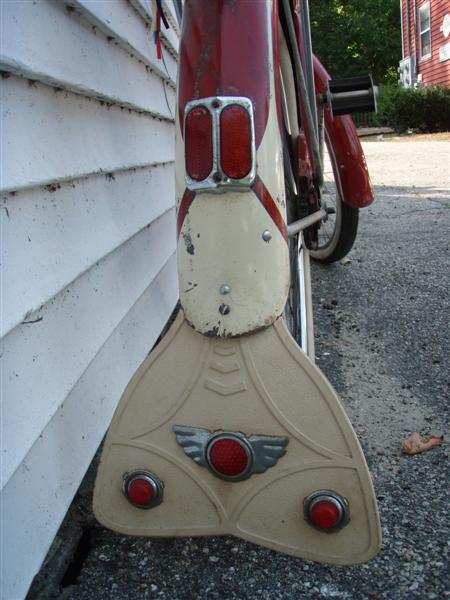
 Adios! Admire my mud flap.

This bike sums up the American attitude toward pedal powered transportation pretty well: it's gaudy, impractical, and you'll only want to ride it a short distance. It's built like a 1950s car. The sheet metal is a gauge never seen on later Muffies. Mufolumbias, actually. The paint, the chrome and the machining show care and investment that also had diminished by the next decade and disappeared in the decade after that. When better bikes were built in this country they borrowed from European designs. Meanwhile the old-school American method rolled on with Huffy, Columbia and Murray. Schwinn had their own twist on it.

While I was down in the back parking lot doing this photo shoot, two brothers on Surly Long Haul Truckers came in the other door to see if we could take care of a minor shifting issue on one of the bikes. The older brother, Scott, couldn't get the indexing to work even though the barcon shifter still clicked. The shifter can be switched to friction. Sometimes the switch gets bumped just enough to move it from the index position. It still clicks but the clicks don't line up with the gears.

Younger brother Jim keeps his shifters in friction. Scott said he would practice that. Meanwhile, we got the shifter working so they could continue their tour. I may see them on my commute this morning. Their route comes up this way.


Thursday, September 08, 2011

Roadside Emergency Kit

Riders often ask me what they should carry with them on the bike in case of a minor mechanical problem.

My own seat bag is a dense mass containing a spare tube, patch kit, chain tool, multi-tool hex key set, individual 8-, 9-, and 10-millimeter box-open wrenches, a spoke wrench and a little scrap of rag. I ride a rural route and sometimes venture onto roads much less traveled. I like to get myself out of a predicament rather than ask anyone for help.

The comprehensive tool kit developed during the time when our shop held weekly mountain bike rides. Many of the participants did not have tools or know how to use them. But I was always the guy with the tools, even 30 years ago when I raced. On the training rides I bothered to carry the stuff other riders just hoped they wouldn't need.

Not all the riders who ask my advice take it. Some of them just carry a cell phone so they can bother a willing supporter to come fetch them back from wherever they broke down. Others want to pick their emergencies. Most often they prepare for a flat tire. They get a tube and a pump or CO2 inflater.

"Should I carry a patch kit?" they ask.

Absolutely. Not only might you patch a minor puncture if you have already used your spare tube, in case you have a serious mechanical problem or -- god forbid -- an injury, you can sniff the glue in the kit to amuse or anesthetize yourself until help arrives.

Tuesday, September 06, 2011

How close is too close?

During my first year as a working class bike commuter I also started bike racing.  You learn right away to relax with other riders almost touching you. In fact, you'd better learn to keep your wits about you when you actually bump another rider or a bunch of you may be hitting the pavement.

When I commuted back then, the space around me among the motor vehicles seemed generous by comparison to a crowded criterium field.  I appreciated a little elbow room, but generally did not freak out when vehicles greased past me in a tight squeeze. It was the way of the world. As long as I was still up I had few complaints. Plenty of drivers gave me ample cause for anger by doing aggressive things like honking, yelling or throwing things. I wasn't going to sweat the average daily squeeze play.

Over the years my perception changed as motorists took too many chances with my safety and I began to imagine the point of view of riders who had not raced in large groups.  A motorist has far less at risk than a cyclist. Sitting in the La-Z-Boy, piloting their rocket sled down the road with only their own schedule in mind, it's too easy for a driver to decide that a maneuver is acceptably safe when that driver definitely will not be paying the price for miscalculation.

Riders who don't have the strength, speed and experience to play racer games with the motoring public deserve their space. But how much is enough?

Many states have enacted safe passing laws that specify a distance motorists are legally required to maintain. These are virtually unenforceable even if law enforcement officials were interested in enforcing them. Some agencies or certain individuals might be more sympathetic than others, but you can't have a cop in every car and truck to make sure the driver stays sober, doesn't play with electronic devices and stays the proper distance from cyclists, passing only when it is clear enough to leave the mandated margin. The laws make two statements. Overtly they acknowledge that a cyclist is a legitimate and vulnerable user of the road. By implication they make it clear that the operator of any vehicle has the ultimate responsibility to operate safely on the honor system, without supervision. The safe passing law is a "best practice." Since you'll probably never ever see anyone ticketed for violating it, it is purely advisory.

With the number of substance abusing, tired, angry, depressed, distracted or fatigued people in the population, it's a wonder we don't have more collisions of all kinds out there. It's a testament mostly to luck.

This summer I decided to rely on luck a little more in some of the tight places.  I opened the gate on more sections of road where I had been taking a strict view of the bicyclist's right and duty to control passing vehicles. Obviously it was okay. I'm here, undamaged.

I still held the lane where it really mattered.  Except for a couple of aggressive idiots back in April or May, drivers seemed to understand why I was out there.  As soon as I could slide to the right without putting anyone at risk I would release anyone who had not already shoved past me.

You can't call what I did an experiment. It proves nothing except that the bad event never happened.  I would not let a big vehicle like a tractor-trailer squeeze past me, but few large vehicles came along in the spots where I would have had to make that decision. Meanwhile, a bunch of people in smaller vehicles were happier because they had an easier time getting around me. They might not have been perfectly content, because I was there at all, but they were able to move on quickly enough to prevent them from wanting to stick around and get ugly about it.

All this time I noticed I was still riding with a speed and efficiency uncommon among people who don't study the craft of cycling at least somewhat. I hesitate to call us serious riders, but you know who we are. We are into biking enough to consider it an important -- if not vital -- part of our complete lives. Maybe you might like to sit more upright, ride with flat pedals and have a basket on your bike, but you're not going to take crap from anybody and you're not going to quit riding just because some driver wishes you would. Right? Bikes --all bikes -- belong. A rider who is not set up like a racer can still ride efficiently. Why waste energy? It's your own personal energy, not some cheap, dirty fuel we pump out of one smelly tank into another and burn with seldom a second thought except to bitch about the rising price. So we ride mindfully.

The people I dodge when I'm walking on the sidewalk and they're riding down it probably see the street in a different way.  It is a hostile environment where they do not belong. Or perhaps some of them are just too lazy and think of the bike as a law unto itself, so they're taking a short cut. They're never in the mood to be interviewed.

As we move into autumn the mood becomes darker with the days.  The teeming summer population of visitors and seasonal residents dwindles, but the locals have bred in plenitude. Until those kids become young adults and leave the area to experience life in the wider world they drive for several years as teenagers. Some of them never leave, so they work through all their young adult issues right here on the road beside me. It's been interesting to observe over the years, especially as mountain biking ceased to be a rite of passage and the Fast and Furious movie series added more and more episodes. They are remarkably benign in spite of that. But I may benefit from my own legend, since I've been riding the same commute on a local highway for 21 years. Your results may vary.

I've also been using the rail trail to get out of town in the evening. It turns out to be pretty clear during supper hour, so I don't have to squeeze past too many other users in the long narrow stretches between the rails. I have about a 5 -minute video I shot on the trail. I just have to find time to put some music to it, Rantwick-style. Or I might just post it with all the rattles, bumps and heavy breathing as it is.

Saturday, August 27, 2011

Before the Storm

The shop is closed tomorrow. I thought the sign on the door should say, "If you're reading this you are an idiot. Go home!" The management opted for something else.

Yesterday was stunningly beautiful. The sun shone down from a cloudless sky. The air was warm but not hot. The Chamber of Commerce had decreed Sidewalk Sale Days, so we had a couple of pop-up tents over some racks of clothes and a couple of tables of sandals and other odds and ends to whet the appetite of a surprising crowd of shoppers for so late in August.

One of our tent minders passed a few boring hours by counting cars passing on Main Street. He came up with an average of more than 560 per hour for about seven hours. He did not figure out how many might have been the same car over again. In terms of traffic volume it doesn't matter whether there are 560 different cars in every hour. If you're out there with them you still have to negotiate with 560 of them.

During my short stint out there I watched cyclists doing what they thought was right. A posse of about ten teenage girls rode on the sidewalk up the opposite side of the street, against the flow of vehicle traffic but separated from it. They were all duly helmeted, on bike shop bikes. The way they rode the sidewalk showed that they were familiar with it and completely comfortable, utterly unencumbered by any doubt or guilt. They rode into crosswalks at intersections at the same slow but steady pace they exhibited on the sidewalk itself. They obviously felt they were where they belonged.

A short time later a man in his fifties or early sixties rode by on a Rolling Rock beer promotional cruiser bike. It was really cool, with a top-tube tank and full fenders, a real 1950s - early '60's retro ride. He rode down the sidewalk in front of the shop, apparently oblivious to the critical commentary several of us exchanged as we watched him ride by. He passed again on the sidewalk on the other side of the street in just a couple of minutes.

I could not imagine any of these riders holding their own in the actual traffic flow. They just didn't have the temperament to take a place in the lane. I could imagine them as drivers encountering vehicular cyclists, wondering why any rider would subject themselves to the abuse, and why any rider would victimize the motoring public by getting out there IN THE WAY.

I've been watching raw video for the bike piece I've been working on. Despite my hope that I could enlist some other riders to take part, so far all the riding footage is of me. I look very efficient. In fact, I look fast. This is funny, because I don't feel fast, but I guess I only know that because I've been around riders who really are fast, so I know the difference. I do know that my view of the road is shaped by decades of riding and a period of racer-like training. I did race for a time. After a few seasons I decided I could put that energy to better use as a transportation cyclist. Transportation cycling is safer than racing and makes better use of resources than a recreational quest for ephemeral glory. I basically just wanted to be able to snack freely as well as saving money and having a lighter environmental impact. But over the years I became an efficient partner with my machine in ways many less experienced cyclists might view as beyond them. Or maybe a lot of them just don't think it's worth it. Who am I to choose their values? All I can do is share what I have learned with anyone who wants to know it.

Learning can be an endless process if you keep yourself open to it. So I watch other riders wherever I see them. I think some of them really do belong on the sidewalk. They'll never be up to the rigors of vehicular cycling. Of course that does make them the terrorists of the sidewalk the way motor vehicles are the terrorists of the roadway. Perhaps most of them will not consciously ride in a malicious fashion, enjoying their dominion over mere pedestrians, but they still beg the indulgence of the walkers for whom the sidewalk is constructed. Why should the pedestrians have to accommodate them any more than cyclists should have to step aside every time someone wants to shove a motor vehicle past them?

The bike industry is happy to sell anyone a bike. You want to hang it on your car rack and let it bake in the sun? You want to ride on the sidewalk? You want to dedicate yourself fully to mountain biking and run roadies into the ditch with your SUV when you see them? No problem. At least you bought a bike. Business is business. Advocating too forcefully for "correct" cycling would probably reduce bike sales. You're telling me I can't ride on the sidewalk? Fine, I quit. I'll get a Segway or an electric scooter. You can't order me to get out there and block traffic like some selfish idiot.

Another rider, a man in his 30s, rode his hybrid in the lane with traffic until he came to the corner. He cut deep inside to turn left, yanking his bike quickly across in front of some oncoming traffic to cut into the cross street on the wrong side of the road. If a car had been coming up to the stop sign it would have peened him. But there was no car and he was not peened and so he will recall that the maneuver worked. He was not close enough to the oncoming drivers on Main Street to make them slow down, swerve or honk. But does he think about how he rides? Does he critique his tactics, acknowledge his luck? Or does he just run like a squirrel until his luck runs out?

Today the clouds built up steadily in advance of Hurricane Irene, or whatever will be left of it by the time it gets here. People still came to shop. Since most of them come from places the hurricane is supposed to hit harder than us, they might as well stay here.

Tuesday, August 23, 2011

Repair Classes

Customers frequently ask if we have repair classes. What most of them don't realize is that they really don't want to take a repair class, they just want to know how to do repairs. They hope that the instructor can sum up two or three decades of experience in one very short presentation which will magically download to their brain all the nuances of procedure we have developed over an entire career devoted to the trivial pursuit of bicycle maintenance and repair.

True, I learned the essentials in a lot less than twenty or thirty years. As with any discipline, you do a lot better with the new stuff if you know something about the old stuff. When I got into bikes, technology had been relatively stable for many years. A lock nut was a lock nut, ball bearings were ball bearings, freewheel ratchets were freewheel ratchets and so forth. I had ample time to master the basics of bearing adjustment and wheel building before the obsessive-compulsive innovators took over in the late 1980s. Thus if I want to teach someone how to work on things now I have to go through some of the simple concepts from back then. Most of these concepts still apply, but they are often deeply buried or thoroughly camouflaged. The novice mechanic will do better knowing they are there and how they work rather than simply working with the new surface.

"Just because you know the latest thing doesn't mean you know everything," as I used to say to smartass punks in the 1990s when they tried to bury me under a pile of articles and hip jargon from bike magazines.

Wow. Magazines. There's a dated reference.

Nothing makes people's eyes glaze faster than a full explanation of how even a simple mechanical thing like a bicycle goes together and works. So where I used to try to rise to the occasion and actually answer people's questions now I grunt and change the subject. Or I give the short, misleading answer instead of the convoluted and boring one because, let's face it, the person who asked wasn't planning on listening to either one.

Most of my bike clientele is glad I know what I know even if they don't want to hear it. They want to see the result in high quality service and good advice. If they wanted to know the details they would have studied them already. Upon occasion a true student arrives. I am ready to respond. But such a student never asks for a repair class. They usually come in with a specific issue because their curiosity and aptitude have already led them into it.

Classes are a symptom of the human tendency to want to fix it and forget it. A bike repair class is like a climbing class or a kayaking class or any of a host of specific activity-related short courses. The participant wants to pay the fee, go in a novice and come out an intermediate, properly instructed.

Almost all school is set up the same way. Kids go in one end. Educated near-adults are supposed to come out the other, equipped with specific knowledge and a standardized version of the facts of life and certain historical events, officially prepared for the next phase of life. Some are, some aren't. Certainly a canned preparation received from an accredited institution is liable to make you think that certain social and national goals are good ideas when in fact they may not be. Because it all happens on a conveyor belt, even if the student tries to jazz it up with some well-thought-out questions and a bit of independent research, they'd better do it within the time allotted -- or faster -- in order to keep up with the rest of their cohort. Otherwise there will be a lot less left on your generation's buffet of opportunities by the time you find your way to it. And these tables have less and less for more and more people as it is.

Actually, those of us who live somewhat outside the norms have certain advantages. We learn skills and live according to our values while avoiding the worst mass hysterics based on unquestioned pre-packaged norms and values. The norm may crush us physically, but we hold sole title to our spirit.

Personally I don't like to talk about nothing but bikes. Much of the time I'd like to talk about anything but bikes. I love to use bikes to get around. I've had some great little adventures on bikes. Riding one adds a lot of good elements to my daily life. But life is life. It's packed with all kinds of things to learn and do. Bikes are part of my Utopian fantasy, but so is personal creativity and a moderate, sustainable lifestyle including local agriculture and a reverence for the local environment wherever you live, not just in the spectacular places or those deemed absolutely necessary to preserve a meager supply of fresh water for a paved-over Hell of Megalopolis.

Monday, August 15, 2011

Forget the helmet cam

I'm giving up on the helmet cam for now. No computer I own can be coaxed into showing the bulky videos at anything like a reasonable speed. You can't edit what you can't see.

I did shoot some stuff for the local TV guy who is working on the bike safety video project I instigated last summer. I'm supposed to be working on the script at this very moment. It all seems pretty disjointed.

It's hard to get a camera to see what the cyclist sees or what you want the motorist to see. It's very difficult to set up single-camera shots that show traffic behavior when the camera vehicle takes up the space you want the other drivers to use.

It's hard to come up with an interesting voice-over when all you really want to say to drivers is "just give me space." All you want to say to other cyclists is, "Don't ride on the sidewalk, idiot! Don't ride against traffic!"

On Saturday I rode on the sidewalk for about ten feet to zip behind a pedestrian who had just committed to the crosswalk as I came blasting down a hill at an inconvenient speed. I twitched the bike to the right into a driveway, slipped behind the walker and shot back out through the handicapped ramp of the crosswalk to regain the street. It was one of those battlefield decisions you can't teach anyone or advise that they do. Sort of like the time I snapped the old Triumph Spitfire into a near death-roll, yanking it into a very fortunately placed side street as the gap I had merged into suddenly started to disappear. On the bike I had more options. The only thing I couldn't have done in the time available was stop short of the crosswalk like a good do-bee.

Anyway, the camera. I guess I thought with so much amateur video out there the technology would be as user friendly as digital still photography and music have been. I had not considered that wearable camcorders come to us from the world of Professional Videographers. The early adopters had professional backgrounds or hefty budgets and sophisticated amateur setups. This is in stark contrast to the fact that the first digital still cameras most of us knew about were very crude point-and-shoots. Home computers and digital cameras have co-evolved for well over a decade now. Meanwhile, little video cameras deliver either a jumpy, grainy image due to the limitations of the camera or a halting high-definition slide show on any but the very latest and greatest home computers. Minimum processor speed 3.2 GHz? Three gigs of RAM?

The first company that invents a competitively sized camera that will not only shoot HD but will also play nicely with elderly computers deserves all the business anyone can send them. I don't foresee being able to afford major computer upgrades anytime soon. By the time I do this video camera format will probably have been abandoned.

So much for video vanity.

Sunday, July 31, 2011

Bicycle Hypochondria

Bicycle Hypochondria has crept up to saturatingly high levels among road cyclists.

When I raced in the late 1970s and early 1980s no one had bicycle hypochondria. Racers and the posers who wanted to look like them beat the crap out of their bikes back then, just as they do today. If anyone was feeling neurotic they might go through a bout of position paranoia. That might lead them to fiddle with their seat height or stem length. Anyone with sufficient funds might indulge in a little component envy if they didn't already own the best of the best or they wanted to buy some obscure brand of brake arch or crankset to turn heads at the next race or group ride.

Hypochondria starts with a genuine fear of real illness. Bicycle hypochondria starts with a justified anxiety about real mechanical problems.

I never heard anyone whinge about their shifting when the shift levers were held on with primitive wing nuts. Accurate shifting was one more skill a racer needed to master. Less skilled riders might have whinged in general about how difficult friction shifting was, but they didn't have to worry about whether it would work if they ever managed to develop the dexterity. If you blew a shift it was because you blew a shift, not because your expensive mechanical servant let you down.

The simple equipment put the focus squarely on the rider. No one got ridiculously neurotic about chain noise, shifting systems or whether your bike was as well-dressed as the next guy's. Shift cables did not have to wind their way through a labyrinth of housing.

When everything is working perfectly, modern shifting systems allow a rider to maintain a more constant cadence by facilitating frequent, precise shifts among closely-spaced gears. This creates a dependence on frequent, precise shifts among closely-spaced gears. What was once an indulgence becomes a necessity. The rider now lives in a world of much more precise tolerances. It takes a lot less to disrupt their mood and confidence, whether they realize it or not.

Some riders manage to blunder along happily oblivious to the feedback from their abused machinery. They may be mentally better off than the bicycle hypochondriac but they still fall victim to the genuine needs of the temperamental modern system.

A moderate approach to the vulnerabilities of modern bicycle crap still requires that the victim of modern componentry open the wallet and dump out money as frequently as the finicky bullshit requires it. A wise rider might accept a little more noise or a slightly crunchier shift for the sake of a more durable chain that's easier to service. At the very least the rider who insists on having the quieter tinsel chain with the Magic Pin has to accept frequent expensive replacement as the price of that noise level.

Shifting systems are just the beginning of the bicycle hypochondriac's concerns. Bikes and parts failed in the era of steel and traditionally spoked wheels, but it was less common. Things got gradually more exciting as aluminum became more common. Now in an age when no self-respecting performance rider will be seen on steel, and titanium seems to be a plaything for the rich, carbon fiber has brought the fear of sudden structural collapse to the nervous rider's list of woes. Sure, it's hardly a daily occurrence, but you have to admit you see more outright snapped-off frame and fork parts than you ever saw in the Iron Age. It's in the back of the mind of every rider on a carbon frame. Is that noise serious?

Bottom brackets with bearings pressed into the frame call for more perfect tolerances in the bottom bracket shell. When cups threaded into the frame, the shell could be faced and tapped even if it was itself slightly misaligned with the rest of the frame. Cartridge bottom bracket bearing units maintain their own alignment, so the BB shell does not even have to be faced. Bearings pressed into the shell eat themselves in no time with even a misalignment of a few thousandths of an inch. If the bike doesn't have it when it's new, it can develop it from a few seasons of vigorous riding. A fellow mechanic in Florida is trying to fix a titanium bike that came from the factory with a misaligned BB 30 shell. It eats a set of bearings in about 50 miles. A rider who uses my shop has noticed that his bike has started chewing through BB 30 bearings now that he's had the frame a while. He gets a little further than 50 miles before he notices the play, but compare that to the cartridge BB in my Cross Check, which I've ridden a lot, which is still running smoothly after almost 11 years.

Whether you think the bike industry started complicating the machinery to make life simpler for the dedicated athletes who use it to express the highest level of human achievement or that they did it to suck ever greater amounts of money from as much of the cycling public as they could ensnare, modern riders have to maintain complex, temperamental equipment or pay someone else to do it for them. I see a lot of haunted expressions on the victims of bicycle hypochondria listening tensely to creaks, pops, squeaks, rattles, chatters, sproings, cracks, crunches... you get the idea.