Tuesday, April 29, 2025

Correcting a long held misconception

 Conservatism in its best sense means a cautious acceptance of change. Changes have to represent actual improvement. Things get murky from there, as various factions debate what is an improvement.

Science is conservative in its insistence on peer review and repeatable results. The method is methodical in the strictest sense.

Evolution of technology throws ideas into the world to fend for themselves, often with very little testing beforehand. Get something so it sorta kinda works and throw it out there for eager early adopters to risk their lives on. That approach dominated the 1990s mountain bike tech boom. Companies competed not only to invent and refine parts and systems that actually worked, but to market whatever they made to an eager and largely uneducated public, to make customers pay for the R&D. Let riders in the field break stuff on their own dime rather than pay for exhaustive testing before unleashing the next latest and greatest transitory offering from the firehose of obsolescence.

During this time, I judged each new thing on the totality of its merits: initial function, longevity, and serviceability. Some was good. A lot was bad.

Drive train manufacturers each defended their proprietary shifting systems, which meant that we had three or four different freehub spline patterns duking it out in the marketplace for a couple of years. While I agreed that the freehub concept put the rear axle bearings in a better position to support the axle, I recalled that freewheel threads had seemed like a pretty universal standard. And that is the misconception that got corrected last week.

I'd been fortunate in my time as a rider and novice mechanic never to encounter a freewheel thread disparity. In the 1970s, anyone who tried to do their own bike work learned about nationalistic thread pitches and other variations, like Italian bottom bracket shells, weird tire sizes, things like that. Because I didn't read myself to sleep with Sutherland's every night, I missed a lot. One or two of my bikier friends had copies, but I only looked into them when I needed specific information, like spoke lengths for a wheel I was building.

So: last week I started in on a complete overhaul for a customer's 1980s Panasonic road bike. I was told that he had done a lot of his own work, but wanted to have the bike gone over professionally before a big trip he was planning this summer. The bike was old enough actually to be serviceable, so I had no misgivings. It looked well used, but not too weird.

At some point, someone had installed a sealed bottom bracket, so I wouldn't be opening that up. The pedals didn't look serviceable, either. The BB is central, often the first place I'll start. Pedals that do have serviceable bearings are the pickiest components to work on because the ball bearings themselves are tiny, and adjustment can be hard to secure. I chose to start with the rear hub.

The wheels don't match. The front has a Joy Tech hub and Araya rim, probably original. The rear wheel had a Campagnolo Record hub and a Mavic rim. The freewheel looked like a Suntour two-notch Winner 7-speed. But no brand name was visible, and the notches looked slightly atypical.

Suntour freewheels can present problems, especially the four-notch models. The tool has to be very carefully secured. The two-notch models are generally more robust, but you can't rush them.

I secured the tool in the deep recess presented by the seventh cog, so I couldn't see what was going on in there. The tool slipped when I applied leverage with the big Park wrench. I examined the damage and determined that the tool couldn't seat fully. I dug in a bin of other old freewheel tools for one that looked like it would engage more fully. No luck. It didn't mar things, but it didn't budge the freewheel, either. I started examining the various elements of the puzzle more closely.

I'd had to remove the locknut, spacers, and hub cone from the drive side to get the tool to seat. Markings on the cone indicated that it might not be English thread. That sent me to Sutherland's to look for all possible variants of the Campy hub, and freewheel threading. And there it was: French threads don't play nicely with any other type of threads. This rider had an English thread hub and had graunched a French thread freewheel onto it. It can't have gone on smoothly. That thing is never coming off.

Best guess from internet image searching, it's a Maillard.

You can overhaul a hub without removing the freewheel...sometimes. This is one of those times. It won't be as clean or quick as a complete disassembly, but it will be better than the loose and crunchy mess he had.

As I removed cones from the axle, I felt that they presented continuous resistance. This could have been from crud in the threads. But no, I noticed a tiny curl of metal coming off as I painstakingly unscrewed the cones and fought them off over the slightly buggered threads that had held in the dropouts. Once I had the axle out I could see that someone had ham-fisted the Campy cones onto a generic Asian axle. Yeah, you could do it, with steady force, as long as you don't care about the damage to the threads. The axle was also too long for the 126mm spacing of the rear triangle. I dug up a new axle with appropriate threading. 

Replacement axles used to be very reasonably priced. Now, however, very few people must be buying them, because they're stunningly expensive. Like, they were between ten and twenty bucks retail all through the 1990s and early 21st Century. Now they're more than $40. You could buy a functional Shimano RS400 rear hub for about the same money. Now, if you were fixing up something that was really good in its day, a $40 axle might make sense, especially if you enjoy thumbing your nose at the industry. The cost of a good time just keeps going up. Inflation.

The bike may originally have had only six speeds in the rear. I can't tell from shifter clicks, because the right-side downtube shifter is permanently jammed between the index and friction settings. It makes a scraping, rasping sound when you shift it. I would recommend friction shifting anyway, because it allows you to use any freewheel or cassette that will fit in there. Number of speeds doesn't matter. All of my road bikes have personalized 9-speed cassettes running with 8-speed chains.

The controlling factor on chain width, aside from whether you get interference on the cassette, is whether the front derailleur cage fits closely enough to shift efficiently between chainrings.

My acceptance of a technology reflects a constant cost-benefit analysis. The new crap might offer some specific advantages, but are they worth it for the average rider compared to the added expense and pain in the ass that they bring? The stone age simplicity of nice bike componentry from the 1970s into the 1990s provides reliability and durability to general purpose riders of all types. Racers and technical specialists, regardless of competency, will need the more temperamental, expensive tools and weapons at the cutting edge. The rest of us can have a sporty good time on the old-fashioned stuff, or a facsimile made from the remaining offerings still on the market.

In conclusion, any time you thread things together, don't keep going if they don't go smoothly. Find a copy of Sutherland's. Check out Sheldon Brown's old site. If you have multiple options in your parts stash, feel around for a combination that works easily. 

Wednesday, April 23, 2025

Is bike commuting "ableist?"

 46 years ago, when I started my life as a full time member of the workforce, rather than a student, I did it as a bike commuter. I have used the bike for transportation to work at least some of every year since then.

At the start, the motives were economic and physical. I knew I couldn't count on a high income, or necessarily a steady one. I also knew that I like to eat tasty food, and that my family had a tendency to run to fat. Throughout my childhood I listened to my parents complain about their need to diet. Exercise wasn't part of any adult's normal life in the white-collar middle class. Every one of them faced a physical decline considered inevitable. Might as well joke about it, and keep buying bigger pants.

As the 1960s rolled on into the 1970s, exercise for adults became a mainstream thing. Jogging and running emerged as respectable, even cool, pastimes. By the 1980s, fitness centers had become an industry. Rolling parallel to that rode the ten-speed boom, which merged into the mountain bike boom.

During the ten-speed boom, bike touring and transportation cycling offered ways to beat the shocking rise of gasoline prices as they rocketed toward a whole dollar a gallon. We'd flip a U-turn in the middle of a busy six-lane arterial roadway now to get into a gas station selling for a dollar a gallon, but after decades of regular gas at 30 cents a gallon or less, a dollar a gallon seemed like onrushing doom. Even so, biking to work was always a fringe activity.

I'm sure that the petroleum industry has not noticed my absence, despite a lifetime commitment to limit my consumption. I can attest that it has saved me thousands of dollars, but admit that it has limited my returns from the economy that every other human voted to pursue instead.

The stubbornness of motor vehicle culture used to arouse my annoyance and contempt. These are not helpful emotions for advocacy. They're a response to the annoyance and contempt directed at me as a cyclist. They're mostly dulled now, worn out from overstimulation, but also tempered by a broader understanding of the complexity of people's transportation needs. Yes, a vast number of people could use something other than a full-size motor vehicle to move themselves and their stuff around, but that leaves many more whose lives would be much more complicated if they tried to rely entirely on walking, biking, and public transportation.

I love the simplicity of using my car when I need the load capacity, speed, and effortless range that it provides. I just dump my crap in the back and head out, in normal clothes, to zip around 80 or a hundred miles of accumulated errands in a few hours. The same circuit on a bike would take a couple of days. And there is no public transportation where I live.

I still roll my eyes at the pickup truck craze. "Gas is sooo expensive! I need a bigger truck!" I don't want to hear the bitching. Plus I have to fit in the lane with these behemoths. But they do pull a nice draft when they go by.

I don't even know what the proper term is for the disabled now. In my lifetime I have seen their emergence from shut-in and shunned to just another category in the workforce. Lots still to be done, but the debate has now taken the dark turn of almost officially discussing euthanasia. Just kill the wounded and put them out of their misery. Pretty dark. Leaning instead toward accommodation, what's the balance between meatheads like me who are willing to live at least part of the year like it's an extended bike tour or stage race, and people who physically can't?

We debate how to spend public money in a rich country that pretends to be a poor one. 

You can't plan for every detail. Some things just have to evolve and adapt as experience accumulates. For the most part, around here, drivers seem to be willing to make the minimal effort to go around rather than over me. Other riders tell me about being hit by a car. I have no answer for that. Riders can make mistakes that put themselves more at risk, but drivers can also either space it or make a malicious choice. As riders, we count on drivers making the choice to steer around us as they overtake. Coming from any other direction than behind us, drivers will be in our field of view. We have tactical options.

Fear of collision has driven many riders to quit using the public roads. There are roads I avoid because of traffic speed and density. Any built up area will have greater traffic density and potentially dangerous speeds. In those circumstances, drivers have less attention and patience for pedalers. Pedalers have less acceleration and speed to work within the traffic flow. Maybe they have route alternatives. Maybe not.

Mountain bikers have to worry about losing access to trails because land owners don't want them around anymore. Road riders don't have to worry about losing access to the public right of way. We just have to worry about encountering the wrong nut job who doesn't want us around anymore.

Road riding has weathered legal challenges, like a Maryland legislative push in the early 1980s that would have cut us off from anything with a speed limit above 30 miles per hour, as I recall. Something crazy like that. These are bound to crop up again. But for the most part the laws seem pretty permissive. They leave it to natural predation to keep our numbers in check. "You don't pay road taxes! I'm going to kill you!"

Transportation cycling can be a beneficial element in the traffic mix. I'm a lot easier to pass when I'm riding my bike than when I'm in my car, stuck in the lane in front of you. Drivers have contempt for cyclists, but real hatred for each other. So, because I am able to ride a bike, I actually help lower the emotional temperature out there. This does change with the number of cyclists and their behavior. Lots of riders give us a bad name with antics that either just look bad to motorists or are outright dangerous. 

The "looks bad but is actually good" category presents a challenge, because it includes running stop signs. This doesn't apply to all stop signs all the time. But it's generally better for a rider to be passed on a flowing stretch of road than to have a motorist decide on their own that they can and should squeeze past at an intersection.

Red lights are a different story. Rarely will I run one because I can't be sure that I won't overlook a hazard in my push to flow through. Also, it sets you up to be passed by the same motorists over and over. They get more and more steamed at having not only to stop and go and stop and go, but to accommodate the rider block after block. Cycling fundamentalists will say fuck 'em for being motorists, but fundamentalists at anything only make life worse. You need empathy and flexibility, even if you don't feel like you're getting it in return most of the time. I'll actually fall back a bit at a red light, to get more vehicles past me when they're stopped or moving slowly. At the very least I hold my place so that the ones who have "beaten" me get to keep their medals.

So: If you're able to use a bike some or most of the time, try it. If you're not sure, try it a few times in different contexts to see if you can start to fit it in. If you can't, you can't. 

Sunday, April 20, 2025

Waste is not just a personal choice

 I'm cleaning up e-bikes for a very wealthy customer. They need parts replaced because of careless maintenance and poor storage. I was told by their property caretaker that the bikes are fairly new. The parts aren't worn. They're corroded. Brake rotors deeply pitted. Aluminum parts beginning to bubble their paint as white blisters of oxide form underneath it. Chains rusted to rebar.

As the bike industry has suffered shrinkage that was largely self-induced, merging with economic setbacks related to the pandemic, and end-stage capitalism in general, I have less and less patience for the rich and feckless who don't have respect and care for their toys. I compare these bikes to that of a worker who literally rode his ebike to pieces, using it as transportation through the New England winter. I resent the grimy task of trying to remedy rich people's neglect. I will charge them. They will pay. They always have. But, while we wait for parts, their 50-pound pigs are cluttering up the shop's limited storage space.

They waste equipment because they can: a trivial write-off that they excuse because they can afford it. They're creating jobs. But they're also wasting manufactured objects that may be in short supply. They're spitting on the labor that went into making their bikes in the first place -- labor that they wasted by taking crappy care of machines that someone else might have wanted and been able to put to good use.

The brake rotors they need are not in stock right now at our supplier. I will piece together something out of our stock, just to get the bikes out of our way, but that means that anyone who shows up right afterward, while we're still waiting for replacement stock, will not get a quick turnaround, even if they depend on their bike to get them to their subsistence job.

Two of the mounting bolts of the rear brake rotor on one of the bikes are rusted into the hub. The hub is the motor housing. The rotor is heavily rusted. Worst case, they have to buy a whole wheel because the bolts won't come out, but can't be trusted to stay in after all of the efforts to remove them. Drilling them out would require perfect precision to remove only the old bolt without damaging the bolt hole. If threads needed to be repaired, it would require a skilled machine shop, not just a hand tap, because the holes are shallow and blind.

This isn't a metaphor for the destructiveness of wealth. It's a flat-out demonstration of it. The attitude became prevalent in the 1980s, as we accelerated away from the early surge of the environmental movement and our flirtation with social consciousness based around the gains of the civil rights and women's movements, and the anti-war sentiments stimulated by the Vietnam War. The pursuit of personal wealth became the main focus of society. The sole measure of whether you should do something was whether you could pay for it. You didn't even need the money, as long as you could get the credit approved. That, incidentally, is why the economy collapsed at the end of the decade, ushering in the 1990s on a recession. Eventually you run out of places to transfer your balance, and actually have to pay something.

Economy is hard. We have unemployment when more people need jobs than jobs need people. We make poor provisions for the players on the bench, because we tend not to think of them as such. We just hope they're still alive and functional when we need to put them in the game. An actual pro team pays those reserves. Not the free market, though. Social safety nets are stigmatized. Employers know that people are busily manufacturing more people, so someone will be around for the next call-up. Industrialization views people as interchangeable parts. Life is cheap and individuals are common.

The winners in the economy take what they want of land, possessions, experiences, and delegate as much as possible of the grubby chores. Their contribution to the economy consists of the money they didn't pay to some laborers, redirected to as little as they can get away with paying to selected other laborers. What are their actual job skills, and why are they worth that much to the rest of us? It's an honest question.

I value real services provided by people who might not have to exert much or get physically dirty in the course of a work day. I can still ask what's fair on a basis other than "whatever the market will bear." The market is driven by marketing. What if things we've been conditioned to condone as lucrative are complete bullshit? I'll bet you can think of a few. I know I can. But only an impossibly detailed audit could disclose all of them and devise a genuinely fair pay scale.

Down here in the middle and lower reaches of the current income scale, we tend to hire each other to do things for which we personally don't have the tools and knowledge. Pure self sufficiency is a myth. It doesn't even exist at the level of photosynthesis. All of life depends on some kind of external input. The higher you go on the income scale, the more you find people who can delegate everything, providing only money and demanding satisfaction.

The level of demand varies widely. People with only one billion dollars look up the steep face of the mountain above them to the lofty heights where the multi-billionaires live and feel like they're one of us little people. Billionaires are people too. They're just as capable of expressing appreciation, even as some scrabbling dubs can be real jerks about paying for services rendered. I could tell you stories... But even as I recall a few, I realize that they're based on a sense of economic asymmetry. We were the richie rich bike shop in the richie rich lakeside town, and the customer was a hardworking dirt digger from that place between the luxury of the lakeshore and the tourist dollars of the mountains: a no-man's land where even the glaciers just dropped their junk and left all life to fend as best it could on scraped rock, gravel, and sand.

This particular time presents a new level of challenge, with the economic policies of the current regime and the unrest associated with the threat posed by their authoritarian governing style. The bike business already suffered from a number of ongoing forces bent on squeezing us into a smaller and smaller social and economic space. Biking in general suffered from the industry's attempts to create consumer dependency. Now all of those struggles wiggle through the obstacles presented by a drop in tourism, and reduced spending by consumers in general.

We still see people who seem oblivious to the instability. Consumer confidence is supposedly low, but some of the individual consumers who show up to spend seem almost dangerously manic. By and large, people buying things ask the same questions that they always have. Buying a bike, they ask about its features and benefits. Getting a bike repaired, they ask if it's worth fixing, and how much it will cost. They're little islands of normality scattered through days where hours pass without a phone call or a customer coming in. It's in those hours and silences that we see the effects of uncertainty.

Repairs are trickling in. Usually they flood as soon as the weather gets warm. The warmth has not come on in a steady rise, but the waves of chill are shorter and more above freezing. It's been years since we had a "normal" bike season. Those years depended on circumstances that will never be repeated. So we feel our way. We try to be ready for customer needs...and wants...

Sunday, April 06, 2025

And on to the next dream...

 After finishing the e-bike stretch cruiser it was time to replace the shifters and crank on a beautiful late-1990s Dean. The bike might actually date from right after the turn of the century. We've been seeing it in the workshop nearly every spring or summer for a long time. I built those wheels more than ten years ago. Maybe so long ago that we looked up parts in a printed catalog and placed orders by phone.


The picture above shows the bike after its recent changes. Originally, it had a Campagnolo Chorus crank, Record 10-speed brifters, and Centaur derailleurs. I vaguely recall that we had already upgraded it from 9-speed to ten-speed by the turn of the century, but we did work on a number of Campy-equipped bikes. Campagnolo actually provided instructions for changing some internal parts in a brifter to change the number of speeds. And, of course, the internals were completely repairable. But the shifter bodies and so many internal parts on this bike were now so worn that repair would have cost a lot more than a new set of brifters.

A lot of years had passed, but Campagnolo had always been the leader in backwards compatibility. You can buy quite a few parts for a 25-year-old shifter, although some of them are being phased out. During that 25 years, the parts fit models that spanned more than eight years, which is phenomenal in the post-Shimano era of technological hyperactivity.

The rider wanted lower gearing than the 53-42 chainrings on his existing crankset. Campy's 135mm bolt circle limits how small a ring you can fit, and they have to match that proprietary bolt pattern. Back when Campy's BCD was 144, other manufacturers copied it. Then Shimano and the Japanese makers brought in the 130 bolt circle diameter, and the industry shifted to that. This meant that you could put on the 53-39 combination that became the de facto standard for road cranks for years. You could even get a 38 for the inner ring, but few did.

When compact road cranks came in, they used the 110mm BCD that mountain bike chainrings were using. Mountain bikes still used triple chainrings. Road compact cranks were designed for just two rings up front. While the young and strong would combine the new little 50-tooth big ring with an 11-tooth cog for the hardest one on the cassette, the 50-34 combination that was most common served as sort of a secret granny gear for riders who were starting to feel a little faded as age took its toll.

So many years had passed before the owner of the Dean felt the need to gear down that a nice compact double for ten-speed was tricky to find. I also recommended trying to match the aesthetic of the old steel frame rather than sticking some aerospace monstrosity on there. I suggested, and he agreed, to get a Velo Orange Grand Cru Drillium crankset. It was actually a little more retro than the bike, but it's also fairly affordable and distinctive compared to the monotonous hellscape of soulless modern componentry.

It's actually made by IRD. But Velo Orange has their Grand Cru badge applied to it, and they deserve support for being such a friend to the retro rider.


The owner dropped the bike off in late March, 2024. I was able to get the brifters and bottom bracket right away. The crank was shown as out of stock for a month or so. The customer was willing to wait. That ETA got kicked down the road a month or two at a time, all the way to the end of the year. We nearly lost the job entirely, but I had contacted Velo Orange directly by that time, to confirm that they were still going to have the cranks at all. We got the customer to hang on. The crank finally arrived a week or two ago. We were still in ski mode, so I didn't start the job right away. We were also buried in the stretch cruiser project, which had been plagued with its own spec problems, but those had resolved more quickly.

As I dug into the Dean, I discovered that the slop in the shifters had been masking slop in the derailleurs. They were very floppy. That led me to look at what we could get for Campy 10-speed derailleurs.

Nothing. That's what we can get for Campy 10-speed derailleurs. Not a zippin' thing. Zippity doodah. Zilch. Nada. Campagnolo has abandoned their faithful long-term customers actually worse than Shimano. Shimano at least still makes some 10-speed road derailleurs for mechanical shifting, with brifters to match, for those who are addicted. For the friction shifters, the truly free, we can buy whatever derailleur we like the looks of and can afford. But for the brifter-dependent, the company that launched the industry into technofascism still has a little lifeline hanging out for the laggards still nursing their older stuff.

Funny: fascism was actually invented in Italy, and the Italian company was the slowest to adopt technofascism. But they're racing to catch up now. Be sure to shell out massive bucks for their 12-speed electronic stuff. It's kind of nice to see them back to duking it out for pro team spec, but the game has no soul anymore, so what are we really winning?

Way way back, in the 1970s and early 1980s, you could actually get every part of a Campagnolo derailleur, separately, to replace what might have gotten bent or cracked in a crash or a workshop mishap. It was treacherously easy to strip the threads on a front derailleur swing arm when tightening the cable anchor bolt. Good thing you could buy just the arm, install it, and pledge to use a lighter touch after that. You could also crack the clamp band, tightening the derailleur on the seat tube. Again: press the rivet out, replace the band, put on the new one and be more sensitive, you clod. Do you caress your lover with those awkward, loutish hands?

Well yes, yes I did, which explains my long spells of monkish solitude, but anyway... You can't get parts to rebuild a derailleur anymore. Long gone, though I do recall seeing them as late as the early 21st Century. I'll have to dig into my archive of Quality catalogs. QBP's print catalogs used to provide such complete tech information that we could figure out a lot of repairs and compatibility puzzles just from what they included about each product.

I had recommended that the customer stick with Campy because of their legendary durability and product support. Seems like I should have investigated them a little more deeply before charging ahead with this job. The customer and I were both trying to extend the life of existing parts rather than junk stuff and start over. Now, if he isn't satisfied with how this thing shifts, we have no option that doesn't cost him a chunk of change to take a different tack.


These shifters seem less substantial than they used to be, and the upshift thumb lever impedes removing the rubber hood to mount the brifter or run cables.

They also only fit 4mm shift cable housing, which means that we can't fit them with the easier-running 5mm which cures so many shifting problems.

Just like Shimano, Campy declares that their shifting systems and drive trains have to be completely matched, 11-speed with 11-speed, 12-speed with 12-speed, end to end. While I would be inclined to test them, trying to graft in 11-speed derailleurs with these 10-speed brifters, the lowest priced front derailleur retails for about $60, and they don't even list an 11-speed rear derailleur. So then we're experimenting with a 12-speed rear derailleur costing more than $200. Or we go on the hunt for good used, and new old stock.

If we talk him into friction barcons, he either eats the cost of the 10-speed brifters and buys some nice brake levers on top of the barcon price, or he uses the brifters as brake levers only, which looks kind of weird and accentuates our defeat at the hands of the technofascists. And all of this is just so that we can graft in whatever derailleurs he wants to try. Whatever derailleurs he wants to try includes pretty much anything on the market if he shifts in friction. They just have to have the gear range and chain capacity to match what he has. And friction shifters will be much more forgiving of the slop in the old derailleurs. He could just keep running those until they totally flop off.

I'm insanely loyal to old machines that I've grown to love. Aided by my own mechanical knowledge, friction shifters, and access to parts, I will keep my own stuff going for decades. I provide the same service to any customers or friends who want to cultivate and maintain the ancestral riding skills. It bums me out deeply when a customer decides to euthanize an old bike because they fall for the lure of the new and exotic, or just decide that something old isn't worth spending money on. I can't afford to rescue any of them, let alone all of them. And I always feel guilty if my enthusiasm for bike immortality and persistence in the face of a challenge leaves them with a result that they're not delighted with.

The industry makes it increasingly hard. Any of us interested in the deathless bike need to pay constant attention to keep track of something that might have been replaceable that has now turned into a vital organ to be preserved. Friction shifting can cover a lot of situations, but it can't work around systems that the industry completely abandons, like certain chainring sizes, or cassettes for proprietary freehub bodies. I'm looking at you again, Campy. While it's contemptible on one level that the entire rest of the industry adopted Shimano's Hyperglide spline pattern, it does create a de facto cassette standard that makes mix and match a lot easier.

I do have a Campy-equipped carcass in the shop basement that might yield donor organs, but it might be 9- or even 8-speed. It's that old. I have defended it against many a clutter purge over the years. Vindication would be sweet. I'm not into losing to the industry and the throwaway mentality.

Sunday, March 30, 2025

We build dreams...

 The owner of this bike has liked distinctive designs for years. I wrote notes on the service tickets on some of the stuff he tried to put together himself that instructed the mechanic "do NOT try to ride this bike." We let the customer know that we would do what he asked us to do on those early death traps, but that no one would put their own safety at risk to see if it actually worked.

One home-made chopper he brought in didn't even have a headset. The fork was just stuffed through the head tube. Foreshadowing of a sort.

Years later, he still likes outlandish-looking (and scary handling) bikes. A year or two ago we assembled a stretch cruiser chopper for him that he had spec'd himself from internet sources. Late last year, on the day after Christmas, he brought us the pieces he had collected for his next dream bike: an e-bike stretch cruiser with a springer fork.

He bought everything separately: frame from one source, fork from another, motor kit somewhere else... It was the start of ski season, so we didn't have a chance to dig into it all right away. More than a month later we finally had a quiet spell where I could start to fit a few parts together.

Aiming for easy stuff first, I installed the bottom bracket and crank. Stuck the rear wheel in the dropouts. Test fitted the front wheel to the fork. He bought a motorized front wheel, which he said would fit the dropouts. I was able to confirm this.

Ski season picked up again, so I pushed the bike aside. When I got to it again, I set up to install the headset. He'd brought the bike with the fork stuck through the head tube, but without the headset cups installed. The springer fork has a heavy aluminum bracket that overhangs the head tube to hold the top end of the springs. This obscured the head tube itself. When I removed it, I discovered that the head tube had been crushed. 


The whole front of the head tube had been flattened. But this is steel. We may not be dead yet.

First of all, I contacted him to let him know. "Oh, yeah," he said. "I forgot to tell you about that." Apparently, it was shipping damage.

"You should have gotten warranty!" I said.

"That's what my dad said," he answered.

Too late now. And he would probably have had to box up the oversize frame and ship it back. Whatever. I told him we would see what we could do.

I started experimenting with different items to use as a drift mounted to the headset press. I also contacted my friend Diane in Orlando. She is an ingenious machinist who has been working on bikes for more than half a century. She has built frames and fabricated some form of just about every part. She had already made a drift that fits the headset press, and shipped it to me on loan.

Many hours of work later, the head tube was round enough to accept the headset cups. I fit the fork.

The steerer tube was too short. It's a one-inch threaded steerer. I went online to see if anyone sold a springer fork with a one-inch, threaded steerer that was longer than what we had. It was nearly impossible to find anyone listing the measurement at all. Most of the forks were 1 1/8-inch threadless. It looked like we had the longest fork of its type. If we couldn't get a fork to fit the head tube, we were going to have to make the head tube fit the fork.

A tool called a head tube facer uses cutters on a rod threaded through the head tube to cut down a small amount from either end, to assure that the ends are parallel. This allows the bearings to turn smoothly. Cut a little, cut a lot. I spent hours, shaving down that head tube like I was digging my way out of prison with a spoon handle. Eventually I had removed about 12 millimeters altogether, to get enough steerer to protrude to fit not only the headset parts but that chunky aluminum bracket for the springs.

Once we could complete the routine assembly tasks, I had to figure out how to install the components of the motor system. Because the frame uses mostly curved tubes, there were no flat, straight areas for the battery bracket that didn't lead to other problems, like interfering with the cranks, or rubbing on the chain. The bracket supplied by the battery manufacturer was drilled for water bottle bolts, but the receivers in the battery box itself left half of its length unsupported. I had to devise a support bracket to allow me to mount the battery in the only usable location on the bike.

Fabricating the bracket required buying some hardened drill bits so that I could drill the plates to match up with the hole in the back of the battery box.

The pedal assist sensor the customer bought was designed for a small bottom bracket shell, not the big, one-piece crank type that the frame had. We had to hunt down a sensor for the larger shell. Then the sensor ring that goes on the crank itself isn't a great fit, but that was better than no fit at all.
The sensor itself came with a different style of plug than the original sensor intended for use with the motor kit he had. I couldn't find an adapter cable to bridge the difference, so I had to snip the end off of the new cable and graft on the plug from the original one. This included salvaging contacts that were not meant to be undone and refastened. Somehow, this actually worked.

Next I had to figure out the cable runs. I only had specific lengths to work with, and no second chance if I broke anything. The harness on the control box had plugs we wouldn't be using, so I had to separate those and bundle them safely in case they get used in the future. The customer had gotten brake levers with his kit, but he was only going to run a coaster brake on the rear wheel. The front wheel -- the one with the motor -- has disc mounts on the left side, as is normal, but the stupid fork has its caliper mounting tabs on the right fork blade. It also has posts for a rim brake, but the customer didn't want to bother with that. This means that he won't have a brake cutout on the motor. Fortunately, his intended route with the bike is entirely flat, using the local rail trail for his commute. 

The motor kit includes a throttle, so he won't really have to pedal at all, but I got the pedal assist to work anyway. He had wanted it enough to order the new sensor kit.

The control box presented another challenge. It needed to be close enough for all the wires to reach, mounted solidly, in a protected location if possible.

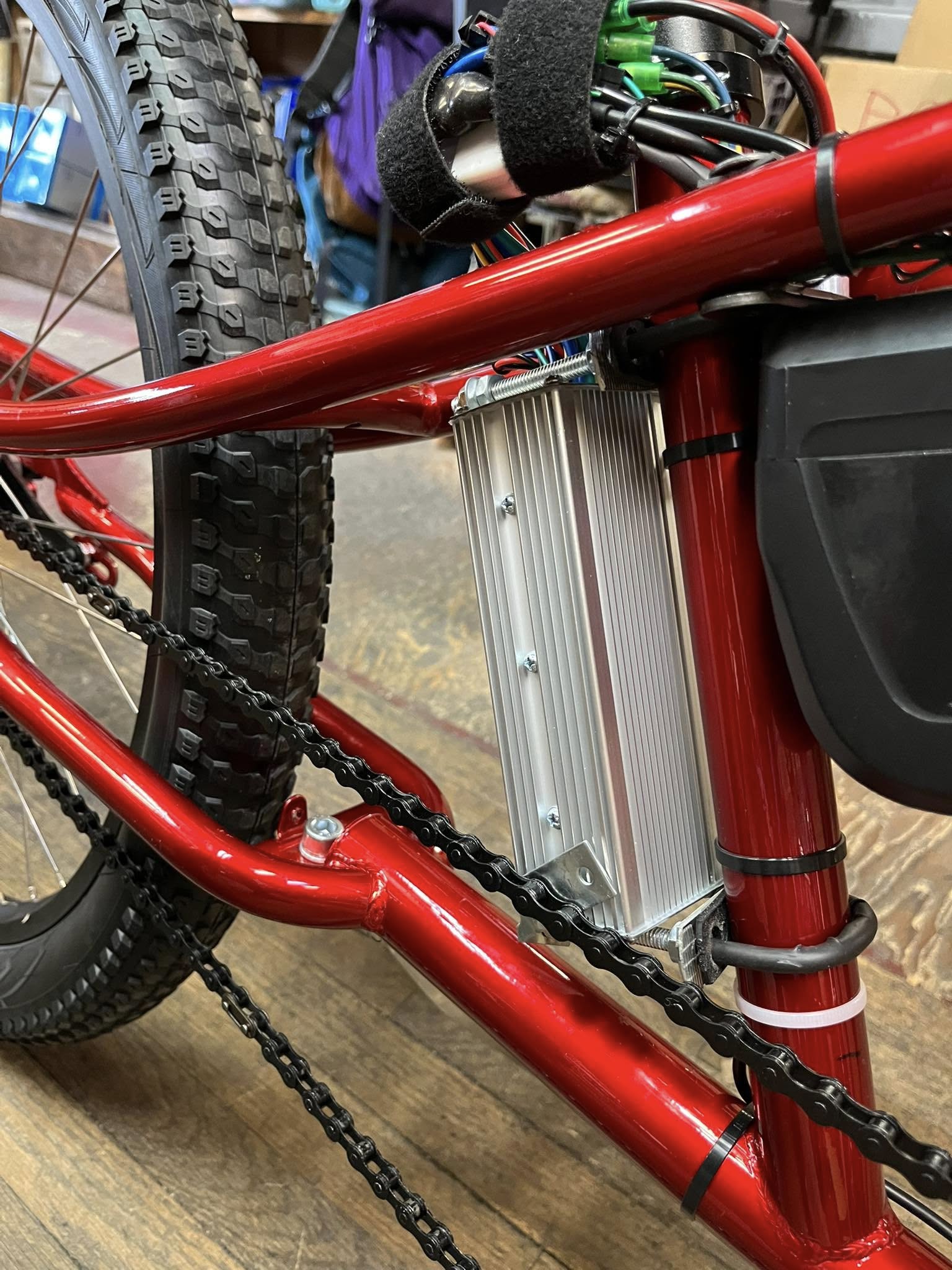
My colleague George sketched up a simple and effective concept. I made a day-off visit to the hardware store for the U-bolts and other bits. The bolts are cushioned with shrink tubing. The box stands off slightly from the seat tube so that airflow over the cooling fins is unrestricted. Because the chain line runs right next to the box, I fabricated a bracket to deflect the chain when it bounces over that way. The customer did not get the chain guard usually included with these frames. He might want to track one down. The chain is very long, so it has a lot of latitude to waggle around. It not only comes within a couple of millimeters of the control box, it also almost rubs on the rear tire.

No notes on the seat. It's perfectly on brand.
Even the handlebar wasn't simple. The apehangers he ordered don't fit the stem. I shimmed them in. It's a perfectly legitimate procedure for which nice shims are machined in a number of sizes representing the standard increments. Of course this setup didn't span the standard increments, but I found something. He can order larger-diameter bars, but the bike is usable in the meantime. He won't be driving fast or cornering hard on it. Not more than once, anyway.

The biggest worry is that the customer will be severely shocked by the final price. Figuring straight time at our posted hourly rate, he's into us for more than $1,700 in labor alone. Then there's 50-some-odd in parts. We may end up eating this thing.

"Why didn't you warn him?" you might say. Our only choice was to pull the plug when we saw the head tube, and just send him out to buy a new frame. So he'd be out whatever he paid for the first one, plus several hundred for another one, plus shipping, plus the labor to fit the head tube to the fork of his choice, plus all of the design and fabrication time that went into fitting the motor kit. Yes, he could buy a pre-made e-bike stretch cruiser for $2,000-$3,000, but none of the ones I saw looked very close to what he chose for himself.

Building a bike on a frame is always more expensive than buying a bike already factory spec'd and assembled, especially if you have to pay for someone else's skilled labor. When you really depart from any kind of plan or standard, you need to have your own ingenuity or pay for someone else's.

You might quibble that everything is just stuck on the outside of this frame. If you're lucky enough to know someone like my friend Diane, or any other mad genius tool user, you might get some sweet custom work for the same price or lower -- Diane does not have the same shop overhead that a retail business has -- but you need to live near her, or travel to her, or ship all of your stuff to her, in a time when shipping prices themselves are staggering. If we had drilled the frame to put battery mounts directly on the top tube, for instance, we would have either had to use rivet nuts (lame) or properly brazed them in, requiring repainting afterward. $$$. The same goes for drilling in for cable guides or brazing something on outside without installing a threaded receiver into the frame.

I don't know anyone locally with the same collection of skills and career bikiness that Diane has.

Anyway, we accomplished the desired task: it's a complete bike, as rideable as its awkward design will allow.
On some level, we do want to give our services away. But we can't. The entire resources of the business contributed to successful completion of the task he requested. All of the knowledge, and all of the collected miscellany hung and piled around the place represent years of experience and a warehouse of potentially useful elements.

Monday, March 17, 2025

5 Days ≠ 5 days

Ski season demands a different kind of energy than bike season. In some ways it's lower. If we have good snow, leading to active rentals and retail sales, we have to deal with a lot of immediate customer needs, but almost nothing spills over into complicated services. Dealing with the public can be tiring and annoying, but it's basically a revolving door kind of transaction. They trample in, we hand them gear, they trample out. In the afternoon, renters return to drop their wet gear and leave again.

I work some long days in rental season, arriving early to set up the shop after wet boots have laid out overnight to dry. My personal life goes on hold for as long as the peak period lasts. That depends on the weather. It could be a couple of months or a few days. It only demands patience and infection control. The five-day week is tiring. I'm always glad to get to the shorter hours of spring.

Here's the thing: bike work, especially service work, is way more exhausting than ski work. Winter is exhausting in its way because I have to take care of my house, clear my driveway, shovel my roof if the winter calls for it, and still get to work on schedule. It taxes my body. But bike work absolutely drains my brain, and has an emotional component as well as I try to handle all of the variables.

Bike comes in for service. What kind of bike is it? How old is it? Expensive or cheap, was it well made? Plenty of expensive stuff out there in the last 20 years is poorly thought out. Some of it, particularly from fringe e-bike companies, is shamefully crappy. But even the "good stuff" from what are perceived as reputable companies suffers from technophilia. So when I assess it I have to determine if it was ever fixable, let alone whether it is still supported.

As the 20th Century neared its end, bike companies started getting more and more coy about publishing tech information and specs. For a while we could keep an archive of printed catalogs to have some idea. Back when we went to trade shows, we could pick up materials from the brands that we didn't sell as well as the latest from our own vendors. That not only helped us when chiseling customers quoted competitors' prices to us. It also helped us repair those bikes. And the bikes themselves were simpler, which helped everyone, especially riders, whether they realized it or not.

I advocated for simplicity as I saw the trend in the industry toward complicated, expensive mechanisms. No one listened to me. Customers voted with their wallets in two ways: A bunch of them abandoned biking altogether. The remainder were technolemmings eager to run off of whatever cliff the industry put a shiny new gizmo on the edge of.

The next steps after figuring out if a repair is possible at all are to determine if we have parts on hand or can get them. At the same time I have to calculate the cost and see if the customer is willing to pay it. People will sink astonishing amounts of money into a piece of cheap junk, while others will walk away from something in the mid or upper price range that could be fixed for significantly less than the price of a new one. It's just that new ones are so expensive that "significantly less than the price of a new one" is still several hundred dollars. We have repairable full suspension bikes abandoned in our basement because the owner ghosted us. More than once this happened after they said, "I do want to pay you for your time." No you didn't. Don't even bother to lie.

You might think that we can then spiff up those bikes and sell them for enough to recover our sunk costs, but with all of the other things that we have to do with a rapidly aging skeleton crew, like vet our decrepit rental bike fleet and keep up with the billable work for customers who do want to pay us for our time, rehabbing a mountain bike rapidly going out of fashion never seems to get done.

As a repair moves through the process, setbacks might occur that lead to additional charges. Then I have to feel out the customer without scaring them off and figure out how much, if any, of the extra cost we can recoup to avoid losing our entire investment of time and material in the repair so far. Most people don't need their bikes. It's all discretionary spending.

The ones who do need their bikes don't usually have a lot of slack in their budgets, no matter how willing they might be in theory to pay us what we're worth. We've had two bikes hanging downstairs for at least four months while the owners try to scrape up the money to have a flat tire repaired. We know from experience that if we fix the bikes and let them go without payment, the owners won't get back to us with the money. Heck, we've got a guy who actually worked part time for us to score employee discounts who is into us for a couple thousand for an e-mountain bike and trailer. Times are tough. A lot of our inadvertent charitable donations are not tax deductible.

The work no longer inspires hope or is particularly satisfying. Some customers appreciate it. Others take it for granted. The cool kids are all way cooler than I am, so I'm barely a step above someone pushing a broom to them. Maybe not even. So at the end of the day, and emphatically at the end of a week, I'm fckin' done. I want as much of the season of light and warmth as I can get. All too soon we go spinning into the darkness again, to grapple with whatever passes for a winter.

Sunday, March 09, 2025

Consistency, fitness, and junk food

 As Driving Season winds down for this winter, I endure the last few commutes in which I am completely at the mercy of whoever is in front of me. It will probably be more than a few, given our typical weather, but the trend is clear. Daylight Relocating Time has started.

Bike commuting time in transit is much more consistent than driving time. I've written about this before. My average speed follows a predictable curve, increasing to a peak in July before tapering as the summer drains away again into autumn. As age takes its toll, I don't know from one season to the next whether I will make it to the previous year's high range. Just feel it out carefully and settle into a moderate, steady pace. Don't stress the cardiovascular system or the joints. Whatever the average turns out to be, I can set my starting time to get me to work more or less on time. Usually less, but that's not the fault of biking. I can have just as little enthusiasm for punctuality when I'm trapped in the car.

Bike commuting was part of a long-term, open-ended strategy to provide consistent exercise around scheduled employment while saving lots of money and burning off my consumption of snack food. Lots of money is a relative term. I've never earned lots of money in my life. But I haven't pissed away a lot of it on motorized activities, particularly getting to my various jobs. Having my winter job at a cross-country skiing shop and touring center has helped somewhat with the winter interruption to cycling, but I can't count on getting out there as regularly as bike commuting. I even wrote a song titled Snacking out of Boredom and Depression about the toll that the dark and frozen -- or inadequately frozen -- months can take.

Learning to bake has given me greater control over the ingredients in what I make, but it has also made it a lot easier to slap together sweet comfort carbs. And I'm not quitting. I built a whole lifestyle and career around not having food discipline, dammit! At some point, your consciousness ends as your energy is recycled into the universe. Have a damn brownie. Have two. Then go run or ride around.

The rest of my diet is generally pretty healthy: meals made with few ingredients, a high proportion of non-meat items. It looks even better if you count maple syrup and coffee as fruit juices. Oh yeah, and chocolate is from plants, too. I just need to get out there and burn it off. It's all fuel.