The shop is closed tomorrow. I thought the sign on the door should say, "If you're reading this you are an idiot. Go home!" The management opted for something else.
Yesterday was stunningly beautiful. The sun shone down from a cloudless sky. The air was warm but not hot. The Chamber of Commerce had decreed Sidewalk Sale Days, so we had a couple of pop-up tents over some racks of clothes and a couple of tables of sandals and other odds and ends to whet the appetite of a surprising crowd of shoppers for so late in August.
One of our tent minders passed a few boring hours by counting cars passing on Main Street. He came up with an average of more than 560 per hour for about seven hours. He did not figure out how many might have been the same car over again. In terms of traffic volume it doesn't matter whether there are 560 different cars in every hour. If you're out there with them you still have to negotiate with 560 of them.
During my short stint out there I watched cyclists doing what they thought was right. A posse of about ten teenage girls rode on the sidewalk up the opposite side of the street, against the flow of vehicle traffic but separated from it. They were all duly helmeted, on bike shop bikes. The way they rode the sidewalk showed that they were familiar with it and completely comfortable, utterly unencumbered by any doubt or guilt. They rode into crosswalks at intersections at the same slow but steady pace they exhibited on the sidewalk itself. They obviously felt they were where they belonged.
A short time later a man in his fifties or early sixties rode by on a Rolling Rock beer promotional cruiser bike. It was really cool, with a top-tube tank and full fenders, a real 1950s - early '60's retro ride. He rode down the sidewalk in front of the shop, apparently oblivious to the critical commentary several of us exchanged as we watched him ride by. He passed again on the sidewalk on the other side of the street in just a couple of minutes.
I could not imagine any of these riders holding their own in the actual traffic flow. They just didn't have the temperament to take a place in the lane. I could imagine them as drivers encountering vehicular cyclists, wondering why any rider would subject themselves to the abuse, and why any rider would victimize the motoring public by getting out there IN THE WAY.
I've been watching raw video for the bike piece I've been working on. Despite my hope that I could enlist some other riders to take part, so far all the riding footage is of me. I look very efficient. In fact, I look fast. This is funny, because I don't feel fast, but I guess I only know that because I've been around riders who really are fast, so I know the difference. I do know that my view of the road is shaped by decades of riding and a period of racer-like training. I did race for a time. After a few seasons I decided I could put that energy to better use as a transportation cyclist. Transportation cycling is safer than racing and makes better use of resources than a recreational quest for ephemeral glory. I basically just wanted to be able to snack freely as well as saving money and having a lighter environmental impact. But over the years I became an efficient partner with my machine in ways many less experienced cyclists might view as beyond them. Or maybe a lot of them just don't think it's worth it. Who am I to choose their values? All I can do is share what I have learned with anyone who wants to know it.
Learning can be an endless process if you keep yourself open to it. So I watch other riders wherever I see them. I think some of them really do belong on the sidewalk. They'll never be up to the rigors of vehicular cycling. Of course that does make them the terrorists of the sidewalk the way motor vehicles are the terrorists of the roadway. Perhaps most of them will not consciously ride in a malicious fashion, enjoying their dominion over mere pedestrians, but they still beg the indulgence of the walkers for whom the sidewalk is constructed. Why should the pedestrians have to accommodate them any more than cyclists should have to step aside every time someone wants to shove a motor vehicle past them?
The bike industry is happy to sell anyone a bike. You want to hang it on your car rack and let it bake in the sun? You want to ride on the sidewalk? You want to dedicate yourself fully to mountain biking and run roadies into the ditch with your SUV when you see them? No problem. At least you bought a bike. Business is business. Advocating too forcefully for "correct" cycling would probably reduce bike sales. You're telling me I can't ride on the sidewalk? Fine, I quit. I'll get a Segway or an electric scooter. You can't order me to get out there and block traffic like some selfish idiot.
Another rider, a man in his 30s, rode his hybrid in the lane with traffic until he came to the corner. He cut deep inside to turn left, yanking his bike quickly across in front of some oncoming traffic to cut into the cross street on the wrong side of the road. If a car had been coming up to the stop sign it would have peened him. But there was no car and he was not peened and so he will recall that the maneuver worked. He was not close enough to the oncoming drivers on Main Street to make them slow down, swerve or honk. But does he think about how he rides? Does he critique his tactics, acknowledge his luck? Or does he just run like a squirrel until his luck runs out?
Today the clouds built up steadily in advance of Hurricane Irene, or whatever will be left of it by the time it gets here. People still came to shop. Since most of them come from places the hurricane is supposed to hit harder than us, they might as well stay here.
Saturday, August 27, 2011


Tuesday, August 23, 2011
Repair Classes
Customers frequently ask if we have repair classes. What most of them don't realize is that they really don't want to take a repair class, they just want to know how to do repairs. They hope that the instructor can sum up two or three decades of experience in one very short presentation which will magically download to their brain all the nuances of procedure we have developed over an entire career devoted to the trivial pursuit of bicycle maintenance and repair.
True, I learned the essentials in a lot less than twenty or thirty years. As with any discipline, you do a lot better with the new stuff if you know something about the old stuff. When I got into bikes, technology had been relatively stable for many years. A lock nut was a lock nut, ball bearings were ball bearings, freewheel ratchets were freewheel ratchets and so forth. I had ample time to master the basics of bearing adjustment and wheel building before the obsessive-compulsive innovators took over in the late 1980s. Thus if I want to teach someone how to work on things now I have to go through some of the simple concepts from back then. Most of these concepts still apply, but they are often deeply buried or thoroughly camouflaged. The novice mechanic will do better knowing they are there and how they work rather than simply working with the new surface.
"Just because you know the latest thing doesn't mean you know everything," as I used to say to smartass punks in the 1990s when they tried to bury me under a pile of articles and hip jargon from bike magazines.
Wow. Magazines. There's a dated reference.
Nothing makes people's eyes glaze faster than a full explanation of how even a simple mechanical thing like a bicycle goes together and works. So where I used to try to rise to the occasion and actually answer people's questions now I grunt and change the subject. Or I give the short, misleading answer instead of the convoluted and boring one because, let's face it, the person who asked wasn't planning on listening to either one.
Most of my bike clientele is glad I know what I know even if they don't want to hear it. They want to see the result in high quality service and good advice. If they wanted to know the details they would have studied them already. Upon occasion a true student arrives. I am ready to respond. But such a student never asks for a repair class. They usually come in with a specific issue because their curiosity and aptitude have already led them into it.
Classes are a symptom of the human tendency to want to fix it and forget it. A bike repair class is like a climbing class or a kayaking class or any of a host of specific activity-related short courses. The participant wants to pay the fee, go in a novice and come out an intermediate, properly instructed.
Almost all school is set up the same way. Kids go in one end. Educated near-adults are supposed to come out the other, equipped with specific knowledge and a standardized version of the facts of life and certain historical events, officially prepared for the next phase of life. Some are, some aren't. Certainly a canned preparation received from an accredited institution is liable to make you think that certain social and national goals are good ideas when in fact they may not be. Because it all happens on a conveyor belt, even if the student tries to jazz it up with some well-thought-out questions and a bit of independent research, they'd better do it within the time allotted -- or faster -- in order to keep up with the rest of their cohort. Otherwise there will be a lot less left on your generation's buffet of opportunities by the time you find your way to it. And these tables have less and less for more and more people as it is.
Actually, those of us who live somewhat outside the norms have certain advantages. We learn skills and live according to our values while avoiding the worst mass hysterics based on unquestioned pre-packaged norms and values. The norm may crush us physically, but we hold sole title to our spirit.
Personally I don't like to talk about nothing but bikes. Much of the time I'd like to talk about anything but bikes. I love to use bikes to get around. I've had some great little adventures on bikes. Riding one adds a lot of good elements to my daily life. But life is life. It's packed with all kinds of things to learn and do. Bikes are part of my Utopian fantasy, but so is personal creativity and a moderate, sustainable lifestyle including local agriculture and a reverence for the local environment wherever you live, not just in the spectacular places or those deemed absolutely necessary to preserve a meager supply of fresh water for a paved-over Hell of Megalopolis.
True, I learned the essentials in a lot less than twenty or thirty years. As with any discipline, you do a lot better with the new stuff if you know something about the old stuff. When I got into bikes, technology had been relatively stable for many years. A lock nut was a lock nut, ball bearings were ball bearings, freewheel ratchets were freewheel ratchets and so forth. I had ample time to master the basics of bearing adjustment and wheel building before the obsessive-compulsive innovators took over in the late 1980s. Thus if I want to teach someone how to work on things now I have to go through some of the simple concepts from back then. Most of these concepts still apply, but they are often deeply buried or thoroughly camouflaged. The novice mechanic will do better knowing they are there and how they work rather than simply working with the new surface.
"Just because you know the latest thing doesn't mean you know everything," as I used to say to smartass punks in the 1990s when they tried to bury me under a pile of articles and hip jargon from bike magazines.
Wow. Magazines. There's a dated reference.
Nothing makes people's eyes glaze faster than a full explanation of how even a simple mechanical thing like a bicycle goes together and works. So where I used to try to rise to the occasion and actually answer people's questions now I grunt and change the subject. Or I give the short, misleading answer instead of the convoluted and boring one because, let's face it, the person who asked wasn't planning on listening to either one.
Most of my bike clientele is glad I know what I know even if they don't want to hear it. They want to see the result in high quality service and good advice. If they wanted to know the details they would have studied them already. Upon occasion a true student arrives. I am ready to respond. But such a student never asks for a repair class. They usually come in with a specific issue because their curiosity and aptitude have already led them into it.
Classes are a symptom of the human tendency to want to fix it and forget it. A bike repair class is like a climbing class or a kayaking class or any of a host of specific activity-related short courses. The participant wants to pay the fee, go in a novice and come out an intermediate, properly instructed.
Almost all school is set up the same way. Kids go in one end. Educated near-adults are supposed to come out the other, equipped with specific knowledge and a standardized version of the facts of life and certain historical events, officially prepared for the next phase of life. Some are, some aren't. Certainly a canned preparation received from an accredited institution is liable to make you think that certain social and national goals are good ideas when in fact they may not be. Because it all happens on a conveyor belt, even if the student tries to jazz it up with some well-thought-out questions and a bit of independent research, they'd better do it within the time allotted -- or faster -- in order to keep up with the rest of their cohort. Otherwise there will be a lot less left on your generation's buffet of opportunities by the time you find your way to it. And these tables have less and less for more and more people as it is.
Actually, those of us who live somewhat outside the norms have certain advantages. We learn skills and live according to our values while avoiding the worst mass hysterics based on unquestioned pre-packaged norms and values. The norm may crush us physically, but we hold sole title to our spirit.
Personally I don't like to talk about nothing but bikes. Much of the time I'd like to talk about anything but bikes. I love to use bikes to get around. I've had some great little adventures on bikes. Riding one adds a lot of good elements to my daily life. But life is life. It's packed with all kinds of things to learn and do. Bikes are part of my Utopian fantasy, but so is personal creativity and a moderate, sustainable lifestyle including local agriculture and a reverence for the local environment wherever you live, not just in the spectacular places or those deemed absolutely necessary to preserve a meager supply of fresh water for a paved-over Hell of Megalopolis.
Monday, August 15, 2011
Forget the helmet cam
I'm giving up on the helmet cam for now. No computer I own can be coaxed into showing the bulky videos at anything like a reasonable speed. You can't edit what you can't see.
I did shoot some stuff for the local TV guy who is working on the bike safety video project I instigated last summer. I'm supposed to be working on the script at this very moment. It all seems pretty disjointed.
It's hard to get a camera to see what the cyclist sees or what you want the motorist to see. It's very difficult to set up single-camera shots that show traffic behavior when the camera vehicle takes up the space you want the other drivers to use.
It's hard to come up with an interesting voice-over when all you really want to say to drivers is "just give me space." All you want to say to other cyclists is, "Don't ride on the sidewalk, idiot! Don't ride against traffic!"
On Saturday I rode on the sidewalk for about ten feet to zip behind a pedestrian who had just committed to the crosswalk as I came blasting down a hill at an inconvenient speed. I twitched the bike to the right into a driveway, slipped behind the walker and shot back out through the handicapped ramp of the crosswalk to regain the street. It was one of those battlefield decisions you can't teach anyone or advise that they do. Sort of like the time I snapped the old Triumph Spitfire into a near death-roll, yanking it into a very fortunately placed side street as the gap I had merged into suddenly started to disappear. On the bike I had more options. The only thing I couldn't have done in the time available was stop short of the crosswalk like a good do-bee.
Anyway, the camera. I guess I thought with so much amateur video out there the technology would be as user friendly as digital still photography and music have been. I had not considered that wearable camcorders come to us from the world of Professional Videographers. The early adopters had professional backgrounds or hefty budgets and sophisticated amateur setups. This is in stark contrast to the fact that the first digital still cameras most of us knew about were very crude point-and-shoots. Home computers and digital cameras have co-evolved for well over a decade now. Meanwhile, little video cameras deliver either a jumpy, grainy image due to the limitations of the camera or a halting high-definition slide show on any but the very latest and greatest home computers. Minimum processor speed 3.2 GHz? Three gigs of RAM?
The first company that invents a competitively sized camera that will not only shoot HD but will also play nicely with elderly computers deserves all the business anyone can send them. I don't foresee being able to afford major computer upgrades anytime soon. By the time I do this video camera format will probably have been abandoned.
So much for video vanity.
I did shoot some stuff for the local TV guy who is working on the bike safety video project I instigated last summer. I'm supposed to be working on the script at this very moment. It all seems pretty disjointed.
It's hard to get a camera to see what the cyclist sees or what you want the motorist to see. It's very difficult to set up single-camera shots that show traffic behavior when the camera vehicle takes up the space you want the other drivers to use.
It's hard to come up with an interesting voice-over when all you really want to say to drivers is "just give me space." All you want to say to other cyclists is, "Don't ride on the sidewalk, idiot! Don't ride against traffic!"
On Saturday I rode on the sidewalk for about ten feet to zip behind a pedestrian who had just committed to the crosswalk as I came blasting down a hill at an inconvenient speed. I twitched the bike to the right into a driveway, slipped behind the walker and shot back out through the handicapped ramp of the crosswalk to regain the street. It was one of those battlefield decisions you can't teach anyone or advise that they do. Sort of like the time I snapped the old Triumph Spitfire into a near death-roll, yanking it into a very fortunately placed side street as the gap I had merged into suddenly started to disappear. On the bike I had more options. The only thing I couldn't have done in the time available was stop short of the crosswalk like a good do-bee.
Anyway, the camera. I guess I thought with so much amateur video out there the technology would be as user friendly as digital still photography and music have been. I had not considered that wearable camcorders come to us from the world of Professional Videographers. The early adopters had professional backgrounds or hefty budgets and sophisticated amateur setups. This is in stark contrast to the fact that the first digital still cameras most of us knew about were very crude point-and-shoots. Home computers and digital cameras have co-evolved for well over a decade now. Meanwhile, little video cameras deliver either a jumpy, grainy image due to the limitations of the camera or a halting high-definition slide show on any but the very latest and greatest home computers. Minimum processor speed 3.2 GHz? Three gigs of RAM?
The first company that invents a competitively sized camera that will not only shoot HD but will also play nicely with elderly computers deserves all the business anyone can send them. I don't foresee being able to afford major computer upgrades anytime soon. By the time I do this video camera format will probably have been abandoned.
So much for video vanity.
Sunday, July 31, 2011
Bicycle Hypochondria
Bicycle Hypochondria has crept up to saturatingly high levels among road cyclists.
When I raced in the late 1970s and early 1980s no one had bicycle hypochondria. Racers and the posers who wanted to look like them beat the crap out of their bikes back then, just as they do today. If anyone was feeling neurotic they might go through a bout of position paranoia. That might lead them to fiddle with their seat height or stem length. Anyone with sufficient funds might indulge in a little component envy if they didn't already own the best of the best or they wanted to buy some obscure brand of brake arch or crankset to turn heads at the next race or group ride.
Hypochondria starts with a genuine fear of real illness. Bicycle hypochondria starts with a justified anxiety about real mechanical problems.
I never heard anyone whinge about their shifting when the shift levers were held on with primitive wing nuts. Accurate shifting was one more skill a racer needed to master. Less skilled riders might have whinged in general about how difficult friction shifting was, but they didn't have to worry about whether it would work if they ever managed to develop the dexterity. If you blew a shift it was because you blew a shift, not because your expensive mechanical servant let you down.
The simple equipment put the focus squarely on the rider. No one got ridiculously neurotic about chain noise, shifting systems or whether your bike was as well-dressed as the next guy's. Shift cables did not have to wind their way through a labyrinth of housing.
When everything is working perfectly, modern shifting systems allow a rider to maintain a more constant cadence by facilitating frequent, precise shifts among closely-spaced gears. This creates a dependence on frequent, precise shifts among closely-spaced gears. What was once an indulgence becomes a necessity. The rider now lives in a world of much more precise tolerances. It takes a lot less to disrupt their mood and confidence, whether they realize it or not.
Some riders manage to blunder along happily oblivious to the feedback from their abused machinery. They may be mentally better off than the bicycle hypochondriac but they still fall victim to the genuine needs of the temperamental modern system.
A moderate approach to the vulnerabilities of modern bicycle crap still requires that the victim of modern componentry open the wallet and dump out money as frequently as the finicky bullshit requires it. A wise rider might accept a little more noise or a slightly crunchier shift for the sake of a more durable chain that's easier to service. At the very least the rider who insists on having the quieter tinsel chain with the Magic Pin has to accept frequent expensive replacement as the price of that noise level.
Shifting systems are just the beginning of the bicycle hypochondriac's concerns. Bikes and parts failed in the era of steel and traditionally spoked wheels, but it was less common. Things got gradually more exciting as aluminum became more common. Now in an age when no self-respecting performance rider will be seen on steel, and titanium seems to be a plaything for the rich, carbon fiber has brought the fear of sudden structural collapse to the nervous rider's list of woes. Sure, it's hardly a daily occurrence, but you have to admit you see more outright snapped-off frame and fork parts than you ever saw in the Iron Age. It's in the back of the mind of every rider on a carbon frame. Is that noise serious?
Bottom brackets with bearings pressed into the frame call for more perfect tolerances in the bottom bracket shell. When cups threaded into the frame, the shell could be faced and tapped even if it was itself slightly misaligned with the rest of the frame. Cartridge bottom bracket bearing units maintain their own alignment, so the BB shell does not even have to be faced. Bearings pressed into the shell eat themselves in no time with even a misalignment of a few thousandths of an inch. If the bike doesn't have it when it's new, it can develop it from a few seasons of vigorous riding. A fellow mechanic in Florida is trying to fix a titanium bike that came from the factory with a misaligned BB 30 shell. It eats a set of bearings in about 50 miles. A rider who uses my shop has noticed that his bike has started chewing through BB 30 bearings now that he's had the frame a while. He gets a little further than 50 miles before he notices the play, but compare that to the cartridge BB in my Cross Check, which I've ridden a lot, which is still running smoothly after almost 11 years.
Whether you think the bike industry started complicating the machinery to make life simpler for the dedicated athletes who use it to express the highest level of human achievement or that they did it to suck ever greater amounts of money from as much of the cycling public as they could ensnare, modern riders have to maintain complex, temperamental equipment or pay someone else to do it for them. I see a lot of haunted expressions on the victims of bicycle hypochondria listening tensely to creaks, pops, squeaks, rattles, chatters, sproings, cracks, crunches... you get the idea.
When I raced in the late 1970s and early 1980s no one had bicycle hypochondria. Racers and the posers who wanted to look like them beat the crap out of their bikes back then, just as they do today. If anyone was feeling neurotic they might go through a bout of position paranoia. That might lead them to fiddle with their seat height or stem length. Anyone with sufficient funds might indulge in a little component envy if they didn't already own the best of the best or they wanted to buy some obscure brand of brake arch or crankset to turn heads at the next race or group ride.
Hypochondria starts with a genuine fear of real illness. Bicycle hypochondria starts with a justified anxiety about real mechanical problems.
I never heard anyone whinge about their shifting when the shift levers were held on with primitive wing nuts. Accurate shifting was one more skill a racer needed to master. Less skilled riders might have whinged in general about how difficult friction shifting was, but they didn't have to worry about whether it would work if they ever managed to develop the dexterity. If you blew a shift it was because you blew a shift, not because your expensive mechanical servant let you down.
The simple equipment put the focus squarely on the rider. No one got ridiculously neurotic about chain noise, shifting systems or whether your bike was as well-dressed as the next guy's. Shift cables did not have to wind their way through a labyrinth of housing.
When everything is working perfectly, modern shifting systems allow a rider to maintain a more constant cadence by facilitating frequent, precise shifts among closely-spaced gears. This creates a dependence on frequent, precise shifts among closely-spaced gears. What was once an indulgence becomes a necessity. The rider now lives in a world of much more precise tolerances. It takes a lot less to disrupt their mood and confidence, whether they realize it or not.
Some riders manage to blunder along happily oblivious to the feedback from their abused machinery. They may be mentally better off than the bicycle hypochondriac but they still fall victim to the genuine needs of the temperamental modern system.
A moderate approach to the vulnerabilities of modern bicycle crap still requires that the victim of modern componentry open the wallet and dump out money as frequently as the finicky bullshit requires it. A wise rider might accept a little more noise or a slightly crunchier shift for the sake of a more durable chain that's easier to service. At the very least the rider who insists on having the quieter tinsel chain with the Magic Pin has to accept frequent expensive replacement as the price of that noise level.
Shifting systems are just the beginning of the bicycle hypochondriac's concerns. Bikes and parts failed in the era of steel and traditionally spoked wheels, but it was less common. Things got gradually more exciting as aluminum became more common. Now in an age when no self-respecting performance rider will be seen on steel, and titanium seems to be a plaything for the rich, carbon fiber has brought the fear of sudden structural collapse to the nervous rider's list of woes. Sure, it's hardly a daily occurrence, but you have to admit you see more outright snapped-off frame and fork parts than you ever saw in the Iron Age. It's in the back of the mind of every rider on a carbon frame. Is that noise serious?
Bottom brackets with bearings pressed into the frame call for more perfect tolerances in the bottom bracket shell. When cups threaded into the frame, the shell could be faced and tapped even if it was itself slightly misaligned with the rest of the frame. Cartridge bottom bracket bearing units maintain their own alignment, so the BB shell does not even have to be faced. Bearings pressed into the shell eat themselves in no time with even a misalignment of a few thousandths of an inch. If the bike doesn't have it when it's new, it can develop it from a few seasons of vigorous riding. A fellow mechanic in Florida is trying to fix a titanium bike that came from the factory with a misaligned BB 30 shell. It eats a set of bearings in about 50 miles. A rider who uses my shop has noticed that his bike has started chewing through BB 30 bearings now that he's had the frame a while. He gets a little further than 50 miles before he notices the play, but compare that to the cartridge BB in my Cross Check, which I've ridden a lot, which is still running smoothly after almost 11 years.
Whether you think the bike industry started complicating the machinery to make life simpler for the dedicated athletes who use it to express the highest level of human achievement or that they did it to suck ever greater amounts of money from as much of the cycling public as they could ensnare, modern riders have to maintain complex, temperamental equipment or pay someone else to do it for them. I see a lot of haunted expressions on the victims of bicycle hypochondria listening tensely to creaks, pops, squeaks, rattles, chatters, sproings, cracks, crunches... you get the idea.
Tuesday, July 26, 2011
Near Death Experience
 For this lucky brifter it was a brush with death. I may have noted before that a failing shift wire can cause irreparable brain damage to brifters, particularly Shimano's. Since Campy shifters can be completely disassembled, fragments of a damaged shift cable could probably be removed. I'm betting SRAM shrouds the interior of their modern horrors in mystery similarly to Shimano, but I haven't dealt with enough of it to say for sure.
All three major suppliers of brifters now route the shift cable housing under the tape. While that gives a lovely clean look to the bars it makes checking the condition of the cables inside the shifter harder because you can't get a lot of slack by popping the housings out of the frame stops. Similarly it is difficult to check whether the ferrules on the linear-wire housing are failing, which is a common cause of erratic shifting. Linear housing wires can also push into the brains of the shifter and jam things completely.
Fortunately for this rider, his shifters have external routing. He noticed a sudden decline in shifting performance and brought the bike right in.
Monday, July 25, 2011
Adventure Commuting
It starts with a line on a map.
 That line circled in yellow highlighter indicates a public right of way still listed as current. It looks like any other road on the map. Any explorer of rural New England knows that the truth on the ground may look quite different.
Looking for an alternate route home after a tiring week, I examined a topographic map of the area around Stoddard Road, which had been my woodsy escape route through North Wolfeboro. Lately, cyclists had reported some bad dog incidents on Stoddard. Some dog owners have a way of relying on the public to train their unruly mutts for them. Cyclists often bear the brunt of this because we're not locked safely in an armored vehicle. I was in no mood to grind my way up Stoddard's considerable climbs only to have to deal with aggressive dogs as I wobbled over the crest.
I knew that Bickford Road goes to Haines Hill Road. It arrives there with a different name. The contours on the topographic map indicated that it comes into Haines Hill at the bottom of a tough climb that eventually leads to the same four-way intersection in North Wolfeboro that Stoddard Road enters. The contours also showed that the discontinued section of Bickford Road runs up a valley between the height of Stoddard Road and the rise of Haines Hill. It looked like a very agreeable gradient. Interesting that the two tougher roads have survived to the modern day while the easier one has fallen into disuse.
Typically I reach the Stoddard Road area by riding out the Cotton Valley Trail. Despite its many shortcomings, the Cotton Valley Trail follows a very convenient line. It is certainly free of motor vehicle traffic except if you encounter one of the rail cars for which the rails were left in place. These encounters are fairly rare.
Bickford Road began with a milder climb than the first one on Stoddard. That brought me to a beautiful little valley with a wetland in it, surrounded by the hills I would not be climbing.

 Sometimes when a road changes names you will find a sign indicating the change, even if there is no obvious intersection or direction change. I hoped such a sign might nail down for sure which set of ruts I should follow into the woods to come out where I expected to on Stoddard, where I'd passed the other end of the old road many times. I knew it would be pretty rough, but that's why I bought the Cross Check. Lately I'd stuck mostly to pavement, but that was more a matter of scheduling than a formal decision to give up absurd bushwhacks as a whole.
There was no sign when I reached the turn. It had to be the right one. The ruts were overgrown with encroaching growth and had obviously channeled some pretty healthy streams of water during the last big rainstorm. Immediately after I entered them I caught something under the thick grass and fell to the left. I yanked a foot out in time to prevent a full crash.
I was a few yards in when I decided to stop for a picture of the prospect.
 A little further on I snapped this shot of emergent rocks.

I pressed on without taking pictures of the two fallen trees that made me dismount and carry, or of some of the more thickly jungled sections in which saplings, tree branches, shrubbery and grasses stroked various insect life all over me.
For all of its obstacles it delivered on the promise of very gradual climbing. If the surface had been smooth I would have felt almost guilty about how completely I was cheating the hills.
Before I reached the junction with Stoddard Road I saw the back of a farm house I'd only ever seen from the front. By that I could tell that I had almost reached the maintained road.
 The ruts diverged as Bickford Road met Stoddard. The first shot shows the direction in which I continued.
 The second shot shows the direction from which I had always come. It also shows the contrast between a Class V maintained road and a Class VI right of way.

A Class VI right of way is still retained for public use, but nothing is done to ease passage through it. Some of them manage to keep looking a lot like a road because so many people use them. Others disappear into stands of trees and the imagination of cartographers.
I plucked a tick off my leg and crushed it between my fingernails before continuing on the familiar route home to a thorough shower.
Next time I try one of these routes I will wear more suitable shoes than my road cleats and bring some means of making fire so I can torch any ticks that get on me.
 That line circled in yellow highlighter indicates a public right of way still listed as current. It looks like any other road on the map. Any explorer of rural New England knows that the truth on the ground may look quite different.
Looking for an alternate route home after a tiring week, I examined a topographic map of the area around Stoddard Road, which had been my woodsy escape route through North Wolfeboro. Lately, cyclists had reported some bad dog incidents on Stoddard. Some dog owners have a way of relying on the public to train their unruly mutts for them. Cyclists often bear the brunt of this because we're not locked safely in an armored vehicle. I was in no mood to grind my way up Stoddard's considerable climbs only to have to deal with aggressive dogs as I wobbled over the crest.
I knew that Bickford Road goes to Haines Hill Road. It arrives there with a different name. The contours on the topographic map indicated that it comes into Haines Hill at the bottom of a tough climb that eventually leads to the same four-way intersection in North Wolfeboro that Stoddard Road enters. The contours also showed that the discontinued section of Bickford Road runs up a valley between the height of Stoddard Road and the rise of Haines Hill. It looked like a very agreeable gradient. Interesting that the two tougher roads have survived to the modern day while the easier one has fallen into disuse.
Typically I reach the Stoddard Road area by riding out the Cotton Valley Trail. Despite its many shortcomings, the Cotton Valley Trail follows a very convenient line. It is certainly free of motor vehicle traffic except if you encounter one of the rail cars for which the rails were left in place. These encounters are fairly rare.
Bickford Road began with a milder climb than the first one on Stoddard. That brought me to a beautiful little valley with a wetland in it, surrounded by the hills I would not be climbing.

 Sometimes when a road changes names you will find a sign indicating the change, even if there is no obvious intersection or direction change. I hoped such a sign might nail down for sure which set of ruts I should follow into the woods to come out where I expected to on Stoddard, where I'd passed the other end of the old road many times. I knew it would be pretty rough, but that's why I bought the Cross Check. Lately I'd stuck mostly to pavement, but that was more a matter of scheduling than a formal decision to give up absurd bushwhacks as a whole.
There was no sign when I reached the turn. It had to be the right one. The ruts were overgrown with encroaching growth and had obviously channeled some pretty healthy streams of water during the last big rainstorm. Immediately after I entered them I caught something under the thick grass and fell to the left. I yanked a foot out in time to prevent a full crash.
I was a few yards in when I decided to stop for a picture of the prospect.
 A little further on I snapped this shot of emergent rocks.
I pressed on without taking pictures of the two fallen trees that made me dismount and carry, or of some of the more thickly jungled sections in which saplings, tree branches, shrubbery and grasses stroked various insect life all over me.
For all of its obstacles it delivered on the promise of very gradual climbing. If the surface had been smooth I would have felt almost guilty about how completely I was cheating the hills.
Before I reached the junction with Stoddard Road I saw the back of a farm house I'd only ever seen from the front. By that I could tell that I had almost reached the maintained road.
 The ruts diverged as Bickford Road met Stoddard. The first shot shows the direction in which I continued.
 The second shot shows the direction from which I had always come. It also shows the contrast between a Class V maintained road and a Class VI right of way.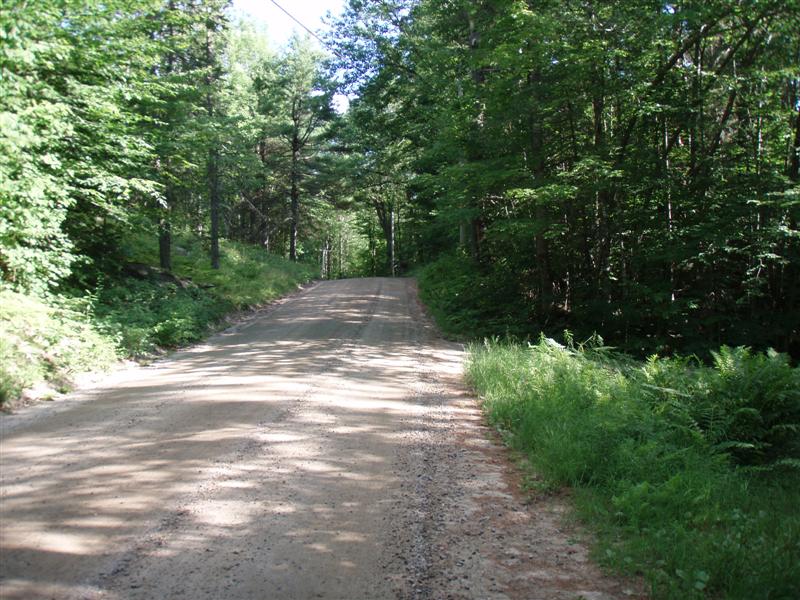
A Class VI right of way is still retained for public use, but nothing is done to ease passage through it. Some of them manage to keep looking a lot like a road because so many people use them. Others disappear into stands of trees and the imagination of cartographers.
I plucked a tick off my leg and crushed it between my fingernails before continuing on the familiar route home to a thorough shower.
Next time I try one of these routes I will wear more suitable shoes than my road cleats and bring some means of making fire so I can torch any ticks that get on me.
Gilford Run Wrap-up
Some days you just can't avoid eating supper after 10 p.m.
In spite of the heat and the work day that preceded the ride, I felt okay heading out on the Gilford run to retrieve my car from the mechanic who is worth the trip. I was nicely wired from the Kenyan coffee Lydia's had served that day. I was also getting fired up to face potential motorist hassles in the known trouble spots.
Okay does not mean great. I did not feel fast and bulletproof, as I once did. However, the motoring public chose this day to be extraordinarily cooperative. For my part, I did not stick much of an elbow into the lane on the long grind from the center of town to the Kingswood Regional High School complex, where the road bends right and tends down. Even on that stretch, where I can maintain 30 miles per hour much of the time, motorists are more than ready to exceed 40 down to the hard 90-degree (or tighter) right turn where King's Highway departs to the left and Route dives down a bit more before slamming into the bottom of the climb the locals call Old Perk. No one has ever explained the name to me. I call it Alpe de Suez as a tribute to the legendary climb in the French Alps and a play on the name of the restaurant East of Suez, situated at the top. It's a restaurant with an undeservedly good reputation, but it has survived decades to be a landmark I will miss if people finally start being underwhelmed by the food and the service. What will I call the hill?
I got a great run through the 90. My size and persistence in the rear-view mirrors of a Nissan that had just passed me caused the driver to punch the gas to gain a gap on me. I appreciated that, since I wanted to hold as much speed as possible going into the beginning of the climb. I knew darn well I was going to head for the low gears and crawl once my momentum ran out. And so it was. Still, I arrived at the crest feeling less sapped than I expected.
The headwind on 28 soon took that out of me. It's a boring slog to Chestnut Cove Road at the best of times. I trudged along to that junction.
It occurred to me as I left Chestnut Cove Road to enter Route 28A that it's the only peaceful little road on the whole route. Route 28A isn't bad for a numbered highway, but it still draws its share of throttle-pushers. Addicted to cornering in whatever vehicle I'm piloting, I understand the lure of 28A's curves. On the bike I can enjoy them without guilt.
I kept thinking about pulling out my camera, but when I have to get somewhere I hate to slow down. Alton Bay bustled with classic summer activity. Smells of fried food hung in the air, reminding me how long I would have to wait for my own supper. Best not to think about it.
The wind seemed to be bent by the hills to a helpful direction I had not expected. I was starting to feel minor twinges from the steady pace, but nothing dire.
Two modern roadies passed me just before the shoulder widened to a full breakdown lane on Route 11. They were courteous, but clearly pulling a pace I had no interest in matching. They didn't really give any hint that I would be welcome, either. I was in the mood to ride alone, so it worked out for all of us.
The first wide bit on 11 gives views of Alton Bay and the lake below. The roadies took 11D, which runs along the shore. I stuck to the high road with its scenic vistas. If they returned from 11D where it rejoins 11 just before the narrows, they were far enough ahead that I never saw them.
Even in the narrows, the motoring public remained eerily courteous. I continued to ride to the right, in no mood to engage in any debate over road rights. I got lucky, because none of the drivers felt like crowding me. In fact, where the narrows end with a fast drop to Ellacoya State Park, I rejoined the flow as my speed approached 40 miles per hour. No one contested my merge. Near the bottom I heard the hiss of truck brakes. I swung to the right as the road widened, which is my normal routine there. After a gracious moment, a tractor trailer that had been waiting politely behind me passed comfortably to the left with a generous margin. Some days humanity seems halfway decent.
The wind shifted gradually against me. The sun angled in. I started to get that out-of-body feeling as fatigue built up and the glare reduced my vision to an approximation, in spite of my polarized sunglasses.
The stretch past Laconia Airport is always a slog. The last bit, on Lily Pond Road drags it out for another mile or so. I was certainly ready to stop by the time I arrived. But once again I had managed to avoid putting more than 40 miles on another car when all I really needed to do was convey a driver to this one.
In spite of the heat and the work day that preceded the ride, I felt okay heading out on the Gilford run to retrieve my car from the mechanic who is worth the trip. I was nicely wired from the Kenyan coffee Lydia's had served that day. I was also getting fired up to face potential motorist hassles in the known trouble spots.
Okay does not mean great. I did not feel fast and bulletproof, as I once did. However, the motoring public chose this day to be extraordinarily cooperative. For my part, I did not stick much of an elbow into the lane on the long grind from the center of town to the Kingswood Regional High School complex, where the road bends right and tends down. Even on that stretch, where I can maintain 30 miles per hour much of the time, motorists are more than ready to exceed 40 down to the hard 90-degree (or tighter) right turn where King's Highway departs to the left and Route dives down a bit more before slamming into the bottom of the climb the locals call Old Perk. No one has ever explained the name to me. I call it Alpe de Suez as a tribute to the legendary climb in the French Alps and a play on the name of the restaurant East of Suez, situated at the top. It's a restaurant with an undeservedly good reputation, but it has survived decades to be a landmark I will miss if people finally start being underwhelmed by the food and the service. What will I call the hill?
I got a great run through the 90. My size and persistence in the rear-view mirrors of a Nissan that had just passed me caused the driver to punch the gas to gain a gap on me. I appreciated that, since I wanted to hold as much speed as possible going into the beginning of the climb. I knew darn well I was going to head for the low gears and crawl once my momentum ran out. And so it was. Still, I arrived at the crest feeling less sapped than I expected.
The headwind on 28 soon took that out of me. It's a boring slog to Chestnut Cove Road at the best of times. I trudged along to that junction.
It occurred to me as I left Chestnut Cove Road to enter Route 28A that it's the only peaceful little road on the whole route. Route 28A isn't bad for a numbered highway, but it still draws its share of throttle-pushers. Addicted to cornering in whatever vehicle I'm piloting, I understand the lure of 28A's curves. On the bike I can enjoy them without guilt.
I kept thinking about pulling out my camera, but when I have to get somewhere I hate to slow down. Alton Bay bustled with classic summer activity. Smells of fried food hung in the air, reminding me how long I would have to wait for my own supper. Best not to think about it.
The wind seemed to be bent by the hills to a helpful direction I had not expected. I was starting to feel minor twinges from the steady pace, but nothing dire.
Two modern roadies passed me just before the shoulder widened to a full breakdown lane on Route 11. They were courteous, but clearly pulling a pace I had no interest in matching. They didn't really give any hint that I would be welcome, either. I was in the mood to ride alone, so it worked out for all of us.
The first wide bit on 11 gives views of Alton Bay and the lake below. The roadies took 11D, which runs along the shore. I stuck to the high road with its scenic vistas. If they returned from 11D where it rejoins 11 just before the narrows, they were far enough ahead that I never saw them.
Even in the narrows, the motoring public remained eerily courteous. I continued to ride to the right, in no mood to engage in any debate over road rights. I got lucky, because none of the drivers felt like crowding me. In fact, where the narrows end with a fast drop to Ellacoya State Park, I rejoined the flow as my speed approached 40 miles per hour. No one contested my merge. Near the bottom I heard the hiss of truck brakes. I swung to the right as the road widened, which is my normal routine there. After a gracious moment, a tractor trailer that had been waiting politely behind me passed comfortably to the left with a generous margin. Some days humanity seems halfway decent.
The wind shifted gradually against me. The sun angled in. I started to get that out-of-body feeling as fatigue built up and the glare reduced my vision to an approximation, in spite of my polarized sunglasses.
The stretch past Laconia Airport is always a slog. The last bit, on Lily Pond Road drags it out for another mile or so. I was certainly ready to stop by the time I arrived. But once again I had managed to avoid putting more than 40 miles on another car when all I really needed to do was convey a driver to this one.
Subscribe to:
Posts (Atom)