Friday, December 16, 2022

Sliding into Winter

 One job is two jobs when you work for a shop with dual specialties. The cross-country ski business has been doomed in the Lower 48 states of the USA for decades, but a few of us keep on out of force of habit and our loyalty to our aging customer base. A trickle of younger participants comes in, but never in great enough numbers to bring us younger coworkers.

As with cycling, cross-country ski racers are somehow viewed as elite even though they will never be enough to support an industry and an economic sector. They are the most impressive athletic specimens, but their competition requires a level of commitment to physical abuse that is beyond healthy.

 Racing makes a beneficial activity pathological. That being said, racing equipment can be very fun to operate at a more survivable level of exertion. This may be more true of ski equipment, because there's less mechanical complexity to suck money out of you in repetitive repair and maintenance costs. And a full-on racing bike feels the most nimble and effective when the rider is in a position that is frankly painful over the long haul. The fact that racers grow accustomed to it does not make it less damaging to a rider who hasn't agreed to trade the physical abuse for the glory of victory, or even the mere consolation of participation. "Comfortable" is relative.

Transportation cycling offers plenty of opportunity for lung-hucking sprints and death-defying maneuvers in a tight field of ruthless adversaries. And you get to save lots of money and eat whatever you like. You don't have to drive yourself to a race venue and pay club memberships and entry fees. Just hop on outside your home and slide into the nonstop Madison flowing past on the streets.

The arrival of snow brings other options. When I lived in Annapolis, Maryland, snowstorms would bring the city to a halt. Cross-country skiers would appear among the other pedestrians enjoying the forced break from the daily churn. For a couple of days the city might be bright and friendly before plows and salt trucks turned the streets into rivers of grimy brine that splattered onto the neglected sidewalks as the citizenry climbed back into their capsules to pass each other with the usual indifference verging into hostility. Up here in New Hampshire, the scene is the same, only there's a snow-based tourist industry operating alongside the imperative to have the streets cleared for normal motor traffic. Cross-country skiers seldom get a chance to slide along unplowed streets, because the snow removal is so well organized and prompt. Residents on side and back roads roll their eyes a bit at this, but everyone gets cleared out within a couple of days.

Roads cleared for motor travel are not necessarily in the best shape for a cyclist. In a dry or warm winter, the edges might thaw back far enough to expose the shoulder, but in a normal or colder year the snowbanks narrow the road and cut off emergency bailouts. I'd rather use the snow for snow activities than fight it to remain on two wheels. Even in a bad snow year, lack of daylight combines with the winter stupor that afflicts many drivers, to limit riding opportunities.

Bad snow years have become the rule more than the exception in New England. The terrain creates variation across the region, so maybe the far north or the western half lie in the snow zone, while to the south and east we forget what winter ever looked like. It's easy to forget that about half of the United States lies to the south of most of Europe. Our north seems so far north to us and Canada is just three blocks south of the tundra.

The last ice age did tilt oddly toward northeastern North America. Weather and climate don't uniformly march across lines of latitude. Without human interference, the glaciers would have sent their ghostly reminders year after year to the areas once buried beneath thousands of feet of compacted snow and ice. Not so much anymore, though. Increasingly, we have to figure out what to do with months of slush, ice, and mud.

Monday, November 21, 2022

Miles per gallon

 As someone with a conflicted relationship with motor vehicles, I have tried to spend as little as possible to buy one. But I need one because of the distances I have to cover in challenging conditions, so they can't just be thrashed pieces of junk.

For the past several cars, I've picked up ones that various members of my family were discarding as they contributed to the used car market by buying new ones. It was an agreeable parade of small Ford station wagons, which mostly succumbed to the long months sitting in the dirt driveway while I'm using the bike for transportation, and the inexorable rust that consumes all New England vehicles that face the tide of brine flooding our roads every winter. The price tended to be pretty affordable, which suited my underlying reluctance to chip in much of anything to the moto-centric culture and polluting, speeding, jostling, sprawling environmental disaster that is transportation in America.

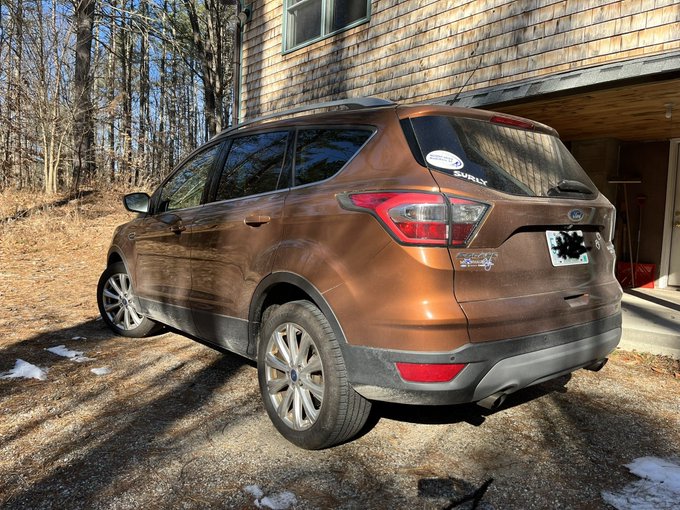
The latest -- and last -- of this line sits in the driveway now. It's far more car than I would ever buy, but the gas mileage is as good as the last Ford Focus that finally rotted out underneath the bodywork. Behold The Shuttlecraft:

"Nice car," a friend and colleague said as we headed out after the last zoning board meeting.

"Thanks. I had to kill my father to get it," I said. Dad was a Ford man. He died at the end of May. My mother is 93, and has decided to quit driving because, as she says, "I'm 93 years old. If anything happens, it will be my fault even if it isn't my fault." My sister is on hand to drive the two of them around. So this car, this space craft full of electronics and automated features, was available for ...really cheap... just as my mechanic was telling me that he couldn't sticker my old car anymore because the frame was almost gone.

There's a lot to get used to.  The speedo and tach are analog, but all other data comes at the driver through two screens. One is a small one centered above the steering wheel. The other is the now ubiquitous touch screen in the middle of the dash.

In the cellist's Honda CR-V, she can punch up a readout that tells her about fuel consumption: miles remaining at current rate, and miles per gallon. She has to ask for it. In The Shuttlecraft, that display is constant. I suppose I could turn it off, but I find it fascinating.

Miles per gallon tells you about the energy required to accelerate a mass against the force of gravity and the other factors that inhibit forward motion. As a cyclist, you have an intuitive -- and very tactile -- awareness of the toll that hills and headwinds demand. Through the readout in The Shuttlecraft, I can see the dramatic difference between uphill and down, and any acceleration. Going down a hill, the mpg readout will max out at 99.9. Woo hoo! Going up a hill it drops to lows like 11, 9, 7, or sometimes 3. It just drains. And any short hops or stop and go driving drops the total from a creditable 30-31 down into the "sorta might be okay" upper 20s. The Focus was surprisingly no better, especially with snow tires, but the Shuttlecraft is undeniably more of a bourgeois armored personnel carrier. It's really hard to find a nice small station wagon these days but I still wish Dad had had a bit more varied taste in cars. A nice Passat wagon logging 40 mpg, perhaps.

Well, po' folks can't be choosers. In an alternate timeline, I stayed in a more built-up area and never bought a car at all. But then I'd have to live in a more built up area. Nature called.

Around here, I've fallen in with the tree huggers to try to defend a natural environment where there still is one. When I moved here, it was the country. Now, 35 years later, it's more like heavily wooded suburbia. That makes our efforts all the more important, because the economy depends increasingly on subdividing large parcels of land and increasing population density. More roads aren't being built, but the ones we have are getting a lot busier all year. Residential development is piecemeal for the most part, a house here and a house there, but larger tracts are proposed as the state grapples with a lack of "workforce housing." Workforce housing is a nice way of saying shacks for the scantily paid grunts who perform the essential but disregarded tasks of actually making civilization and the economy run. If it had existed in Annapolis in the 1980s, I might never have moved away. But Annapolis was obliterated by explosive, poorly planned development. I saw it coming and ran for the hills, literally.

Ironically, the tree huggers do a lot of driving. It's the norm. In rural areas, the distances demand it. In winter country, however degraded the winter might be, the weather favors a heated, enclosed vehicle, too. Some of the environmental folk have electric or hybrid vehicles, but most of us drive used, internal combustion vehicles. Their designs reflect the American norm. Mine is hardly the largest. You can only be so much of the change you want to see before you are so far beyond the leading edge of societal evolution that you're just a freak out there, with no infrastructure and no momentum of social change behind you. So for now, the environmentalists drive to work and drive to public hearings and educational presentations and off to their environmentally appreciative recreational activities.

When I get out of the car every spring, I immediately have less time for other things. Commuting takes at least twice as long. It provides beneficial exercise, but cycling is not complete exercise. A bike rider needs to do weight bearing, stretching, and resistance exercise to preserve bone density and avoid muscle imbalance. And the route takes me longer and leaves me more tired than it did when I was in my 30s and 40s, or even early 50s. Freedom isn't free. It's an investment decision no matter what type of freedom you choose.

Thursday, November 03, 2022

Cause of death: snake bite. Or was it?

 A regular customer brought his bike in to be checked after he’d had a flat tire out on the road. He’d put in his spare tube and pumped it up to full pressure at a nearby friend’s house before he made his way home, but wanted a professional eye to make sure that he hadn’t missed anything.

By his account, he’d done all the right things. But the holes in his punctured inner tube were a classic snake bite, when he is conscientious about proper tire pressure, and did not recall hitting anything like a stone or a pothole.

It was the rear tire, as usual. I pulled the wheel out and examined it carefully. He had not perfectly noted which way the tube was oriented, so I had to look in both directions from the valve stem. There was a faint scratch on one end of the arc and an almost imaginary ding at the other end, corroborating a snake bite either way.

No debris showed on the outside of the tire. The twin holes that we’d all seen would have needed a thin but long object, like a finishing nail, to have gone and and fallen out again before he stopped. Yep. This had to be the snake bite that it appeared to be.

A responsible mechanic always checks the casing, regardless of the cause of the flat. It takes maybe an extra minute. I was perfunctorily sweeping my fingers through the tire when I felt like telltale poke of sharp debris. Wire? Thorn? I had to pull it down through the casing because absolutely nothing stood up above the tread. It was pointy, dark, and ferrous. Not the usual skinny wire fragment, but possibly thicker wire in its youth.

Because the rider had traveled 13 miles home after fixing the flat, he could have picked up this little ninja on that part of his ride, and just been lucky that he didn’t flat again.

Feeling like a crime scene investigator, I clamped the snake bite holes in his old tube and pumped it up. After a careful search, feeling for the faintest breath of escaping air, I found the tiny pinhole of the initial puncture that started his misadventure. It was like one of those crime shows where the cops find a victim with obvious wounds and build a scenario based only on those and then the smarty pants detective finds the other thing that reveals the true perpetrator.

My theory is that the rider hit the poky debris without realizing it. Air very gradually escaped until pressure was low enough to get the obvious and faster-acting snake bite from a surface hazard that might not have imperiled a fully inflated tire.

It’s only trivial bullshit, but it provided a bit more entertainment than your average flat tire.

Tuesday, September 13, 2022

Don't confuse your shark

 A rider in traffic can use motor vehicles the way the pilot fish uses a shark. We can hover near the larger beast and let it make holes for us that we would have trouble making for ourselves. It's a way to improve our flow through the system, which helps everyone, whether they realize it or not.

Most of the time, the motorized shark doesn't notice the pedaled escort fish. It's vital to remember this. The big vehicle helps you the most when it maneuvers without worrying about you. As long as you remember this, the technique is as safe as any traffic riding, and actually safer than squeezing along in the door zone out of the way of the motorists.

In faster traffic, in high density and moderately high speed flow, pilot fish technique is no longer reliable. One recently reported accident involved a cyclist maintaining traffic speed in the lane who was right-hooked catastrophically by a vehicle that passed anyway. You must use your judgement at all times. I almost had a bad encounter this summer when I was rolling in on Center Street at traffic speed, and laid into the corner onto Lehner Street just as a local tourist trolley decided to push out into the lane from the gas station on the corner to force an entry into a line of stopped traffic at the stop sign on Lehner to enter Center Street. I had the right of way, and momentum, but the driver still yelled that I was a "fuckin' idiot," because I was on a bike and should have been able to stop in an instant to let his barge pull out and cut me off. We are the lowest on the traffic totem pole.

Downtown Wolfeboro in the summer is mostly perfect for pilot fish technique. But sometimes the sharks are too aware. Last week, for example, I was coming down into the area near the train station building that marks the start of the Bridge-Falls Path/Cotton Valley Trail, as a huge, shiny, black Suburban came around the end of the block from Railroad Avenue to loop around and head out the short but grandly named Central Avenue past the Post Office to Main Street. Whenever a motor vehicle comes through there as I am coming down to make my left, I maintain speed, but swing right to get them to complete their turn, so I can then loop back to the left to settle in behind them. Whether I wait behind them or filter through to get onto Main Street ahead of them depends on how choked up the intersection is at Main Street.

The driver of the SUV did not look over at me as she came around and into Central Avenue. But I had a front blinky light still operating from the trip down Center Street. Also, as I assessed the clot at the intersection ahead, I slid up on the right before drifting back to let her take the lead onto Main Street. Main Street was backed up, and drivers there were not consistent about letting side traffic join them.

Once on Main Street, we accelerated nicely to a quick but accessible pace. We slowed at the crosswalks, but did not have to stop. Approaching Mill Street, the shark put on its right turn signal. No problem, I was turning right, too. But the confused shark, aware of my presence but oblivious to my hand signal for the right turn, stopped short and offered me the Death Hole on the right. All she had to do was drive up to the corner and turn it, and whether I was going straight or right it was up to me to keep myself out from under her wheels. But she might have thought that I had been trying to get past her, rather than scavenge a bit of draft. With the best of intentions, she was trying to avoid hooking me. I stopped short in a track stand until she made the turn and I could follow her. She went on down Mill Street while I kept swinging right to enter the parking lot behind the shop.

Sometimes a shark will be vindictive, brake checking or making other moves to kill the pilot fish in its buffer zone. You have to learn to read the body language of the vehicle. For most drivers, the vehicle is an extension of their body and personal space. This ability is what allows us safely to pilot our large machines, but it also extends the area of sensitivity for operators who are protective of their personal bubble. Remember that the vast majority of drivers don't want to hurt you, even though absolutely none of them would be sorry to see cyclists banished completely from the public roads. This doesn't protect you from the careless or distracted driver, but it's some tiny consolation.

Meanwhile, in the "I mountain bike because it's safer" crowd, the casualty list includes one separated shoulder, one busted collarbone, and one rider who fractured two vertebrae and busted the top off of his femur.  And the Cotton Valley Trail continues to claim numerous victims with its numerous rail crossings. Wherever you ride, your own judgement is always your most important defense.

Wednesday, September 07, 2022

Corporate greed further impacts the freedom of bicycling

 As the big two companies, Specialized and Trek, continue to pull in large independents and chain shops in major market areas, the black hole of corporate accounting continues to pull away chunks of what had been a workable system of distribution at all levels of population density. The latest casualty is Quality Bicycle Products, which recently announced layoffs even as it expanded its warehouse locations, and has now begun to offer some of its house brand products direct to consumer.

Currently, the QBP plan will share profits with dealers enrolled in their Dealer's Choice program, but it indicates that QBP's status as the top distributor of parts and accessories has suffered inroads from the vertical integration pursued by Spec and Trek, pushing their own lines of parts and accessories through their controlled network to consumers with less and less choice.

You don't have to build a better mousetrap. You just have to market yours more effectively, or otherwise gain control of the market so that no other mousetrap gets enough visibility to compete. Consumers can only vote with their wallets a limited number of times. Usually, once we own a product, we have to put up with it because that portion of our budget has been expended.

The bike industry faces a peculiar challenge because of the strange niche bikes occupy. From their first emergence they have been controversial. Their haters hate them and their lovers love them passionately. The great neutral middle blobs toward use and neglect in response to forces as hard to calculate as the actual parameters that make bikes work at all. So when money started pouring in during the mountain bike boom of the 1990s, no one in the business knew how to keep it going. The power players only knew that they were finally earning like real capitalists, so they'd better start acting like it. Partly due to their own technological and financial decisions, and partly due to the inevitable public swing away from any boom activity, the wave broke by the turn of the century, leaving the industry leaders trying to figure out how to hold onto what they'd gained.

Small brands have vanished, folded outright, or folded into a larger consolidation, and perhaps sold online, "ready to ride out of the box." Small shops have gone under. And now, the major supplier to the independents dips a toe into direct consumer sales. They're strong enough to become a dominant force in direct consumer sales. One hopes that they will continue to supply the kind of durable, simple stuff that allows a truly independent rider-mechanic to build and maintain the kind of bikes we used to have in the second half of the last century. In any case, it's always a good idea to stockpile parts if you can. I'd rather be on foot than ride some gimcrack marvel of flashy technofashion.

Thursday, August 25, 2022

A bike on demand

This was a test of the Emergency Beater Bike System.

The cellist wanted me to have a bike in Delaware, so that we could ride when I visit her during the school year. Each of the bikes I already built has a specific profile. Even if I haven’t used a particular one in a while, I might. And the least used is the hardest to replace. I needed another bike, and quickly. We were heading south in about a week.

Any good bike mechanic has a bike’s worth of pieces around. This is true whether you’re a professional or just an enthusiast. If you’ve gotten very far into doing your own work, you’ve collected parts, and perhaps frames, and wheels.

The first frame I pulled out was a sporty little Univega road bike from the early 1980s. I’d used it in 1994-‘95 when my primary road frame needed repairs. I inventoried parts on hand and brought home the ones I needed. But at the beginning of assembly I discovered that the 700x28 tires would never fit. The 28s were barely wide enough for an urban exploration bike. I needed a different frame.

Fortunately, someone had abandoned an intact Raleigh Grand Prix from about 1972 and I’d brought it home as a fixed gear prospect. Between what it already had and my archive of parts dating back to the mid 1970s, it should go together as fast as I could slap the parts on. Right?

Of course not. Maybe building a complete gruppo on a perfect new frame designed for it, but not in the gritty world of junk-box custom. 

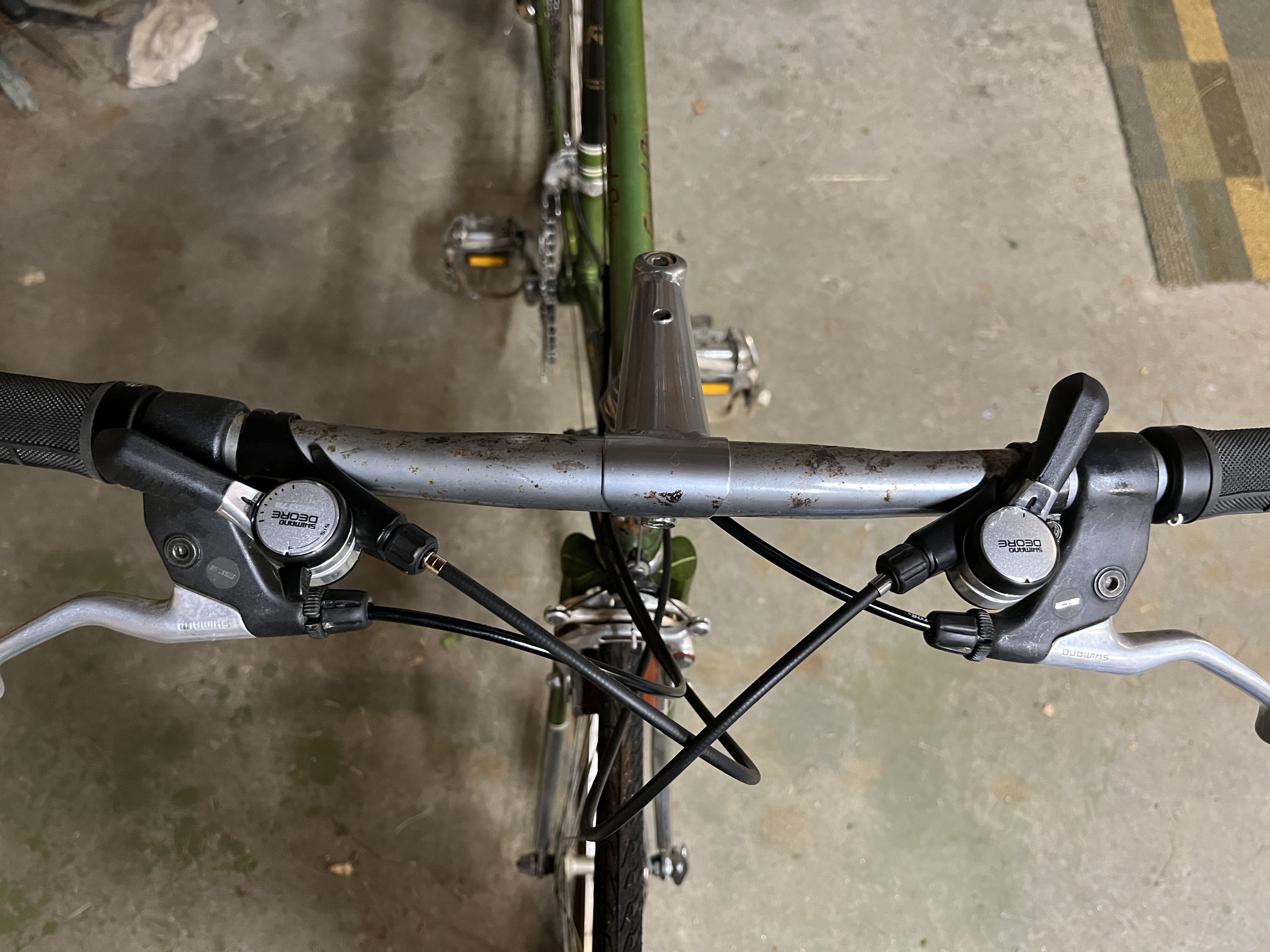
The frame was designed for 27-inch wheels. I had a set left over from a touring build in 1980, complete with 6-speed 13-28 freewheel. The drop bars were coming off, in favor of flat bars. Drop bars are better for longer distance, but then I’d need primary and interrupter brake levers, and lots of other refinements that would take too much time. I was retaining a lot of things on the bike that I would have discarded for a fixed gear build. A fixed gear conversion is more of an unbuild.

Accepting the 42-52 steel cottered crank, the low gear is 42-28. Delaware is flat, right? I should be able to run those chainrings with a 13-18 corncob. But that’s poor gearing for leisurely exploring.

Wilmington is in the mountains of northern Delaware. That 42-28 is none too low.

Thinking I was home free, I put 1 1/8 tires on the wheels and slapped them in. That’s when I discovered that the fork was a little bent, and the front brake for some reason didn’t quite reach the rim. I was out of time, so I needed to solve this with parts on hand.

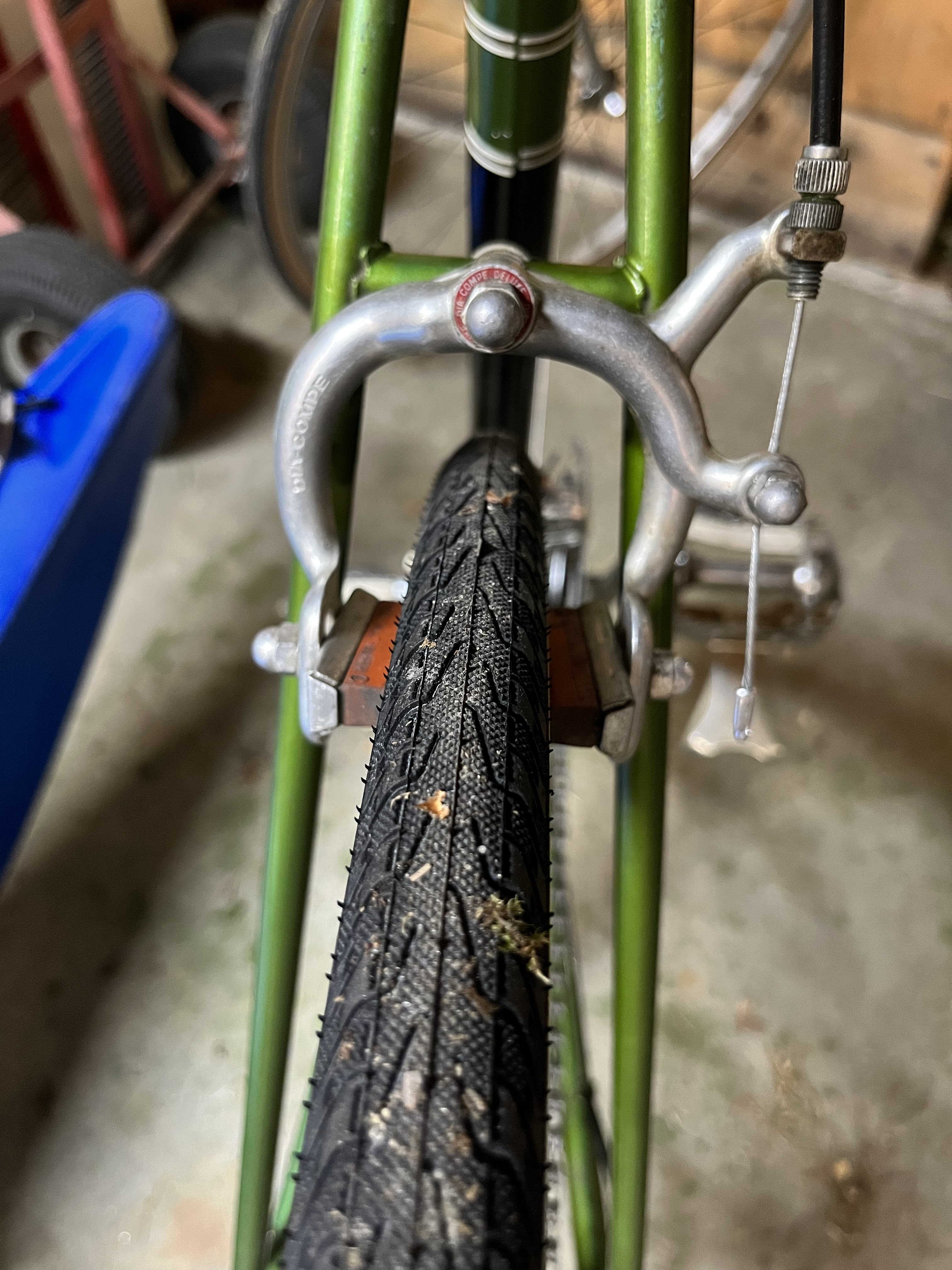
I had a long reach side pull brake, but it had a rear center bolt. However, center bolts are easy to swap on center pull brakes, so I moved the original rear center pull to the front and put the side pull on the rear. I’d straightened the fork ends adequately, so the wheel sat straight. The bike was ready to ride with 18 hours before we hit the road.


This Simplex front derailleur was one of the first upgrades I ever bought for my first road bike in 1975.

This slightly worn and probably slightly bent 1990s derailleur is totally fine to shift in friction.
The whole mess is controlled from this circa 1991 mountain bike dashboard.

The bike will return to the lab in the winter for refinements and upgrades, but nothing too fancy. Meanwhile, it met the urgent need.


Tuesday, June 14, 2022

Wood and oil: Things you purchase, just to burn

The first installment of firewood arrived at the end of May. My fun day off activities centered around getting it stacked in shelter so that I can call for the next load as soon as possible, before the price goes up again. It's a tedious chore, but it's part of the price of freedom from fossil fuel dependency.

This year, the direct link between fossil fuel prices and firewood prices has been highlighted. My wood supplier called to say that she had some stuff I could get now that was already expensive, but that any later loads would be subject to price increases because of the soaring cost of the petroleum distillates used in the trucks, heavy equipment, and chainsaws of the cutters and transporters of the "renewable resource" from the forest. This first batch reflected a 20 percent jump in the per-cord price over what I'd been paying for the past three years. The greener wood to follow will be worse.

This house started out as something not as rustic as a cabin, as quaint as a cottage, or as rudimentary as a hut. It was a square little box with walls a little too thin for the climate, but an interior volume about like a large packing crate, so it heated readily from a wood stove plunked in the center of its large open space that was kitchen at one end and living room at the other. We later moved the hot iron box to the basement, after we added a proper chimney and cut a hatch to make a ladder to that lower level.

The basic shelter evolved into something much larger. The newer parts are better insulated, but taller, so they're nowhere near as easy to heat. I spend a lot of time colder, wearing more layers indoors, than I did when I lived in the little box. The little old place didn't have enough room for studio space and an occasional guest. The bigger house evolved to make room for a cohabitant and a music school.

Way back in the mid 1970s I looked to a future of scarce and expensive petroleum and decided to limit my dependence as much as I could. I believed -- and still do -- that we can find a balance between the convenience and economic advantages of some degree of mass production and a cooperative energy grid, and a well-protected environment doing its job to support all life. So I didn't become a full homesteading hermit.

Back when gasoline and heating oil seemed like the primary expenses and pollutants that consumers had any choice about, riding a bike and heating with wood seemed like good strategies. And the bike remains unassailably virtuous. Any number really can play, and the world only gets better as the number of riders -- particularly transportational riders -- increases. The wood stove not so much. This adds to the toil of stacking the expensive chunks of tree, as I think about the evils of my carbon emissions and contributions to atmospheric particulates. I'll have to be even colder and wear more layers through the long gray months.

The design of the house lends itself to a seasonal division. I could shut off the tall back part, and barely heat it, only enough to keep the plumbing from freezing, or even drain that section, and live only in the low part. The tall part is actually helpful in the summer, because I can send heat up and out through the upper windows, drawing in cool air when it's available through the lower ones. It justifies its continued existence.

I'd go solar if I could, but I can't afford the initial investment. So I have to rely on small fires and heavy sweaters. I've been incredibly and undeservedly lucky in sidestepping some expenses for a number of years, but now some older bits of infrastructure look like they're crumbling. And the car is succumbing to its 19 years of New England road salt. So now I have to find something less decrepit, when we should all be weaning ourselves off of our default vehicles. It's hard to get enthused about going into debt for the rest of my life to pay for a vehicle that should have been phased out decades ago. Everyone has been focused on the price of gasoline and paid no attention to the cost of it.

Faced with winters that could bring only cold darkness or could bury us in feet of snow, I can't live without a motor vehicle as long as I live here. I'd be willing to try, but my winter job depends on our mobile society as it exists. I need other people to be able to drive to get here. Without winter tourism, I don't know what would keep the economy going until spring. Locals have a long history of catering to visitors and travelers to bring in extra cash. By the late 20th Century it was a primary source of income for a lot of them.

Loggers do a lot of work in winter, when wet areas are frozen solid, but there's only so many trees at any given time. Cut 'em all down now and you have to find something else to do for 30-50 years while you build up a new crop.

Back when New England was nearly deforested, more people farmed, but the soil was full of rocks, and the growing season was short. The soil is still full of rocks, and the growing season is still short. The air may warm, but the sun only shines for the same length of time that it always did. In mountainous terrain, cold dark hollows are cold dark hollows. Removal of trees only mildly enhances the exposure to sunlight. And the soil will still be uncooperative.

In my own little clearing, the sandy soil makes its way to the top, displacing organic matter. Some areas seem to grow grass and plants better than others, but those are mostly places I would prefer less lush, like the driveway. We've experimented with gardens a few times, but we'd need to push the trees back much further, and work constantly to maintain a good growing medium. It's made more sense to support local farms than to try to establish our own.

When the propane company finally sent out its budget plan for the coming season, the price of that had jumped 50 percent. Fifty percent. Half again as much every month to fill the tank. I've tended to reduce my usage year by year, but the cobbled-together heating system in the house depends on the propane heater to maintain a baseline. That baseline just dropped by about eight degrees. It's going to be a cold, dark winter.

What the hey. I moved here because I liked winter camping. Then I hardly camped because I didn't really have to, once I lived within easy day-trip range of all the fun stuff. And that's when I thought I could afford to do things for fun. Looks like I'll be living in a winter hut by default. On the plus side, the cellist will be safely lodged at her school-year job well south of here, except for her brief visits home.

The wood dealer hasn't come through with a price for the second installment of firewood. If the price stays high, I may be back to scavenging dead stuff from the forest and picking up scraps that fall along the roads. That was the basis for the humorous name for "the estate" when it was a tiny box in a patch of forest: Scavengewood. Now it's more like the drafty castle of broke nobility once the sun slides southward and leaves the northern hemisphere to pay is orbital dues to the implacable cold of the universe.