El Queso Grande had to solo one day while I was away. A repair and rental load that would have seemed ominously scanty when we had a full staff is more than enough to paralyze the shop with only one or two mechanics available, and only one of them very experienced. With El Queso Grande juggling all the chainsaws by himself, it looked to the untrained eye like a man barely finding time to open the cash register to stash away the shower of doubloons that must be coming from all these customers lined up at every door and counter.
Someone even said, "You must really be raking it in."
Bike shops are never raking it in. One nice young man with money to burn did buy an eleven thousand dollar road bike from us this summer, but that was one guy, one bike, one time. The average bike sells for maybe $400, with a clear profit of less than $100, after you extract overhead expenses. Probably closer to $10. Bigger shops are just making more of those average sales, with correspondingly higher overhead expenses. They might also sell more of the higher end bikes, but probably not a lot of the $11,000 variety. And more expensive bikes require lots more diligence, skill, and experience to assemble correctly and tune precisely enough to satisfy a customer who has dropped anywhere from $1,500 to $4,000 for what is now a mid-range or barely high-end bike. It still seems like a lot of money to most of us, even if the steady march of generational inflation has made it worth less.
Because of our short staff, we have had to turn work away. This is the first time since I started there 30 years ago that I have seen the management say we just couldn't do something. We've always tried to cram it in. Granted, it's partly because they've realized -- belatedly -- that life itself is more valuable than money, and that they have to get out of the shop to enjoy that life, but it's also because business itself is now so scanty that we couldn't afford staff even if we could find any. We have to make do with our own selves, and the couple of welcome fill-in people who will work specific days. And one of them just got a real job, coaching cross-country running and cross-country skiing at Clarkson University. His last day was Sunday.
When the rush of business ends, it dumps us into a weird solitude. The town still looks pretty much the same. The late summer sun spreads its golden light over the waters that are still warm, the green trees abuzz with cicadas. But no one jockeys for parking. No crawling, baking parade of motor vehicles inches through Main Street. No throng of pedestrians spreads out in all directions from the center of town. No money comes into the cash register. Because summer has shrunk to Fourth of July weekend and the first three weeks of August, that's it for major earning potential. Foliage tourism has dwindled significantly since the 1990s. Winter tourism for us depends on good natural conditions, which have become even more unreliable than New England's schizophrenic weather already was.
The changing climate and polluted world have led to such things as algae blooms that will kill your dog if it swims in an infected lake or pond, and a surge in tick-borne illnesses. El Queso Grande got anaplasmosis this summer, on top of his other challenges. In our country's asinine treasure hunt of a medical system, that entailed driving to labs "in his network" that he can also afford. That really cuts into the "raking it in." And that was after his carpal tunnel and cubital tunnel surgery: more overhead expenses related to remaining alive.
Showing posts with label August. Show all posts
Showing posts with label August. Show all posts
Tuesday, August 20, 2019


Summer is not a bell curve
Summer seemed to arrive sooner and last longer around here 20 years ago. It seemed to crank up at Memorial Day and go pretty steadily until Labor Day, with some peaks and valleys, but all on a pretty high plateau. Whatever has contributed to the decline, the shape has been distinctly different since shortly after the turn of the century.
Summer now is Fourth of July weekend, and August. Depending on the year, July might stay a bit active, but August is as close to crazy as we ever get anymore.
This summer, I left for a vacation trip at just about the worst possible time. Because the cellist has limited time at home with her out-of-state employment, we had to schedule the trip when she had the chance. I knew it would put me on the long-term shit list with my employer, but the cellist has limited time in more ways than one. I spend most of my time disappointing someone. I just have to choose who it will be. So I returned from the trip feeling like the guy who sneaked out of the Alamo before things got really bad, to hit the saloon and brothel. In reality my goals were more lofty than that, but the siege mentality of a small shop with inadequate staff leads to high stress and exaggerated emotions.
Because so many schools go back in session before summer technically ends, the crowds should drop right off this week. Because some schools are making a point to start after Labor Day, we might see more residual activity in this period of tapering. After Labor Day we'll get the early September rush of people who make a point to take vacation after the crowds are gone, when hospitality businesses might be offering discounted rates. That's what I used to do, decades ago, when I took vacations.
Has summer travel always been a business? Back 12,000 years ago, or even just three or four centuries, did seasonal travelers interact with fixed populations in ways similar to the economic exploitation of today? Exploitation sounds like price gouging, but it isn't always. It's just a matter of harvesting a resource when the resource is available. I've used the metaphor of hunting migratory herds to describe our handling of regular cycles of tourist business. We don't actually kill and eat them, and wear their hides -- except perhaps in some of the more remote hollows of the mountains -- but we extract as much as we can from them when they're here, knowing that they will be gone in a few weeks.
Summer now is Fourth of July weekend, and August. Depending on the year, July might stay a bit active, but August is as close to crazy as we ever get anymore.
This summer, I left for a vacation trip at just about the worst possible time. Because the cellist has limited time at home with her out-of-state employment, we had to schedule the trip when she had the chance. I knew it would put me on the long-term shit list with my employer, but the cellist has limited time in more ways than one. I spend most of my time disappointing someone. I just have to choose who it will be. So I returned from the trip feeling like the guy who sneaked out of the Alamo before things got really bad, to hit the saloon and brothel. In reality my goals were more lofty than that, but the siege mentality of a small shop with inadequate staff leads to high stress and exaggerated emotions.
Because so many schools go back in session before summer technically ends, the crowds should drop right off this week. Because some schools are making a point to start after Labor Day, we might see more residual activity in this period of tapering. After Labor Day we'll get the early September rush of people who make a point to take vacation after the crowds are gone, when hospitality businesses might be offering discounted rates. That's what I used to do, decades ago, when I took vacations.
Has summer travel always been a business? Back 12,000 years ago, or even just three or four centuries, did seasonal travelers interact with fixed populations in ways similar to the economic exploitation of today? Exploitation sounds like price gouging, but it isn't always. It's just a matter of harvesting a resource when the resource is available. I've used the metaphor of hunting migratory herds to describe our handling of regular cycles of tourist business. We don't actually kill and eat them, and wear their hides -- except perhaps in some of the more remote hollows of the mountains -- but we extract as much as we can from them when they're here, knowing that they will be gone in a few weeks.
Thursday, August 10, 2017
Why Mechanics Drink
When I arrived at work yesterday, there were about 15 bikes in the repair queue. We checked in a new one about every 20 minutes for the rest of the day, leaving us more buried at closing time than we were at opening.


Anyone who wants to blurt that it's great to be busy should try being force fed.
Highlights from the past couple of weeks include:

This rider wanted to sit up higher, so he raised his threadless stem and left this gap. Front end noise? What front end noise?

The upper bolt is clearly completely above the top of the steerer tube. Let's go trail riding!
When a roadie complains about funky shifting, the answer is frequently within:

Internal cable routing has turned a routine task into a time-consuming chore. Thanks, Bike Industry!
The new fashion for routing the shift cables under the bar tape has not eliminated the problem of cables fraying inside the shifter.

Shi-no has made access to the mess a little easier, reducing the chances that leftover fragments will jam an expensive mechanism permanently, but I did find pieces of an old cable inside a brifter that I was servicing. They had been in there from a previous break. That explained the intermittent crunching and imprecision.

OEM cables all seem to come with this bullshit coating on them. It quickly scrubs up into lint balls inside the undersized 4mm cable housing that the industry is trying very hard to turn into an inescapable standard. Many high end bikes won't accommodate an upgrade to 5mm.

Here's what came out of this brifter: potential Strands of Death, plus wads of scuffed-up coating. Thanks, Bike Industry!
Someone thought it would be a good idea to shove a stack of cable doughnuts onto the shift wires inside the sleek, black Trek in which I spent close to an hour spelunking. You have to run your guide tubing up the old cable, if it's still there and not too frayed. Otherwise you do a lot of blind fishing to get cables to feed. And hurry up! Someone's waiting to have a flat tire fixed immediately, and six people are renting bikes.

Hire more staff, you say? I'm writing this in stolen minutes before scampering off to work, so I don't have time to explain the particular economy of scale that keeps us from heeding that logical suggestion.

People don't need us until they need us. Then they need us right away. This customer bought this bike on line and assembled it at home. Hey! The left crank arm fell off! Is it supposed to do that? Gosh, between on line sales and You Tube experts, why does anybody need a bike shop anyway?

The forced adoption of disc brakes brings its own time-sucking extra steps. On bikes with adjustable bearings, the rotor bolts almost always block the wrench flats on the inner cone. The mechanic can try wiggling a worn cone wrench in there at a slight angle, or remove the rotor, complete the proper adjustment, and reinstall the rotor. Or, as most likely happens, fudge it in some way and send it down the road.
Yesterday, parts had finally come in for yet another improvised ride that some kid had bought used. The parts, individually, had at one time been decent, but the way in which they had been combined, and some of them mangled, left me zigzagging through the underbrush in search of a path forward that was safe and reasonably priced.

It had obviously been built by someone with only the beginning of an idea how things go together, who pummeled it for a while and then scraped it off on its current owner. Its problems can be summed up nicely by the fact that the crank arms were two different brands and two different lengths.
Looking through the archives for component compatibility information, I found this piece of copy editing I did in 1998 or '99:
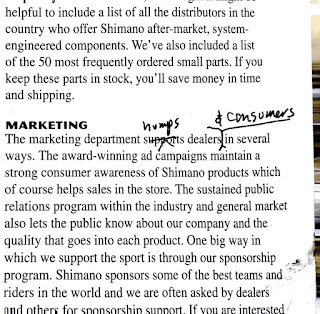
Looking through the archives for component compatibility information, I found this piece of copy editing I did in 1998 or '99:

The pile awaits. I have to rip out of here and go burrow into it again. Grease be with you.
Subscribe to:
Comments (Atom)