Showing posts with label evolution. Show all posts

Saturday, July 12, 2025

E-bikes will kill the bike industry as we know it

 We're witnessing the beginning of an evolutionary shift in the bike industry and in popular bike usage. Where people used to talk about the dangers of riding on the streets, now they talk about the dangers of sharing the sidewalk with numbnuts on e-bikes. But that's not what will kill the bike industry. The sheer ease of riding a smokeless moped, combined with the popular misconception that you can neglect them they way you used to neglect your meat-powered bike, have driven sales at a phenomenal rate.

In our shop just this year, a few callers asking about bikes we carry have asked about gravel bikes, and dozens have asked about e-bikes. Then we've had a smattering of calls for kids' bikes. Maybe one or two for technical mountain bikes. Repair business is steady, but it's only enough to overload our understaffing. If we had one more mechanic we would worry about paying them. General retail, mostly clothing, used to cover a lot, but those sales are flat, too.

Yesterday I was working on the firewood piled in my driveway when I heard the buzzing of tires on the road out front. Two riders on fat-tire e-bikes blazed past at full throttle, pulling close to 30 miles per hour. Bareheaded, in shorts and tee shirts, they flashed past, headed north. The only sound was their buzzing tires and Dopplered conversation. Nothing could go wrong. They were only riding bikes after all.

In more congested traffic situations, grim accidents are piling up, but only grumpy outside observers blame the bikes themselves. Guns don't kill people. People kill people. E-bikes don't cause crashes. Unprepared riders on e-bikes cause crashes.

Yes, the mass and speed of the bikes make the crashes worse, but they only combine with the lack of street smarts among the riders.  Bad riding habits lead to more dangerous situations. The motor assistance just makes it easier to get there. People will ride the e-bike who would never consider riding the rapids of a busy street on a bike powered entirely by themselves.

I see riders on e-bikes on the street below the backshop windows. Most of them have bikes with a throttle option, which appears to be their default. Looking across the bay toward the train station where the rail trail terminates, I can see many other moped riders. They jet up effortlessly to a cruising speed a purely pedaling rider would train hard to achieve and maintain.

I pull out of my driveway and warm up at maybe 10-12 miles per hour. The smokeless moped rider hops on and spurts away at 20. Who would put up with the snail's pace of a bike without a motor? What do they gain in the short run by giving up the power assist? There is no long run. People flit from place to place and thought to thought. If the bike is cheap transportation, and a few dollars more gets a faster machine requiring less effort, who will bother to work harder?

Demand for bicycles was already falling fast as the 21st Century began. The decline accelerated, with only a brief plateau when 2020 brought a surge of demand coinciding with a dearth of supply. The bike industry was struggling after its profitable bender through the 1990s. E-bikes will end up being a bigger category than mountain bikes were at their height, but the profits won't go to traditional bike companies unless they seriously retool into motor vehicle companies. How much money will be left over for the far less popular non-motorized bikes?

Legend has it that bike manufacturers in the 1880s and '90s were surprised by the high level of demand from working class people to buy what were considered luxury items. The manufacturers hadn't recognized yet that they had created a revolutionary transportation device that needed very little maintenance for the amount of mobility it provided to people formerly limited only to shoe leather. The same calculation drives the market in e-bikes now.

Change happens faster and faster in the technological world, but pedal-powered bikes won't disappear overnight. Especially if laws and regulations restrict the age of riders on motorized bikes, pedal power will remain the child's first experience on a two-wheeler. However, I have already had to deal with motorized balance bikes for a couple of richie rich little kids whose parents want them to have the latest greatest thing. On private property, anything goes. Buy your 12-year-old a Lamborghini and let them blaze around your private race track. Meanwhile, out in the slums, kids may have to settle for the time-honored ritual of learning to wobble along under their own power until they're old enough to get a real grownup vehicle that doesn't require them to sweat.

My parents, and other adults born between the world wars, recount their experiences riding bikes. Very few people carried the habit into adulthood in the United States. In the 1950s and '60s, the bike was just a step on the way to becoming a driver. You could even buy an accessory for your bike that looked like a motor and made varoom noises. No one knows what the future holds for our species. Maybe we cover the planet with our sprawling cities, through which we dart on our motorized little bikes. The only wide-open spaces will be the ones utterly inhospitable to life. Nature will consist of cockroaches, rats, bacteria, and viruses. So will our diet.

Sunday, April 25, 2021

The benefits of neglect and obscurity

 Being forgotten by the technological world for decades was one of the best things to happen to bicycling. The machinery evolved very slowly, which made bicycles a reliable device and a reassuring piece of stability in a changing world.

 When I started paying attention, in the mid 1970s, no one seemed to be clamoring for space-age advancements. Kids born in the 1950s received their bikes as something their parents had received in almost the same form. Some kids born even later received the same actual bikes. My older brother wanted an "English racer" three-speed because our family had been introduced to the works of Arthur Ransome as soon as we were old enough to read. The characters in those books, when they weren't on the water, were likely to be getting around the English countryside on classic black bikes that you could still buy at a shop near you in the 1960s. Much might change in the world, but bikes were your living connection to history. Not only that, they worked perfectly well as personal transportation.

When the "ten speed" came on the scene, it didn't strike me as a wild new concept, only a more advanced existing concept of which I had been previously unaware. It also seemed like risky magic to encourage your chain to jump off the sprockets, after all my years when chains popping off was a greasy nuisance. I was very slow to adopt. However, as with other vices from which I initially shied, I embraced this one emphatically when I was finally corrupted by the right exposure. Indeed, the derailleur had existed in the form we would recognize for almost as long as Arthur Ransome's children's books. Whatever prompted the 1970s bike boom merely thrust it into the American public's eye, somewhat the same way cross-country skiing became the cool new thing around the same time.

Bikes through the 1980s -- meaning mostly road bikes -- had an aesthetic that seemed to span the 20th Century. Steel frames held together with lugged joints might have elaborate curlicues and cutouts or showcase the precision of smooth spear points, but at a distance the general configuration would convey instantly the bike's purpose and connect it to its heritage. By the 1990s, essayists like Maynard Hershon might gripe about its "19th Century" technology, but the stuff still works.

Check out some of the details on this Richard Sachs. The bike's owner is the real deal. She's been touring on it since she bought it new in the early 1980s (or earlier).

These cutouts are on the inside of the fork. 

Downtube friction shifters pull the derailleur across  a five-speed freewheel.

The rear wheel sits in long horizontal dropouts. This allows for all sorts of modifications and improvisations that you can't do with VD (vertical dropouts).


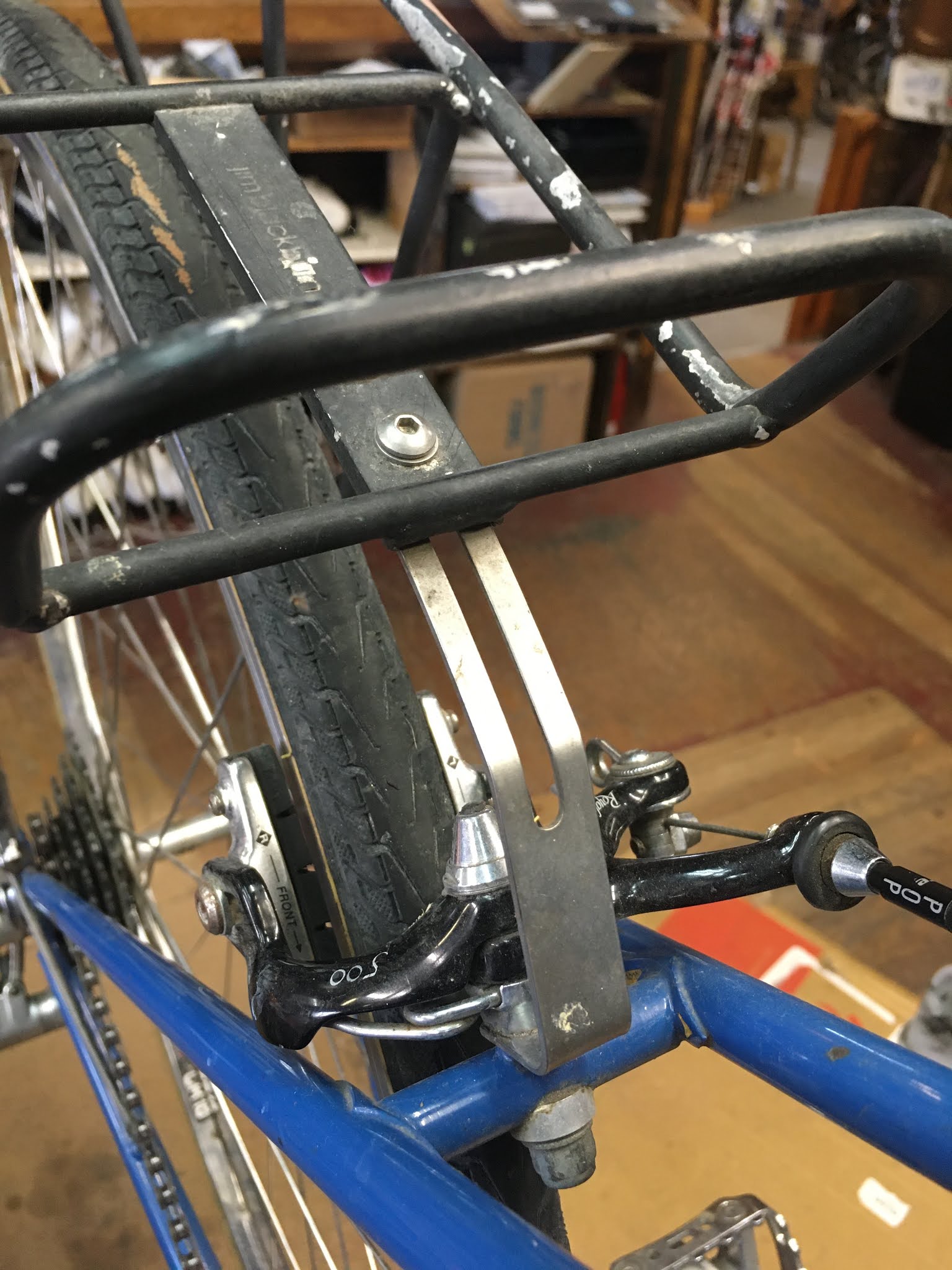
 Check out the original Blackburn rack from when the original Blackburn guy still had anything to do with the original small company by the same name.

Even the saddle is original.

I wore out several Avocet saddles until you couldn't get them anymore. I know she's logged some serious miles, but she probably hasn't crashed as much as I did, and perhaps has a smoother style. Her gearing is realistically low for a load-carrying bike.

The cam on these Gran Compe brakes actually opens up wide enough to get the tire through the brake pads, unlike the token range of much newer -- and not cheap -- offerings here in the dying days of the Age of Rim Brakes.

Old plastic Silca frame pumps tend to crack at the threads. You can repair a minor crack by wrapping the barrel with filament tape. This pump has that repair. I don't know how much she's had to use it in that condition. I finally gave up on mine and got a Lezyne mini pump.

Before the Sachs I had a bike called a Sketchy on the stand. In a color strikingly similar to Surly's "Beef Gravy Brown," which was one of the Cross Check colors around 2011, this bike was apparently a hip item around that time. Made of lighter weight, more upscale tubing, it completely lacks the touches that make the Cross Check such a great basic platform on which to build a wide variety of bikes, such as the above-mentioned long horizontal dropouts. The Sketchy had VD, and shapely but highly inefficient curvaceous chainstays that would completely prevent the use of fenders with plump tires.


What's a nine-letter (two-word) phrase meaning "overrated?"

Until FSA got rid of the needle bearing version of the Orbit UF headset, that was the answer, at a tiny fraction of the cost, to the issues that the CK headset purports to fix. The CKs are serviceable, but what a pain in the ass to get in there, just to have ball bearings  -- albeit in a sealed cartridge -- anyway. Tapered roller bearings were the best for headsets, which is probably why they disappear almost as quickly as they appear when a company offers them. The Orbit UF stayed on the market for several years before they went on the angular contact bandwagon. So they're still a good deal for the price, but not as good a deal.

Despite its unfortunate modernist touches, the Sketchy at least used a steel frame with basically round tubes. The aesthetic is not at all classical. It doesn't look like art, the way lugged frames did. The Cross Check has a welded fame, but the dropouts have a classic shape, and the forks have an external crown that gives them a classic look as well. The Sketchy fork looks like an old suspension bridge tower. It's kind of cool in its way, but it looks heavy.

The bike business seems to be able to support a number of limited-edition boutique builders who do their thing for a while and then move on. As long as they build to fit off-the-shelf componentry, you can keep the frame going almost indefinitely. Whatever it is, if it works for you, it's a good bike. 

This old Manitou fork showed really bold marketing in naming a new model (at the time) for what planned obsolescence would soon turn it into:

As we charge forward into the battery-powered future, a category called "hunting bikes" is on the rise. Camouflaged smokeless mopeds are becoming a popular vehicle for some hunters to use to get into the woods and fields in pursuit of their quarry. Back in the 1990s we had a customer or two who embraced the mountain bike as a silent approach vehicle for hunting, because they were quieter than ATVs and didn't produce stinky exhaust. But you had to be willing and able to pedal. Now a wider range of hunter can take advantage of not only pedal assistance but also pure motor power on some models. They're being sold through hunting and fishing stores, assembled by people who may not have a lot of familiarity with the basics of bike mechanics. Or the customer might have bought it online and had to assemble it themselves. Such was the case with this behemoth:

What have we gained by junking reliable simplicity? I still prepare for hostility and negligence before every time I venture out on the roads. This is true even in a car. Are the few riders retained or recruited by electric motors or enticed by technological ephemera enough to offset the general loss of people who don't grow up with bicycles as a normal part of their life, with the option to continue into adulthood?

Bike categories have forever altered the concept of what is possible under pedal power. Mountain bikes started out as just bikes. Modification piled onto modification in rapid evolution, but it was only the same process by which bicycles had developed from the beginning: largely trial and error. Only when the type was firmly established did the engineers really focus on seriously designing the machines of today.

As for the road, the demand for technology is more driven by fashion than function. Shifting systems since the onset of indexing have increased precision when they work, but also increased the demand for precision in their construction and adjustment. Road riding could still thrive if all of that went away, just as road riding could thrive if disc brakes went away, along with carbon fiber frames and 52 different bottom bracket standards. Mountain biking, on the other hand, is entirely dependent on its suspension technology and gearing systems to make the preferred style of riding possible. Some mavericks might sing the praises of a hardtail versus full suspension, but almost no one -- and perhaps no one at all -- is extolling the virtues of a fully rigid frame and fork. Fully rigid bikes have been relegated to another category, like bikepacking, in which they are still the weirder option, or fat bikes, which have always been a weird option.

Millions of riders logged millions of miles before there were through-axles, disc brakes, electronic shifters, and 1X drivetrains dragging tinfoil chains across 12 cogs (or more) spanning a range from 10 or 11 to 52 teeth. Some things could safely be rolled back and advanced along different lines with only gains for the riding public.

Monday, December 17, 2018

Evolution is a popularity contest

When you walk into a store or other public place that has music playing over a sound system, you have to listen to it. You may be distracted enough not to notice it consciously, or you may find it inescapably intrusive. Or you might even enjoy it. And it changes you. Like it or not, because the popular hits soundtrack is so ubiquitous, you will have songs that autoplay in your head when you hear the first three notes. Regardless, you have to go through the experience with everyone else in that environment, because someone, somewhere, determined that music in public places was the more popular choice.

Think of the mass of humanity's environmental and social choices the same way. If everyone else set themselves on fire, would you set yourself on fire? You might prefer not to, but you will still have to breathe in the stench of charring flesh. And one or more of the happy incendiaries might careen into you and set you ablaze against your wishes.

In the USA, some percentage of people are unquestionably law abiding, and another percentage are automatically resistant to, and defiant of, any authority. In between lies the greatest number, fluctuating between the poles of obedience and defiance as they analyze each situation they happen to notice. A lot of us are oblivious to larger implications most of the time. Back in the late 1970s and early 1980s, when we should have been paying attention to the first bits of debris leading up to the avalanche of deferred consequences our species now faces, the Baby Boomers were focused instead on the basics of life: finding paying work, establishing homes, reproducing. Even the politically savvy tended mostly to view it from a personal perspective, multiplied through an uncounted legion of their theoretical allies who would all benefit if a particular policy made things better for one of them. It's hard to imagine a life very different from one's own. You really have to go try it out. Even the most detailed book or movie can't drag you right in and trap you in it. Interactive video games may come close. I don't know, because I have never tried one. As detailed as they may be, every single thing that happens in one was created by the mind of someone else and is known to them.

Believers in an almighty deity say that the simulation we think of as real life is also the product of a creator to whom everything is known. That really takes the fun out of it. I see how the notion can be comforting, but it's also limiting in more ways than moral strictures and mandatory rituals.

Now that the Teachable Moment has come, environmentally, we find that a substantial portion of the class wants to act up. Look at the scorn and ridicule that greeted California's plastic straw ban. Read the back -- and sometimes all sides -- of a truck or van belonging to a really jacked-up paranoid who sees threats to sacred liberty in every admonition to throttle back and lighten up. You won't have to wait long to see some sentiment that will make you want to retire to a cave and live with the few surviving animals.

In the 1980s I had the same vision that I have today: we could use the grid for good as much as ill. Convenience is not a sin. But conveniences required adjustment to keep them from becoming the engines of global destruction that they eventually did. And eventually was pretty rapidly, because moderation was scorned and ridiculed.

The slogan in the 1980s was "Whoever dies with the most toys wins." It was the golden age of the loaded roof rack, when Yakima and Thule products on the roof of your increasingly large vehicle needed to be locked securely. More than once we heard from friends who had made a day or evening jaunt into a city, only to find their roof rack stripped of every unlocked accessory. We were Recreation Nation, and anything related to the popular activities had really good street value. My attempt to steer that behemoth hinged on trying, through my published writings and in my day jobs, at least to get more people thinking about doing it without internal combustion. Try to get an appreciation of nature to sneak up on them, because Americans -- and probably most humans -- are very resistant to confrontational change. We love confrontation, but only to demonstrate how we can stick to our original position until it kills us. Think of the Confederacy.

I'm approaching a deadline for my quarterly environmental cartoon. The cartoon has been increasingly hard to draw because so many great causes make poor subjects for a single panel image. And I have realized the uselessness of mockery. Humor will only work on someone already inclined to agree with it. The inclination may be deeply buried, unknown to its owner, but it has to be there. Are the few who seem to be awakened worth the stiffened resolve of the outraged opposition?

I don't mind preaching to the choir. It keeps morale up. But nothing seems funny. The extent of the problems that begin with simple individual choices and multiply instantly to a global epidemic, like air pollution or the proliferation of plastic is better served by animation and real video, compressing the sequence of events into a much more visceral revelation of the ugly truth.

One of the hardest things to get used to when you're out there riding a bike and trying to live a low impact life is finding out how many people hate you for it and think you should die. It doesn't have to be the majority. You only have to encounter one homicidal jerk. That's true whether you get tagged by a hit and run driver or you happen to be at the mall the day one of them shows up and opens fire.

Less dramatic and more deadly is the steady accumulation of pollution and degradation by one individual at a time, repeated across a global population in the billions. The system that has evolved funnels gains to a small number of dominant apes, requiring that the lesser apes -- regardless of good intentions -- play some form of the game just to survive. The lifestyle is as inescapable as the music in a department store. It touches every place on this small planet. "Pristine" places are not pure because they are out of reach. We could strip mine the Himalaya, and eventually we probably will.

Tuesday, September 11, 2018

Sensitivity Training

Still mulling over last Saturday's slapstick comedy in the parking lot.

Because human evolution has been physically invisible for longer than we've even had a name for it, we have to think about what we're doing and why we're doing it instead of just doing it. Not only do we have lots of instinctual behavior, we have philosophies attached to it and reflexive behavior taught to us to further complicate the candor of our reactions. And we haven't even figured out where our instinctive promptings reside. Some of us have mental and emotional images that don't match their physical bodies. Even the big fat blob in the middle of most bell curves has its own curves that make up that very average average. How much of what feels instinctive now is attached to physical brain and neural structures, and genetic coding, that could in time disappear? I don't mean a lifetime. I mean thousands of years, if we don't manage to annihilate our species well before then.

Say, on the other hand, that we have stalled physically, and all further evolution will have to continue to be philosophical. That makes all of it optional, especially as it pertains to personal freedom and interpersonal respect.

For behavior to be deemed improper, society must have standards of propriety. As we fumble our way toward a genuine respect for women, we come up against instinctive promptings that are a source of both outrage and comedy. We could always laugh at our instincts. The outrage is much newer, even if it is long, long overdue. Right now we've begun overthinking it as we begin to compensate for thousands of years of underthinking it.

"Trust your instincts" is some of the worst advice imaginable.

Question normality. You may affirm it, but make it justify itself. To tangle you up even more, never forget that it's your own brain analyzing your own brain. It's enough to make you say "screw it," and do what feels like it comes naturally. Let the audience decide.

While I joke that my recoil was prompted by the admonition to avoid uninvited physical contact with someone of the opposite sex, I also don't particularly like to grab onto people at all. I'll take it from my huggy friends, but it's not my first impulse. And I'm so accustomed to falling in various contexts without anyone there to catch me or help squeegee me up afterwards, I actually forget what it's like to be in a mutually dependent group. I vaguely recall that it could be nice. But it went away. It's too easy to fall into habits of isolation. Even when I'm with people I have this weird sense of looking at them from a distance, or through a screen. Oh wait, this is real? Oops.

Even at work, I spend most of my time working individually on the gratuitous complexities of machines that their own inventors don't even seem to understand. The longest conversations I have except on the day when I have another mechanic in the backshop are with my cats. It has its good points, but certainly a down side as well.

Sunday, July 08, 2018

Prehistoric

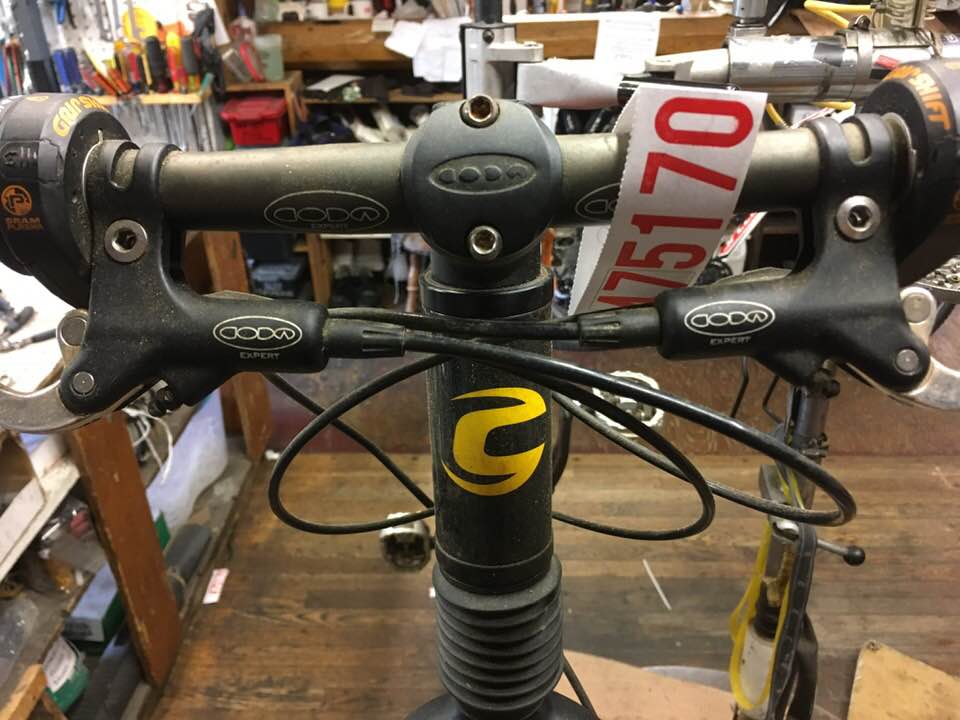
When bikes like this Cannondale come in, I feel like a veterinarian in Jurassic Park:
Early versions of a new phase of technology automatically look primitive and weird, like the bones of a giant sloth. As the bike industry moved aggressively toward disc brakes and a full commitment to suspension, each of their experiments looked futuristic for about a week. Once a format settles down, the changes become more subtle. All high end bikes are on a conveyor belt of obsolescence, but the critical differences are easier to overlook until you need to fix something.


Cannondale liked to invent their own stuff. Their technical curiosity is laudable, even if their results might not have been. To boldly go where no one has gone before...except for several other innovators who did it better. But beyond one company's specific early mutations, the products of the entire era are more abandoned than the the more settled technology of 1970s ten-speeds. Companies vied for control of the market with implications of exclusivity. For instance, the Coda brake fluid bottle calls it  a race-proven synthetic blend. They don't say whether it is glycol or mineral oil, implying that it could be some third thing that you can only get from them. Years later, the mechanic trying to decide which juice and bleed kit to use gets no help from the label. Forum posts on line indicate that it's mineral oil. Fortunately, I did not have to bleed them. Chasing air bubbles is a finicky, fiddly, time-eating task.

The rotors are held on the hubs with only four bolts. Good luck finding parts for that.

The crank has an aftermarket bash guard, an accessory that came and went and came again.
Crank manufacturers have embraced the concept now, so they are common. The crank shown here also exhibits the five-bolt, 58-94 BCD that was briefly everywhere, and now is almost nowhere.

This bike was over the threshold of the new age, but only barely. The equipment has evolved as mountain biking has split into subcategories. From a common ancestor, the genus has spawned numerous species. Each one requires habitat in which to flourish, and riders with money on which to feed.