Showing posts with label disc brakes. Show all posts

Wednesday, January 07, 2026

Parts replacement versus "mechanicking" again

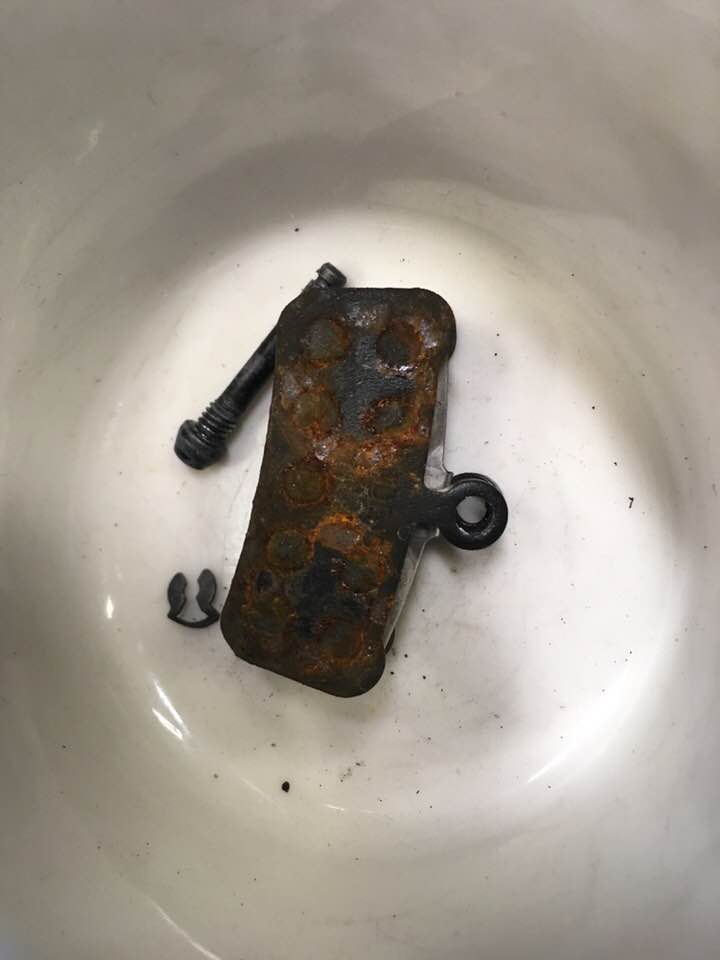
 A rider brought in his fat bike because he had accidentally burped out one of the caliper pistons in the SRAM G2 Ultimate front brake. So it's a four-piston caliper with three stuck, one on the floor, and no juice left in it.

I figured I had one shot to do it economically with what he had: reinsert the rogue piston, juice the system with fluid I didn't mind losing, and use the usual pressure tactics to dislodge the other pistons. This meant trying to do at least a semi-effective fill and bleed to get any kind of pressure from the lever.

The procedure failed because the piston seals for the runaway were too damaged to hold the fluid. It gooshed out around the piston too quickly to impart any force on the remaining pistons. There is no back door way to get those bastards out of there. I can reassemble and keep trying, or troll through YouTube videos, but the shop's hour costs about $80.

This is yet another example of how the industry and its technolemming devotees have set themselves up for ever more expensive repairs for the sake of taking a bike ride.

One more time with the old chorus: Mountain biking started out as relatively cheap fun on beater bikes. Certain visionary riders saw that it could be so much more as long as money was no object. Money, and the precious life hours of mechanics who know better, but are stuck in this futuristic nightmare.

It fits right in with every other dystopian horror we're living through.

I've got one more thing I can try that might save this particular bacon before I report to him that he can tinker with it at his leisure or get a new caliper and start fresh. We'll see how it goes.

EDIT TWO HOURS LATER: The one more thing worked. It worked smoothly enough that it wasn't even too pricey, relatively speaking.

Friday, October 01, 2021

I'm not a doctor...

Stock photo: syringe shown is for mineral oil. Organic cotton mask by Graf Lantz. Not surgically approved.
 
Before I had to work with hydraulic brakes a lot, I didn't really know how to get the air out of a syringe correctly. When I would get an injection from a doctor, I didn't watch the procedure closely. Never stop learning! I'm not a doctor, but I play one in the workshop.

Yesterday's hydraulic fluid surgery had me rebuilding the lever and caliper of a SRAM Guide RS brake. Not only was the lever piston stuck in the characteristic way, but the caliper pistons were stuck. Water gets into the brake system in various ways. Oxidation and corrosion can follow. The glycol-based fluid SRAM uses absorbs water, so it is distributed evenly throughout the system. That reduces the effects of undiluted water pooling in a low spot, but does decrease braking power steadily, as the percentage of water increases and the boiling point of the fluid gets lower.

At least it was a front brake.

On the Lefty fork, you have to remove the brake caliper to unbolt the wheel from the axle. You should remove the wheel when working with brake fluid, to avoid contaminating the rotor. I was removing the whole brake anyway, because it had to be taken apart.

You can't start a job until the parts arrive, so that put me a bit behind schedule. The customer had hoped for the bike that day. It had been hanging in the shop for about a week, but we needed to get parts. They're lucky that the parts were available. Then nothing went according to the basic printed instructions or cheerful YouTube video tutorials, because every piston that needed to come out was jammed tightly in. I had to reassemble the caliper and put a spacer in, wrap the whole thing in a thick cushion of rags, and blast it with compressed air. That brought out three of the four pistons with varying degrees of willingness, but left one of them stubbornly buried. I had to reconfigure the spacer to hold the other pistons back a bit and leave space for the one holdout to expand into when it was finally willing. This took several tries.

The lever piston was also not responding. Compressed air doesn't help there, because the pressure vents into the upper reservoir of the lever rather than going full force against the recalcitrant piston. In that case, you can just clamp an old spoke in the vise, pointing straight up, insert it into the little hole where the brake line was connected, and tap the lever body down with a rubber mallet to dislodge the old piston. Feel free to damage that. It's not going back in. Just don't hit the lever body very hard with anything, and certainly not a metal hammer. Also be careful not to score the inside of the cylinder with the spoke end. It's pretty well guided by the size of the hole it's fed through, but if you get angry or frisky when hammering it could bend and give you worse problems than you already had. A scored cylinder will not seal, even if it just looks like a scratch. Hydraulic systems are very unforgiving.

After the tedious process of disassembly, the caliper halves and lever body need to be cleaned and inspected. Then all the new parts need to be installed cleanly and without excessive force. With the caliper pistons in particular, you're working blind once you go to shove the piston in, so you take it on faith that the seal stayed in place. There's quite a bit of resistance, because the seals have to hold sufficient pressure to stop a rider and bike going hell-bent down a rough slope. They're squared off and fit into a squared-off recess in the caliper half, but in a worst case you might fold one over partway. Once it's mangled, it's done.

The component on the bench never seems to look exactly like the examples in the manual. You have to determine whether the difference makes a difference. Are these the right instructions for this version of a component that may have been manufactured for a couple of years with the same model name and superficial appearance, but actually have critical differences inside that are not made obvious by any marking you can readily see? In that case, you may have ordered the wrong parts kit as well. The differences this time were not enough to stop the job.

Once the caliper was back together I had to assemble the lever. The current parts kit includes things that this old lever didn't use, but they were trivial. Still, getting a lively new piston in was fiddlier than getting the stuck old one out. The return spring on it fought hard against the insertion of a washer and spring clip that hold it in its proper position so that the little push rod on the cam that the lever actuates can do its thing, and all the magic juice stays in. You're working in the narrow interior of the lever body, to try to cram the spring clip at least far enough that you can coax it the rest of the way by pressing it with some object that gets it to snap into its little recess and properly engage. Except that it doesn't really snap, it just sort of stops and you have to keep peering in there with a light that you keep blocking with your own face as you try to align the light beam and your sight line to sort of confirm that you're pretty sure you've got it. That sums up almost all work on the most modern bike crap.

After successfully reassembling the whole brake, line and all, it was time to fill and bleed it. That's another fussy procedure that drips caustic brake fluid all over the place. Because it was a complete fill, there was a lot of air to chase out. The first go-round did not end with a firm lever feel. Because it always feels good on the bleed block you use to hold the caliper pistons back, you have to completely reinstall everything and test it with pads on the rotor to see if you've really got it. If not, the wheel comes out, the pads come out, the bleed block goes back in, you refill the syringes, hook everything up, perform the ritual again, and then reassemble to check, cleaning carefully as you go so that the brake fluid doesn't eat the paint on the bike or ruin the pads.

SRAM's instructions say to be sure to clean the brake fluid off of the lever and caliper, in part because the fluid's tendency to eat paint will remove the snazzy logos. Seriously? You guys have been working with this fluid -- by choice -- for how many years and you haven't come up with a way to apply the logos that's immune to it? Way to innovate.

It was well after official closing time when I left. It's bad luck to put any of the tools away when you're doing a brake bleed or a tubeless tire job until you're absolutely sure that it's a winner. I left the bike on the stand and the bleed kit strewn across the bench until I return today and make sure that no little air ninjas sneaked out of a crevice in the caliper.

Friday, July 17, 2020

Internal cable routing is better

Bike frames are built to withstand pedaling forces, cornering forces, and road shock. These all impact the structure in sort of broad, general ways. Cable forces put point loads on very small areas of the frame. They're not huge forces, but the strength required to hold up to them is quite different from the more distributed stress of being a bicycle. 

Internal cable routing may seem like a needlessly complicated answer to a relatively trivial problem of air drag -- because it is -- but it also strikes me as a better way to load the carbon fiber frame, compared to attaching external cable stops. Because I don't build my life around the latest technology, I may have missed a memo on this. I focus on the annoyance of working on things that I can't see and can't reach. Belatedly I realized that it's probably easier and stronger to make reinforced entry and exit holes than it is so attach external anchor points.

A few years ago, Specialized road bikes even came with instructions not to pull on the external cables to seat the housings as we would with metal frames with welded cable stops. The stops on these carbon frames could pop off if pulled outward. External stops on all carbon bikes displayed various ways to reinforce the bond, including little pop rivets.

It's still a pain in the ass. If it went away I would not miss it.

On metal frames, holes may be a liability. Back in the 1990s I found cracks in an aluminum Klein frame at the entry hole for an internally routed brake cable. Aluminum being aluminum, this represented a potentially terminal condition. There seemed to be no good way to stop the crack from spreading in the thin metal, at least not with the skills and equipment available in our shop. The owner seemed angry at us for finding it. But to know is to be responsible. We couldn't just let him ride on it without knowing his risk.

Not every shop agrees. A customer brought in a Dahon folding bike to get a flat tire fixed. He complained that he had taken the bike to a shop where he lives, to get tuned up and have the tubes replaced. The shop did the tuneup, but didn't do the tires. As he went on at some length, he mentioned that the other shop had told him there was a hairline crack in the head tube. Without explaining the dangers of abrupt catastrophic failure in aluminum, they took his money for the tuneup and told him to "keep an eye on it."

The bike had been fitted with a very tall stem riser, atop a very short head tube.
Leverage is an amazing thing. The "hairline" crack was not hard to find.
We refused to work on his bike and advised him to junk it. Considering that we left him with the flat tire, he wasn't likely to jump on it soon.

Next up was a brake bleed on a mountain bike. There are two kinds of bleed: the classic removal of air from the line, and the more medieval leeching of excess fluid when someone filled the system without resetting the pistons first, leading to hot-weather lockups. This bike only needed the latter, which was nice. But some idiot somewhere had cut the rear brake line so short that I don't know why the rider hasn't torn it loose just making a tight turn, or in a mild crash that yanks the bars around.

I could go on, but the morning is evaporating quickly, and a long queue of repairs is still piled up at work.

Thursday, September 19, 2019

A world of squish

Once again I spend a couple of hours chasing down weird issues in disc brakes.

The customer came in with his Giant Revolt gravel bike. He said that the brakes needed bleeding, especially the rear, because the lever was pulling right to the bar.

I squeezed it. It was pulling right down. But at the end it didn’t have the telltale squishy feeling of air in the system. It came to a sort of firm stop, as hydraulics go. I told him I thought that it probably just needed new pads.

When I pulled the old pads out, they were only about one-third gone. Because the bike uses Giant’s cable actuated master cylinder, to work with normal brifters, I thought maybe I could snug up the cable part of the system.

No such luck.

I had to root around on the internet for a real service manual. There are little screws all over this unit, so I wanted at least a sketch map to confirm where to attach the syringes full of mineral oil.

As always the configuration of the rear brake line makes it impossible to get a clean, rising line from caliper to master cylinder. I had already taken the bars out of the stem to get access to the cable anchor screws. That made it easy to turn them 90 degrees to the ground to orient the bleed port upwards. But the brake line itself serpentines down and under and around in ways that make the rising line approximate. I hoped it was good enough. Sometimes it is.

After doing the bleed two complete times, the lever feel was still no better. Screw it. I threw a set of pads in, and bingo.

Well, bingo-ish, anyway.  Because I never got to feel this bike in the flower of its youth, I have no way to know how it felt at its showroom best. I can tell you this much: almost every set of hydraulic brakes I have operated has felt squishy, even when the rider was perfectly happy with it. A mountain biker passing through this spring laughed when he felt a set of brakes that a noob complained were too soft. “They all feel like that!” he said. “Get used to it.”

The only hydraulic disc brakes that haven’t felt squishy have been overfilled and rock-like. They’ve needed to be bled down to get the pads to retract at all.

I’m really starting to hate them.

I’m also starting to hate Outside Magazine. Always the rag of egotistical vacationers, their increasing attempts to represent cycling expertise are oriented toward the hobbyist with disposable income and no resistance to technofascist propaganda. Because of all my searching for info on disc brakes, Google fed me this article on “Why you should throw your rim brakes in the trash.”  Hobbyist McMoneybags says that when he’s riding down a mountain pass in the rain, rim brakes don’t work at all on his carbon rims. Dude! I’ve found your problem! Use disc brakes on your tech-weenie wanker hoops. Preach to your well funded hobbyist buddies about what they really must have. But save your pronouncements about what should be the future of a once simple, durable, and highly user serviceable technology.

Tuesday, June 25, 2019

Just a technicality, followed by another technicality, followed by...

Shimano's latest mechanical shifting systems seem designed to make you hate mechanical shifting systems. Weird cable routing in the frames already made mechanical derailleurs an increasing nuisance. This style of front derailleur cable attachment puts another few solid spikes into the coffin lid. And it gives double value to current technofascist fashion, because it's not just an annoying cable, it's an annoying front derailleur cable. Front derailleurs? Why did we ever think those were cool?

The instructions for this style of derailleur are an 8-page PDF. That's simple and straightforward compared to the treasure hunt I went through later in the week looking for information about electronic shifting and hydraulic road disc brakes on a bike I was assembling. Bikes like that used to come with a few helpful hints and diagrams to help with componentry that is less and less intuitive all the time. Now most of the printed matter is just legal disclaimers and directions to "visit our website."

The front derailleur on this bike led me upstream to the R7000 front shifter. In yet another silent recall situation, these marvelously redesigned shifters are apparently hanging up, jamming intermittently on bikes that are new or nearly new. 


I poked around looking for clues, but found nothing that I could tweak to make the ratchet behave consistently. I found a video by some guy that supposedly showed how to fix the problem with a little piece of plastic and some double stick tape, but further investigation revealed that whatever "cured" the problem was purely coincidental. The comments include testimonials from people who followed his instructions and achieved satisfactory results, but my explorations in the interior revealed an oily place where double-stick tape would have a very short service life. And why should someone have to fiddle around with their new shifters because Shimano screwed up again?

After I poked at things for quite a while, the shifter worked consistently without malfunctioning, even when I tried to make it misbehave. That doesn't mean I cured it. It just means that the clever bastard decided to go underground until the heat is off. I advised the rider to go to the shop where she bought the bike and ask them for warranty support, rather than pay us to dig around in it any further. The problem is similar to the old 105 ST-5600 almost-recall a few years ago. It's become common in the industry for a big component manufacturer to hand out free replacements to anyone who asks, while doing nothing to publicize the problem or take direct responsibility for it, which would cost them a lot more money. If you haven't ridden your bike enough develop the problem, why should they spend their money to give you something that actually works?

The current fashion for cable routing under the bar wrap requires some ingenuity in feeding the cables so that they don't get a kink in them at any of the tight changes of direction needed to make their way into the cable housing.
This little screwdriver with a notch filed in the tip had been kicking around the workshop for years after whatever job had led to its creation. It has now become a crucial tool for guiding a new cable into the exit from a Shimano brifter.
You have to push the end of the cable into the exit groove without extracting a lot of cable behind it. The little notched screwdriver is perfect for this.

Another bike with the annoying front derailleurs was a gravel bike with through-axles front and rear. The rear wheel shows how designers have realized that long horizontal dropouts really did serve a purpose back in the dark ages:
Whoever assembled this bike was not familiar with horizontal dropouts. The wheel was crooked in the frame. With an old style dropout, you'd just undo the quick release, straighten the wheel, and tighten the quick release again. With a nutted axle, loosen the nuts, straighten, tighten the nuts. In the through-axle version, you have to loosen the through-axle attachment, loosen the two 20mm nuts, turn the threaded adjusters to straighten the wheel, re-torque the 20mm nuts to 200 in.-lbs, and re-tighten the through-axle itself. The nuts are alloy, thick enough to make a cone wrench an inadequate fit, but not thick enough to fit a regular off-the-rack spanner.

In the middle of one morning, in came a regular customer who never buys a bike from us, but comes in for service when he's at his spare home up here. He said he was just starting out on a road ride with  his daughter, when the bottom bracket made a "snap" noise, and the crank got really loose.

The left crank bearing (press fit) had blown apart. Most of it was now cozied up against the right side bearing. The rest of it was greasy fragments inside the bottom bracket shell. He borrowed a rental bike to nip home and get his gravel bike, so that he and the offspring could continue their ride. We didn't have the bearings in stock, so we ordered him a nice mid-price set. No need for hundreds of dollars in ceramic bearings, but nothing too cheesy, either.

On the lower end of the price range, someone checked this thing in, with a couple of squirrel tails woven into the cables at the handlebar.
I don't know how. I don't know why. I don't think I want to know.

Sometimes, a rider will get the rear derailleur caught in the spokes or jammed with a stick. The pieces will be dangling or twisted up around the dropout. But this guy set a new high mark, sucking the derailleur cage all the way through the rear gears:

Moving back up the price range, it was time to assemble a special order bike for another summer customer. 

This Specialized Tarmac does away with cable-actuated anything. Specialized had previously sent rather detailed instructions with their technological marvels, given that the consequences of error are potentially worse than embarrassing for all concerned. Not this time, though. The most detailed instruction sheets were for parts that were already fully installed. The hydraulic brake lines were not connected, and electronic shifting reveals nothing to the external observer. The enclosed sheets from Shimano contained only the vaguest generic information in one or two sentences buried in paragraphs of even less useful verbiage. Their website was even less help. After studying it from all angles and trying to piece together clues from all of the fragmentary or obsolete sources I could find, it was time to poke and hope.

The brakes have "easy connect" brakes lines that aren't really. There was nothing magical about them. Fluid did get lost. Air did get in. I did have to do a short bleed of the top end of the system. It was better than a complete fill and bleed, but not significantly easier than any other pre-filled system on which I've had to trim the lines for size and replace lost juice.

The electronic shifting either works or it doesn't. At least the wires had already been run, but I did have to stuff the battery into the seat post. The non-round seatpost on this bike holds the battery more conveniently than the round post on a previous bike I wrestled with last summer. But I didn't want to mess up its brain by fumbling something in the initial startup, if such a thing is possible.

The charger that came with the bike only had a USB plug, so we had to plug the bike into the shop computer to top up the battery. The system was set in manual shifting mode. The customer can decide if he wants to use either of the synchro modes. The rear derailleur clicks or clunks into gear depending on how many cogs you've asked it to cross at one time. The front derailleur makes an officious, annoyed whine when it shifts. Back when Shimano first pushed index shifting on the road biking world in the mid 1980s, riders joked about how you knew someone was attacking when you heard their shifters click. On large-diameter frames like Cannondales, the snap was amplified. But it wasn't enough of a problem to keep indexing from becoming the norm, paving the way for STI and the rest of the Super Highly Integrated Technology we deal with today.

Look Ma! No cables! Just Shimano Mechanical-Electrical Gear Manipulation Apparatus.

The customer will have to synchronize his own personal electronics with the crank. Your riding style will determine the kind of targeted ads you see on the internet after every ride. And if you complain about hunger, muscle aches, or saddle pain, those remarks are recorded and uploaded to your profile to help refine your personalized marketing even more.

There it is, in serious black. Not only does it look badass, the manufacturer saved lots of money on paint. And the naked frame is easier to inspect for damage that could "lead to serious injury or death."

Thursday, August 30, 2018

Hydraulic Fracturing

El Queso Grande texted me on Tuesday night to say that the workshop was slammed and that several sets of hydraulic disc brakes awaited my healing touch. The repair shop continues to challenge my intellect while depressing me in general. I keep thinking that if I was a real mechanic type, sucking on a Gauloise and not giving a shit about actually riding, I could simply take pride in fixing whatever was dumped in front of me. Or if I was young and smitten with the technology -- or not young and still smitten with the technology -- I would still feel like I worked in the candy store. 

Given the choice I'd take the Gauloise. It reflects my attitude toward the consumerism and the subcultural tribalism that has fractured riding. Less than once a year something comes through the shop that I might actually desire. In truth, all I really desire is to keep my personal bikes rolling in their present form, and be able to replace each as necessary with something as close as possible when the time comes.

Just as the perfect metaphor for consumer goods marketing is cocaine, the perfect metaphor for any service occupation is sex work. Certainly in my case, I now have to handle a lot of fluids I don't want to, and stick things in places I'd rather they didn't go.

I mean brake fluid and internal cable routing, of course.

Speaking of internal cable routing, a local rider was in a crash when last Sunday's group road ride literally ran into a couple of dogs on a back back road in Ossipee. Riders have snapped forks hitting a squirrel, but this guy managed to get halfway over a Jack Russell terrier before the chainring stopped everything. The rider was banged up but able to continue the ride to get back to Wolfe City. (We haven't heard a report on the dog.) He brought me the bike to check over. His wheels needed truing. His bar tape was shredded on one side. We would check any frame and fork carefully after a crash, but with carbon fiber the stakes are higher. Because carbon is an all-or-nothing material, any crack is a serious crack.

Everything seemed remarkably good. Maybe it would have been worse if he'd hit a squirrel. I put the wheels back on and ran it through the gears. The front derailleur was rubbing the chain on the big ring. The rear derailleur was imprecise. I snugged the cables up. Things were better, but not quite perfect enough. Drive trains with 10 and 11 speeds are very sensitive to minor inaccuracies. Electronic shifting avoids the problems of cable-actuated mechanical systems, but introduces its own set of problems.

With internal cable routing, you don't get to see much of the cable. This creates the mistaken impression that the cable is protected, when it is really just inaccessible. Everything looks so clean, so aerodynamic. But what you really have are a bunch of little holes into the interior of your frame. It's a Roach Motel for dirt. Dirt makes shifting unreliable.

I turned the bike up in the work stand to check the bottom bracket cable guides. They're the Achilles heel of internal cable routing systems.
At the very bottom of the bike, closest to the ground, the cables emerge from their little tunnels to be routed to the front derailleur through a short little tube, and to the rear derailleur through a longer sewer. Any attempt to clean this area will simply drive little dirt ninjas deeper into the interior of your frame. Your best chance is to change the cables completely, which is a time consuming and finicky task with internal routing.

I blew dirt away with a lateral burst of air from the compressor. Depending on Bernoulli to help me out, I have used directed air on numerous occasions to suck dirt away rather than blow it in. But under the bottom bracket you have openings in at least two directions at odd angles, so you can't really blast away with any method. Or you can try the shop vac.

The shifting seemed acceptable after all that.

The day had started with one brake job after another. The owner of the first bike had taken his wheel out and then squeezed the lever. He'd managed to pry the pads apart and put the wheel in, but said that the brakes didn't work. Every brake job gets written up as a bleed these days, but after I reset the pistons and cleaned the pads and rotor it seemed to be working fine. The gears were a different story. The bike is a Rockhopper 29er, just old enough to have external cables, but they're in full-length housing. The SRAM rear derailleur didn't want to fold up enough to drop the chain onto the hardest cog. Fine silty dirt and a few crashes have stiffened up the pivots so that the return spring can't retract the parallelogram completely. And fully housed cables aren't really better protected from contamination; the housing seems to produce more drag than shelter.

Next up was a double bleed on a Specialized Stumpjumper 6-Fattie that really emphasizes the evolution of mountain bikes into motorless motorcycles. On the plus side, it had SRAM brakes that take the Bleeding Edge tool, which does seem to make the process somewhat easier. I think I only had to redo the rear brake once. The pads were worn an ambiguous amount, so I put in new ones, which stiffened up the lever feel even more. Because I never get to work without interruption, meticulous procedures take even longer.

One interruption came from a customer who had brought his Orbea Orca to have a skipping problem checked out. The chain was so worn, it skipped on the derailleur pulleys. Changing chain and cassette seemed to set things right, but then he rode it and had more problems. I explained that we would ordinarily have started with cables and housing, but that the chain issue had seemed obvious, and cables and housing would have meant stripping off his sexy bar wrap. I'll sacrifice what's necessary to get a job done, but since the look of the bike was obviously important to him I didn't want to shred the cosmetics unnecessarily. Then, as we were examining the bike in the parking lot, we turned it over and found a crack in one chainstay. This was probably not the cause of the chain problems, because the ding from which it originated was small and fairly fresh. The bike did not flex or make scary noises. He's pursuing replacement through Orbea, and came in to discuss riding position and fit issues. That's never a short conversation.

The last brake bleed had to wait until this morning. The bike came from Bikes Direct to the Repair Shop. I assembled it in early July. The rear brake calipers are already a rust pit.

The bike has SRAM Guide R brakes, nominally the same as the ones that behaved reasonably well on the previous day's Stumpjumper, but these have conventional bleed ports. That calls for a slightly more cumbersome procedure, but I've done it before. The wrinkle this time is that the rider and his buddy tried to bleed the system themselves before giving up and bringing us not only their original problem but the results of whatever they had done.

The lever was whacked out. We had to reposition a couple of parts just to set it up according to the instructions to begin the actual bleeding. I'm not sure how they got things as jammed up as they did, but I could not get fluid to go through the system no matter what I did. I finally faced the fact that I was going to have to open up the lever to see why the piston did not want to move.
This isn't all the parts. The real business was still stuck inside the lever body.
Supposedly, when you take out a spring clip and a washer, you can reach in with the tippy tips of needle nose pliers and extract that piston. I couldn't get it to budge. I tried everything, even things that will put your eye out if you do them wrong. Eventually I was able to poke something through from the brake line end of the lever and push the piston out, but it's a very stiff fit. And between whatever they did, and what I had to do to get it out, it ain't going back in.

Of course all parts for this lever are out of stock for at least three weeks.

So there went a couple of irreplaceable hours of my life. I spend most of my time now working on equipment I would never advise anyone to buy, for a riding style that doesn't interest me in the least.

Motorless motorcycles.

If anyone ever did all the maintenance that the fine print tells them they should, they would never have time to ride. But biking is supposed to be cheap. The biggest expense is the bike, right? They're cheap to fix. There's no motor. How hard can it be?

The owner of the Stumpjumper asked me, "Is it a real pain in the ass to work on these things?"

"Yes," I said. "Everything takes longer, so we're making less money, and it's still expensive for the rider. So how's the ride?"

"It's great!" he said. "Wonderful!"

"Well there you have it then."

Even from supposedly reputable brands, low end bikes are shockingly shoddy. The upper end is staggeringly expensive not only to purchase but to maintain, if you really use it hard. Even if you want to settle for fewer features but well made componentry, it's a treasure hunt to find parts, and you'll need to know how to do your own work.

Biking has no use for elder statesmen. Expertise is only good for a short time. Does anyone in mountain biking today care what the pioneers of the sport think? Only if those pioneers repeat currently popular opinion. You're only as good as your last ride.

Friday, July 13, 2018

Treading water in brake fluid

The repair shop continues to be busy. Nearly every time-sucking repair has involved hydraulic disc brakes. Even now I don't have time to go into detail, because I have to sprint to town to deal with the backlog. I'm trying to finish a bike for a guy who bought it from Bikes Direct to the Repair Shop. It arrived in many more pieces than he expected. After fumbling with it a bit, he brought it to us. He leaves for vacation this afternoon. It all went together routinely except for the rear SRAM Guide R disc brake, which has multiple issues. The symptoms don't make sense.

The work load would not seem heavy at all with two full-time mechanics, but we have been unable to fill the other full time position. Not enough people share the right balance of intelligence and delusion to want to get into the job. And the presence of another full time mechanic would reveal the underlying weakness in the economy. Most of the activity in Wolfe City is coming from millionaires and their minions, here for their summer getaway.

Our local billionaire stopped by to say hello. He wants to know why we aren't selling ebikes yet.

"I've got a whole garage full of them," he said.

I do not know anyone who owns one who has an income less than six figures.

I pointed out to him that for eight months of the year -- and I should have said ten -- there are 7,000 year-round residents sewing patches on their patches. For four months -- and I should have said two -- there are people with disposable income. And they all buy their stuff where they live, not where they spend their long, leisurely holidays.

Sunday, July 08, 2018

Prehistoric

When bikes like this Cannondale come in, I feel like a veterinarian in Jurassic Park:
Early versions of a new phase of technology automatically look primitive and weird, like the bones of a giant sloth. As the bike industry moved aggressively toward disc brakes and a full commitment to suspension, each of their experiments looked futuristic for about a week. Once a format settles down, the changes become more subtle. All high end bikes are on a conveyor belt of obsolescence, but the critical differences are easier to overlook until you need to fix something.


Cannondale liked to invent their own stuff. Their technical curiosity is laudable, even if their results might not have been. To boldly go where no one has gone before...except for several other innovators who did it better. But beyond one company's specific early mutations, the products of the entire era are more abandoned than the the more settled technology of 1970s ten-speeds. Companies vied for control of the market with implications of exclusivity. For instance, the Coda brake fluid bottle calls it  a race-proven synthetic blend. They don't say whether it is glycol or mineral oil, implying that it could be some third thing that you can only get from them. Years later, the mechanic trying to decide which juice and bleed kit to use gets no help from the label. Forum posts on line indicate that it's mineral oil. Fortunately, I did not have to bleed them. Chasing air bubbles is a finicky, fiddly, time-eating task.

The rotors are held on the hubs with only four bolts. Good luck finding parts for that.

The crank has an aftermarket bash guard, an accessory that came and went and came again.
Crank manufacturers have embraced the concept now, so they are common. The crank shown here also exhibits the five-bolt, 58-94 BCD that was briefly everywhere, and now is almost nowhere.

This bike was over the threshold of the new age, but only barely. The equipment has evolved as mountain biking has split into subcategories. From a common ancestor, the genus has spawned numerous species. Each one requires habitat in which to flourish, and riders with money on which to feed.

Wednesday, July 20, 2016

Try to be nice. Try to be nice. Try to be nice...

Home Mechanic Week continues. On the stand before me is a Cannondale Flash 29er with Avid Elixir hydraulic disc brakes. The customer got mad when the rear brakes acted up out on the rail trail, so he ripped the pads out and flung them into the undergrowth. He also managed to lose the screw that secures the pads in the caliper.

He had tried to make things work better by blasting both brake calipers and the bottom bracket area with spray white lithium grease. Wasn't I just talking about grandpa grease?
The front caliper still has pads, but the customer says, "They don't work very well." Apparently, a blast of lithium grease does not enhance brake performance.

People feel free to mess with their bikes when they wouldn't dream of ripping into their car, their electronics, or the plumbing in their house, because bikes are kid stuff. Has anyone told the bike industry this? That whole Tour dee France thingie is just a bunch of overgrown kids in short pants who have figured out how to get paid not to grow up. It ain't a real man's sport, like football,  or NASCAR.

The customer says he only rides on the path. I will recommend that he ditch the hydraulics completely, in favor of a mechanical system less vulnerable to abuse. Grandpa grease will still contaminate the pads, but he won't have to worry about caliper pistons. I'm having to reseat the pistons and bleed the system as a result of whatever was wrong in the first place, compounded by his completely unhelpful intervention.

Wednesday, October 29, 2014

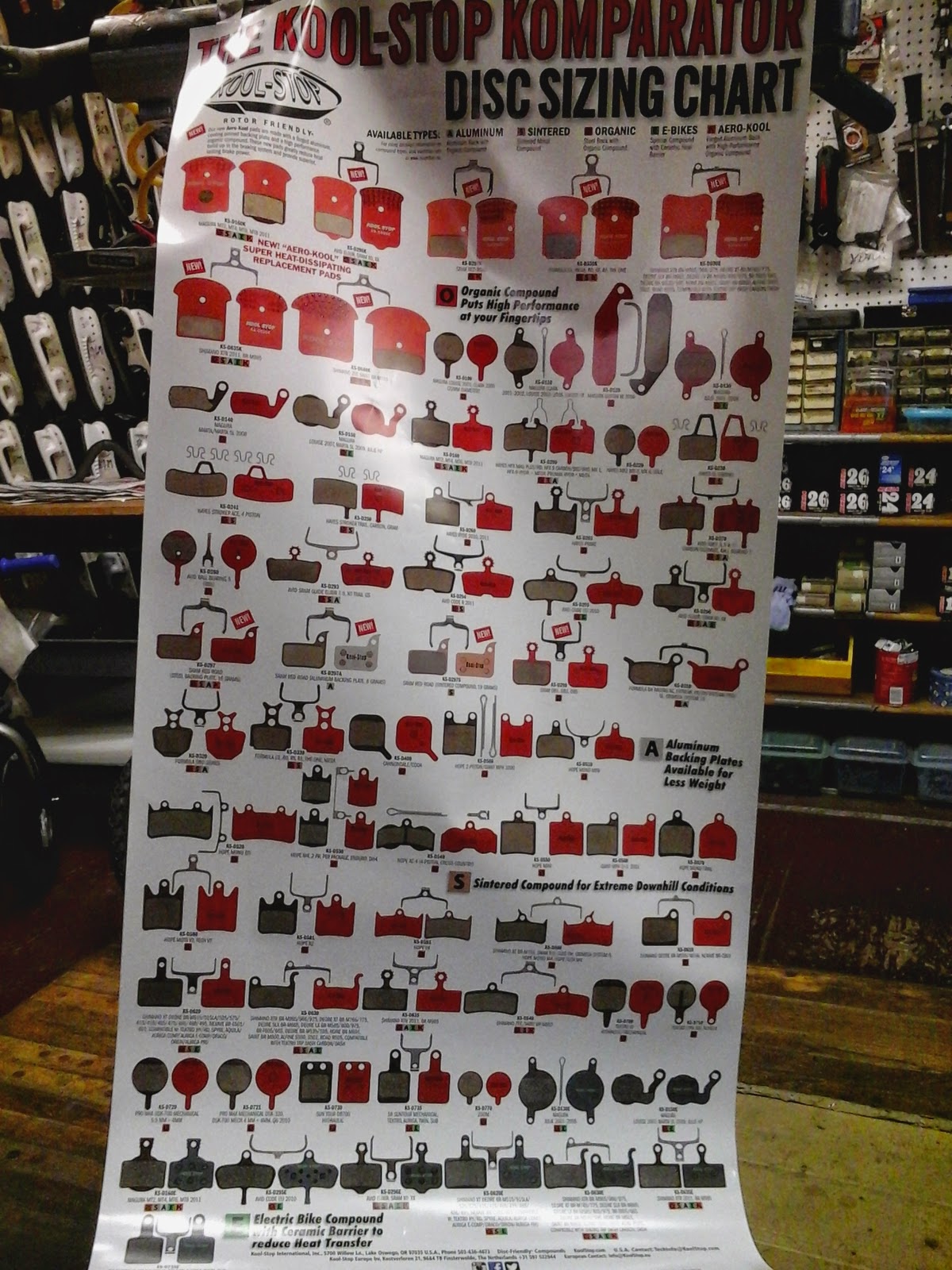
This simple chart should make things clear

Disc brake pad selection made easy. Sort of. 

Obviously you need to match the make and model of the brake. Beyond that, where you have a choice of pad compound you should try to match it to the customer's riding style and venue. If the customer can't give you clear answers you have to figure out which compound will produce the least amount of annoying noise...from the rider.

Bass ackwards weather this week. The forecast for today called for, "Drizzle. May be heavy at times." How heavy does it have to be before it no longer qualifies as drizzle? What's the next rung on the promotion ladder? Probability ranged from 20 to 40 percent depending on when I looked. I took the odds because my schedule requires me to drive tomorrow when the forecast is completely dry. Friday looks okay so far, but Saturday picks up a 40 percent chance of precipitation including snow. 

Sunday continues the wintry theme. I'm volunteering at the Castle in the Clouds Half Marathon that day. Mountain runners are a tough crowd. They'll love it.

Friday, July 18, 2014

Today's contrast

This was on the stand:
when a guy walked in with this:
Mr X called to see if we could slap on the new rear caliper Stromer sent for his bike in 30 minutes or less. The person who said we could does not do wrench work and did not ask those of us who do. I got to disappoint him in person when he showed up.

Stromer has admitted that they have issues with those brakes. I was right.

Lunch is over.  Back to work.

Wednesday, June 25, 2014

I predict

With disc brakes being shoved onto more and more bikes in all categories, repair shops will see the first ripples of a rising wave of rusted rotors and frozen calipers on bikes laid up by riders who had to address other priorities and found themselves storing the bike for months or years.

In some climates the damage can occur in weeks.

Your alloy rims and rubber brake pads won't do that to you.

A customer looking at road bikes the other day asked our sales person why road bikes are coming with disc brakes now. I did not pop out of my lair and say it's because the bike industry thinks anything worth doing is worth overdoing and recount their long history of shoving technology down consumers' throats. I'm not mellowing in my old age, I'm just giving up.

The sales person would not speak ill of any product a customer could be induced to order. And if the customer shows clear enthusiasm for a product, mechanical advice be damned. So I'm assembling the disc brake Roubaix today.

Disc brakes have their place. Their spread to many other places is like the escape of an invasive plant. Those are often impulsively imported from Asia, too.

Monday, June 23, 2014

Aggravated battery

Got a call from a wealthy summer resident last month asking if our shop would receive and assemble three or four Stromer electric bikes for him. He's been a dedicated pedaler for many years, but those years have a way of adding up. Mr. X gave up riding the Mount Washington hill climb a year or two ago.

One of his friends is executive chairman of a corporation known for battery powered tools. The chairman has been into e-bikes since Lee Iacocca had his fling with them in the 1990s. We've gotten to see the evolution of the type as he has brought in various broken ones from his fleet. Apparently he is an energetic advocate. Since he took up the Stromer brand he has hooked up several of his friends.

One of those friends brought in two older Stromers. They've lost the keys to the battery compartments. The customer service guy at Stromer told me they can't replace those.  They're apparently not cross referenced to the serial number. Both bikes also have an intermittent electrical problem causing the pedal assist to cut out randomly. Intermittent problems are always great fun to track down. The manual says to check the right brake sensor. Just for grins I checked both of them.  To do that I had to make a test lamp because I don't keep any kind of electronic diagnostic equipment here. The sensor is just a push button anyway. I needed to see how sensitive it was so I could determine whether a rider who rests a hand on the lever could cut the motor out with only a slight twitch.

To get the sensors out I had to remove the lever blades. Electric bikes are bulky, heavy and complicated. Some combination of those factors -- weight, size and complexity -- makes even a simple job take a lot longer.

The Stromers weigh at least 60 pounds. About 25 pounds of that is the rear wheel. The wiring for the motor connects back there. The rear axle is keyed so it goes in the right way. So any job that involves removing the rear wheel means you have to juggle this heavy wheel as you guide it into its nest of cables, past the rear derailleur, sliding the brake rotor back into the caliper, with the axle oriented the only way it will go in.

The older Stromers have Avid cable disc brakes. The levers used on electric bikes have to be set up to accommodate the brake sensors. These levers predate the introduction of cable disc brakes, so their leverage is set up for traditional cantilevers. This means when you pay upwards of two grand for a fancy electric bike with cable disc brakes they feel mushy. Admittedly I've only seen the e-bikes that have wandered into my shop, but every one of them across the price range has had the same lame brake levers hooked up to mushy cable disc brakes. You'd think the e-bike industry would have caught up with the times by retooling to make a sensor-equipped lever with the right pivot distance for the brakes they're actually operating, but that kind of organized thinking seems alien to the battery brigade.

The new Stromers I assembled have Magura MT 2 hydraulic disc brakes. There's only a sensor in the right lever, so you could ride the front brake while still powering the motor, but how many people use the front brake by itself? I do, but I'm a deviant.

The rear brake on one bike went really mushy without making a puddle of fluid to indicate a leak. There was a little fluid around the caliper, but nothing to indicate exactly where it came from or when it got there.

To bleed the brake the bike needs to be oriented so the hydraulic lines run upward to the lever. Stromer puts the rear brake down on the chainstay. Magura says to remove the pads and push the pistons back all the way before bleeding the system. So that means the 25-pound wheel needs to come out and the bike needs to be held in the work stand with the front end pointing at the ceiling.

My bleed kit was improvised late in the last century. After two rounds of bleeding -- completely reassembling the bike to check each time -- the brakes were better, but still not great. Interestingly, there were two black bikes in this shipment and the brakes felt a bit mushy on both of them. The brakes on the red men's bike and the white step-through felt much firmer.  The color is coincidental, but perhaps it indicates production runs with different personnel or even different factories.

A new bleed kit is on order. Friggin' hydraulics.

If you're thinking of getting an electric bike, don't. Just go the whole Hog, as it were, and buy the new electric Harley Davidson. The pedal assist thing is novel, but when it quits on you you're left with a bike that handles like a truck. Imagine pedaling a truck. A two-wheeled truck with sluggish steering. The heck with that.

The older Stromers I've worked on have twist throttles you can use when the control unit is set in the proper mode so you can just twist its ear and feel it leap forward. It takes more out of the battery than any other mode, but it cuts right to the best part of having a motor: putting out no effort to fly through space. Pedal assist not only requires that the pedals be moving, you also have to put at least some pressure on them. That sounds exhausting. And because the power comes on in spurts based on your own output it can make the bike surge a bit erratically. I suppose you adapt after riding electric bikes long enough. I only get to play with them for a few minutes at a time.

In the repair shop the bikes take up a lot of room, especially when you start taking them apart. Information about their innards is hard to get, even from the manufacturer. Manufacturers seem much more interested in pumping more products into the market than in helping existing customers keep existing bikes running smoothly. It seems to be part of the inherent nature of electronics that things work perfectly until they don't work at all, whereupon you junk the whole rig and start over. But some of these characteristics apply to all modern manufacturing and many modern products. Shimano shifters, for instance. And all manner of consumer electronics.

If I did not have an immensely wealthy person's name to drop, I wonder if I would get the level of service I've received so far. Even with the magic name the quality of service has diminished. I think the Stromerians may have crunched the numbers and decided they don't need to be quite so responsive to get their trickle from the trickle-down. No sense wasting deference when profit remains the same. Even a high profile customer is just another existing customer. In modern business ethics, existing customers get taken for granted while the energy goes to snaring new customers. Customer loyalty does not engender manufacturer loyalty, it breeds contempt. That attitude has afflicted the bike industry since the 1990s. No one can tell them how foolish and shortsighted it is. They'll have to learn the hard way, if consumers ever wake up and decide they're sick enough of it to support a different model. A whole lot of shit will have to hit a whole lot of fans for that to happen. So maybe the contemptuous manufacturers are right not to worry.

Mixed in with the electric shenanigans were plenty of brain teasers involving conventional bikes. Repair season is upon us, though business seems to diminish every year. It's not going to competing shops...much. People just don't seem to be around, let alone spending money.