Showing posts with label technological enslavement. Show all posts

Wednesday, January 07, 2026

Parts replacement versus "mechanicking" again

 A rider brought in his fat bike because he had accidentally burped out one of the caliper pistons in the SRAM G2 Ultimate front brake. So it's a four-piston caliper with three stuck, one on the floor, and no juice left in it.

I figured I had one shot to do it economically with what he had: reinsert the rogue piston, juice the system with fluid I didn't mind losing, and use the usual pressure tactics to dislodge the other pistons. This meant trying to do at least a semi-effective fill and bleed to get any kind of pressure from the lever.

The procedure failed because the piston seals for the runaway were too damaged to hold the fluid. It gooshed out around the piston too quickly to impart any force on the remaining pistons. There is no back door way to get those bastards out of there. I can reassemble and keep trying, or troll through YouTube videos, but the shop's hour costs about $80.

This is yet another example of how the industry and its technolemming devotees have set themselves up for ever more expensive repairs for the sake of taking a bike ride.

One more time with the old chorus: Mountain biking started out as relatively cheap fun on beater bikes. Certain visionary riders saw that it could be so much more as long as money was no object. Money, and the precious life hours of mechanics who know better, but are stuck in this futuristic nightmare.

It fits right in with every other dystopian horror we're living through.

I've got one more thing I can try that might save this particular bacon before I report to him that he can tinker with it at his leisure or get a new caliper and start fresh. We'll see how it goes.

EDIT TWO HOURS LATER: The one more thing worked. It worked smoothly enough that it wasn't even too pricey, relatively speaking.

Wednesday, October 09, 2024

The steady creep of crap...

Like rising sea levels, a steady tide of brake fluid, shock oil, and tire sealant laps higher and higher. On it float the carbon fiber fuselages of high-priced industrial flotsam, while the currents of the murky depths carry along the aluminum offerings. Dragged along the bottom is a spreading tangle of cheap steel frames and flimsy mid- and low-end parts. Brand name and no name products jostle in this festering stew.

There never was a dike against it, but if there had been there would be a lone, drowned mechanic with his finger stuck in it. The surge came right over the top. But there was no dike, so there's just me and my finger, which I have been giving to the industry since the early 1990s. I'm still treading water in this great oceanic garbage patch, trying to rescue the few who are not swimming avidly away.

Hey, if you're going to lose anyway, you might as well have some fun with it. I used to find energy in the belief that I could have some wider influence. Fantasy has played an essential role in human survival. It just functions differently under the influence of different eras. We can tap into each other's imaginations like never before in this period of individual social media participation overlapping with professional productions in a range of legacy media and their evolved, evolving forms. As many as a few dozen people might read this essay. That's a bigger crowd than I could draw if I was raving in a public park anywhere within a short bike ride of where I live or work. Good return on my time, says the lazy man.

Bike season is winding down around here. Enthusiasts are still riding, but the frenzy of summer has gone to sleep until next year. By then we will know if we're going to be living in a smog-shrouded theocracy or be zigzagging toward the flickering image of a world where people are trying to get along with each other rather than get on top of one another. Service work still drops in a job or two at a time. The shop converts to ski season as autumn progresses. It's still only cross-country skiing, so we never get mobbed. As long as people can use motors to get them up a hill, that will be their preference. It's true with increasing numbers of two-wheeled "pedalers," too.

A guy in the shop last week said that he was getting an e-bike that would go 50 miles per hour. I figured he was full of sht, so I looked around online. I found quite a few ads for e-bikes that will do 50 mph. It's absolutely not legal, but the police have much more pressing matters to worry about. There are thousands of bikes on the road, and no effective means to keep track of them. This is a good thing in many ways. I don't like the idea of omnipresent surveillance, even if it does permit jackasses on rule-beating motorbikes to pretend they're on a machine that they would ever power by pedaling alone. I figure that they will sort themselves out on their 50 mile per hour mopeds.

Riders with power assistance do present a hazard to path riders, both recreational and transportational. Few act with malice, but insensitivity hits just as hard. Any vehicle operator becomes velocitized. You get used to your flow through the scenery based on the feedback you get through the contact points with the machine. We drive our cars at what seems like a sedate speed, while a pedestrian walking on the side of that road perceives our vehicle as hurtling past them. Riding an analog bike, 15 mph feels pretty zippy. Twenty feels downright godlike. Throw a little power assist in there and you can legally push close to 30 mph. Juice up the moped and you get into survival mode.

Survival mode is sneaky. You are in it before you realize it. You may be within your own reaction time to negotiate the road in front of you as you see it, but have no margin for the unexpected. It happens on an analog bike as well, but almost always on a downhill. The other place you can get into trouble is when larger vehicles are slowed by their own traffic congestion, and a bicyclist is tempted to fly past them or even cut between them at full speed. Filtering is fine, but trying to show off with a power play will get you smacked sooner or later.

As daylight shortens, my bike commuting season comes to an end. I will become flabbier and grouchier (if you can imagine that) as the months progress until next spring releases me to see how much strength my aging body still retains. The problem isn't the darkness, it's the lights. The floodlit behemoths I share the road with blind each other with their headlights and make me disappear. The imperative that motorists have, to pass any cyclist without pausing, means that they will shove through in that tunnel of glare and blackness wherever we encounter it.

There's also a slight uptick in malicious behavior under cover of darkness, but the major issue is insensitivity and impatience.

If I had a good place to park for park-and-ride commuting, I could continue for months, gaining at least some of the advantages of fully car-free transportation. Unfortunately, the local cyclist ghetto, the Cotton Valley Trail, runs off at an angle, so I end up driving almost the whole way to town, or equivalent distance, to intersect it at various points from which to continue by bike. And it's the Cotton Valley Trail: an active rail line masquerading as a multi-use rec path. The rail car hobbyists have the right of way, and some of them can be real pricks about it. Others are kindly ambassadors, but you don't know which is which when you both enter a railed section. On the other end of the speed range, not one single pedestrian is ever glad to see someone on a bike. Add a dog on a leash and your stock drops even further. I'd rather be out on the road with the armored personnel carriers whipping past me. It's much less personal.

Too late this morning as I sit under a cat, but maybe I'll try a few rides from the shopping center three miles out from my house. That cuts off the worst stretch for night riding. But the challenge points up a major issue for anyone with a motor vehicle: where can you leave it? They do lock. They're hard to remove casually. But anyone annoyed at your presence can do a whole lot of inconvenient things short of completely removing your expensive appliance. Pick the right wrong place and you could even lose the catalytic converter. That's become a new hazard at some hiking trailheads in the area.

For now, it's time to displace the cat and finish getting ready to load the car. Driving is so brain-dead easy compared to riding a bike. It's a habit-forming sedative in that way, but side effects include joint pain, stiffness, irritability, inattentiveness, weight gain,... see package insert for full list.

Saturday, January 22, 2022

The Competition

 Two local beer joints are run by mountain bikers. Both of them have toyed with the idea of starting a shop to cater to their specialty here, but only one of them has actually done anything.

The backroom shop started as a service facility, but recent social media posts indicate that the proprietors might be selling new bikes on a limited basis.

I absolutely love this. They will find out the difference between beer customers and gear customers. If somebody drinks until they puke, they don't come asking for a refund or warranty. "Hey, that last beer was only in my stomach for about ten minutes! You should at least comp me my next one!" However, a person with a history of fraudulent warranty claims on bike frames is still a rider in town. Maybe it will never be a problem. Maybe they'll stonewall anyone who tries it. They're in a good position to take a hard line, because they're just playing store. They won't live and die by their reputation. They'll play at this as long as it's fun, and then quit. Maybe that's how all specialty bike shops should be, since the equipment is ephemeral, and there are lots of ways to quit riding.

The hobbyist shop or the cutting edge techno hangout may turn the bike shop business into something like the restaurant business. A shop will start up with no clear long-term plan, just serving its specialties until their quality slips or the economics catch up with them or they just get tired of it. It'll be the hot place for a few years at best, and then vanish. Another one will already be taking its place.

When we first heard about their operation, it was based on sending the technical repairs to a guy up north a ways, who does earn his living as a bike mechanic, doing a lot of boutique work for the disposable income crowd. The shop puts technology front and center and passes no judgment on expense and complexity, and the relentless march of obsolescence. He's staked out the technological territory.

There are two ways to ride out a period of technological ferment: Replace your bike frequently, or pull way back to solid simplicity for a few decades to see where it all goes. It depends on your goals for riding. I'd decided more than two decades ago that mountain biking was a nice hike spoiled. But someone into the modern style of mountain biking will be enslaved to the technology, because you definitely can't ride that way on the kind of old, simple bikes I own, any more than you could be competitive in road racing with a vintage steel bike with friction shifting.

I can think of a lot of ways that the backroom bike shop could operate, but with no reliable intel from the inside, I will probably never know. For instance, they could piggyback on a real shop's wholesale supply orders to get parts. But then do they take a markup, or bro deal their friends, undercutting every legitimate shop in the area? Or do they make their customers dig up the parts, and only supply the labor and whatever know-how they have, as well as the work space?

The great part is, I don't need to know. All I have to do is deal with whatever comes through my door on a given day, and keep my own simple fleet running for as long as I have the energy to ride it. What happens next door stays next door...except for what gets trumpeted on social media, but you know that's always buffed up to look great, regardless of what's really going on. Time will tell. It always does.

Sunday, April 25, 2021

The benefits of neglect and obscurity

 Being forgotten by the technological world for decades was one of the best things to happen to bicycling. The machinery evolved very slowly, which made bicycles a reliable device and a reassuring piece of stability in a changing world.

 When I started paying attention, in the mid 1970s, no one seemed to be clamoring for space-age advancements. Kids born in the 1950s received their bikes as something their parents had received in almost the same form. Some kids born even later received the same actual bikes. My older brother wanted an "English racer" three-speed because our family had been introduced to the works of Arthur Ransome as soon as we were old enough to read. The characters in those books, when they weren't on the water, were likely to be getting around the English countryside on classic black bikes that you could still buy at a shop near you in the 1960s. Much might change in the world, but bikes were your living connection to history. Not only that, they worked perfectly well as personal transportation.

When the "ten speed" came on the scene, it didn't strike me as a wild new concept, only a more advanced existing concept of which I had been previously unaware. It also seemed like risky magic to encourage your chain to jump off the sprockets, after all my years when chains popping off was a greasy nuisance. I was very slow to adopt. However, as with other vices from which I initially shied, I embraced this one emphatically when I was finally corrupted by the right exposure. Indeed, the derailleur had existed in the form we would recognize for almost as long as Arthur Ransome's children's books. Whatever prompted the 1970s bike boom merely thrust it into the American public's eye, somewhat the same way cross-country skiing became the cool new thing around the same time.

Bikes through the 1980s -- meaning mostly road bikes -- had an aesthetic that seemed to span the 20th Century. Steel frames held together with lugged joints might have elaborate curlicues and cutouts or showcase the precision of smooth spear points, but at a distance the general configuration would convey instantly the bike's purpose and connect it to its heritage. By the 1990s, essayists like Maynard Hershon might gripe about its "19th Century" technology, but the stuff still works.

Check out some of the details on this Richard Sachs. The bike's owner is the real deal. She's been touring on it since she bought it new in the early 1980s (or earlier).

These cutouts are on the inside of the fork. 

Downtube friction shifters pull the derailleur across  a five-speed freewheel.

The rear wheel sits in long horizontal dropouts. This allows for all sorts of modifications and improvisations that you can't do with VD (vertical dropouts).


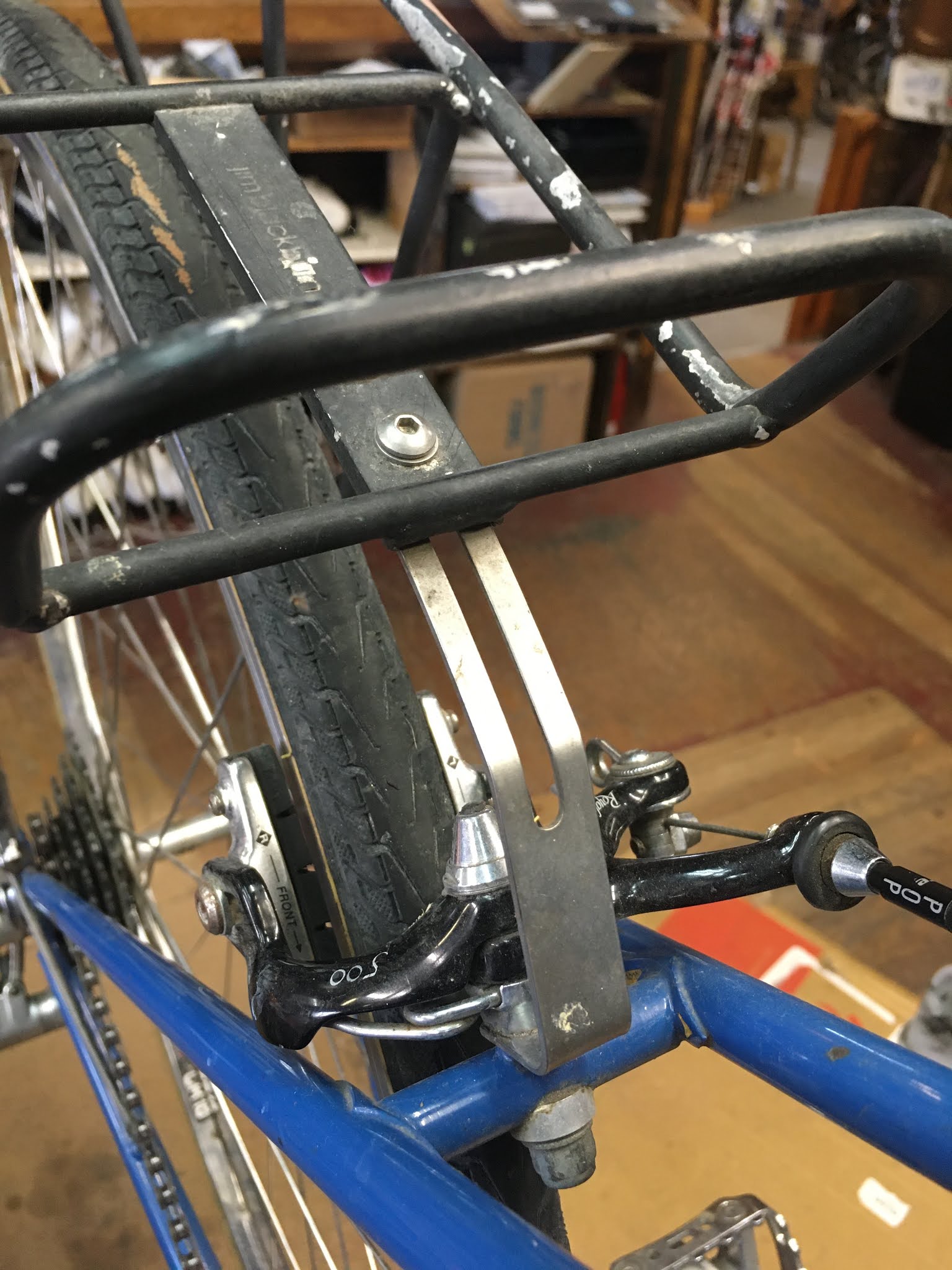
 Check out the original Blackburn rack from when the original Blackburn guy still had anything to do with the original small company by the same name.

Even the saddle is original.

I wore out several Avocet saddles until you couldn't get them anymore. I know she's logged some serious miles, but she probably hasn't crashed as much as I did, and perhaps has a smoother style. Her gearing is realistically low for a load-carrying bike.

The cam on these Gran Compe brakes actually opens up wide enough to get the tire through the brake pads, unlike the token range of much newer -- and not cheap -- offerings here in the dying days of the Age of Rim Brakes.

Old plastic Silca frame pumps tend to crack at the threads. You can repair a minor crack by wrapping the barrel with filament tape. This pump has that repair. I don't know how much she's had to use it in that condition. I finally gave up on mine and got a Lezyne mini pump.

Before the Sachs I had a bike called a Sketchy on the stand. In a color strikingly similar to Surly's "Beef Gravy Brown," which was one of the Cross Check colors around 2011, this bike was apparently a hip item around that time. Made of lighter weight, more upscale tubing, it completely lacks the touches that make the Cross Check such a great basic platform on which to build a wide variety of bikes, such as the above-mentioned long horizontal dropouts. The Sketchy had VD, and shapely but highly inefficient curvaceous chainstays that would completely prevent the use of fenders with plump tires.


What's a nine-letter (two-word) phrase meaning "overrated?"

Until FSA got rid of the needle bearing version of the Orbit UF headset, that was the answer, at a tiny fraction of the cost, to the issues that the CK headset purports to fix. The CKs are serviceable, but what a pain in the ass to get in there, just to have ball bearings  -- albeit in a sealed cartridge -- anyway. Tapered roller bearings were the best for headsets, which is probably why they disappear almost as quickly as they appear when a company offers them. The Orbit UF stayed on the market for several years before they went on the angular contact bandwagon. So they're still a good deal for the price, but not as good a deal.

Despite its unfortunate modernist touches, the Sketchy at least used a steel frame with basically round tubes. The aesthetic is not at all classical. It doesn't look like art, the way lugged frames did. The Cross Check has a welded fame, but the dropouts have a classic shape, and the forks have an external crown that gives them a classic look as well. The Sketchy fork looks like an old suspension bridge tower. It's kind of cool in its way, but it looks heavy.

The bike business seems to be able to support a number of limited-edition boutique builders who do their thing for a while and then move on. As long as they build to fit off-the-shelf componentry, you can keep the frame going almost indefinitely. Whatever it is, if it works for you, it's a good bike. 

This old Manitou fork showed really bold marketing in naming a new model (at the time) for what planned obsolescence would soon turn it into:

As we charge forward into the battery-powered future, a category called "hunting bikes" is on the rise. Camouflaged smokeless mopeds are becoming a popular vehicle for some hunters to use to get into the woods and fields in pursuit of their quarry. Back in the 1990s we had a customer or two who embraced the mountain bike as a silent approach vehicle for hunting, because they were quieter than ATVs and didn't produce stinky exhaust. But you had to be willing and able to pedal. Now a wider range of hunter can take advantage of not only pedal assistance but also pure motor power on some models. They're being sold through hunting and fishing stores, assembled by people who may not have a lot of familiarity with the basics of bike mechanics. Or the customer might have bought it online and had to assemble it themselves. Such was the case with this behemoth:

What have we gained by junking reliable simplicity? I still prepare for hostility and negligence before every time I venture out on the roads. This is true even in a car. Are the few riders retained or recruited by electric motors or enticed by technological ephemera enough to offset the general loss of people who don't grow up with bicycles as a normal part of their life, with the option to continue into adulthood?

Bike categories have forever altered the concept of what is possible under pedal power. Mountain bikes started out as just bikes. Modification piled onto modification in rapid evolution, but it was only the same process by which bicycles had developed from the beginning: largely trial and error. Only when the type was firmly established did the engineers really focus on seriously designing the machines of today.

As for the road, the demand for technology is more driven by fashion than function. Shifting systems since the onset of indexing have increased precision when they work, but also increased the demand for precision in their construction and adjustment. Road riding could still thrive if all of that went away, just as road riding could thrive if disc brakes went away, along with carbon fiber frames and 52 different bottom bracket standards. Mountain biking, on the other hand, is entirely dependent on its suspension technology and gearing systems to make the preferred style of riding possible. Some mavericks might sing the praises of a hardtail versus full suspension, but almost no one -- and perhaps no one at all -- is extolling the virtues of a fully rigid frame and fork. Fully rigid bikes have been relegated to another category, like bikepacking, in which they are still the weirder option, or fat bikes, which have always been a weird option.

Millions of riders logged millions of miles before there were through-axles, disc brakes, electronic shifters, and 1X drivetrains dragging tinfoil chains across 12 cogs (or more) spanning a range from 10 or 11 to 52 teeth. Some things could safely be rolled back and advanced along different lines with only gains for the riding public.

Tuesday, July 02, 2019

Serious Injury or Death

Danger is all around us. An almost infinite number of things could go wrong at any moment. Some computer program might be able to measure the probabilities in something close to real time, but most of us just have to live on our luck. By and large that luck is surprisingly good, considering the massive risks people take all the time and get away with it.

Bicycles are seen as safe, stupid little machines. Bike mechanics aren't considered "real" mechanics, because we don't have to deal with powerful engines. Bike riders are contemptible, wobbling along slowly. Adults on bikes need to "grow up." Bikes are toys. Bike crashes are slapstick comedy, unless it's you, skimming along the tarmac, feeling skin burn away, or feeling the snap of bone and ligament from a more vertical landing.

Bikes are also seen as terribly dangerous, the act of balancing on two wheels an affront to the laws of nature. A bike rider is a daredevil, especially riding on the road. And there are the obvious daredevils on mountain bikes, launching sick tricks off of every available drop.

Bikes themselves might as well be made out of stone, the way most people treat them. They leave them out in the weather, neglect maintenance, and basically treat them they way they treat cars. But a car has its house with it all the time, like a turtle has its shell. And the mechanical parts of a motor vehicle can be made more robustly, because even a small car has power to spare, compared to the .25 hp of a human engine pushing the pedals.

Serious component failures are rare. The massive crank recall of 1997, when Shimano had to replace millions of cranks on bikes sold worldwide, was the last -- and the first -- really enormous safety crisis, created by Shimano's design aesthetic favoring skinnier and skinnier alloy crank arms. But cracking cranks have always been a problem. My first experience with them was back in the early 1980s, when Campagnolo Super Record cranks were cracking, as were any other brands trying to make their cranks look like Campy's. Stress concentrates at the spider, where too thin a web of aluminum between the crank arm and the spider can start to crack in non-structural metal. If you spot the nascent crack soon enough, you can file away the material with the crack in it, and prevent it from traveling into the load-bearing metal. If you know the problem could occur, you can file away the web before a crack even starts, rounding out the radius to remove the stress riser. Wait too long, and the crack gets into real meat. Then the crank is doomed.

Here is an example of a web crack that got away:
You have to look really closely to spot them. That's where you benefit from the vigilant eye of an experienced not-a-real-mechanic who has seen quite a few of these over the years of a misspent life. This particular crank, a Sugino made for Specialized, could never have been saved, because of the shape of the back side of the crank arm. It's hollowed out back there, and has casting residues that create permanent stress risers immune to filing. Too bad, too. It's a pretty crank. The cracks only revealed themselves by the pattern of the oily grime that had adhered to them, hidden in the rest of the oily grime that had accumulated on the surface of the crank.

We play the game "Scratch or Crack?" a lot in the workshop. For instance, here is a Shimano Ultegra Hollowtech crank belonging to a rider who should be concerned about the load-bearing capability of his components:
Rubbing against a badly adjusted front derailleur cage, the arm has been scored, but hasn't cracked...yet. Hollowtech cranks are breaking, but Shimano has yet to acknowledge it with an official bulletin or recall. It's just street knowledge among not-real-mechanics.

Any lightweight component subjected to vigorous riding can eventually fail. As manufacturers try to make parts as light as possible, they will shave down the margin of safety, slap on warning labels, and call it good. You, the consumer, have the ultimate responsibility to accept or reject their creation. It gets much harder when the manufacturers stop making anything nicely finished but a bit more robust, and you have to keep up with the latest number of cogs in order to buy top of the line parts. We have some poor bastard who wants to put Di2 shifting on his "old" bike with mechanical 10-speed Dura Ace. Haaaa! You're what... five years too late? Three years? I don't keep up with the ephemeral crap the way I should, because we don't sell much of it in our market area, and I keep hoping that it will just go away. And it does go away, but only to be replaced by worse ephemeral crap.

Here is another entry in Scratch or Crack:
This one was just a scratch. But you have to take every one seriously.

Rims are another common site for cracks. But you can't ignore hub flanges, handlebars, stems...you can't ignore anything, really. I've found frame cracks and fork cracks as well. I spotted cracks in the crown of a guy's Cannondale Lefty fork that would have led to a nasty face plant. Aluminum and carbon fiber each fail more quickly and more abruptly than steel or titanium, so spotting cracks becomes more urgent with these inescapably common materials. Carbon in particular will just disappear when it reaches its load limit. It doesn't bend. It breaks. Properly designed and manufactured, it will function perfectly well for an almost indefinite period. Parts that can be made more ruggedly, like crank arms and stems, can hide a little reserve strength under a negligible bit of extra weight. Frames present greater design challenges, because a shape and wall thickness amply strong to stand up to the normal loads of hard riding will still be vulnerable to highly probable mishaps like collisions or simply having the bike fall over against something with a hard corner to it. Sure, a nice metal frame might dent in a case like that, but small dents are only a cosmetic problem. It takes a pretty deep dent to render the bike unridable.

Any time you are dependent on a machine, you could end up stranded. The simpler the machine, the better the odds that it will continue to function, provided it was well enough designed and built in the first place. But it has to do what you want it to do, which invites complexity. And even a fixed gear has plenty of parts that can break. Whatever you ride just remember to take a close look at it from time to time. Good luck out there.

Tuesday, June 25, 2019

Just a technicality, followed by another technicality, followed by...

Shimano's latest mechanical shifting systems seem designed to make you hate mechanical shifting systems. Weird cable routing in the frames already made mechanical derailleurs an increasing nuisance. This style of front derailleur cable attachment puts another few solid spikes into the coffin lid. And it gives double value to current technofascist fashion, because it's not just an annoying cable, it's an annoying front derailleur cable. Front derailleurs? Why did we ever think those were cool?

The instructions for this style of derailleur are an 8-page PDF. That's simple and straightforward compared to the treasure hunt I went through later in the week looking for information about electronic shifting and hydraulic road disc brakes on a bike I was assembling. Bikes like that used to come with a few helpful hints and diagrams to help with componentry that is less and less intuitive all the time. Now most of the printed matter is just legal disclaimers and directions to "visit our website."

The front derailleur on this bike led me upstream to the R7000 front shifter. In yet another silent recall situation, these marvelously redesigned shifters are apparently hanging up, jamming intermittently on bikes that are new or nearly new. 


I poked around looking for clues, but found nothing that I could tweak to make the ratchet behave consistently. I found a video by some guy that supposedly showed how to fix the problem with a little piece of plastic and some double stick tape, but further investigation revealed that whatever "cured" the problem was purely coincidental. The comments include testimonials from people who followed his instructions and achieved satisfactory results, but my explorations in the interior revealed an oily place where double-stick tape would have a very short service life. And why should someone have to fiddle around with their new shifters because Shimano screwed up again?

After I poked at things for quite a while, the shifter worked consistently without malfunctioning, even when I tried to make it misbehave. That doesn't mean I cured it. It just means that the clever bastard decided to go underground until the heat is off. I advised the rider to go to the shop where she bought the bike and ask them for warranty support, rather than pay us to dig around in it any further. The problem is similar to the old 105 ST-5600 almost-recall a few years ago. It's become common in the industry for a big component manufacturer to hand out free replacements to anyone who asks, while doing nothing to publicize the problem or take direct responsibility for it, which would cost them a lot more money. If you haven't ridden your bike enough develop the problem, why should they spend their money to give you something that actually works?

The current fashion for cable routing under the bar wrap requires some ingenuity in feeding the cables so that they don't get a kink in them at any of the tight changes of direction needed to make their way into the cable housing.
This little screwdriver with a notch filed in the tip had been kicking around the workshop for years after whatever job had led to its creation. It has now become a crucial tool for guiding a new cable into the exit from a Shimano brifter.
You have to push the end of the cable into the exit groove without extracting a lot of cable behind it. The little notched screwdriver is perfect for this.

Another bike with the annoying front derailleurs was a gravel bike with through-axles front and rear. The rear wheel shows how designers have realized that long horizontal dropouts really did serve a purpose back in the dark ages:
Whoever assembled this bike was not familiar with horizontal dropouts. The wheel was crooked in the frame. With an old style dropout, you'd just undo the quick release, straighten the wheel, and tighten the quick release again. With a nutted axle, loosen the nuts, straighten, tighten the nuts. In the through-axle version, you have to loosen the through-axle attachment, loosen the two 20mm nuts, turn the threaded adjusters to straighten the wheel, re-torque the 20mm nuts to 200 in.-lbs, and re-tighten the through-axle itself. The nuts are alloy, thick enough to make a cone wrench an inadequate fit, but not thick enough to fit a regular off-the-rack spanner.

In the middle of one morning, in came a regular customer who never buys a bike from us, but comes in for service when he's at his spare home up here. He said he was just starting out on a road ride with  his daughter, when the bottom bracket made a "snap" noise, and the crank got really loose.

The left crank bearing (press fit) had blown apart. Most of it was now cozied up against the right side bearing. The rest of it was greasy fragments inside the bottom bracket shell. He borrowed a rental bike to nip home and get his gravel bike, so that he and the offspring could continue their ride. We didn't have the bearings in stock, so we ordered him a nice mid-price set. No need for hundreds of dollars in ceramic bearings, but nothing too cheesy, either.

On the lower end of the price range, someone checked this thing in, with a couple of squirrel tails woven into the cables at the handlebar.
I don't know how. I don't know why. I don't think I want to know.

Sometimes, a rider will get the rear derailleur caught in the spokes or jammed with a stick. The pieces will be dangling or twisted up around the dropout. But this guy set a new high mark, sucking the derailleur cage all the way through the rear gears:

Moving back up the price range, it was time to assemble a special order bike for another summer customer. 

This Specialized Tarmac does away with cable-actuated anything. Specialized had previously sent rather detailed instructions with their technological marvels, given that the consequences of error are potentially worse than embarrassing for all concerned. Not this time, though. The most detailed instruction sheets were for parts that were already fully installed. The hydraulic brake lines were not connected, and electronic shifting reveals nothing to the external observer. The enclosed sheets from Shimano contained only the vaguest generic information in one or two sentences buried in paragraphs of even less useful verbiage. Their website was even less help. After studying it from all angles and trying to piece together clues from all of the fragmentary or obsolete sources I could find, it was time to poke and hope.

The brakes have "easy connect" brakes lines that aren't really. There was nothing magical about them. Fluid did get lost. Air did get in. I did have to do a short bleed of the top end of the system. It was better than a complete fill and bleed, but not significantly easier than any other pre-filled system on which I've had to trim the lines for size and replace lost juice.

The electronic shifting either works or it doesn't. At least the wires had already been run, but I did have to stuff the battery into the seat post. The non-round seatpost on this bike holds the battery more conveniently than the round post on a previous bike I wrestled with last summer. But I didn't want to mess up its brain by fumbling something in the initial startup, if such a thing is possible.

The charger that came with the bike only had a USB plug, so we had to plug the bike into the shop computer to top up the battery. The system was set in manual shifting mode. The customer can decide if he wants to use either of the synchro modes. The rear derailleur clicks or clunks into gear depending on how many cogs you've asked it to cross at one time. The front derailleur makes an officious, annoyed whine when it shifts. Back when Shimano first pushed index shifting on the road biking world in the mid 1980s, riders joked about how you knew someone was attacking when you heard their shifters click. On large-diameter frames like Cannondales, the snap was amplified. But it wasn't enough of a problem to keep indexing from becoming the norm, paving the way for STI and the rest of the Super Highly Integrated Technology we deal with today.

Look Ma! No cables! Just Shimano Mechanical-Electrical Gear Manipulation Apparatus.

The customer will have to synchronize his own personal electronics with the crank. Your riding style will determine the kind of targeted ads you see on the internet after every ride. And if you complain about hunger, muscle aches, or saddle pain, those remarks are recorded and uploaded to your profile to help refine your personalized marketing even more.

There it is, in serious black. Not only does it look badass, the manufacturer saved lots of money on paint. And the naked frame is easier to inspect for damage that could "lead to serious injury or death."

Sunday, October 28, 2018

The latest and greatest!

Bike componentry development reminds me of the joke about the two guys running away from a bear. One guy stops to put on his running shoes. The other guy says, "Why bother? You can't outrun a bear." The other guy says, "I only have to outrun you."

No matter how much money you spend on ultra-fancy bikes and parts, you'll never really be fast. You'll only -- maybe -- be faster than the other pathetic dorks working outrageously hard to go about as fast as a prudent driver in a residential neighborhood.

Monday, September 03, 2018

Is the sad truth unavoidable?

A cartoonist and art teacher whose work I admire recently posted a piece in which he reveals that making art -- even making funny art -- for a living turns into as much of a boring grind as any job.

When I got to work last Wednesday, I thought, "There's nowhere else I'd rather be right now, and that makes me sad as hell, because I damn sure don't want to be here."

In all my years of incarceration in search of income, I either found things to like about what I was doing or could easily imagine what I would prefer to be doing as soon as I got the chance. When neither of those is true, what's left is bleak. I'm slogging forward out of nothing more than force of habit and the unfounded optimism of living things.

A few years out of college, I wrote to my independent study professor to suggest that the creative writing department include a course called The Day Job. While he responded to various other communications over the years, he never responded to that one. By basically drifting downstream rather than knowing where I was going and how to paddle effectively, I had ended up majoring in poetry rather than fiction. The professor, a poet, said that he'd been having to do a lot of academic writing and found that it drained his poetic energy as well. So even though his day job was closely related to his chosen creative path, it ended up as an obstacle to the kind of creativity he had expected to pursue.

The unfounded optimism of living things. Depression is manageable as long as the endless dull ache of an unidentifiable longing is preferable to the finality of nonexistence.

I believe that burnout is a function of temperament. Some people in nearly any profession you can name remain energetic and happy. It's probably another bell curve, with a blob in the middle experiencing fluctuating satisfaction, while each end reflects either a hum of happiness or unrelieved gloom.

As my work week began I felt like I was washed up and hadn't ever been much at best. I will still acknowledge that this might be true, but by the end of the week I felt like I regained some ground in my accidental profession. Modern bike componentry is a disease more than a cure, but I can bring myself to study it and treat it, because the sufferers still need succor. Because the symptoms are mental as well as physical, most of the sufferers don't know that they've been afflicted with an industrial disease. They think that they've purchased state of the art marvels that will serve them well for years, the way bikes always used to. Or they don't care if it lasts, because their interest won't either.

As recently as about 27 years ago, you really could spend top dollar on a bike -- particularly a road bike -- and have something that would give you pleasure for the rest of your life. Then came STI and the steady addition of cog after cog.

Consider the violin: Certain violins and other stringed instruments in the violin family from the 17th and 18th Century can command staggering prices not just because they are pretty pieces of cabinetry, but because they have all the audible and operational qualities that make a musical instrument desirable. Violins much younger can perform just as well, but they do so by adhering to qualities established centuries ago. You can also buy various mutants that make interesting and enjoyable noises, but the basic pattern remains so desirable that its extinction does not appear imminent. You can play all genres of music on it if you know the technique. You want to select one in your price range with the best playability and tone you can get. Then you meet its simplicity with your own willingness to practice.

The road bicycle frame was perfected before the middle of the 20th Century. All the strange looking frames you see today are still putting all of the critical contact points in the same position relative to the rider and the riding surface. But I've ridden that Draisine to death.

Mountain bikers face a bleaker future when it comes to technological enslavement. They're not going to be able to ride the way they want to ride without all those pivots, shock absorbers, and shifting and braking systems. All of those require maintenance or replacement at frequent intervals. Your hydraulic fluid goes bad even when the bike is stored. At least the DOT stuff does. It goes bad in the container and in your bike. If you've ever had brake fade, you created gas in the system that supposedly reabsorbs when the fluid cools, but never completely. And the absorbed water that made the brakes more prone to fade is still there, getting reinforcements by the day.

Shock seals dry out and pivot bearings rust, even in storage. You will pay in money and time to keep up with all of this relentless deterioration.

I, on the other hand, take my trusty road bike off the hook, pump up the tires, double check the chain lube, and go for a ride. The Cross Check even sees quite a bit of unpaved road and trail, and still gives very little trouble. I just replaced its original bottom bracket, installed in 2001, probably about 18,000 miles ago. I vaguely recall putting another one in there, but I don't seem to have written it down, and the one I took out is the right vintage to be 2001. But I could have stockpiled it. So maybe I only had 9,000 or 10,000 hard miles on the BB. Still pretty good, though.

The day job still eats my creative time and energy. When I could get by on less sleep, I could at least try to scratch out a drawing or a piece of writing in the scraps of time before or after work. I still held out the hope that I could produce something of publication quality in either genre. But now I find that a real professional is someone who has done so much for so long that it's less enjoyable than the morning bowel movement. It's more like just scooping the mental litter box for hours. I missed my opportunity to burn out on being a creative professional.

On the other hand, I entered the Union of Concerned Scientists cartoon contest four times and made the calendar three. I have actually gotten paid for some cartoon work, and for some writing. It was never enough to qualify as my living for tax purposes, but not because I was trying to pull a fast one. I just kept getting blown out of the groove.

Robert Pirsig is famous for basically one book. So is Harper Lee. So even if you don't manage to reach saturation and feel imprisoned by your former passion, you can still contribute works of value to humanity as a whole.

The basic problem facing cartoonists is the crappy pay scale. A few -- very few -- might manage to hit syndication and licensing deals, as well as crossover productions, that bring them financial comfort and actual fame. If a cartoonist springs to your mind, and you're not a fan and student of the art, you are probably naming one of these few. There's not much middle class in the cartooning world. Even when there was, the ink-stained wretches did have to slave at the drawing board for workday hours. It was their job, just like the steel mill or the garment factory or the offices of IBM. So the whole free expression part of it was always a bit elusive. A cartoonist for a big newspaper or commercial art house lived as a king's favorite, with the threat of beheading always in the background.

My friend suffers from the additional burden of artistic standards. He has a masters degree in fine arts. He composes his panels with all of those principles in mind. His draftsmanship is depressingly precise and clean. He has mastered not only the traditional techniques of ink and paper, but the digital techniques now de rigeur in graphic design. That means investing in hardware and software and spending time to learn how to use it.

Digital art and art editing make a piece of line art multiply useful because the digitized image can be copied and toned and colored in multiple different ways without having to be redrawn. The original can then be finished using traditional techniques and be available for gallery viewing or sale. I have not mastered any digital techniques. My old scanner might still work. The computer to which I had it hooked up is an old XP machine that I don't let out to play on the Internet anymore. My tentative attempts to use some software that a friend gave me didn't go well. And then concerns of daily life dragged me out of the studio because it wasn't my livelihood, so I couldn't shut the door and insist on finishing projects that never really coalesced anyway.

I used to really love sitting in a pool of light, working on a drawing with the smell of coffee and India ink mingling around me. I was dragged away from it so many times that being interrupted became the habit. Interruption is the enemy of flow. That's true no matter what you're doing. In every draft of my never-finished novel I would come back from any interruption with a disruptively different view of everything, whether the interruption was a single shift at the day job or months in the service of other people's needs. Eventually starting over becomes too painful because interruption seems inevitable. Why bother when the world has plenty of great creative stuff already made by people who managed to fight their way through the crap or got lucky and found a tunnel underneath it?

Writing does seem to survive interruption more easily than quality artistic rendering does. I don't find drawing easy, which is obvious from the stiff and overworked, yet still crude, look of my finished work. But thoughts in words can be scribbled and then typed, connected and reconnected like mechanical parts to make little vehicles for the mind. Readers can hop on or in them. Maybe when time permits, more elaborate, rooted edifices can be built: mind palaces rather than bikes and scooters and little camper trailers.

I will never give up the hope of enjoying what I do for a living. If it does not reward you in some way other than financially, it probably isn't a very good thing to be doing in the first place.