Showing posts with label adventure commuting. Show all posts

Monday, August 03, 2020

The road less traveled, more traveled

The work crew on the Elm Street bridge shows up earlier now, but not consistently. Wednesday I got through, but they were on site on Thursday morning, so I sprinted on toward the Pine River State Forest without hesitation.

This was only my second time through since the end of the 1990s, but it already felt familiar again. Still under-gunned on the spindly bike, I was making the best of it when a voice behind me startled me. A mountain biker on modern equipment announced that he was passing. We exchanged pleasant greetings as I pulled aside to let him go. He vanished quickly.

On the other side of the bridge, I took the low road and geared down early. The trail hit its first steep climb and I didn't even try to stay on. It leveled out a bit above that before hitting the real climb. Ahead of me on that, I saw the mountain biker on foot, pushing his own bike. I was actually gaining on him. But he hit the crest first. He was long gone by the time I reached the top about 30 seconds later. Mountain bike plus gravity equals speed.
The enemy of traction

A Long Haul Trucker might handle the trail better, particularly in the 54cm that I would ride, with its 26-inch wheels. The Trucker has a more laid-back head angle and no toe overlap, so it's less easily disrupted by the uneven surface. It's funny how small a rock can create a big jolt, like when you're digging a hole in the glacial soil around here and the shovel clanks with a wrist-numbing impact against what has to be a huge ledge, only to disclose a rock smaller than a lime. But I've said before that the Cross Check is very good at a lot of things, and was never meant for rough trails. It gets by.

These forest excursions are putting a hurt on my Diadoras. My regular kicks are fairly smooth soled, meant for the finer things in life. With this in mind, for Friday morning I put an old pair of mountain bike shoes in the woodshed. Because it would take only a minute or two to check the bridge, I figured I could start in my Diadoras and nip back for the more rugged footwear if the news was bad. And it was.

These date from the twilight of the toeclip era, so they have a tapered toe and a streamlined sole without a bulky rand. They don't protect as well from lateral rock strikes, but they slip into the strap easily and feel more secure when snugged in.

The sole has outlined areas to cut out for an SPD-style cleat. I never cut them out, but one broke loose and fell out on its own. I had to replace it with the screw-in cover that came on later models much more adapted to step-in pedals, assuming that the rider would go that route.
The plate protrudes slightly. It's a little bit slick to walk on, and pushes my toe uncomfortably into the clip after a while. But the shoes are a better choice than beating up the Diadoras, and they were surprisingly satisfactory on the road portion. Without that unfortunate damage to the sole I would have used them more consistently. Good luck finding anything well adapted to toeclip use anymore.

I've written before about the advantages of the humble and discarded toeclip. To recap briefly: clips and straps allow a rider to be connected with varying degrees of firmness. Fully tightened, straps transmit the most power. Straps loosened still provide some security and power transfer while permitting easier escape. A clip and strap system accommodates a variety of footwear. It is less convenient to get in and out of than flats or a step-in system, but neither of those provides the intermediate levels of connection, and step-ins only work well with their intended shoes.

The road less traveled is becoming a trade route. But in the evenings I still get to breeze through Elm Street, more or less.

Where they've dug out the rusted expansion joint, the trench is so deep and wide that you have to climb down through it. The surface with the rebar sticking up provides sketchy footing. But who's complaining, when no one is supposed to be going through there anyway? It's on me to leave no trace.

Monday, July 27, 2020

The cyclist advantage, sort of

The Elm Street bridge project has developed complications.
The Little Dig is going to last longer than expected. No word yet on whether it will also go way over budget. As a taxpayer in a poor rural town I certainly hope we're getting the bulk of the money from a federal program that spreads the load over millions of people across the country, any one of whom would be grateful to find a passable bridge should they ever drive through here.

The bridge remains usable for a cyclist, as long as you can get yourself over the gap.
Try that with your 70-pound ebike.

I was in a bit of a panic because the news of the delay came a day or two after I informed the Board of Selectmen and the state department of environmental services that the work crew appeared to be doing little to control debris. The shore beneath the bridge was covered with concrete dust and chunks of broken concrete, some of them fairly large. As I said in my notes to the town government and the state agency, I don't know whether this is considered an official problem. I just wanted to know, as a resident and a member of the town's conservation commission, whether the job was meeting applicable regulations to protect the river. The work site is also immediately above where I test the river every two weeks for a local environmental organization. If I had done anything to delay the reopening of the bridge, I could be sure that my house would be set on fire within a day or two. Imagine my relief when I found out that the problem was in the bridge, not from some frog-kissing do-gooder making a fuss about some artificial rocks landing among the wildflowers.

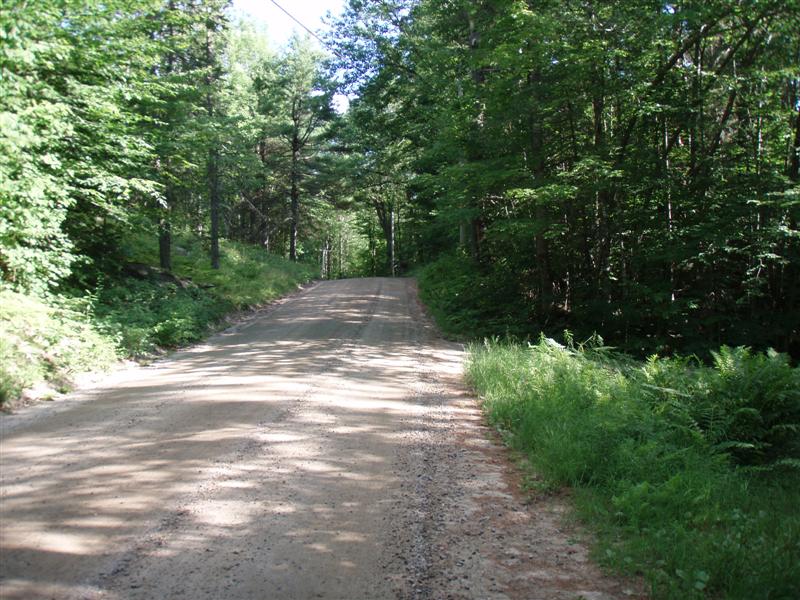
I did not have that assurance when I set out on Friday morning and discovered that the work crew had started much earlier than they've been showing up. On Thursday I had driven the dirt route through the Pine River State Forest to Granite, just to check it out. It's 17.7 miles as opposed to the usual 14 and change. It also includes a couple of stiff climbs on soft dirt and gravel, well rumpled by speeding motorists who have been using it during the bridge closure. It was still a shorter and better option than the Big Zig. Metaphorically I turned up my collar and slunk past Elm Street, hoping that no one noticed me.

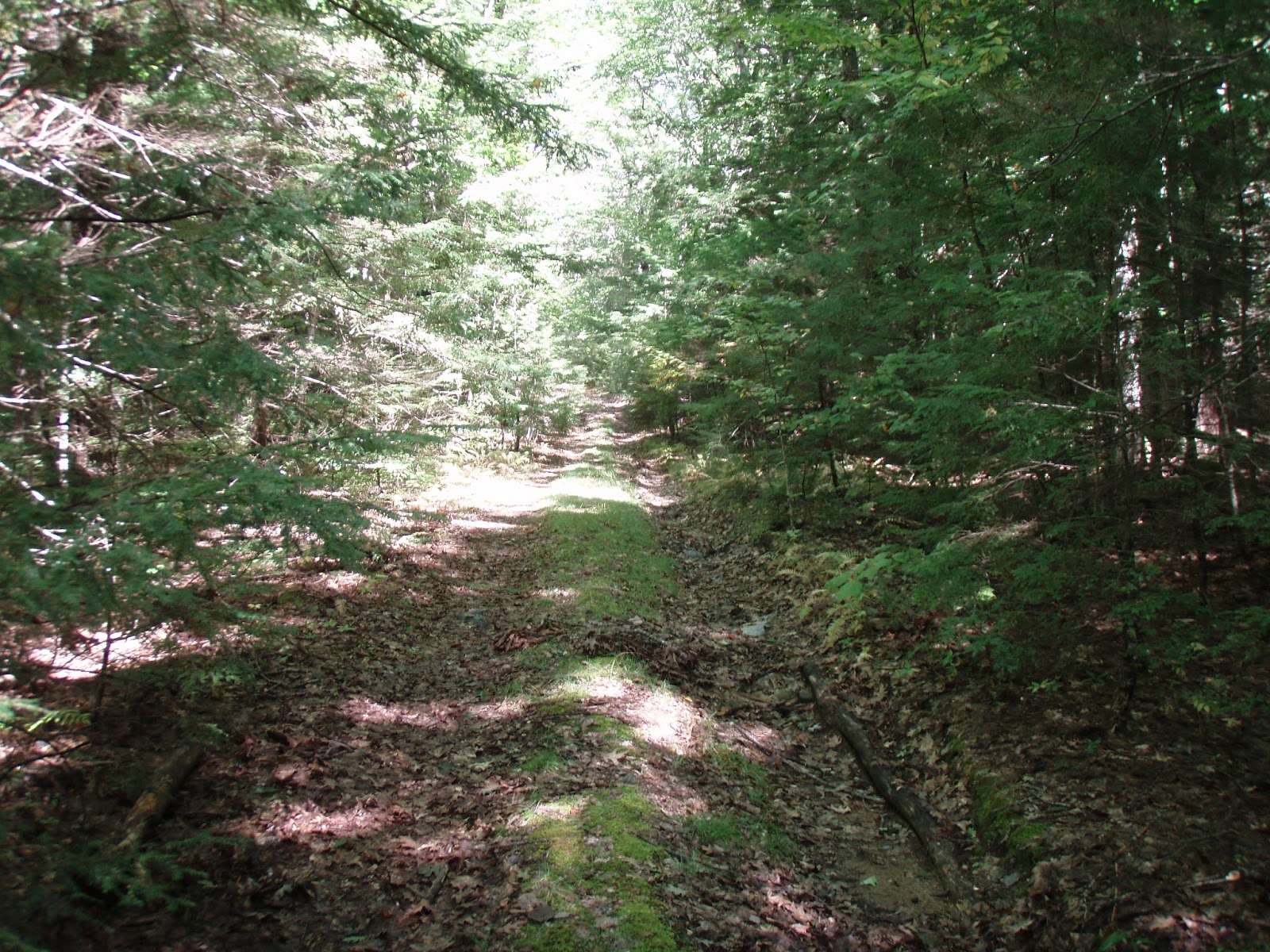
As I mentioned in an earlier post, there's another option in the PRSF as well: a snow machine trail. Because the junction is probably less than a mile into the dirt section, I figured it would save me some time even if I had to walk for half of it. Because there was still a gate and a trail sign, I figured it was okay that I hadn't brought my machete.
The road to Granite
The trail to adventure
  
The trail started out promisingly enough. The Cross Check isn't a great technical trail bike, being a tad steep and short for the real rough stuff, but that's not its main mission. It's a bike that will get you through a short stretch of the rough to connect to faster traveling surfaces.

Because I would only have to do this route on the morning half of a commute, most of it is downhill anyway. The surface is packed sand, held in place by some hardy grass -- except where it isn't. The ruts on the flatter bits and mild slopes were soft enough to make the bike wallow a little. On steeper slopes, the glacial till emerged: various-sized rocks, mostly rounded. Some larger embedded boulders or bits of ledge would have been no challenge for a mountain bike, even one from ancient times, with a rigid frame and fork and 26X2-ish tires. And, with gravity on my side, I just had to find the sweet speed to flow through it with only a few sudden swerves and dabs when the front tire dropped into a soft spot.

The river looked cool and peaceful.


On the other side of the river, the trail split. I remembered the old route that climbed up onto the esker behind the gravel pit there. I could hear the machinery of the pit. The trail had been rerouted along the base of the esker. Bearing in mind that I was already running behind schedule, I debated whether to take the easier new route. Snow machine riders are just out to have fun. They aren't on a schedule to get to a specific destination. This new section could meander all over the place, and maybe never emerge where the old route did. I needed to come out where the trail used to come out, so I could get onto Duncan Lake Road and out to Route 16 near Route 28. As bad as the old trail looked -- and it looked really bad -- I had to go that way.

The grade was a lot steeper and longer than I remembered. But then I remembered that I had almost always ridden the trail the other way, so I was descending this hell run. I do not know anyone who could have -- or would have -- ridden this climb. I dismounted and trudged over the washed out mess of rocks, overhung with tree branches. Even the fairly level top of the esker was hard to ride because of fallen trees and limbs, and slick rocks from the previous day's rain showers and the unending humidity of this summer.

The new route rejoined at the descent. The trail wasn't much better than the abandoned route, because the till underlies everything and emerges wherever the surface is disturbed.
At the bottom of this descent the trail joins a dirt road. On a mountain bike, take a left to stay on the technical trail. On the adventure commute, take a right to get to Duncan Lake Road.

 Back on the regular route it was the usual hammer to get to work. The total was just over 16 miles, and did cut out the unnecessary elevation gain going up to Granite and coming back down again, so it saved more than a mile and a half, and probably at least 15 minutes.

Elapsed time depends on how the motor is feeling that day. You don't use a bike for transportation in a rural area unless you really like riding. I love not having a car in Wolfeboro, but I work harder than the average person to get there. It certainly won't work for everyone. But as long as it works for me I'm saving a parking space for someone who needs it.

Tuesday, July 07, 2020

Territory

The rural bike commuter faces particular challenges that a rider in a more built-up area does not. For instance, alternate routes may be hard to find and considerably longer than the primary route. which is already long enough, thank you.

This morning, the bridge that connects me to the rest of my world was closed for "a minimum of two weeks," according to the bulletin on the town website. It is undergoing much needed and long delayed repairs.

The river is small and not that deep, but the bottom is irregular, with silt, sand, boulders, mud, and leeches. I'm not excited by the idea of wading across it, carrying my bike over my head. I might try it if I was wearing chest waders, but then I would have to lug the waders for the rest of the ride, or stash them somewhere near the river bank and hope they were there when I returned in the evening.

The first alternate route idea adds about 10 miles at either end, going up Green Mountain Road to Ryefield Road, to Route 25 west, to Route 16 south. It's not a nice ride once you get to 16, which has heavy traffic and no shoulder for part of it. To make it worse, the narrow part is being rebuilt, which will be great for the future, but has the road torn up and traffic snarled now and for the next couple of months at least. So even if I put the bike in the car and did a park-and-ride from The Blot (Ocean State Job Lot), I would have to sit through the inevitable delays at the construction zone.

Another alternative exits the same way as far as the 25-16 junction, but continues straight into Center Ossipee and cuts through to a back road out of the village, to go over into Tuftonboro. It adds even more mileage, and a lot more hills. When I was 30 years younger I would do it just to do it, but I felt like I had more time, I know I had more energy, and I was oblivious to the toll it was taking on my marriage. I have none of those advantages now. As part of a park and ride it would put me in an area of roads I haven't ridden in years, where I have scouted out no parking places.

I drove through it on my way home from a semi-emergency dental appointment this morning. That's what got me thinking about territory. From 1988 through the late 1990s, that was familiar ground. From May of 1988 through September of 1989, I lived on Tuftonboro Neck, so all my rides were based from there. Even after moving to Effingham, I continued to ride extended versions of my commute or training rides using those roads. I could absorb the changes incrementally as people built things, or tore them down, or logged. Seeing it transformed after years unseen I felt dispossessed. Not that I ever had any control over it, but at least I felt like part of the scene when I traveled through it on a more regular basis.

I should be used to the feeling of dispossession after growing up with it. Every time we moved, we had to learn our way around a place. Then we would leave it, and that local knowledge became obsolete. Because we lived in Annapolis, Maryland, three times, we got to study it in more detail, but it still changed in the gaps. And it was mutating rapidly when I hightailed out of there ahead of the first tsunami of character-obliterating sprawl in 1987. Any time I happen to go back to a place I inhabited before, I can usually see some outline of what I knew -- perhaps even pockets of surprising familiarity -- but I view it as a ghost. The same is true for places I would regularly visit. Summer residents up here feel territorial about the places that most of them only see for a couple of weeks or a couple of months in one season of the year.

Another alternate route uses another system of roads I used to frequent and no longer do. In April I took a ride through some of the unpaved roads near me, not thinking I might need to consider them as transportation routes. The ruts on the Class VI unmaintained portions were pretty deep. I made better time on my bike than a bunch of off-roaders were making with their trucks and Jeeps. But it would add another eight or ten miles to each end of the commute because I would have to go so far to get to another river crossing.

There used to be a snow machine trail that crossed the river on a wooden bridge, well short of the full traverse through the Pine River State Forest to the Granite Road in Ossipee. It was a favorite mountain biking segment. The loose surface of glacial till, and short, steep climbs onto an esker make it a poor prospect for the commuting bike I would want to have for the more refined surfaces on most of the rest of the route. I could see it adding an hour to each end of the ride, no matter which alternative I choose. Heroic and committed it may be, but it isn't practical.

How practical is rural bike commuting anyway? It can be hard to justify, except that I only put gas in the car once a month, and I'm forced to get beneficial exercise when my personality is otherwise pretty slothful. If I had to depend entirely on dietary discipline I would be screwed. So I'm saving petroleum, saving other people a parking space, reducing air pollution by an infinitesimal amount, and easing traffic congestion in an area that chokes on traffic in the summer. It's not as bad as Cape Cod, but it's bad enough, especially with this year's construction projects.

It may be possible to sneak through the Elm Street bridge construction if I go out early enough in the morning to nip through before they start, and return after they finish up in the evening. That's if they don't take the decking right off the bridge. However, as long as I didn't have irate workers chasing me, I could see tiptoeing across on a girder more readily than slogging through the leech-infested stream below. I'm not kidding about the leeches. They've muckled onto the hull of my scruffy old kayak because they could detect my body heat through the thin fiberglass shell.

If I could get at tall trees on the river bank I might set up a Tyrolean traverse. Talk about impractical. And the banks aren't high enough to build some sort of primitive rope and plank bridge. The shore front is private, so I would have to get landowner permission even to try. I hate talking to people any more than I have to.

Even a knocked-together ferry boat would sit there vulnerable to tampering or pilferage when I wasn't using it.

The next two weeks (or more) will be interesting.

Wednesday, November 13, 2019

A daily adventure

Nine degrees F this morning. The forecast high is 26. The ground is covered with a frozen white layer of the perfect thickness for the studded tires. I just have to make sure I dress properly for the chill now and the deeper freeze coming after sunset this afternoon.

Disclaimer: bike commuting is not for everyone. Some occupations require equipment too cumbersome for even a smokeless moped to haul around. Some people have to go too far in a day to make pedaling practical. That still leaves a lot of people who could do it but don't. It's okay. You don't have to. Life is hard enough in other ways. Don't believe me when I tell you that simply doing this one thing that seems hard can make other things feel less challenging.

Bike commuting over short distances can be much more efficient than using a motor vehicle. Even in some degree of adverse weather, the bike can make better time, and the rider can wear normal enough clothing to go right to the business of the day with little time in the transition area. As distances get longer, you will want to dress in clothing designed to make it less uncomfortable: cycling shorts, technical fabrics, closer-fitting tops, and riding shoes. You may work harder and sweat more over longer distances with headwinds or hills. It takes more commitment. You could also be called stubborn, obsessed, or thick-headed. You can hardly claim that it's more efficient and faster than driving when it gets longer than ten miles each way, unless you live in traffic hell.

I have pondered the lengthy preparations I go through at either end of a work day when the weather isn't mild enough to pull on shorts and a jersey and head right out. Even in shorts-and-a-jersey season, I change into work clothes at work and back into riding clothes to go home. It adds at most a couple of minutes, added to a few minutes more to load the bike. In cold weather, changing clothes adds a solid 15 minutes because of all the layers. This all has to be hung to dry on arrival and pulled back onto me to get ready to depart. On the days when I drive, I might put on some outerwear, and maybe change footwear, but all that goes over whatever I wore all day. On a fairly mild day, it's just a quick zip out to the waiting vehicle. If I got one of those remote start thingies, the car could already be idling. I wouldn't do that. But I could.

On the bike side, after all the dressing, departure is about as simple as throwing a leg over the bike and pushing off. So there's that.

Darkness comes early now. When I'm getting ready to head out into the frigid solitude of the bike path, I think about Jack London's protagonist in To Build a Fire. I'm just as happy not to see anyone else when I'm out there alone in the dark, but it does emphasize what an idiot I am to be out there at all. However, maybe I'm just intrepid. It isn't 75 degrees below zero. It's a temperature that Alaskans and northern Canadians would consider mild, even when it's in the single digits and glittering with frost.

Sometimes the adventure is wet. Hypothermia beckons in those conditions too. It's an extra level of bullshit that a motorist doesn't deal with. It all depends on how much you want to ride as opposed to taking the easy way out.

Obligate bike commuters, who do not have a car whether they want one or not, will have to ride in whatever conditions they get. Either that or walk, take public transportation, or hitch. I keep my own privilege in mind. But I'm also down there on the pay scale compared to the median average. I hate the median average, because it's a bullshit statistic, but it does indicate that a lot of people are managing to make too little money on a lot bigger income than mine. I don't just piss away the money I save by reducing automobile use. I do spend it on a decent diet -- which some consider a luxury -- and hope that a healthy lifestyle will help me avoid medical issues that I can't afford. We're all living on an edge we can't see. Money will only cover you so far. But the truly impoverished are really depending on the economic efficiency of human-powered transportation.

The more accustomed you are to getting yourself around and getting things done without help, the less it seems like a hardship. If you do it optionally, you'll be able to weather it a little better should it for some reason become a necessity. That was part of my rationale in bike commuting from the start. If civilization was going to fold, I would do well to be in shape before it happened rather than try to get in shape after it happened. And a modest, self-propelled lifestyle seemed like something closer to a sustainable global average than an energy-gobbling, resource-intensive one. If the debts of industrial society were suddenly going to be called in, I didn't want to be too heavily invested. That's even more true now.

Tuesday, August 07, 2018

We interrupt these brake cables...

After I spent hours cutting these interrupter levers into the brake system on my old road bike, the next commuting week offered no opportunities to try out the rig until the very last day.

It takes some creative packing to fit my standard commuting load onto a bike with no racks. I'm not ready to go full racks and fenders on the old road bike. It would just be a watered-down version of the Cross Check, not even that much lighter once I hung all the nerd-rigging on it. Just setting it up with frame pack and expander seat bag is enough of a handicap on its sporty capabilities.

After a week of shortened commutes -- park-and-rides fit around various schedule conflicts and stormy weather -- I expected more of a feeling of speed and power when I set out on the racy bike with cleated shoes and all. The fact that it was exactly a week since I had dropped a 10-foot log on my ankle while bushwhacking through a Class VI road on the previous Sunday's commute probably held me back. It's amazing how much your ankle swells up after something like that.
I had gone to check on Bickford Road, a very mellow line through North Wolfeboro, unfortunately abandoned by the modern world. I had first gone through it in 2011. In the fall of 2016, I went back to do a little stealth pruning and found it badly washed out. But I knew that some locals go through there in their trucks, so I hoped that they might have done some heavier remedial work on it. With the Cross Check and walkable shoes, I figured I could get through one way or another.

The road was in bad shape, with multiple blowdowns across it at different points. Feeling curiously adrenaliny, I attempted to heave two broken sections of a fallen birch out of the way. The longer piece slipped out of my hands and nailed my leg.

As a good uninsured American, my first thought was, "How expensive is this going to be?"

"Don't need stitches! Don't need stitches! Don't need stitches!" I said to myself as I reluctantly brought my eyes to focus on the wound. I gingerly tried to part the reddening gouge down the center of the ridge of swelling that had sprung up immediately. The news was good: no flaps. But the jagged end of the log had scraped the front of my shin, drawn this gouge down the medial side of my ankle, scraped down along the Achilles tendon, and pummeled the soft tissue hard enough to make it numb as it increased steadily in size. And I was miles into the woods, alone. I pulled my sock up for whatever compression it could provide.

Even uninjured, I would have been unable to ride for the next mile or so. The road was a rocky stream bed. The rocks were slimy and black with algae. There was standing water in some places, deep mud in others. The temperature seemed to jump up 20 degrees as mosquitoes and biting flies swarmed around me in the stifling, windless air. It was a fever swamp.

I had limped and trudged to where the road improved enough to remount and ride, almost at the junction with Stoddard Road. I still had to ride ten miles home to ice and elevate my ankle.

The numbness didn't subside for several days. After it did, the nerves decided to catch up on the pain they'd been putting off. So I shouldn't have been surprised when I didn't feel like a powerhouse, cleated shoes and all. The bike felt good. It was nice to have the auxiliary braking position. I've really gotten used to that.

Monday, September 04, 2017

Can you afford to be a technolemming?

In the 1990s I coined the term "technofascist" to describe the forces in the bike industry and their propagandists in the cycling press that insisted on ramming their innovations down everyone's throats. Recently I came up with "technolemming" to describe the consumers who self destructively run off the cliff en masse when the industry tells them that the newest great thing is just beyond the edge of it. There are more good reasons to avoid electronic shifting than to embrace it.

About once a week during the height of summer, someone comes into the shop where I work in a resort town because their electronic shifting has developed a mental issue. Among year-round residents, almost no riders own it. The ones who do are wealthy. In spite of this, the cheerleaders of over-sophisticated technology tout its reliability. Like many people in an abusive relationship, even the ones who are being kicked around by their temperamental lover swear that they still think it's worth it.

A misleading promo for SRAM eTap made it sound like they had developed electronic brakes. I had a good laugh over that for a few days until I double-checked before citing it in this blog. SRAM just has hydraulic disc brakes to go with their wireless electronic shifting. I had to perform therapy on an eTap shifter this summer. There's nothing intuitive about it. You have to learn and remember procedures, and be prepared to have nothing anyway if the batteries die or it develops any number of mysterious ailments of tiny circuitry. But its proponents fall back on statistics. More of it works than doesn't, and that should be good enough to get you to part with the coin.

I've also unstuck a few hydraulic calipers each season. Sure, brake cables can rust on a neglected bike, but sophisticated stuff rots and binds up in so many more and intricate ways. It's all great fun for the short-term addict, but it's an expensive relationship if you try to stay in it for the long haul. Crap that breaks and wears out in a few seasons may be good for the economy, but it is bad for our species and our planet. We've got to get into the habit of owning things for longer and spending whatever we spend on them to fix them, and to buy the time to use them. A bicycle used to be an elegantly simple escape from tweaky technology. The industry couldn't throw that away fast enough when the easy money hit in the 1990s. That's become the minority view of retro-geezers and weirdos. Even your stalwart "bikepackers" embrace hydraulics and suspension, judging by the photos. And those are still consumer activities that waste a person's energy on going away from their productive lives, rather than integrating their exertion into their productive lives.

Still without a car, due to a rather humorous setback suffered by my mechanic*, I rode my 29 commuting miles yesterday under threatening skies in the morning, and under the delivery of that threat in the afternoon. Given the wetness, I rode the old silver fixed gear, for ultimate simplicity. It had been perhaps a couple of years since I used it for a commute. Coming at the end of a week of full-distance commutes, it was kind of grueling. The temperature was in the 50s, with increasing rain for my whole ride home. People travel to distant lands to be this uncomfortable climbing mountains, or trekking across wildernesses, when they can be cold, wet, miserable, and totally thrashed just getting home to supper. I would not trade it.

I've had a lot of purely recreational adventures, all non-motorized. But the baseline through the decades has been bike commuting. Particularly once I moved to a rural area, I have not been able to live entirely car-free, but I will inject transportational cycling wherever I can.

Under the heading of adventure commuting, I did do park-and-paddle commutes in which I used my kayak to cross about four miles of lake and connecting channel, ending with a walk across town to work. Those were great fun, and did save some car use, but took about twice as long as a bike ride all the way from home. I did like the challenge of facing whatever the weather was dishing out: wind, rain, sleet, snow, fog, or placid beauty. Because lake traffic basically vanishes at the end of summer, I would push the season into darkness. Yeah, I might die out there, but you could have a car accident, too.

I would ski to work if there was enough graded width outside the travel lanes on the most direct line to town. Unfortunately, it would be a long, rugged bushwhack with the terrain as it is.

It is more beneficial, physically, economically, and environmentally, to use non-motorized ways to go places you have to go anyway. It is your physiology, your economy, and the environment in which you live that all improve as a result. And yet, because there are considerable social benefits, it's not just self indulgent. Traffic is eased, parking pressure is alleviated, and more people are in better shape.

A shift to durability and more physical engagement with our lives would require a period of adjustment. I don't bother to make a lot of noise about it, aside from my incessant personal whining, because so many people have so many valid excuses born of the technology, infrastructure, and attitudes we have evolved. If you're in a hurry -- and who isn't -- you get in the motor vehicle and mash the throttle. If you want to get a lot done with an awkward load of equipment across a wide geographical area, you use a motor vehicle. I have to borrow one tomorrow to take two cats for their routine vet checkups, because my car is still in the shop.

*The setback my mechanic had fits the theme of over-sophistication: He'd been stacking cars in his shop when he leaves at the end of his day, one on each lift, and another one parked below. My car was in the upper berth above a Mercedes. The Mercedes developed an electrical problem that made it immovable for about 3 hours while the mechanic sorted out its electrical issue (or dragged it away with a chain. He didn't say).

In many ways, I consider my life to be a series of carefully thought out mistakes, interspersed with impulsive blunders. I got here by a series of things that seemed like good ideas at the time. If I'd known how a lot of them were going to play out, I might have narrowed my focus earlier and lived an even less acquisitive life. But you can't change one thing without changing everything. Whatever alternate universes exist, this is the one in which I appear to be. In another one, my parents never met.

Tuesday, September 20, 2016

Alternate routes

Back in 2011, I took advantage of dry summer conditions to explore a discontinued section of road in North Wolfeboro as part of my ride home from work. I kept meaning to get back and do a little pruning to clear the smoothest line on some sections. It's only taken five years.

This summer is even drier than that summer was, but two days of tropical humidity with passing downpours activated some muddy areas and slickened up the slime on mossy rocks.

While much of the route would be no problem with the 700X32 tires on the Cross Check, there are a couple of significant eroded bits that would call for precision bike handling or a portage. It's a short cut that would not be faster.

It doesn't look like much of a road...which is good. Locals have obviously put trucks through it regularly, taking out major obstructions. Blowdowns and other obstacles have been cleared, while side growth encroaches to discourage casual use. But then somebody went through and snipped a clear line through the most bothersome vegetation.

No idea how that happened. I carry an implement in case I'm attacked by pumas, but the pumas were all busy elsewhere.

Past the unassuming entryway, the road line becomes obvious, if not clear.
This is one of the eroded areas, so it's a bit of a dance to get the bike up to the better surfaces further in. I documented the trail pretty thoroughly in the post from July 2011.

Today turned out to be another muggy one. I made a slow trip down from the top of this road, performing botanical sampling. The return trip took less than half the time.

Here's a little rare mud in this droughty summer. Beyond it was a rocky section that would probably call for a dismount on the Cross Check.
As noted in 2011, this old road bypasses both nasty climbs on the maintained roads, Stoddard and Haines Hill. It might make a nice addition to a park-and-ride using the mountain bike, but it doesn't look like a great option for regular use on the full route with the more roadworthy bike.

At least now I know.

Monday, July 25, 2011

Adventure Commuting

It starts with a line on a map.
That line circled in yellow highlighter indicates a public right of way still listed as current. It looks like any other road on the map. Any explorer of rural New England knows that the truth on the ground may look quite different.

Looking for an alternate route home after a tiring week, I examined a topographic map of the area around Stoddard Road, which had been my woodsy escape route through North Wolfeboro. Lately, cyclists had reported some bad dog incidents on Stoddard. Some dog owners have a way of relying on the public to train their unruly mutts for them. Cyclists often bear the brunt of this because we're not locked safely in an armored vehicle. I was in no mood to grind my way up Stoddard's considerable climbs only to have to deal with aggressive dogs as I wobbled over the crest.

I knew that Bickford Road goes to Haines Hill Road. It arrives there with a different name. The contours on the topographic map indicated that it comes into Haines Hill at the bottom of a tough climb that eventually leads to the same four-way intersection in North Wolfeboro that Stoddard Road enters. The contours also showed that the discontinued section of Bickford Road runs up a valley between the height of Stoddard Road and the rise of Haines Hill. It looked like a very agreeable gradient. Interesting that the two tougher roads have survived to the modern day while the easier one has fallen into disuse.

Typically I reach the Stoddard Road area by riding out the Cotton Valley Trail. Despite its many shortcomings, the Cotton Valley Trail follows a very convenient line. It is certainly free of motor vehicle traffic except if you encounter one of the rail cars for which the rails were left in place. These encounters are fairly rare.

Bickford Road began with a milder climb than the first one on Stoddard. That brought me to a beautiful little valley with a wetland in it, surrounded by the hills I would not be climbing.

Sometimes when a road changes names you will find a sign indicating the change, even if there is no obvious intersection or direction change. I hoped such a sign might nail down for sure which set of ruts I should follow into the woods to come out where I expected to on Stoddard, where I'd passed the other end of the old road many times. I knew it would be pretty rough, but that's why I bought the Cross Check. Lately I'd stuck mostly to pavement, but that was more a matter of scheduling than a formal decision to give up absurd bushwhacks as a whole.

There was no sign when I reached the turn. It had to be the right one. The ruts were overgrown with encroaching growth and had obviously channeled some pretty healthy streams of water during the last big rainstorm. Immediately after I entered them I caught something under the thick grass and fell to the left. I yanked a foot out in time to prevent a full crash.

I was a few yards in when I decided to stop for a picture of the prospect.
A little further on I snapped this shot of emergent rocks.

I pressed on without taking pictures of the two fallen trees that made me dismount and carry, or of some of the more thickly jungled sections in which saplings, tree branches, shrubbery and grasses stroked various insect life all over me.

For all of its obstacles it delivered on the promise of very gradual climbing. If the surface had been smooth I would have felt almost guilty about how completely I was cheating the hills.

Before I reached the junction with Stoddard Road I saw the back of a farm house I'd only ever seen from the front. By that I could tell that I had almost reached the maintained road.

The ruts diverged as Bickford Road met Stoddard. The first shot shows the direction in which I continued.
The second shot shows the direction from which I had always come. It also shows the contrast between a Class V maintained road and a Class VI right of way.

A Class VI right of way is still retained for public use, but nothing is done to ease passage through it. Some of them manage to keep looking a lot like a road because so many people use them. Others disappear into stands of trees and the imagination of cartographers.

I plucked a tick off my leg and crushed it between my fingernails before continuing on the familiar route home to a thorough shower.

Next time I try one of these routes I will wear more suitable shoes than my road cleats and bring some means of making fire so I can torch any ticks that get on me.