Monday, February 24th was a dazzling foretaste of spring. The sun was bright, the sky clear, and the temperature surged up to the low 50s (F). In April and May, 50 degrees feels like a punishment, but in February it calls to the prisoners of indoor training and the cross-trainers starting to remember their road bikes.
I had almost gone out on my own bike that day, but decided that it was too early to commit. I went trudging up the mountain out back instead on my 30-year-old chore skis. Still, the road and the commute begin to beckon. Daylight relocating time begins this Sunday, putting the return leg of the commute into usable light. Motorists will be able to see me.
Yesterday, I soloed at the shop. El Queso Grande had been away since Friday, getting his heart worked on. I spent much of the day alone. The ski trails are all ice and dirt after more than an inch of rain on Thursday. Then the temperature dove back down to seasonable winter cold. That turned what could have been busy ski rental days into long vigils broken by brief visits by one or two people at a time, checking out the bargains among the remnants of our winter stock. No one was available from our rotating cast of fill-in employees to work on Sunday, but it didn't really matter.
The door alarm beeped. A single customer came up the back stairs. It was a local road rider. He's a tall guy, a physician, very active, so in good shape. He does a lot of his own work on his Campy-equipped carbon road bike. I don't remember what brand it was, but it turns out that no longer matters. We exchanged greetings, and he said he was looking for a small item of apparel for his son. Then he said, "Hey, I was hit by a car the other day." It was that beautiful Monday.
He described the incident. For anyone who knows the area, or wants to look it up on their favorite map app, he came out of Dame Road and turned south on Ledge Hill Road, toward Tuftonboro Elementary School. There was no one else on the road. With no warning, blam! He was hit from behind.
"The next thing I knew, I came to in the ditch with some guy saying, 'don't try to get up.'"
The person who found him had been driving northbound on Ledge Hill and had seen a dirty white or tan SUV with the bumper torn loose on the right side. Then, just a bit further on, there was the unconscious rider and his crushed bike.
The rider was miraculously intact for having been mowed down by more than a ton of metal and glass, piloted by a few pounds of idiot. He showed me the massive bruising on his legs, and said that he had some broken ribs. Seeing as he was unconscious for a bit, he has had a mild concussion as well. But until he told me that he was only six days out from such a serious crash I would not have spotted him as injured. He moved okay. Only after he told me the story did I see a bit of caution in his gait, particularly when he headed back down the stairs to the back parking lot on his way out. He will also find that he has the inescapable touch of PTSD. He can't get right back on the bike, because the bike was destroyed, and his next scheduled activities are more winter appropriate. It will be interesting to see how his mental and emotional state evolve when riding season does get here and he gets a new bike.
Mountain bikers and path riders are all nodding sagely at this point, and congratulating themselves on their wisdom in abandoning the road to the potentially lethal motoring majority. Gravel riders are wrapping themselves in their false sense of security because they ride on roads that they perceive as having little traffic. But the doctor was on a quiet rural road, and the vehicle that hit him was the only other user. There are certain gravel roads around here that I avoid because the motorists who do use them typically drive like they've got a trunk full of moonshine and a revenuer on their tail. Other gravel roads are as placid as you might expect. You have to know your area.
The driver of the hit-and-run vehicle, now thought to be a white SUV with Florida plates, did exactly the right thing to make this a perfect crime. The one witness, the approaching driver who got a glimpse before coming around the bend and finding the victim, was unable to provide enough information to proceed with much of an investigation. Get that bumper fixed, or just tear it the rest of the way off, let a few weeks pass, and plausible deniability will take care of the rest. Or just leave the area and you'll blend in with all the other down-and-outers driving dinged-up vehicles, with no one to wonder how it got that way. Add to this the fact that law enforcement seldom has the time or interest to investigate these things fully enough to conclude them. The doctor didn't die. Even if he had, it would have been just another unfortunate loss because he didn't have the sense to quit riding his darn fool bike around like some kid.
Kids don't ride anymore. In rural areas, they probably never did, although I remember in my two years in mid-coast Maine that we fourth and fifth graders would ride well outside the village limits to get to friends who lived on farms in the surrounding countryside. Then we would play in haylofts and abandoned quarries until it was time to ride home again for supper. But you certainly see almost none of it now.
Because the driver ran away, we don't know if they were malicious or negligent. Are they celebrating their coup, cherishing the memory, or are they horrified that the phone in their hand had distracted them, and deeply relieved that the rider lived, so no harm done?
As the years have passed, and drivers have become far more numerous, with more distractions and no reduction in hostility, I look forward less and less to the start of bike commuting season. But I depend on it for its economic and physical benefits when it's not interrupted by mayhem and assault. Most of the time, the worst that happens is an unprovoked honk, a close pass, a few Dopplered obscenities, perhaps a wildly inaccurate thrown object. The fear, of course comes from the ambush hunter who will strike from behind. While drivers crossing, entering, or turning too close present the greater hazards, the rear end collision is the hardest to defend against. I can't afford a fancy camera. A mirror only works when you're looking in it, not looking at the road in front of you. The swerve could happen between mirror checks. As for video, it seems remarkably ineffective as evidence in a prosecution. The authorities have to care enough to pursue it. And that's only after an incident has taken place. Close calls get you nothing but a range of advice that boils down mostly to, "quit riding your bike, you idiot." Or cover yourself with garish colors and flashing lights, which will do absolutely nothing to deter a malicious attack.
The videos that cyclists post to elicit outrage and sympathy for their cause elicit just as much reluctance on the part of non-riders to begin riding, and lots of pushback from drivers who hate cyclists, whose blood lust is heightened when they see how easy it is to engage in some wish fulfillment. Sadly, the best response is to keep riding as if nothing had happened, happy if you are undamaged. We can't win, because the opposition is too pervasive. Only the idea can win, if in some fantasy future enough people simply don't want to drive anymore, and don't want to act like assholes on the road in or on whatever vehicles they choose.
A troll on a comment thread a few days ago told me that I am a guest on the roads entirely paid for and owned by motorists. He told me to behave myself with appropriate gratitude and stay out of the way. He responded predictably badly to rational counterpoints. His rants attracted sympathizers, even though the overall majority in the comment thread were supportive of cyclists and seconded the rational counterpoints. The anti-cyclists soon resorted to all caps. I was long gone by then, knowing better than to continue down the gas-lit path to the Troll Kingdom. But that's who is out there, throwing their weight around, emboldened by their armored vehicles. You can't think about them. Your only sure defense is abstinence. They are simply one of the many modern hazards, like mass shootings, that might or might not impact your life directly, but constantly weigh on you. Freedom isn't free. But "defense" of it is never as straightforwardly confrontational as the usual users of that slogan would have you believe. Most of the time it's done by setting an example and proceeding with courage in things that should never have been burdened with such significance.
Showing posts with label defenses. Show all posts
Showing posts with label defenses. Show all posts
Monday, March 02, 2020


Sunday, November 13, 2016
A lucky break and some chilling thoughts
When my house was broken into a couple of weeks ago, the investigating officer left his card and said I should call if I noticed anything that could help the investigation. I had little hope that the investigation would yield anything, but I did call when I noticed that a flashlight I kept near the front door had been stolen. It was a PeliLght Submersible light that I had used for kayaking. I had exchanged parts between this orange light and a black one of the same type, giving the light a distinctive appearance.
Three days later, I got a call back. Cooperating law enforcement agencies in several communities on either side of the Maine-New Hampshire border have been working on the burglary epidemic for months. They had just managed to catch and arrest a couple leaving the scene of another burglary in the next town to the north, which led investigators to a stash of loot in a town about 30 miles to the south. Among the identifiable items they recovered was my funky flashlight.
I may never see any of my stuff again. Some may have been sold or bartered. Some may have been tossed as worthless in the thief and drug addict economy. Recovered items will have to serve as evidence for an undetermined length of time. But it's nice to know that someone has officially connected names and faces to the crime.
Effingham's police chief told me that opioid users in this area may be living in the woods. Items stolen are often bartered directly for drugs, or used for survival. Thus the Gerber knife, the flashlight, and the binoculars taken from my house might go directly to support an encampment, wherever it might be.
Guess I'll have to go armed when I go bushwhacking now. What a drag. Fortunately, I do most of that in the winter, when snow will reveal the tracks of any forest dwellers. I already dress in muted colors. This may give me a better chance of seeing them before they see me.
What a thing to have to worry about. I think about it on the night commute, too. I'm riding along, brightly lit, a movable feast of useful and salable items on a deserted forest path. The illuminated person is the one at risk in the darkness. I've toyed with contingency plans for years. Now they seem more realistic. How do I escape? How quickly can I shuck reflective items, to blend with the darkness and escape or counterattack? I load my bike and personal pack with this in mind. I want my phone, a weapon, and one light in my possession, ready to run when I abandon the lighted bike and use it as bait. How I respond after that depends on how many assailants gather, and how badass they look. Certainly an open line to 911 is first. Then use the darkness myself to observe the enemy.
Probably nothing will ever happen. But you can't predict what a jonesing addict might think is a good idea. And the average lifespan of an opioid addict after the onset of addiction is 15 to 20 years. They don't instantly turn into frail twigs hovering at the edge of death. They may be sturdy, muscular people who have turned all their energy toward acquiring more of their chemical best friend by any means necessary. Whether they are truly bad or good is immaterial, if they are opportunistic, and driven by a craving.`
The path was my refuge for the night commute. If I leave it to ride the road, I'm exposed to narrow, rural highways in the darkness. That not only adds the possibility of a collision with an inattentive driver, it may increase the chance of being picked off by a "shopper" who would not have seen me if I was not right there on the public right of way.
All this is no more true than it was before I was aware of it. The opioid crisis has been building for several years. But any kind of personal contact with the effects of the crisis makes it more real. Is danger a reason not to do something worthwhile? Of course not. But new dangers add new elements to be managed.
In case you think something is too trivial to attract a miscreant's attention, consider the shaving kits: I had marveled that the thieves had taken mine when it contained nothing I thought they would want. I reckoned they had snatched it just because it might contain prescription drugs, and that they would toss it as soon as they had time to look in it. Nope. The investigating officer called to ask me to describe my shaving kit, because the people they arrested had a bunch of them. In light of that, and because you do hear about riders on urban paths getting mugged for their bikes, I figure it's only a matter of time before the light bulb comes on over some dirtbag's head around here, and they try to pick off a lone rider in a secluded setting.
Ideas like this reinforce people's idea that they are safer in their swift-moving armored vehicles than they are on a slow, wobbly bicycle. The fact that they would be safest of all on foot, efficiently but lightly armed, does not fit most people's work schedule and world view. I'm certainly not going to start hiking to work with a side arm and a medium-length blade. Not yet, anyhow. Ask me again in a couple of years, when the social order has collapsed because of disastrous economic policies and fully unleashed xenophobia. But at that point I will probably be self-employed and working from home. Or I will already have been killed while defending one or another of my less mainstream friends from the aforementioned xenophobia.
We have so much to look forward to in the exciting future created by at least 30 years of ignoring what were once soluble problems. Or maybe -- unprecedented though it may be in all of human existence -- our species will finally have that long, deep talk that we've fought countless wars and squandered millions of lives to avoid.
Three days later, I got a call back. Cooperating law enforcement agencies in several communities on either side of the Maine-New Hampshire border have been working on the burglary epidemic for months. They had just managed to catch and arrest a couple leaving the scene of another burglary in the next town to the north, which led investigators to a stash of loot in a town about 30 miles to the south. Among the identifiable items they recovered was my funky flashlight.
I may never see any of my stuff again. Some may have been sold or bartered. Some may have been tossed as worthless in the thief and drug addict economy. Recovered items will have to serve as evidence for an undetermined length of time. But it's nice to know that someone has officially connected names and faces to the crime.
Effingham's police chief told me that opioid users in this area may be living in the woods. Items stolen are often bartered directly for drugs, or used for survival. Thus the Gerber knife, the flashlight, and the binoculars taken from my house might go directly to support an encampment, wherever it might be.
Guess I'll have to go armed when I go bushwhacking now. What a drag. Fortunately, I do most of that in the winter, when snow will reveal the tracks of any forest dwellers. I already dress in muted colors. This may give me a better chance of seeing them before they see me.
What a thing to have to worry about. I think about it on the night commute, too. I'm riding along, brightly lit, a movable feast of useful and salable items on a deserted forest path. The illuminated person is the one at risk in the darkness. I've toyed with contingency plans for years. Now they seem more realistic. How do I escape? How quickly can I shuck reflective items, to blend with the darkness and escape or counterattack? I load my bike and personal pack with this in mind. I want my phone, a weapon, and one light in my possession, ready to run when I abandon the lighted bike and use it as bait. How I respond after that depends on how many assailants gather, and how badass they look. Certainly an open line to 911 is first. Then use the darkness myself to observe the enemy.
Probably nothing will ever happen. But you can't predict what a jonesing addict might think is a good idea. And the average lifespan of an opioid addict after the onset of addiction is 15 to 20 years. They don't instantly turn into frail twigs hovering at the edge of death. They may be sturdy, muscular people who have turned all their energy toward acquiring more of their chemical best friend by any means necessary. Whether they are truly bad or good is immaterial, if they are opportunistic, and driven by a craving.`
The path was my refuge for the night commute. If I leave it to ride the road, I'm exposed to narrow, rural highways in the darkness. That not only adds the possibility of a collision with an inattentive driver, it may increase the chance of being picked off by a "shopper" who would not have seen me if I was not right there on the public right of way.
All this is no more true than it was before I was aware of it. The opioid crisis has been building for several years. But any kind of personal contact with the effects of the crisis makes it more real. Is danger a reason not to do something worthwhile? Of course not. But new dangers add new elements to be managed.
In case you think something is too trivial to attract a miscreant's attention, consider the shaving kits: I had marveled that the thieves had taken mine when it contained nothing I thought they would want. I reckoned they had snatched it just because it might contain prescription drugs, and that they would toss it as soon as they had time to look in it. Nope. The investigating officer called to ask me to describe my shaving kit, because the people they arrested had a bunch of them. In light of that, and because you do hear about riders on urban paths getting mugged for their bikes, I figure it's only a matter of time before the light bulb comes on over some dirtbag's head around here, and they try to pick off a lone rider in a secluded setting.
Ideas like this reinforce people's idea that they are safer in their swift-moving armored vehicles than they are on a slow, wobbly bicycle. The fact that they would be safest of all on foot, efficiently but lightly armed, does not fit most people's work schedule and world view. I'm certainly not going to start hiking to work with a side arm and a medium-length blade. Not yet, anyhow. Ask me again in a couple of years, when the social order has collapsed because of disastrous economic policies and fully unleashed xenophobia. But at that point I will probably be self-employed and working from home. Or I will already have been killed while defending one or another of my less mainstream friends from the aforementioned xenophobia.
We have so much to look forward to in the exciting future created by at least 30 years of ignoring what were once soluble problems. Or maybe -- unprecedented though it may be in all of human existence -- our species will finally have that long, deep talk that we've fought countless wars and squandered millions of lives to avoid.
Sunday, March 13, 2016
The work of hateful cowards
This item came up in my Facebook feed. Spring seems to have brought out the haters on both sides of the Atlantic:
http://road.cc/content/news/182405-barbed-wire-booby-trap-found-kent-cycle-trail
Tacks on a trail could be considered mischief. Most likely, they will only cause a rider inconvenience rather than bodily harm. But barbed wire strung across a trail is a premeditated assault on the rider, not just sabotage of the machine.
Traps are the work of cowards. Trappers may set them out of contempt, but they are also avoiding any confrontation or accounting for the harm they might cause.
Our species produces a certain percentage of damaged people who like to inflict pain. An even larger pool justifies acts of aggression -- even passive aggression -- because the targets of the aggression have aggrieved them in some way. In most cases, you can't settle things with a fight, because you can't kill a mindset. At best you can hope to educate someone out of one. Even then, sickos remain sickos.
As population density increases, we all get on each other's nerves. Whether we're really headed down the drain of the behavioral sink is still debated in the scientific community. The higher intellect of humans at least slows the process of total degeneration by keeping notions of conscience alive in a large percentage of us. That still does not protect us from the less-evolved types who think hunting each other is a fun and effective way to solve their problems.
The joker with the barbed wire should be tangled in a length of it and rolled down a bumpy slope, just for educational purposes. Or we just wait to see what karma comes up with on its own. It's always tempting to intervene and try to speed up the process.
The first priority is always to avoid the traps and cheat the cowards of their fun. If you can get it to blow back on them, that's a bonus. If you put too much thought and energy into it, you become part of the problem yourself.
http://road.cc/content/news/182405-barbed-wire-booby-trap-found-kent-cycle-trail
Tacks on a trail could be considered mischief. Most likely, they will only cause a rider inconvenience rather than bodily harm. But barbed wire strung across a trail is a premeditated assault on the rider, not just sabotage of the machine.
Traps are the work of cowards. Trappers may set them out of contempt, but they are also avoiding any confrontation or accounting for the harm they might cause.
Our species produces a certain percentage of damaged people who like to inflict pain. An even larger pool justifies acts of aggression -- even passive aggression -- because the targets of the aggression have aggrieved them in some way. In most cases, you can't settle things with a fight, because you can't kill a mindset. At best you can hope to educate someone out of one. Even then, sickos remain sickos.
As population density increases, we all get on each other's nerves. Whether we're really headed down the drain of the behavioral sink is still debated in the scientific community. The higher intellect of humans at least slows the process of total degeneration by keeping notions of conscience alive in a large percentage of us. That still does not protect us from the less-evolved types who think hunting each other is a fun and effective way to solve their problems.
The joker with the barbed wire should be tangled in a length of it and rolled down a bumpy slope, just for educational purposes. Or we just wait to see what karma comes up with on its own. It's always tempting to intervene and try to speed up the process.
The first priority is always to avoid the traps and cheat the cowards of their fun. If you can get it to blow back on them, that's a bonus. If you put too much thought and energy into it, you become part of the problem yourself.
Friday, July 03, 2015
Devise and Conquer
A bike mechanic should do more than absorb and repeat the industry's latest technical information to keep pushing the wave of product rollouts down the long shore of history. The master of the craft knows you have to deal with a lot of other stuff that washes up in front of you after drifting derelict or perhaps breeding in the depths.
A minor challenge that has bubbled up in the last decade is, "where do I put the blinky light on this bike?"
The lights themselves usually come with various mounting options. Some of them actually solve the problem effectively. But the combination of seat height, seat bags, and other factors can make the mounting more of a token gesture. Why have an in-your-face flashing light when you end up mounting it down around hubcap level?
Yesterday I had to put Superflash lights on two low-priced bikes with sprung seats and suspension seatposts. This is a combination that makes on-bike mounting difficult, especially with the trend for frames with low stand-over clearance. The suspension mechanism on the post and the thickness of the cushy saddle mean that the solid part of the seat post may be buried in the frame. Even if a bit of it shows, it may be so low that the light is practically eclipsed by the rear tire.
Your average blinky user will not clip it to their clothing. That's too much to remember. They want the light on the bike. There it will remain, while its first set of batteries dies, bursts and destroys the circuitry. So I should not care whether the light is in the best possible location. But I can't help trying to do things in a neater, more functional way if I can.
After studying the bikes yesterday I realized I could take a bolt out of the seat spring assembly on the left side and devise a mounting point that would take the seat stay clamp provided with the light.


A minor challenge that has bubbled up in the last decade is, "where do I put the blinky light on this bike?"
The lights themselves usually come with various mounting options. Some of them actually solve the problem effectively. But the combination of seat height, seat bags, and other factors can make the mounting more of a token gesture. Why have an in-your-face flashing light when you end up mounting it down around hubcap level?
Yesterday I had to put Superflash lights on two low-priced bikes with sprung seats and suspension seatposts. This is a combination that makes on-bike mounting difficult, especially with the trend for frames with low stand-over clearance. The suspension mechanism on the post and the thickness of the cushy saddle mean that the solid part of the seat post may be buried in the frame. Even if a bit of it shows, it may be so low that the light is practically eclipsed by the rear tire.
Your average blinky user will not clip it to their clothing. That's too much to remember. They want the light on the bike. There it will remain, while its first set of batteries dies, bursts and destroys the circuitry. So I should not care whether the light is in the best possible location. But I can't help trying to do things in a neater, more functional way if I can.
After studying the bikes yesterday I realized I could take a bolt out of the seat spring assembly on the left side and devise a mounting point that would take the seat stay clamp provided with the light.

Step one: longer bolt. The nut has a step on it which will engage the hole in a washer that will form the top of the mount.

A metal washer and a rubber faucet washer go on the bolt next.

At this stage the bracket is assembled with a section of aluminum ski pole, a bottom faucet washer, a bottom metal washer and a nut to hold the whole thing together.

Here is the light bracket in place.
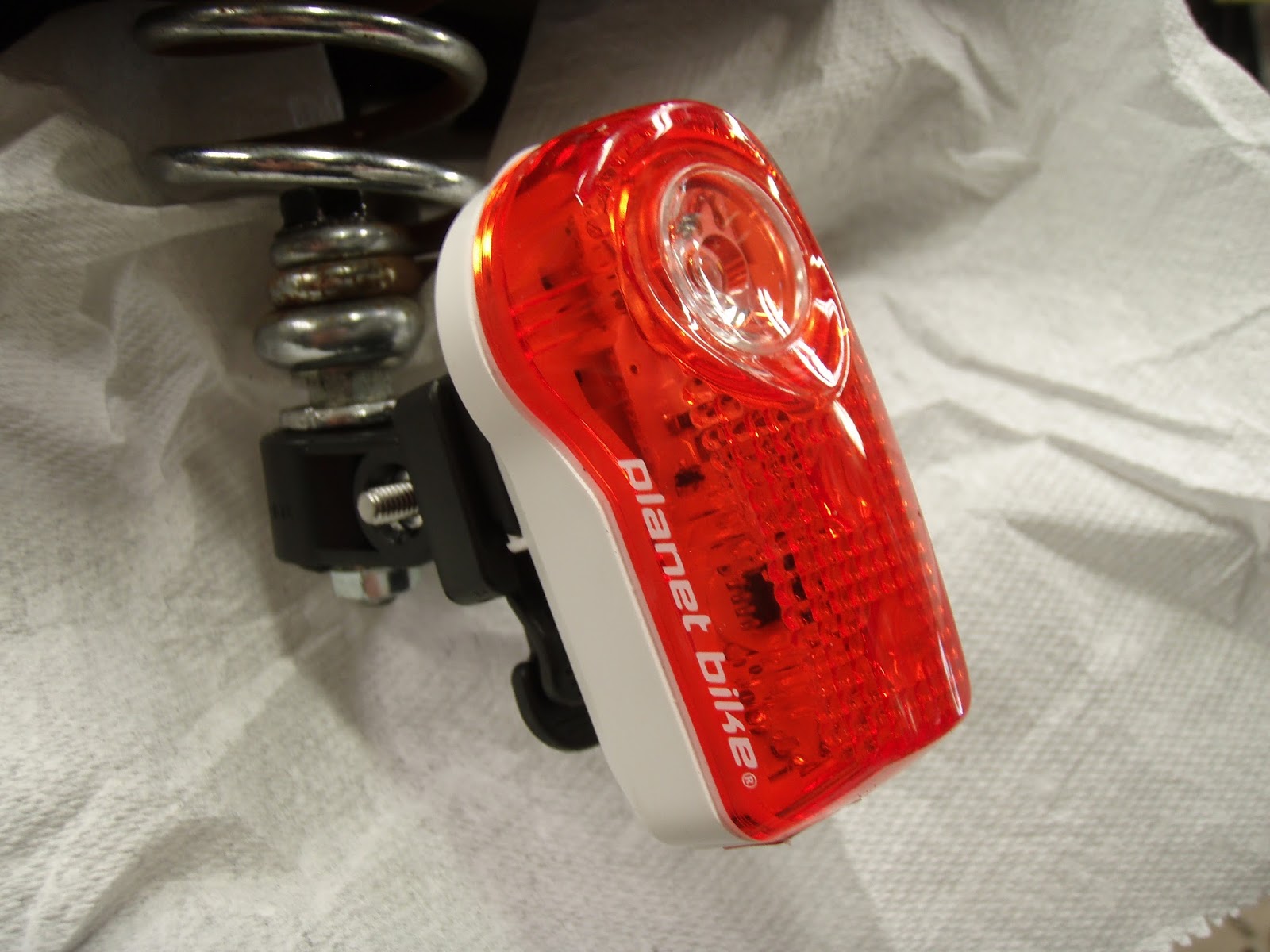
It's Superflash!

And there you have it. Ready to blink.
The rear rack limits how low the seat can go with this rig, but that would be as true with any other seat post mount. Mounting to the seat stay just puts the light down in the ground clutter.
Not a momentous accomplishment, but a nice little craft project.
Thursday, October 16, 2014
As darkness falls
Last night I headed out under cloudy skies in summer-like heat to ride the path and back roads back out to my car.
The path is not totally deserted yet, even in the outer reaches, but away from town other users are getting pretty scarce. So I might see the occasional dog walker or I might not.
I saw something. It was way out ahead of me. Dusk was not too deep yet, but against the backdrop of forest this black animal was hard to make out. Ordinarily I see a black animal without a white stripe and I figure it's a bear. They're pretty common. But when I got a profile shot this looked doglike. I thought I could see the downward sweep of a canine tail. But it was a hundred yards away in failing light. It was not near a house. It was not accompanied by a human. When I got to where it had entered the woods there was no trail. It had simply melted into the vegetation.
Here I am, unmauled and not even inconvenienced. But I wondered, not for the first time, what I don't see when I'm riding in full darkness the whole way.
October is spooky because the nights are getting longer while leaves remain on the trees to make the darkness darker under forest cover. Once November gets well established spooky just turns to dismal.
If something does come after you on a rail trail you can only flee in one direction or the other. The Cotton Valley Trail is so narrow in many places you wouldn't be able to reverse course anyway. I'll load up on garlic, silver bullets and whatnot to get through the next few weeks.
The path is not totally deserted yet, even in the outer reaches, but away from town other users are getting pretty scarce. So I might see the occasional dog walker or I might not.
I saw something. It was way out ahead of me. Dusk was not too deep yet, but against the backdrop of forest this black animal was hard to make out. Ordinarily I see a black animal without a white stripe and I figure it's a bear. They're pretty common. But when I got a profile shot this looked doglike. I thought I could see the downward sweep of a canine tail. But it was a hundred yards away in failing light. It was not near a house. It was not accompanied by a human. When I got to where it had entered the woods there was no trail. It had simply melted into the vegetation.
Here I am, unmauled and not even inconvenienced. But I wondered, not for the first time, what I don't see when I'm riding in full darkness the whole way.
October is spooky because the nights are getting longer while leaves remain on the trees to make the darkness darker under forest cover. Once November gets well established spooky just turns to dismal.
If something does come after you on a rail trail you can only flee in one direction or the other. The Cotton Valley Trail is so narrow in many places you wouldn't be able to reverse course anyway. I'll load up on garlic, silver bullets and whatnot to get through the next few weeks.
Wednesday, October 08, 2014
This guy REALLY doesn't like dogs
A woman asked me to help get her father's bike out of the car so he could leave it with us to get new tires. The front wheel was off. The bike was stuffed into the back seat of a sedan.
In the bottle cage I saw a full size can of hornet spray. I said it was a strange choice of refreshment.
"He carries that for when dogs chase him," she said.
I ventured that it was pretty harsh stuff to blast a dog with. Not only that, blowback would be pretty rough on the rider,too.
"I know," she said. "But he's been bitten a couple of times and he's 86 years old. I can't really tell him a thing."
So, word to the wise: don't startle or intimidate the old dude on the 17 inch black Fuji Absolute. And definitely don't bark at him.
In the bottle cage I saw a full size can of hornet spray. I said it was a strange choice of refreshment.
"He carries that for when dogs chase him," she said.
I ventured that it was pretty harsh stuff to blast a dog with. Not only that, blowback would be pretty rough on the rider,too.
"I know," she said. "But he's been bitten a couple of times and he's 86 years old. I can't really tell him a thing."
So, word to the wise: don't startle or intimidate the old dude on the 17 inch black Fuji Absolute. And definitely don't bark at him.
Subscribe to:
Comments (Atom)