On the Facebook page of a sort-of-young mountain bike rider, he made reference to the three whole weeks he spent working for a bike shop. He dismissed most of the bikes he had to work on as “shit.” It was a classic example of the arrogance of a category-specific rider who ranks the whole world based on his personal choices in technology and obsession.
The arrogant cyclist in any category is a common enough character to have become the stereotype of all bike riders as viewed by our hostile audience. Almost any reviews of a bike shop will mention one or more examples of dismissive conceit. And wherever non riders encounter riders, someone’s feathers will be ruffled. Disregarding the small percentage of hardcore non cyclists who will always find a reason to hate, we cyclists have to admit that a sizable percentage of us do ride in stupid and offensive ways. It is certainly not the majority, but it’s hardly rare. Riders who are impressed with themselves will expect everyone else to be equally impressed.
I love pulling off a good maneuver just as much as anyone. And when I ride the multi-use path I try to maintain my flow and give the pedestrians only as much as I have to for safety and basic courtesy. Based on the expressions on most of them, it’s never enough.
As for shit bikes, most people have the bike they feel they can afford. In 1980 I tried to work the sales floor at the shop where I worked at the time, to see if I could get more people to buy better bikes. Once in a while, it worked. But most people’s eyes would glaze when I tried to get them to buy up from nutted axles, steel rims, and vinyl vasectomy seats. That was when we sold mostly just ten-speeds and three-speeds for adults, and coaster brakes and BMX bikes for kids. When I reentered the bike business in 1989, I had more success convincing customers to aim a little higher. Even during the recession of 1988-‘92, people seemed to be able to scrape up the money for a mountain bike. But that boom is long gone, along with solidly built bikes that cost $600.
Some shops are lucky enough to be able to specialize in one or two categories they particularly like. To do that, you either need a source of independent wealth, or a strong customer base in your favorite market segment. In a rural town, you need to attract a lot of people from outside the area to finance your dream shop. Otherwise, you will have to make your living by servicing the bikes you call shit.
Youth makes a mechanic arrogant in two ways. On a basic level, young adults are automatically susceptible to arrogance as a matter of simple biology. It’s the time of life when animals try to establish breeding territory and compete for mates. Humans are complex creatures. We filter our simple urges through our technology and experience to form our self image and world view. I would be willing to bet that the vast majority of bike shop snots are males between age 20 and 40.
Anyone stupid or trapped enough to have stayed in the bike business for more than two decades has probably had all the arrogance crushed out of them. We can despise WalMart bikes because they are truly a ripoff and a danger to the people who get stuck with them. But there’s a whole world of bikes that would bore and annoy a young firebrand or a bike snob, that still have value and deserve a measure of consideration.
My opinions on bikes are shaped more by economics than by the cutting edge sophistication of their technology. I definitely prefer working on some things more than others. The tweaky new stuff is stupidly expensive and kind of a pain in the ass. Really cheap stuff presents its own challenge. Working on something twenty years old can be a relief. The people who taught me about bikes instilled a respect for the craft. It's a point of self respect to be able to work on whatever anyone throws at you, and to know something of the history and evolution of our machines.
Young riders and mechanics are handicapped by what they’ve never seen. The world begins for them at the point where they began to pay attention. Every generation goes through the same thing. A set of assumptions is provided. Only a minority will look beyond that. Even then, their analysis has to work with their grasp of basic principles. The basics for a bike nerd starting out in the mid 1970s are all cup and cone bearings and things that secure with lock nuts. Someone joining up in the 21st Century may have had some cheap equipment with cup and cone hubs and a fake sealed bottom bracket, but they surely aspire to something with all cartridge bearings, hydraulics, and electronics. Road, mountain, or other, sophistication afflicts all categories. A fashionable conceit can afflict each of them as well.
Modern riders are resigned to the idea that the components they buy and the tools they buy to work on them are all going on the junk pile in a couple of years, to be replaced by the compete set of new stuff they buy, for as long as they can afford to buy. Addicts spend money on their habit. Dealers keep feeding them stronger and stronger doses. If your riding style involves frequent crashes on rough surfaces, nothing will last long anyway. Some burn hot and short. Some endure.
Showing posts with label inexperienced mechanics. Show all posts
Showing posts with label inexperienced mechanics. Show all posts
Friday, April 12, 2019


Thursday, August 30, 2018
Hydraulic Fracturing
El Queso Grande texted me on Tuesday night to say that the workshop was slammed and that several sets of hydraulic disc brakes awaited my healing touch. The repair shop continues to challenge my intellect while depressing me in general. I keep thinking that if I was a real mechanic type, sucking on a Gauloise and not giving a shit about actually riding, I could simply take pride in fixing whatever was dumped in front of me. Or if I was young and smitten with the technology -- or not young and still smitten with the technology -- I would still feel like I worked in the candy store.
Given the choice I'd take the Gauloise. It reflects my attitude toward the consumerism and the subcultural tribalism that has fractured riding. Less than once a year something comes through the shop that I might actually desire. In truth, all I really desire is to keep my personal bikes rolling in their present form, and be able to replace each as necessary with something as close as possible when the time comes.
Just as the perfect metaphor for consumer goods marketing is cocaine, the perfect metaphor for any service occupation is sex work. Certainly in my case, I now have to handle a lot of fluids I don't want to, and stick things in places I'd rather they didn't go.
I mean brake fluid and internal cable routing, of course.
Speaking of internal cable routing, a local rider was in a crash when last Sunday's group road ride literally ran into a couple of dogs on a back back road in Ossipee. Riders have snapped forks hitting a squirrel, but this guy managed to get halfway over a Jack Russell terrier before the chainring stopped everything. The rider was banged up but able to continue the ride to get back to Wolfe City. (We haven't heard a report on the dog.) He brought me the bike to check over. His wheels needed truing. His bar tape was shredded on one side. We would check any frame and fork carefully after a crash, but with carbon fiber the stakes are higher. Because carbon is an all-or-nothing material, any crack is a serious crack.
Everything seemed remarkably good. Maybe it would have been worse if he'd hit a squirrel. I put the wheels back on and ran it through the gears. The front derailleur was rubbing the chain on the big ring. The rear derailleur was imprecise. I snugged the cables up. Things were better, but not quite perfect enough. Drive trains with 10 and 11 speeds are very sensitive to minor inaccuracies. Electronic shifting avoids the problems of cable-actuated mechanical systems, but introduces its own set of problems.
With internal cable routing, you don't get to see much of the cable. This creates the mistaken impression that the cable is protected, when it is really just inaccessible. Everything looks so clean, so aerodynamic. But what you really have are a bunch of little holes into the interior of your frame. It's a Roach Motel for dirt. Dirt makes shifting unreliable.
I turned the bike up in the work stand to check the bottom bracket cable guides. They're the Achilles heel of internal cable routing systems.
 At the very bottom of the bike, closest to the ground, the cables emerge from their little tunnels to be routed to the front derailleur through a short little tube, and to the rear derailleur through a longer sewer. Any attempt to clean this area will simply drive little dirt ninjas deeper into the interior of your frame. Your best chance is to change the cables completely, which is a time consuming and finicky task with internal routing.
I blew dirt away with a lateral burst of air from the compressor. Depending on Bernoulli to help me out, I have used directed air on numerous occasions to suck dirt away rather than blow it in. But under the bottom bracket you have openings in at least two directions at odd angles, so you can't really blast away with any method. Or you can try the shop vac.
The shifting seemed acceptable after all that.
The day had started with one brake job after another. The owner of the first bike had taken his wheel out and then squeezed the lever. He'd managed to pry the pads apart and put the wheel in, but said that the brakes didn't work. Every brake job gets written up as a bleed these days, but after I reset the pistons and cleaned the pads and rotor it seemed to be working fine. The gears were a different story. The bike is a Rockhopper 29er, just old enough to have external cables, but they're in full-length housing. The SRAM rear derailleur didn't want to fold up enough to drop the chain onto the hardest cog. Fine silty dirt and a few crashes have stiffened up the pivots so that the return spring can't retract the parallelogram completely. And fully housed cables aren't really better protected from contamination; the housing seems to produce more drag than shelter.
Next up was a double bleed on a Specialized Stumpjumper 6-Fattie that really emphasizes the evolution of mountain bikes into motorless motorcycles. On the plus side, it had SRAM brakes that take the Bleeding Edge tool, which does seem to make the process somewhat easier. I think I only had to redo the rear brake once. The pads were worn an ambiguous amount, so I put in new ones, which stiffened up the lever feel even more. Because I never get to work without interruption, meticulous procedures take even longer.
One interruption came from a customer who had brought his Orbea Orca to have a skipping problem checked out. The chain was so worn, it skipped on the derailleur pulleys. Changing chain and cassette seemed to set things right, but then he rode it and had more problems. I explained that we would ordinarily have started with cables and housing, but that the chain issue had seemed obvious, and cables and housing would have meant stripping off his sexy bar wrap. I'll sacrifice what's necessary to get a job done, but since the look of the bike was obviously important to him I didn't want to shred the cosmetics unnecessarily. Then, as we were examining the bike in the parking lot, we turned it over and found a crack in one chainstay. This was probably not the cause of the chain problems, because the ding from which it originated was small and fairly fresh. The bike did not flex or make scary noises. He's pursuing replacement through Orbea, and came in to discuss riding position and fit issues. That's never a short conversation.
The last brake bleed had to wait until this morning. The bike came from Bikes Direct to the Repair Shop. I assembled it in early July. The rear brake calipers are already a rust pit.


The bike has SRAM Guide R brakes, nominally the same as the ones that behaved reasonably well on the previous day's Stumpjumper, but these have conventional bleed ports. That calls for a slightly more cumbersome procedure, but I've done it before. The wrinkle this time is that the rider and his buddy tried to bleed the system themselves before giving up and bringing us not only their original problem but the results of whatever they had done.
The lever was whacked out. We had to reposition a couple of parts just to set it up according to the instructions to begin the actual bleeding. I'm not sure how they got things as jammed up as they did, but I could not get fluid to go through the system no matter what I did. I finally faced the fact that I was going to have to open up the lever to see why the piston did not want to move.
 This isn't all the parts. The real business was still stuck inside the lever body.
 Supposedly, when you take out a spring clip and a washer, you can reach in with the tippy tips of needle nose pliers and extract that piston. I couldn't get it to budge. I tried everything, even things that will put your eye out if you do them wrong. Eventually I was able to poke something through from the brake line end of the lever and push the piston out, but it's a very stiff fit. And between whatever they did, and what I had to do to get it out, it ain't going back in.
Of course all parts for this lever are out of stock for at least three weeks.
So there went a couple of irreplaceable hours of my life. I spend most of my time now working on equipment I would never advise anyone to buy, for a riding style that doesn't interest me in the least.
Motorless motorcycles.
If anyone ever did all the maintenance that the fine print tells them they should, they would never have time to ride. But biking is supposed to be cheap. The biggest expense is the bike, right? They're cheap to fix. There's no motor. How hard can it be?
The owner of the Stumpjumper asked me, "Is it a real pain in the ass to work on these things?"
"Yes," I said. "Everything takes longer, so we're making less money, and it's still expensive for the rider. So how's the ride?"
"It's great!" he said. "Wonderful!"
"Well there you have it then."
Even from supposedly reputable brands, low end bikes are shockingly shoddy. The upper end is staggeringly expensive not only to purchase but to maintain, if you really use it hard. Even if you want to settle for fewer features but well made componentry, it's a treasure hunt to find parts, and you'll need to know how to do your own work.
Biking has no use for elder statesmen. Expertise is only good for a short time. Does anyone in mountain biking today care what the pioneers of the sport think? Only if those pioneers repeat currently popular opinion. You're only as good as your last ride.
Just as the perfect metaphor for consumer goods marketing is cocaine, the perfect metaphor for any service occupation is sex work. Certainly in my case, I now have to handle a lot of fluids I don't want to, and stick things in places I'd rather they didn't go.
I mean brake fluid and internal cable routing, of course.
Speaking of internal cable routing, a local rider was in a crash when last Sunday's group road ride literally ran into a couple of dogs on a back back road in Ossipee. Riders have snapped forks hitting a squirrel, but this guy managed to get halfway over a Jack Russell terrier before the chainring stopped everything. The rider was banged up but able to continue the ride to get back to Wolfe City. (We haven't heard a report on the dog.) He brought me the bike to check over. His wheels needed truing. His bar tape was shredded on one side. We would check any frame and fork carefully after a crash, but with carbon fiber the stakes are higher. Because carbon is an all-or-nothing material, any crack is a serious crack.
Everything seemed remarkably good. Maybe it would have been worse if he'd hit a squirrel. I put the wheels back on and ran it through the gears. The front derailleur was rubbing the chain on the big ring. The rear derailleur was imprecise. I snugged the cables up. Things were better, but not quite perfect enough. Drive trains with 10 and 11 speeds are very sensitive to minor inaccuracies. Electronic shifting avoids the problems of cable-actuated mechanical systems, but introduces its own set of problems.
With internal cable routing, you don't get to see much of the cable. This creates the mistaken impression that the cable is protected, when it is really just inaccessible. Everything looks so clean, so aerodynamic. But what you really have are a bunch of little holes into the interior of your frame. It's a Roach Motel for dirt. Dirt makes shifting unreliable.
I turned the bike up in the work stand to check the bottom bracket cable guides. They're the Achilles heel of internal cable routing systems.

I blew dirt away with a lateral burst of air from the compressor. Depending on Bernoulli to help me out, I have used directed air on numerous occasions to suck dirt away rather than blow it in. But under the bottom bracket you have openings in at least two directions at odd angles, so you can't really blast away with any method. Or you can try the shop vac.
The shifting seemed acceptable after all that.
The day had started with one brake job after another. The owner of the first bike had taken his wheel out and then squeezed the lever. He'd managed to pry the pads apart and put the wheel in, but said that the brakes didn't work. Every brake job gets written up as a bleed these days, but after I reset the pistons and cleaned the pads and rotor it seemed to be working fine. The gears were a different story. The bike is a Rockhopper 29er, just old enough to have external cables, but they're in full-length housing. The SRAM rear derailleur didn't want to fold up enough to drop the chain onto the hardest cog. Fine silty dirt and a few crashes have stiffened up the pivots so that the return spring can't retract the parallelogram completely. And fully housed cables aren't really better protected from contamination; the housing seems to produce more drag than shelter.
Next up was a double bleed on a Specialized Stumpjumper 6-Fattie that really emphasizes the evolution of mountain bikes into motorless motorcycles. On the plus side, it had SRAM brakes that take the Bleeding Edge tool, which does seem to make the process somewhat easier. I think I only had to redo the rear brake once. The pads were worn an ambiguous amount, so I put in new ones, which stiffened up the lever feel even more. Because I never get to work without interruption, meticulous procedures take even longer.
One interruption came from a customer who had brought his Orbea Orca to have a skipping problem checked out. The chain was so worn, it skipped on the derailleur pulleys. Changing chain and cassette seemed to set things right, but then he rode it and had more problems. I explained that we would ordinarily have started with cables and housing, but that the chain issue had seemed obvious, and cables and housing would have meant stripping off his sexy bar wrap. I'll sacrifice what's necessary to get a job done, but since the look of the bike was obviously important to him I didn't want to shred the cosmetics unnecessarily. Then, as we were examining the bike in the parking lot, we turned it over and found a crack in one chainstay. This was probably not the cause of the chain problems, because the ding from which it originated was small and fairly fresh. The bike did not flex or make scary noises. He's pursuing replacement through Orbea, and came in to discuss riding position and fit issues. That's never a short conversation.
The last brake bleed had to wait until this morning. The bike came from Bikes Direct to the Repair Shop. I assembled it in early July. The rear brake calipers are already a rust pit.

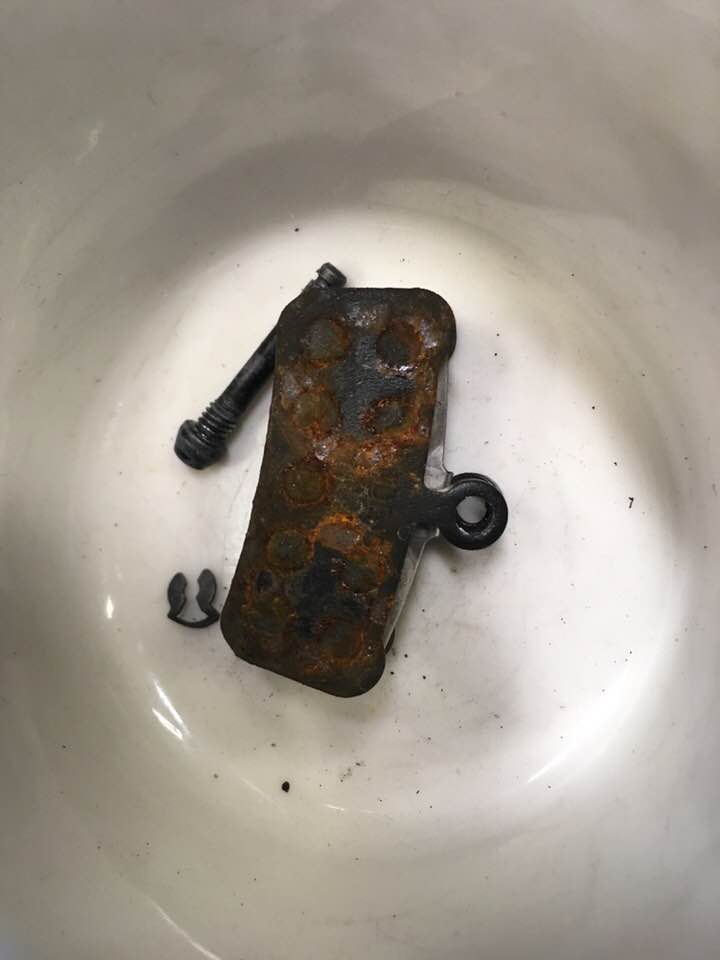
The bike has SRAM Guide R brakes, nominally the same as the ones that behaved reasonably well on the previous day's Stumpjumper, but these have conventional bleed ports. That calls for a slightly more cumbersome procedure, but I've done it before. The wrinkle this time is that the rider and his buddy tried to bleed the system themselves before giving up and bringing us not only their original problem but the results of whatever they had done.
The lever was whacked out. We had to reposition a couple of parts just to set it up according to the instructions to begin the actual bleeding. I'm not sure how they got things as jammed up as they did, but I could not get fluid to go through the system no matter what I did. I finally faced the fact that I was going to have to open up the lever to see why the piston did not want to move.


Of course all parts for this lever are out of stock for at least three weeks.
So there went a couple of irreplaceable hours of my life. I spend most of my time now working on equipment I would never advise anyone to buy, for a riding style that doesn't interest me in the least.
Motorless motorcycles.
If anyone ever did all the maintenance that the fine print tells them they should, they would never have time to ride. But biking is supposed to be cheap. The biggest expense is the bike, right? They're cheap to fix. There's no motor. How hard can it be?
The owner of the Stumpjumper asked me, "Is it a real pain in the ass to work on these things?"
"Yes," I said. "Everything takes longer, so we're making less money, and it's still expensive for the rider. So how's the ride?"
"It's great!" he said. "Wonderful!"
"Well there you have it then."
Even from supposedly reputable brands, low end bikes are shockingly shoddy. The upper end is staggeringly expensive not only to purchase but to maintain, if you really use it hard. Even if you want to settle for fewer features but well made componentry, it's a treasure hunt to find parts, and you'll need to know how to do your own work.
Biking has no use for elder statesmen. Expertise is only good for a short time. Does anyone in mountain biking today care what the pioneers of the sport think? Only if those pioneers repeat currently popular opinion. You're only as good as your last ride.
Friday, March 23, 2018
The misunderstanders write the history books
Dredging around on the interwebs for a certain specific mutant mountain bike from the 1990s, I found a site depicting bikes of that period, viewed through the perception of young modernists. Discussing the flat, narrow handlebars we ran back then, these analysts said that we did it to reduce weight. This is entirely inaccurate.
The mountain bikes of the early ‘90s had short top tubes and long stems. We cut the bars down for better clearance on narrow trails, and to reduce unnecessary steering leverage. No one today understands bar ends, either. I don’t miss bar ends, because I bought a late ‘90s frame with a longer top tube, and put wider bars with more sweep on it, but I also don’t ride off-road in the 1990s cruising style anymore. Back then our rides were little journeys, not a series of linked stunts. We actually chose to challenge ourselves with long climbs, and liked riding cross-country.
The inheritors of mountain biking, the children of parks, ramps, moto-style courses and highly evolved suspension, have come up with their own narrative about a world they never knew. It doesn’t matter. Mountain bikers can pick and choose which antecedents to honor. It’s a young person’s game, so it will always exist in the present and recent past. The machines of history will be judged by the standards of modern riders who have not had to fumble through the period of discovery and refinement.
The older I get, the younger I realize the ages are that I once thought of as old. But if your sport is highly likely to tax your body’s ability to heal quickly, it is a young person’s game.
Back when cycling was just cycling, riders pedaled as best they could over whatever surfaces they had. The first bike ride across the United States predated the first official transcontinental road by about 30 years. And that was on a bike with skinny tires and no suspension. Really differentiated speciation didn't afflict us until the late 20th Century.
Granted, bicycling innovators experimented relentlessly, and forms of suspension can be seen from the beginning. At the start, roads themselves were often little more than trails in some places, or a set of ruts that would be dusty or muddy depending on the season.
The first mountain bikes continued that time line of branching but still related lines. The basic objective was the same: get from point A to point B over a given type of terrain. Riders in different regions, with different backgrounds, took the basic form and mutated it to suit their local conditions and tastes. Are your trees close together? Cut your bars down.
Commuting in the city, I had 38cm drop bars on my fixed gear so that I could slip through skinny gaps. On my open-road bike I had 44cm drop bars. When I started commuting over longer distances of open road, and didn't need to thread the needle in a tight cityscape with close traffic and parked cars, I put wider bars on all my bikes. It's called adaptation. Riders who adopted the mountain bike as an urban platform also modified their bars based on those considerations. Riders who visited our rugged, forested part of New England from the wide-open spaces of the golden West often had bikes adapted to plush singletrack through open range and meadows. But even they exhibited slightly narrower bars than the current norm, because of the top-tube-to-stem ratio I already cited.
Different brands adopted the longer cockpit gradually, taking a couple or three years to shift every company's offerings to the format now viewed as normal. Stems shortened. Bars widened. Riders wanted to sit up a little higher for better weight distribution and a better view down the trail. With suspension, you don't want to risk being way out over the front end of the bike. With full suspension, you can and should stay more neutral on the bike anyway. And of course suspension has bred its own nuances of kinetics to propel the bike. Once you embrace the expense and complexity of a fully modern mountain bike, you might as well take advantage of everything it has to offer in return for its need for maintenance.
The website also dismissed threaded headsets as a misguided carryover from road biking. The article states that the pounding of mountain biking would make the locknut and top cone loosen up. If the headset had been properly adjusted and secured, it would not loosen. The major problem is that the explosion of bike business led to an explosion of shops, and a need to hire lots of "mechanics" while still trying to pay them dirt. Legions of inexperienced people came in who had no idea how a locknut works, and no patience. And why should they, when they just took the job to get the employee discount on schwag, and their employer was trying to nickel and dime them?
I ran threaded headsets without a problem until the turn of the century, when you could hardly find good quality product in quill stems and threaded headsets. The threadless headset is very convenient to work on, but it makes adjustment of bar height an awkward yank a lot of the time. Young riders on their stunt machines don't mind being locked in at an aggressive angle. Riders looking for a little more relaxation end up with a stack of spacers or a stem with a dorky rise that makes the bike steer funny.
Their picture shows someone adjusting the threaded headset without a stem in place, which will result in a headset that binds once the stem is installed and tightened. That kind of makes my point that the vast majority of people getting into the game in the 1990s knew the latest thing, but they didn't know everything. And now the current archaeologists look back from what they know and guess about what they see.
The mountain bikes of the early ‘90s had short top tubes and long stems. We cut the bars down for better clearance on narrow trails, and to reduce unnecessary steering leverage. No one today understands bar ends, either. I don’t miss bar ends, because I bought a late ‘90s frame with a longer top tube, and put wider bars with more sweep on it, but I also don’t ride off-road in the 1990s cruising style anymore. Back then our rides were little journeys, not a series of linked stunts. We actually chose to challenge ourselves with long climbs, and liked riding cross-country.
The inheritors of mountain biking, the children of parks, ramps, moto-style courses and highly evolved suspension, have come up with their own narrative about a world they never knew. It doesn’t matter. Mountain bikers can pick and choose which antecedents to honor. It’s a young person’s game, so it will always exist in the present and recent past. The machines of history will be judged by the standards of modern riders who have not had to fumble through the period of discovery and refinement.
The older I get, the younger I realize the ages are that I once thought of as old. But if your sport is highly likely to tax your body’s ability to heal quickly, it is a young person’s game.
Back when cycling was just cycling, riders pedaled as best they could over whatever surfaces they had. The first bike ride across the United States predated the first official transcontinental road by about 30 years. And that was on a bike with skinny tires and no suspension. Really differentiated speciation didn't afflict us until the late 20th Century.
Granted, bicycling innovators experimented relentlessly, and forms of suspension can be seen from the beginning. At the start, roads themselves were often little more than trails in some places, or a set of ruts that would be dusty or muddy depending on the season.
The first mountain bikes continued that time line of branching but still related lines. The basic objective was the same: get from point A to point B over a given type of terrain. Riders in different regions, with different backgrounds, took the basic form and mutated it to suit their local conditions and tastes. Are your trees close together? Cut your bars down.
Commuting in the city, I had 38cm drop bars on my fixed gear so that I could slip through skinny gaps. On my open-road bike I had 44cm drop bars. When I started commuting over longer distances of open road, and didn't need to thread the needle in a tight cityscape with close traffic and parked cars, I put wider bars on all my bikes. It's called adaptation. Riders who adopted the mountain bike as an urban platform also modified their bars based on those considerations. Riders who visited our rugged, forested part of New England from the wide-open spaces of the golden West often had bikes adapted to plush singletrack through open range and meadows. But even they exhibited slightly narrower bars than the current norm, because of the top-tube-to-stem ratio I already cited.
Different brands adopted the longer cockpit gradually, taking a couple or three years to shift every company's offerings to the format now viewed as normal. Stems shortened. Bars widened. Riders wanted to sit up a little higher for better weight distribution and a better view down the trail. With suspension, you don't want to risk being way out over the front end of the bike. With full suspension, you can and should stay more neutral on the bike anyway. And of course suspension has bred its own nuances of kinetics to propel the bike. Once you embrace the expense and complexity of a fully modern mountain bike, you might as well take advantage of everything it has to offer in return for its need for maintenance.
The website also dismissed threaded headsets as a misguided carryover from road biking. The article states that the pounding of mountain biking would make the locknut and top cone loosen up. If the headset had been properly adjusted and secured, it would not loosen. The major problem is that the explosion of bike business led to an explosion of shops, and a need to hire lots of "mechanics" while still trying to pay them dirt. Legions of inexperienced people came in who had no idea how a locknut works, and no patience. And why should they, when they just took the job to get the employee discount on schwag, and their employer was trying to nickel and dime them?
I ran threaded headsets without a problem until the turn of the century, when you could hardly find good quality product in quill stems and threaded headsets. The threadless headset is very convenient to work on, but it makes adjustment of bar height an awkward yank a lot of the time. Young riders on their stunt machines don't mind being locked in at an aggressive angle. Riders looking for a little more relaxation end up with a stack of spacers or a stem with a dorky rise that makes the bike steer funny.
Their picture shows someone adjusting the threaded headset without a stem in place, which will result in a headset that binds once the stem is installed and tightened. That kind of makes my point that the vast majority of people getting into the game in the 1990s knew the latest thing, but they didn't know everything. And now the current archaeologists look back from what they know and guess about what they see.
Wednesday, May 20, 2015
Move the finish line
As you may recall, Jake the Satanic Serpent absolutely refused to shift into the lowest gear on the rear cassette. Based on the noises from the inaccessible interior and the way it acted like it had too much and too little cable tension at the same time, I wondered if the cables had been run correctly when the bike was built. If they had somehow gotten tangled with each other, running a guide sleeve to install new cables would simply replicate the error.
With a bit of time to think about it I realized I could feel for any interference by shifting to the mid range on the rear and feeling the exposed section of cable below the chain stay as I shifted the front. There was nary a twitch.
Jake seemed strangely well-behaved today, even before I started adjusting things. The rear derailleur shifted pretty smoothly through ten of eleven cogs. But that last step, onto the lowest gear, was like a wall.
The limit screws on the rear derailleur were backed out far enough that it would start to shift into the spokes if I pulled cable tension by hand or simply shoved the derailleur over. The problem lay in the ratchet of the brifter itself. It could not pull any more cable. The rear derailleur cable was led properly, but the eleventh cog calls for tension at an angle that reduces the cable pull by just enough to prevent the shift.
If the derailleur won't go to low gear, low gear must come to the derailleur. A 1mm spacer was too thick for the lock ring threads to engage, but I had a .7mm spacer left over from someone else's weird problem. It was just enough to get the shifting to work across all rear gears from both front rings, in today's barometric pressure, relative humidity, wind speed and direction, with brand new cables and housing and everything clean.
That's as good as it gets with a lot of this ultra-modern stuff.
Jake's unfortunate owner is taking up these problems with the shop where he got the bike. I fully expect them to tell him I'm full of shit and the bike is fine.
If it comes back again, choking on silt, I'm going to drill bigger cable exit holes in the down tube by the BB. Maybe I'll cut a few big inspection ports in it, too.
Barcons, man. Eight speeds. Maybe nine. If he really wants to be competitive in 'cross, finicky brifters are just the beginning. He's going to have to turn into one of these neurotics with four different sets of sewup wheels. If that's not where he wants to go, why put up with this shit? Ah, but I ask myself that question many times a day in bike season. People believe the industry's marketing bullshit. They only have a choice of pseudo-racer tweakitude or some other very specific category. Even the all-around roadish bike has to be "a gravel bike" so it can be another freaking category.
******
High-dollar tickets often start with the words, "my friend gave me this bike." Or it might be, "my friend sold me his old bike when he got a new one," but there's always a friend. Friendship can apparently survive a lot.
The next bike after the Serpent was a Giant full suspension mountain bike, archaeologically dated to about 2004. The guy who brought it in initially just wanted to buy toe clips, a bottle cage and bar ends and install them himself. Cool, no problem. But as I looked over the bike to answer his questions I saw a few things and he began to open up about problems he had experienced with it. It wasn't shifting right. The old Avid BBDB cable disk brakes needed pads in the rear. The right crank arm was floppy loose.
Between the floppy crank arm on the drive side and the fact that the bottom bracket was crawling out of the frame, it's no wonder the bike did not shift right.
Luck was with this guy. The ISIS splined crank arm was not damaged from being ridden loose. I was able to examine the BB cartridge and crank it back in, before graunching down on the crank arm bolts with all the power of a mighty breaker bar.
Note: splined crank arms require frequent reapplications of high torque. They do not stay tight the way contemptible old stone-age square taper axles and crank arms do. Not to say you don't need to check those at somewhat regular intervals, especially after removal and reinstallation, but the square taper interface is supposed to be a press fit. Splined axles are not a press fit. So the bolt has to be tight tight tight.
Notice that the industry has basically abandoned the splined cartridge in favor of the cranks with the BB axle swaged into one side or the other of the crankset itself. This has led to its own set of problems, of course.
Once I had the Giant's BB back in the frame and the crank arms firmly attached I could start adjusting the gears. On the front derailleur I found another moving finish line: Someone had steadily shifted the limit screws on the front derailleur to chase the crank as it moved further and further out. Yep. Don't fix the underlying problem. Just move the derailleur.
Chaos is upon us. You can't look at the whole pile, only at what is right in front of you. Straighten one out, move it along. Grab the next one.
With a bit of time to think about it I realized I could feel for any interference by shifting to the mid range on the rear and feeling the exposed section of cable below the chain stay as I shifted the front. There was nary a twitch.
Jake seemed strangely well-behaved today, even before I started adjusting things. The rear derailleur shifted pretty smoothly through ten of eleven cogs. But that last step, onto the lowest gear, was like a wall.
The limit screws on the rear derailleur were backed out far enough that it would start to shift into the spokes if I pulled cable tension by hand or simply shoved the derailleur over. The problem lay in the ratchet of the brifter itself. It could not pull any more cable. The rear derailleur cable was led properly, but the eleventh cog calls for tension at an angle that reduces the cable pull by just enough to prevent the shift.
If the derailleur won't go to low gear, low gear must come to the derailleur. A 1mm spacer was too thick for the lock ring threads to engage, but I had a .7mm spacer left over from someone else's weird problem. It was just enough to get the shifting to work across all rear gears from both front rings, in today's barometric pressure, relative humidity, wind speed and direction, with brand new cables and housing and everything clean.
That's as good as it gets with a lot of this ultra-modern stuff.
Jake's unfortunate owner is taking up these problems with the shop where he got the bike. I fully expect them to tell him I'm full of shit and the bike is fine.
If it comes back again, choking on silt, I'm going to drill bigger cable exit holes in the down tube by the BB. Maybe I'll cut a few big inspection ports in it, too.
Barcons, man. Eight speeds. Maybe nine. If he really wants to be competitive in 'cross, finicky brifters are just the beginning. He's going to have to turn into one of these neurotics with four different sets of sewup wheels. If that's not where he wants to go, why put up with this shit? Ah, but I ask myself that question many times a day in bike season. People believe the industry's marketing bullshit. They only have a choice of pseudo-racer tweakitude or some other very specific category. Even the all-around roadish bike has to be "a gravel bike" so it can be another freaking category.
******
High-dollar tickets often start with the words, "my friend gave me this bike." Or it might be, "my friend sold me his old bike when he got a new one," but there's always a friend. Friendship can apparently survive a lot.
The next bike after the Serpent was a Giant full suspension mountain bike, archaeologically dated to about 2004. The guy who brought it in initially just wanted to buy toe clips, a bottle cage and bar ends and install them himself. Cool, no problem. But as I looked over the bike to answer his questions I saw a few things and he began to open up about problems he had experienced with it. It wasn't shifting right. The old Avid BBDB cable disk brakes needed pads in the rear. The right crank arm was floppy loose.
Between the floppy crank arm on the drive side and the fact that the bottom bracket was crawling out of the frame, it's no wonder the bike did not shift right.
Luck was with this guy. The ISIS splined crank arm was not damaged from being ridden loose. I was able to examine the BB cartridge and crank it back in, before graunching down on the crank arm bolts with all the power of a mighty breaker bar.
Note: splined crank arms require frequent reapplications of high torque. They do not stay tight the way contemptible old stone-age square taper axles and crank arms do. Not to say you don't need to check those at somewhat regular intervals, especially after removal and reinstallation, but the square taper interface is supposed to be a press fit. Splined axles are not a press fit. So the bolt has to be tight tight tight.
Notice that the industry has basically abandoned the splined cartridge in favor of the cranks with the BB axle swaged into one side or the other of the crankset itself. This has led to its own set of problems, of course.
Once I had the Giant's BB back in the frame and the crank arms firmly attached I could start adjusting the gears. On the front derailleur I found another moving finish line: Someone had steadily shifted the limit screws on the front derailleur to chase the crank as it moved further and further out. Yep. Don't fix the underlying problem. Just move the derailleur.
Chaos is upon us. You can't look at the whole pile, only at what is right in front of you. Straighten one out, move it along. Grab the next one.
Wednesday, April 01, 2015
Housing crunch
And so my season begins. Local rider brings in the bike he got somewhere else because the shifting went bad on him during his abusive first ride.
Kona Jake the Snake cyclocross bike. New 105 11-speed. "I read that it's hard to adjust," he said. "So I brought it to you."
"I kept twisting the barrel adjusters the whole ride," he went on. "It was never right." He added that the ride group wallowed through a lot of mud and snow.
The way the internal cable routing was done, the shift cables can't be cross routed. That would have helped with the angle up front. Either way, longer housing will feed it more smoothly into the stops. The in-line barrel adjusters need to be moved closer to the handlebars because the housing can't be led to the opposite sides of the head tube. All this could have been done by an imaginative mechanic during assembly. Now it will cost him a couple of shift cables and some new housing. As they're done now, the plastic ferrules on the constrictive 4mm housing are already kinking after about 50 miles.
This kind of rescue operation after some other mechanic's ethical lapse or simple inexperience really makes me tired. I could just dial it in as closely as I can and tell him he'll have to live with it, but I want to see if it can be improved. In terms of ultra modern bike componentry, that means, "be made to work more or less adequately for as much as a couple of months."
I already noticed that the housing for the rear cable disc brake aims upward, where it will surely collect water. So that'll be rusting in within months. But it's got eleven speeds. And carbon forks. Oo, baby. Value added.
Something sounds raspy in the impenetrable interior of the cable path through the frame. The bike came with the same weird, brown cables that Big G's Roubaix had, with some shreddy coating on them. On this bike, wads of scuffed-off coating are wedged like old snake skin at friction points in the system. Who knows how much of that is binding the new cable inside the down tube where no one can get at it.
With new cables and better-aligned housing, the shifting still won't dial in. But as you slog through the mud in your three or four working gears out of 22 (I'm being optimistic), you can rest assured your bike looks really sharp and is aerodynamically its most efficient, thanks to the internal cable routing.
As so often happens, you have to do the job to see if the job can be done. So after the extra rigamarole of a routine internal cable change I'm only a little better off than I was before. I'll know after more fiddling whether I can raise this annoying piece of crap to an acceptable level of function.
Kona Jake the Snake cyclocross bike. New 105 11-speed. "I read that it's hard to adjust," he said. "So I brought it to you."
"I kept twisting the barrel adjusters the whole ride," he went on. "It was never right." He added that the ride group wallowed through a lot of mud and snow.
The way the internal cable routing was done, the shift cables can't be cross routed. That would have helped with the angle up front. Either way, longer housing will feed it more smoothly into the stops. The in-line barrel adjusters need to be moved closer to the handlebars because the housing can't be led to the opposite sides of the head tube. All this could have been done by an imaginative mechanic during assembly. Now it will cost him a couple of shift cables and some new housing. As they're done now, the plastic ferrules on the constrictive 4mm housing are already kinking after about 50 miles.
This kind of rescue operation after some other mechanic's ethical lapse or simple inexperience really makes me tired. I could just dial it in as closely as I can and tell him he'll have to live with it, but I want to see if it can be improved. In terms of ultra modern bike componentry, that means, "be made to work more or less adequately for as much as a couple of months."
I already noticed that the housing for the rear cable disc brake aims upward, where it will surely collect water. So that'll be rusting in within months. But it's got eleven speeds. And carbon forks. Oo, baby. Value added.
Something sounds raspy in the impenetrable interior of the cable path through the frame. The bike came with the same weird, brown cables that Big G's Roubaix had, with some shreddy coating on them. On this bike, wads of scuffed-off coating are wedged like old snake skin at friction points in the system. Who knows how much of that is binding the new cable inside the down tube where no one can get at it.
With new cables and better-aligned housing, the shifting still won't dial in. But as you slog through the mud in your three or four working gears out of 22 (I'm being optimistic), you can rest assured your bike looks really sharp and is aerodynamically its most efficient, thanks to the internal cable routing.
As so often happens, you have to do the job to see if the job can be done. So after the extra rigamarole of a routine internal cable change I'm only a little better off than I was before. I'll know after more fiddling whether I can raise this annoying piece of crap to an acceptable level of function.
Wednesday, September 24, 2014
Truth in labeling


Everything I did was easily reversible, unlike most of what the rider, his last mechanic and a careless family member have done. Parts are on order. I can pass the time until they arrive cleaning off the coating of either 90 weight or chainsaw bar oil on the entire bike.
Thursday, July 03, 2014
Funky assembly #479
"I was told this bike was put together by someone who didn't know what they were doing," the customer said. She brought in an early- '90s Cannondale road bike. Initially she had wanted to know if the bike would take wide enough tires to ride comfortably on the local rail trail. At best the frame and fork would accommodate a 28 tire if it wasn't too tall. So the discussion moved to a tune up.
"Someone I was riding with said the brakes were backwards or something," she added. We haven't figured out what that meant, but I've found a few other weird things. No one had mentioned the horribly stiff headset. I took that apart to find it packed with something that acts more like plumber's putty than grease.
 I'm having to pick the stiffened crud out manually because it will not dissolve in any solvent I have tried so far.
The workshop has gone from a trickle of repairs to a flood. Before you say some stupid thing like, "It's great to be busy," imagine getting six weeks worth of meat by having a 12 pound pot roast shoved down your throat. This shit was fun back in the rockin' 1990s, with another really good full time mechanic sharing the load. We were a center of activity then, not an afterthought. We're just another errand now, like getting the dry cleaning done. Maybe we get a tad more appreciation, but no more of the old feeling that we were in the middle of the action.
Since I started writing this a couple of hours ago I've been dragged away from the cruddy headset to deal with several more urgent crises. And the headset was part of a repair already marked as urgent itself.
Back to it.
"Someone I was riding with said the brakes were backwards or something," she added. We haven't figured out what that meant, but I've found a few other weird things. No one had mentioned the horribly stiff headset. I took that apart to find it packed with something that acts more like plumber's putty than grease.
The workshop has gone from a trickle of repairs to a flood. Before you say some stupid thing like, "It's great to be busy," imagine getting six weeks worth of meat by having a 12 pound pot roast shoved down your throat. This shit was fun back in the rockin' 1990s, with another really good full time mechanic sharing the load. We were a center of activity then, not an afterthought. We're just another errand now, like getting the dry cleaning done. Maybe we get a tad more appreciation, but no more of the old feeling that we were in the middle of the action.
Since I started writing this a couple of hours ago I've been dragged away from the cruddy headset to deal with several more urgent crises. And the headset was part of a repair already marked as urgent itself.
Back to it.
Subscribe to:
Comments (Atom)