Showing posts with label junk box custom. Show all posts

Thursday, August 25, 2022

A bike on demand

This was a test of the Emergency Beater Bike System.

The cellist wanted me to have a bike in Delaware, so that we could ride when I visit her during the school year. Each of the bikes I already built has a specific profile. Even if I haven’t used a particular one in a while, I might. And the least used is the hardest to replace. I needed another bike, and quickly. We were heading south in about a week.

Any good bike mechanic has a bike’s worth of pieces around. This is true whether you’re a professional or just an enthusiast. If you’ve gotten very far into doing your own work, you’ve collected parts, and perhaps frames, and wheels.

The first frame I pulled out was a sporty little Univega road bike from the early 1980s. I’d used it in 1994-‘95 when my primary road frame needed repairs. I inventoried parts on hand and brought home the ones I needed. But at the beginning of assembly I discovered that the 700x28 tires would never fit. The 28s were barely wide enough for an urban exploration bike. I needed a different frame.

Fortunately, someone had abandoned an intact Raleigh Grand Prix from about 1972 and I’d brought it home as a fixed gear prospect. Between what it already had and my archive of parts dating back to the mid 1970s, it should go together as fast as I could slap the parts on. Right?

Of course not. Maybe building a complete gruppo on a perfect new frame designed for it, but not in the gritty world of junk-box custom. 

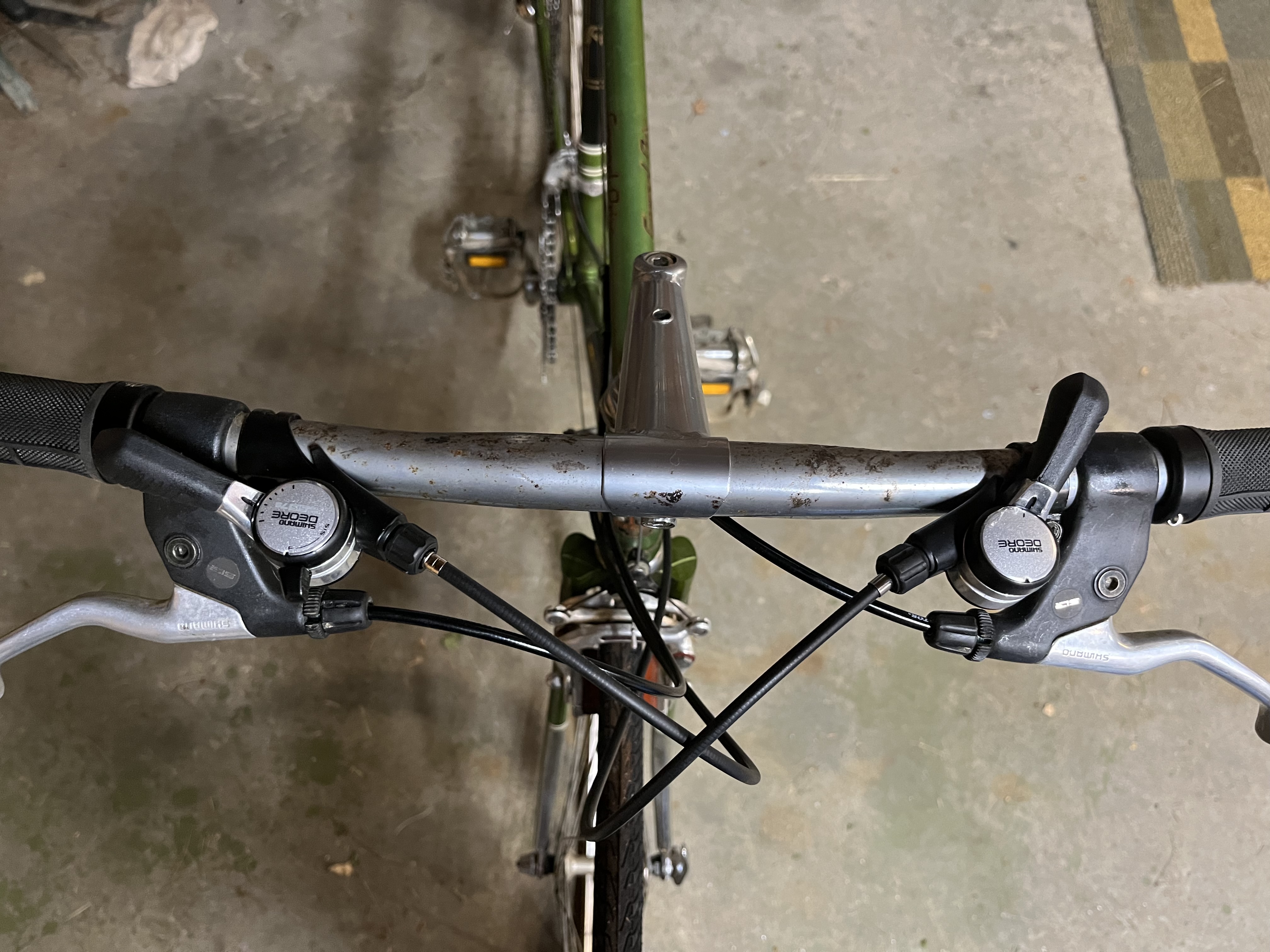
The frame was designed for 27-inch wheels. I had a set left over from a touring build in 1980, complete with 6-speed 13-28 freewheel. The drop bars were coming off, in favor of flat bars. Drop bars are better for longer distance, but then I’d need primary and interrupter brake levers, and lots of other refinements that would take too much time. I was retaining a lot of things on the bike that I would have discarded for a fixed gear build. A fixed gear conversion is more of an unbuild.

Accepting the 42-52 steel cottered crank, the low gear is 42-28. Delaware is flat, right? I should be able to run those chainrings with a 13-18 corncob. But that’s poor gearing for leisurely exploring.

Wilmington is in the mountains of northern Delaware. That 42-28 is none too low.

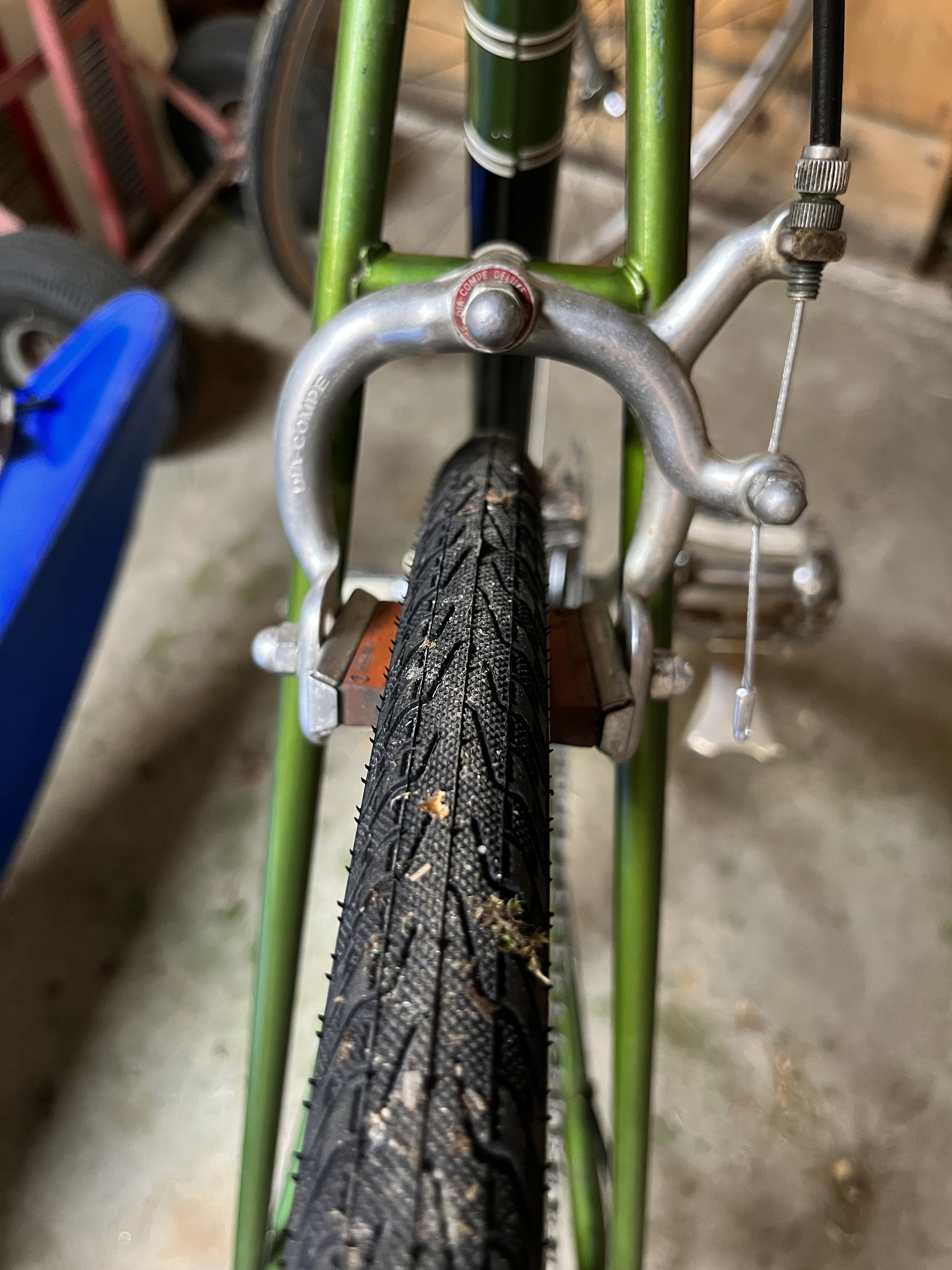
Thinking I was home free, I put 1 1/8 tires on the wheels and slapped them in. That’s when I discovered that the fork was a little bent, and the front brake for some reason didn’t quite reach the rim. I was out of time, so I needed to solve this with parts on hand.

I had a long reach side pull brake, but it had a rear center bolt. However, center bolts are easy to swap on center pull brakes, so I moved the original rear center pull to the front and put the side pull on the rear. I’d straightened the fork ends adequately, so the wheel sat straight. The bike was ready to ride with 18 hours before we hit the road.

This Simplex front derailleur was one of the first upgrades I ever bought for my first road bike in 1975.

This slightly worn and probably slightly bent 1990s derailleur is totally fine to shift in friction.
The whole mess is controlled from this circa 1991 mountain bike dashboard.

The bike will return to the lab in the winter for refinements and upgrades, but nothing too fancy. Meanwhile, it met the urgent need.


Tuesday, September 22, 2015

The Bike that Never Was

A woman in town wanted a road bike to leave at a place she regularly visits in Maine, so she wouldn't have to transport her regular bike back and forth.

A good used bike is like a glass slipper: it's no use if it doesn't fit. We don't see the flood of trade-ins we used to get in the 1990s, when everyone was dumping their road bikes to get mountain bikes. Some places probably do a brisk trade in used bikes, but few of them make it all the way to our backwater anymore.

I had a couple of frames hanging around. If one of them fit her, I said I would try to scrape up the parts turn it into a bike.

The frame that fit had a bent fork. But I had a fork that would probably work. The frame had a crank, derailleurs, a headset and seatpost.

We got pretty lucky with wheels and brake levers. I kept running into blockades and then surmounting them somehow. The only things we had to buy new were the handlebars and interrupter brake levers. Oh, and a chain and cables. And she wanted a good women's saddle. That was the most expensive item.

On second look, my replacement fork didn't look all that great. I remembered I'd bought the Park Big Honkin' Pry Bar, so I figured I would take a shot at straightening the fork that was on there.

The Park BHPB-1
Lacking a fork jig, the straightening process was an art project. The first time through it looked pretty good until I put a wheel in it. Even then it wasn't too bad...until I tried to make it better. The quest for near perfection, as always, was a trapdoor into Hell. I tried to quit at least a half a dozen times before it somehow ended up better than some 1970s production bikes were when new.

The bike isn't ready to roll out yet, but we're down to the rigging and details.

I don't even remember where I got the frame. As I worked on it I noticed things that make me think it had been improvised by Bill, a mysterious man who had been the team mechanic for cantankerous old geezers around town until his death from cancer several years ago. The frame before me might have been ridden by Crazy George. Crazy George's riding habits did not kill him. He was run over walking in a crosswalk one early winter night, going from the library to the church across the street. A van hit and dragged him. He lingered for weeks at Maine Medical Center before finally succumbing. This is how it is to be elderly and non-motorized.

Crazy George would have ridden the bike with its bent fork, helmetless and headlong. Bill would have kept it running as best he could with parts he scrounged. I am only doing the same thing, with better parts and tools. The improvisations I have upgraded were all cleverly done. They showed knowledge of how a bike should be, not just superficial applications of whatever hardware-store bolt will sort of fit the hole in need of filling.

Because a bicycle is a collection of parts, I can keep an eye out for a better frame and fork while my client rides this one. Nearly every part will transfer to any decent frame that comes along.