Showing posts with label hunting. Show all posts

Sunday, April 25, 2021

The benefits of neglect and obscurity

 Being forgotten by the technological world for decades was one of the best things to happen to bicycling. The machinery evolved very slowly, which made bicycles a reliable device and a reassuring piece of stability in a changing world.

 When I started paying attention, in the mid 1970s, no one seemed to be clamoring for space-age advancements. Kids born in the 1950s received their bikes as something their parents had received in almost the same form. Some kids born even later received the same actual bikes. My older brother wanted an "English racer" three-speed because our family had been introduced to the works of Arthur Ransome as soon as we were old enough to read. The characters in those books, when they weren't on the water, were likely to be getting around the English countryside on classic black bikes that you could still buy at a shop near you in the 1960s. Much might change in the world, but bikes were your living connection to history. Not only that, they worked perfectly well as personal transportation.

When the "ten speed" came on the scene, it didn't strike me as a wild new concept, only a more advanced existing concept of which I had been previously unaware. It also seemed like risky magic to encourage your chain to jump off the sprockets, after all my years when chains popping off was a greasy nuisance. I was very slow to adopt. However, as with other vices from which I initially shied, I embraced this one emphatically when I was finally corrupted by the right exposure. Indeed, the derailleur had existed in the form we would recognize for almost as long as Arthur Ransome's children's books. Whatever prompted the 1970s bike boom merely thrust it into the American public's eye, somewhat the same way cross-country skiing became the cool new thing around the same time.

Bikes through the 1980s -- meaning mostly road bikes -- had an aesthetic that seemed to span the 20th Century. Steel frames held together with lugged joints might have elaborate curlicues and cutouts or showcase the precision of smooth spear points, but at a distance the general configuration would convey instantly the bike's purpose and connect it to its heritage. By the 1990s, essayists like Maynard Hershon might gripe about its "19th Century" technology, but the stuff still works.

Check out some of the details on this Richard Sachs. The bike's owner is the real deal. She's been touring on it since she bought it new in the early 1980s (or earlier).

These cutouts are on the inside of the fork. 

Downtube friction shifters pull the derailleur across  a five-speed freewheel.

The rear wheel sits in long horizontal dropouts. This allows for all sorts of modifications and improvisations that you can't do with VD (vertical dropouts).


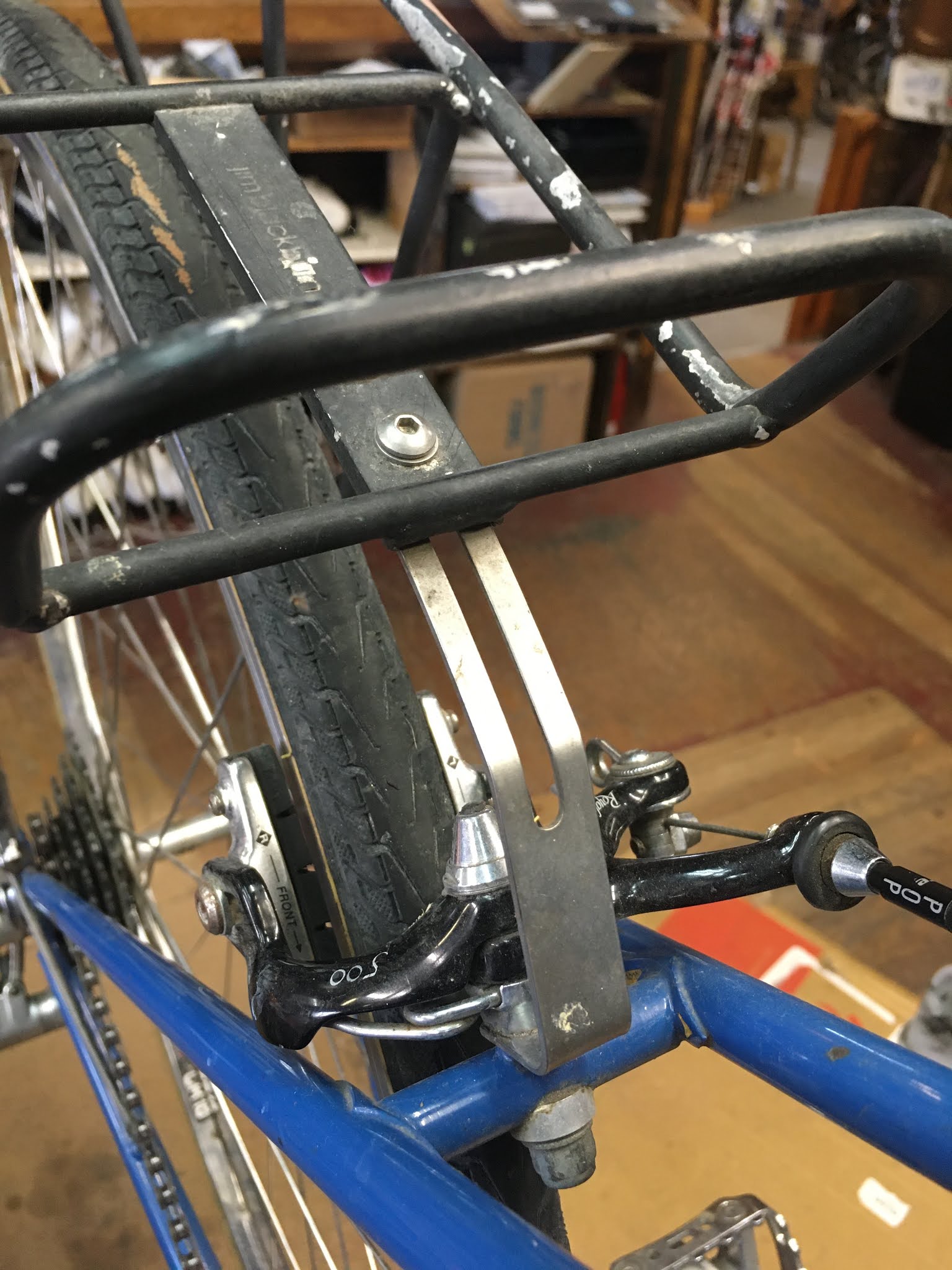
 Check out the original Blackburn rack from when the original Blackburn guy still had anything to do with the original small company by the same name.
Even the saddle is original.

I wore out several Avocet saddles until you couldn't get them anymore. I know she's logged some serious miles, but she probably hasn't crashed as much as I did, and perhaps has a smoother style. Her gearing is realistically low for a load-carrying bike.

The cam on these Gran Compe brakes actually opens up wide enough to get the tire through the brake pads, unlike the token range of much newer -- and not cheap -- offerings here in the dying days of the Age of Rim Brakes.

Old plastic Silca frame pumps tend to crack at the threads. You can repair a minor crack by wrapping the barrel with filament tape. This pump has that repair. I don't know how much she's had to use it in that condition. I finally gave up on mine and got a Lezyne mini pump.

Before the Sachs I had a bike called a Sketchy on the stand. In a color strikingly similar to Surly's "Beef Gravy Brown," which was one of the Cross Check colors around 2011, this bike was apparently a hip item around that time. Made of lighter weight, more upscale tubing, it completely lacks the touches that make the Cross Check such a great basic platform on which to build a wide variety of bikes, such as the above-mentioned long horizontal dropouts. The Sketchy had VD, and shapely but highly inefficient curvaceous chainstays that would completely prevent the use of fenders with plump tires.


What's a nine-letter (two-word) phrase meaning "overrated?"

Until FSA got rid of the needle bearing version of the Orbit UF headset, that was the answer, at a tiny fraction of the cost, to the issues that the CK headset purports to fix. The CKs are serviceable, but what a pain in the ass to get in there, just to have ball bearings  -- albeit in a sealed cartridge -- anyway. Tapered roller bearings were the best for headsets, which is probably why they disappear almost as quickly as they appear when a company offers them. The Orbit UF stayed on the market for several years before they went on the angular contact bandwagon. So they're still a good deal for the price, but not as good a deal.

Despite its unfortunate modernist touches, the Sketchy at least used a steel frame with basically round tubes. The aesthetic is not at all classical. It doesn't look like art, the way lugged frames did. The Cross Check has a welded fame, but the dropouts have a classic shape, and the forks have an external crown that gives them a classic look as well. The Sketchy fork looks like an old suspension bridge tower. It's kind of cool in its way, but it looks heavy.

The bike business seems to be able to support a number of limited-edition boutique builders who do their thing for a while and then move on. As long as they build to fit off-the-shelf componentry, you can keep the frame going almost indefinitely. Whatever it is, if it works for you, it's a good bike. 

This old Manitou fork showed really bold marketing in naming a new model (at the time) for what planned obsolescence would soon turn it into:

As we charge forward into the battery-powered future, a category called "hunting bikes" is on the rise. Camouflaged smokeless mopeds are becoming a popular vehicle for some hunters to use to get into the woods and fields in pursuit of their quarry. Back in the 1990s we had a customer or two who embraced the mountain bike as a silent approach vehicle for hunting, because they were quieter than ATVs and didn't produce stinky exhaust. But you had to be willing and able to pedal. Now a wider range of hunter can take advantage of not only pedal assistance but also pure motor power on some models. They're being sold through hunting and fishing stores, assembled by people who may not have a lot of familiarity with the basics of bike mechanics. Or the customer might have bought it online and had to assemble it themselves. Such was the case with this behemoth:

What have we gained by junking reliable simplicity? I still prepare for hostility and negligence before every time I venture out on the roads. This is true even in a car. Are the few riders retained or recruited by electric motors or enticed by technological ephemera enough to offset the general loss of people who don't grow up with bicycles as a normal part of their life, with the option to continue into adulthood?

Bike categories have forever altered the concept of what is possible under pedal power. Mountain bikes started out as just bikes. Modification piled onto modification in rapid evolution, but it was only the same process by which bicycles had developed from the beginning: largely trial and error. Only when the type was firmly established did the engineers really focus on seriously designing the machines of today.

As for the road, the demand for technology is more driven by fashion than function. Shifting systems since the onset of indexing have increased precision when they work, but also increased the demand for precision in their construction and adjustment. Road riding could still thrive if all of that went away, just as road riding could thrive if disc brakes went away, along with carbon fiber frames and 52 different bottom bracket standards. Mountain biking, on the other hand, is entirely dependent on its suspension technology and gearing systems to make the preferred style of riding possible. Some mavericks might sing the praises of a hardtail versus full suspension, but almost no one -- and perhaps no one at all -- is extolling the virtues of a fully rigid frame and fork. Fully rigid bikes have been relegated to another category, like bikepacking, in which they are still the weirder option, or fat bikes, which have always been a weird option.

Millions of riders logged millions of miles before there were through-axles, disc brakes, electronic shifters, and 1X drivetrains dragging tinfoil chains across 12 cogs (or more) spanning a range from 10 or 11 to 52 teeth. Some things could safely be rolled back and advanced along different lines with only gains for the riding public.

Tuesday, September 18, 2018

Guns and Bicycles

After years of mental drought and increasing depression, I suddenly received a request for some cartoons to be used in political advertising by a local group. They wanted clear, simple cartoons to illustrate various current political issues.

The first one was easy. It supports environmental science in governmental policy. I was able to spruce up a piece I'd sent them as a sample and submit it as the pay copy. But the second assignment supports gun control. I wrote about this dilemma on Brain Lynt today, so I won't repeat the whole essay here.

I researched hunting rifles so that I could try to present a nuanced situation as fairly as possible in a literally black and white graphic. The political group takes a firm position, but the case is far from simple. The two sides throw statistics and Constitutional interpretations at each other, and neither side is convinced. One single sentence in our constitution has made the country a great place to be a homicidal paranoid. The group that has hired me supports the "assault weapon" ban, and other measures to restrict firing rate and magazine capacity. Those seem sensible, so I wanted to see what the counter-arguments were.

Being a peace and love hippie type, I never got into guns and gun culture. I've shot guns, and had them pointed at me, but I wasn't turned on by the hardware or the activity. I have a couple at home for defensive purposes, but there again I'm more likely to grab something else when I hear a noise at night. Maybe I'll regret my life choices when civilization collapses next month and we're all suddenly living in the wild west again, but I do hear that it's easy to get a gun whenever you want one. That's one of the primary arguments against gun control. Apparently, you can go to just about any shopping center parking lot and find an arms dealer peddling Glocks out of his trunk. Maybe. Probably not.

As I read through various lists of "best deer rifles" I saw how the reviewers included something for everybody. Militarily-styled rifles were on every list, but they were never the first choice. The reviewers included them for people who were already inclined that way.

Outsiders come at the gun control debate viewing gun owners and users as a monolithic block, the way outsiders come at debates over cycling viewing all riders as a monolithic block. As soon as you look a little more closely you find gun owners who support various controls, based on their own point of view, just as you find riders who support specific types of riding. You can find regular users in either general category -- gun owners or bike owners -- who will support points of view held by outsiders who are partly or entirely unfamiliar with the details of either activity. Because ownership of either guns or bicycles encompasses such a huge cross-section of the population, there are few broad-brush proposals that don't severely inhibit the freedom of some users. When you're dealing with an activity protected in the Bill of Rights, you can't just brush it off unless you want to consider letting some other constitutionally-protected things get brushed off.

Not every gun user likes all guns. Not every gun user uses them for their lethal potential. All guns do basically the same thing, go bang and make a little projectile come flying out of the tube, but the power and destination of that little projectile can differ widely. Bicycles all appear to work basically the same way and do basically the same thing, until you look more closely at where they're ridden and how.

Guns still kill more people than bicycles do. Even if a gun owner doesn't use it for its lethal potential, guns weren't invented just for perforating paper or plinking cans. The desire to control their use is understandable. I support the concept. But the solution will not be something simple enough to depict in a single panel cartoon. As long as they're considered a legitimate part of daily life, and possession is enshrined as a right, any limitation on them risks impinging on what would be a justifiable use. Even militarily-styled weapons apparently have non-homicidal uses for lead-heads who want to deliver a lot of rounds in a hurry. If you're hunting something with no bag limit, that moves fast, you might want that quick-firing, shorter weapon. While I am not into killing for fun, and I wish no one else was either, that's a philosophical debate that can go on for several more centuries. In the meantime, it's legal in a lot of places.

Monday, April 16, 2018

Farmers aren’t cows

The merchant-customer relationship has a lot in common with farming or hunting. Specialty retail used to be different, because so many of the workers were also users, but it was never purely thus. It has moved steadily away from the fellow enthusiast model since the 1990s. The business model moved from small specialty stores to larger, higher-volume retail outlets, through mail order to the impersonal mechanism of the internet.

The larger and more impersonal the delivery systems become, the more the relationship changes not only from an interpersonal exchange between fellow enthusiasts to a quasi-predatory one, but also from a small scale hunting or farming metaphor to a factory farming analogy. You all are being processed, like a bunch of turkeys.

Granted, the metaphor falters because animals used in various ways for food production don't have any autonomy. As a human, you have your knowledge -- such as it may be -- and your free will, to question what seems questionable, to buy from someone else, or to quit an activity entirely. That last factor guides a lot of marketing thought. Purveyors of specialty stuff understand that many people get in, but few stay. This is dramatically evident in a boom and bust cycle, but goes on all the time in lesser waves.

Your knowledge may not be as comprehensive as you think it is. I've been in the business for about 30 years, and I still forget some things from the historical record, or have to dredge my memory for diagnostic information or procedures I might not have used in awhile. And my immersion in this area has taught me about the interdependence of a civilized society. Primitive hunter-gatherers needed to cooperate, but in the earliest times there was a lot less to know. Because we have eradicated that subsistence world, we have to function in the interconnected web of overlapping technology and customs that has evolved ever more rapidly as our species has invented and interpreted lots and lots of things. Become an expert in your field and you automatically don't have the time or the brain space to master many other fields. You have to trust others to inform and guide you. But can you trust anyone who is selling something?

If you have enough coin to have internet access and a credit card, your circumstances are probably not desperate enough to make a poor buying decision a fatal error. Not when it comes to bikes and parts thereof, anyway. Then again, I have both of those things, and I definitely do not have money to waste. But say you have to live entirely in the real world, obtaining whatever you need from physical locations where money changes hands directly. You have a personal relationship with your guardian and protector, or your hunter and exploiter.

Life is one big gray area. Working in a small shop, I have to balance the needs of the business to exist and support its staff against the desire to outfit every customer with the absolute perfect stuff for each individual. Working in a large shop, I would still run up against the limitations of that business's ability or willingness to stock a lot of variety and cater to anything other than the largest common denominator in any category. "It's good enough," the saying goes. And it's true, up to a point. But if you have the misfortune to buy into technology just before a massive shift, you will be on the wrong side of obsolescence for longer than if you'd stumbled in nearer the launch of a new platform. See much 9-speed Dura Ace these days?

New platforms do not guarantee less trouble from the get-go. Early versions often hit the market with bugs that the industry counts on early adopters to disclose. The first customers for any new marvel are often test pilots, whether they know it or not. That's the predatory angle. Someone has to buy the latest crap so that its real-world failings can be discerned and refined out in later editions. So the smart money waits as much as a whole season. But if everyone held back, it would simply delay the onset of this testing period. They've got you by the components, man.

The bike industry began as a cauldron of innovation. The machines evolved steadily from something with wheels like a wagon to the sleek wonders that you see today...and fat bikes...and 75-pound smokeless mopeds. From the beginning, they were creatures of desire, not need. But luxuries become needs. Transportation on demand found a ready market when "the poor man's horse" came on the scene. That led fairly shortly to motorized vehicles that could carry a person around the countryside without the need to build a railroad. By the late 20th Century, automobiles featured in ads for employment: "must have own transportation," "Reliable transportation a must," and so on. These were not high level jobs, either. The regular grunts were expected to own a car. We went from having a workforce on foot to a workforce using mass transit to a workforce swarming around like the Dunkirk evacuation fleet, only doing it every morning and evening, five or six days a week, year after year.

The needs of mass production slow the pace of change slightly, but the pressures of marketing accelerate it. Bike manufacturers seem to be keeping production runs really low in spite of access to the lower costs in Asia. They know that the pool of people with the wherewithal to buy their trinkets is shrinking, and that within an economic sector not everyone will want to play with those toys. Sell-through is easier if you accept that some customers will miss out. It still frees up each company to pump out a newer and better model about every ten months. This is like dumping piles of old doughnuts out in the woods to attract bears, or putting out apples and a salt lick to be "nice" to the deer. Bait 'em in and pick 'em off. Regulations from state to state may require some variations on the theme to meet strict legality, but the underlying motive to create habits in the prey that make hunting them easier is always the same. Have you seen the latest issue of Bicycling!!?!?!

One sales rep we had in the 1990s listened to me griping and said, "You sound like a consumer!" That's it right there: Industry versus customers. He wasn't facing customers every day, getting chewed on for the shortcomings of the latest mechanical marvel. Indeed, from the very early 1990s to the end of the decade I saw a serious gap open up between the manufacturers and distributors, and the front line retailers. Reps who were friendly and available at the start of the decade disappeared, replaced by increasingly numbers-driven salesmen looking for as big an order as they could write, with as little feedback as possible. We weren't insiders anymore. We became the first rank of suckers. Don't talk back. No one cares. Better minds than you have already decided what will be best for several years in advance.

The vast majority of customers these days do not complain, but I don't think it's because they are satisfied. Maybe they don't know what to ask. Maybe they don't ride enough to break anything. Maybe they don't care enough about function to take issue with something that works haphazardly. Maybe all the years of dealing with tech support for just about everything have finally beaten consumers down to the point where they don't even bother to try.

As someone who has devoted a lifetime to educating people about human powered transportation and environmental issues and the connection between economy, ecology, and quality of life, I can tell you, it's hopeless. Should I have figured this out 40 years ago and gone straight for as big a pile of money as I could amass? Too late now. What I hoped would bear fruit in a couple of decades looks like it might bring about some improvement in two or three generations. Or not. C'est la vie. We still seem to be uncovering deeper and deeper layers of problems even in areas where we seemed to have made considerable progress as of the late 1970s. Are we really going backwards, or simply finding out that we hadn't come forward in the first place?

The best you can do is try to be trustworthy. Is it really all just a metaphorical food chain out there?