Showing posts with label old equipment. Show all posts

Sunday, April 06, 2025

And on to the next dream...

 After finishing the e-bike stretch cruiser it was time to replace the shifters and crank on a beautiful late-1990s Dean. The bike might actually date from right after the turn of the century. We've been seeing it in the workshop nearly every spring or summer for a long time. I built those wheels more than ten years ago. Maybe so long ago that we looked up parts in a printed catalog and placed orders by phone.


The picture above shows the bike after its recent changes. Originally, it had a Campagnolo Chorus crank, Record 10-speed brifters, and Centaur derailleurs. I vaguely recall that we had already upgraded it from 9-speed to ten-speed by the turn of the century, but we did work on a number of Campy-equipped bikes. Campagnolo actually provided instructions for changing some internal parts in a brifter to change the number of speeds. And, of course, the internals were completely repairable. But the shifter bodies and so many internal parts on this bike were now so worn that repair would have cost a lot more than a new set of brifters.

A lot of years had passed, but Campagnolo had always been the leader in backwards compatibility. You can buy quite a few parts for a 25-year-old shifter, although some of them are being phased out. During that 25 years, the parts fit models that spanned more than eight years, which is phenomenal in the post-Shimano era of technological hyperactivity.

The rider wanted lower gearing than the 53-42 chainrings on his existing crankset. Campy's 135mm bolt circle limits how small a ring you can fit, and they have to match that proprietary bolt pattern. Back when Campy's BCD was 144, other manufacturers copied it. Then Shimano and the Japanese makers brought in the 130 bolt circle diameter, and the industry shifted to that. This meant that you could put on the 53-39 combination that became the de facto standard for road cranks for years. You could even get a 38 for the inner ring, but few did.

When compact road cranks came in, they used the 110mm BCD that mountain bike chainrings were using. Mountain bikes still used triple chainrings. Road compact cranks were designed for just two rings up front. While the young and strong would combine the new little 50-tooth big ring with an 11-tooth cog for the hardest one on the cassette, the 50-34 combination that was most common served as sort of a secret granny gear for riders who were starting to feel a little faded as age took its toll.

So many years had passed before the owner of the Dean felt the need to gear down that a nice compact double for ten-speed was tricky to find. I also recommended trying to match the aesthetic of the old steel frame rather than sticking some aerospace monstrosity on there. I suggested, and he agreed, to get a Velo Orange Grand Cru Drillium crankset. It was actually a little more retro than the bike, but it's also fairly affordable and distinctive compared to the monotonous hellscape of soulless modern componentry.

It's actually made by IRD. But Velo Orange has their Grand Cru badge applied to it, and they deserve support for being such a friend to the retro rider.


The owner dropped the bike off in late March, 2024. I was able to get the brifters and bottom bracket right away. The crank was shown as out of stock for a month or so. The customer was willing to wait. That ETA got kicked down the road a month or two at a time, all the way to the end of the year. We nearly lost the job entirely, but I had contacted Velo Orange directly by that time, to confirm that they were still going to have the cranks at all. We got the customer to hang on. The crank finally arrived a week or two ago. We were still in ski mode, so I didn't start the job right away. We were also buried in the stretch cruiser project, which had been plagued with its own spec problems, but those had resolved more quickly.

As I dug into the Dean, I discovered that the slop in the shifters had been masking slop in the derailleurs. They were very floppy. That led me to look at what we could get for Campy 10-speed derailleurs.

Nothing. That's what we can get for Campy 10-speed derailleurs. Not a zippin' thing. Zippity doodah. Zilch. Nada. Campagnolo has abandoned their faithful long-term customers actually worse than Shimano. Shimano at least still makes some 10-speed road derailleurs for mechanical shifting, with brifters to match, for those who are addicted. For the friction shifters, the truly free, we can buy whatever derailleur we like the looks of and can afford. But for the brifter-dependent, the company that launched the industry into technofascism still has a little lifeline hanging out for the laggards still nursing their older stuff.

Funny: fascism was actually invented in Italy, and the Italian company was the slowest to adopt technofascism. But they're racing to catch up now. Be sure to shell out massive bucks for their 12-speed electronic stuff. It's kind of nice to see them back to duking it out for pro team spec, but the game has no soul anymore, so what are we really winning?

Way way back, in the 1970s and early 1980s, you could actually get every part of a Campagnolo derailleur, separately, to replace what might have gotten bent or cracked in a crash or a workshop mishap. It was treacherously easy to strip the threads on a front derailleur swing arm when tightening the cable anchor bolt. Good thing you could buy just the arm, install it, and pledge to use a lighter touch after that. You could also crack the clamp band, tightening the derailleur on the seat tube. Again: press the rivet out, replace the band, put on the new one and be more sensitive, you clod. Do you caress your lover with those awkward, loutish hands?

Well yes, yes I did, which explains my long spells of monkish solitude, but anyway... You can't get parts to rebuild a derailleur anymore. Long gone, though I do recall seeing them as late as the early 21st Century. I'll have to dig into my archive of Quality catalogs. QBP's print catalogs used to provide such complete tech information that we could figure out a lot of repairs and compatibility puzzles just from what they included about each product.

I had recommended that the customer stick with Campy because of their legendary durability and product support. Seems like I should have investigated them a little more deeply before charging ahead with this job. The customer and I were both trying to extend the life of existing parts rather than junk stuff and start over. Now, if he isn't satisfied with how this thing shifts, we have no option that doesn't cost him a chunk of change to take a different tack.


These shifters seem less substantial than they used to be, and the upshift thumb lever impedes removing the rubber hood to mount the brifter or run cables.

They also only fit 4mm shift cable housing, which means that we can't fit them with the easier-running 5mm which cures so many shifting problems.

Just like Shimano, Campy declares that their shifting systems and drive trains have to be completely matched, 11-speed with 11-speed, 12-speed with 12-speed, end to end. While I would be inclined to test them, trying to graft in 11-speed derailleurs with these 10-speed brifters, the lowest priced front derailleur retails for about $60, and they don't even list an 11-speed rear derailleur. So then we're experimenting with a 12-speed rear derailleur costing more than $200. Or we go on the hunt for good used, and new old stock.

If we talk him into friction barcons, he either eats the cost of the 10-speed brifters and buys some nice brake levers on top of the barcon price, or he uses the brifters as brake levers only, which looks kind of weird and accentuates our defeat at the hands of the technofascists. And all of this is just so that we can graft in whatever derailleurs he wants to try. Whatever derailleurs he wants to try includes pretty much anything on the market if he shifts in friction. They just have to have the gear range and chain capacity to match what he has. And friction shifters will be much more forgiving of the slop in the old derailleurs. He could just keep running those until they totally flop off.

I'm insanely loyal to old machines that I've grown to love. Aided by my own mechanical knowledge, friction shifters, and access to parts, I will keep my own stuff going for decades. I provide the same service to any customers or friends who want to cultivate and maintain the ancestral riding skills. It bums me out deeply when a customer decides to euthanize an old bike because they fall for the lure of the new and exotic, or just decide that something old isn't worth spending money on. I can't afford to rescue any of them, let alone all of them. And I always feel guilty if my enthusiasm for bike immortality and persistence in the face of a challenge leaves them with a result that they're not delighted with.

The industry makes it increasingly hard. Any of us interested in the deathless bike need to pay constant attention to keep track of something that might have been replaceable that has now turned into a vital organ to be preserved. Friction shifting can cover a lot of situations, but it can't work around systems that the industry completely abandons, like certain chainring sizes, or cassettes for proprietary freehub bodies. I'm looking at you again, Campy. While it's contemptible on one level that the entire rest of the industry adopted Shimano's Hyperglide spline pattern, it does create a de facto cassette standard that makes mix and match a lot easier.

I do have a Campy-equipped carcass in the shop basement that might yield donor organs, but it might be 9- or even 8-speed. It's that old. I have defended it against many a clutter purge over the years. Vindication would be sweet. I'm not into losing to the industry and the throwaway mentality.

Sunday, April 25, 2021

The benefits of neglect and obscurity

 Being forgotten by the technological world for decades was one of the best things to happen to bicycling. The machinery evolved very slowly, which made bicycles a reliable device and a reassuring piece of stability in a changing world.

 When I started paying attention, in the mid 1970s, no one seemed to be clamoring for space-age advancements. Kids born in the 1950s received their bikes as something their parents had received in almost the same form. Some kids born even later received the same actual bikes. My older brother wanted an "English racer" three-speed because our family had been introduced to the works of Arthur Ransome as soon as we were old enough to read. The characters in those books, when they weren't on the water, were likely to be getting around the English countryside on classic black bikes that you could still buy at a shop near you in the 1960s. Much might change in the world, but bikes were your living connection to history. Not only that, they worked perfectly well as personal transportation.

When the "ten speed" came on the scene, it didn't strike me as a wild new concept, only a more advanced existing concept of which I had been previously unaware. It also seemed like risky magic to encourage your chain to jump off the sprockets, after all my years when chains popping off was a greasy nuisance. I was very slow to adopt. However, as with other vices from which I initially shied, I embraced this one emphatically when I was finally corrupted by the right exposure. Indeed, the derailleur had existed in the form we would recognize for almost as long as Arthur Ransome's children's books. Whatever prompted the 1970s bike boom merely thrust it into the American public's eye, somewhat the same way cross-country skiing became the cool new thing around the same time.

Bikes through the 1980s -- meaning mostly road bikes -- had an aesthetic that seemed to span the 20th Century. Steel frames held together with lugged joints might have elaborate curlicues and cutouts or showcase the precision of smooth spear points, but at a distance the general configuration would convey instantly the bike's purpose and connect it to its heritage. By the 1990s, essayists like Maynard Hershon might gripe about its "19th Century" technology, but the stuff still works.

Check out some of the details on this Richard Sachs. The bike's owner is the real deal. She's been touring on it since she bought it new in the early 1980s (or earlier).

These cutouts are on the inside of the fork. 

Downtube friction shifters pull the derailleur across  a five-speed freewheel.

The rear wheel sits in long horizontal dropouts. This allows for all sorts of modifications and improvisations that you can't do with VD (vertical dropouts).


 Check out the original Blackburn rack from when the original Blackburn guy still had anything to do with the original small company by the same name.

Even the saddle is original.

I wore out several Avocet saddles until you couldn't get them anymore. I know she's logged some serious miles, but she probably hasn't crashed as much as I did, and perhaps has a smoother style. Her gearing is realistically low for a load-carrying bike.

The cam on these Gran Compe brakes actually opens up wide enough to get the tire through the brake pads, unlike the token range of much newer -- and not cheap -- offerings here in the dying days of the Age of Rim Brakes.

Old plastic Silca frame pumps tend to crack at the threads. You can repair a minor crack by wrapping the barrel with filament tape. This pump has that repair. I don't know how much she's had to use it in that condition. I finally gave up on mine and got a Lezyne mini pump.

Before the Sachs I had a bike called a Sketchy on the stand. In a color strikingly similar to Surly's "Beef Gravy Brown," which was one of the Cross Check colors around 2011, this bike was apparently a hip item around that time. Made of lighter weight, more upscale tubing, it completely lacks the touches that make the Cross Check such a great basic platform on which to build a wide variety of bikes, such as the above-mentioned long horizontal dropouts. The Sketchy had VD, and shapely but highly inefficient curvaceous chainstays that would completely prevent the use of fenders with plump tires.


What's a nine-letter (two-word) phrase meaning "overrated?"

Until FSA got rid of the needle bearing version of the Orbit UF headset, that was the answer, at a tiny fraction of the cost, to the issues that the CK headset purports to fix. The CKs are serviceable, but what a pain in the ass to get in there, just to have ball bearings  -- albeit in a sealed cartridge -- anyway. Tapered roller bearings were the best for headsets, which is probably why they disappear almost as quickly as they appear when a company offers them. The Orbit UF stayed on the market for several years before they went on the angular contact bandwagon. So they're still a good deal for the price, but not as good a deal.

Despite its unfortunate modernist touches, the Sketchy at least used a steel frame with basically round tubes. The aesthetic is not at all classical. It doesn't look like art, the way lugged frames did. The Cross Check has a welded fame, but the dropouts have a classic shape, and the forks have an external crown that gives them a classic look as well. The Sketchy fork looks like an old suspension bridge tower. It's kind of cool in its way, but it looks heavy.

The bike business seems to be able to support a number of limited-edition boutique builders who do their thing for a while and then move on. As long as they build to fit off-the-shelf componentry, you can keep the frame going almost indefinitely. Whatever it is, if it works for you, it's a good bike. 

This old Manitou fork showed really bold marketing in naming a new model (at the time) for what planned obsolescence would soon turn it into:

As we charge forward into the battery-powered future, a category called "hunting bikes" is on the rise. Camouflaged smokeless mopeds are becoming a popular vehicle for some hunters to use to get into the woods and fields in pursuit of their quarry. Back in the 1990s we had a customer or two who embraced the mountain bike as a silent approach vehicle for hunting, because they were quieter than ATVs and didn't produce stinky exhaust. But you had to be willing and able to pedal. Now a wider range of hunter can take advantage of not only pedal assistance but also pure motor power on some models. They're being sold through hunting and fishing stores, assembled by people who may not have a lot of familiarity with the basics of bike mechanics. Or the customer might have bought it online and had to assemble it themselves. Such was the case with this behemoth:

What have we gained by junking reliable simplicity? I still prepare for hostility and negligence before every time I venture out on the roads. This is true even in a car. Are the few riders retained or recruited by electric motors or enticed by technological ephemera enough to offset the general loss of people who don't grow up with bicycles as a normal part of their life, with the option to continue into adulthood?

Bike categories have forever altered the concept of what is possible under pedal power. Mountain bikes started out as just bikes. Modification piled onto modification in rapid evolution, but it was only the same process by which bicycles had developed from the beginning: largely trial and error. Only when the type was firmly established did the engineers really focus on seriously designing the machines of today.

As for the road, the demand for technology is more driven by fashion than function. Shifting systems since the onset of indexing have increased precision when they work, but also increased the demand for precision in their construction and adjustment. Road riding could still thrive if all of that went away, just as road riding could thrive if disc brakes went away, along with carbon fiber frames and 52 different bottom bracket standards. Mountain biking, on the other hand, is entirely dependent on its suspension technology and gearing systems to make the preferred style of riding possible. Some mavericks might sing the praises of a hardtail versus full suspension, but almost no one -- and perhaps no one at all -- is extolling the virtues of a fully rigid frame and fork. Fully rigid bikes have been relegated to another category, like bikepacking, in which they are still the weirder option, or fat bikes, which have always been a weird option.

Millions of riders logged millions of miles before there were through-axles, disc brakes, electronic shifters, and 1X drivetrains dragging tinfoil chains across 12 cogs (or more) spanning a range from 10 or 11 to 52 teeth. Some things could safely be rolled back and advanced along different lines with only gains for the riding public.

Monday, October 28, 2019

The season of cabbage and caffeine

As bike commuting mileage drops, and other activities don't seem to fill in like they used to, I shift from using brown rice under a lot of my slapped-together meals, to using sautéed shredded cabbage instead. Shred it fine, and cook it over medium-high heat in a little oil (your choice) with some onion and seasonings you think you'll like. In another pan I cook up whatever meat and vegetables I would have slapped onto -- or mixed with -- the rice. Separate pans work out best for the quantities I try to make, because I make enough to get a supper and two or three lunch-size portions of leftovers. A grab and go container for lunch helps speed me through my typical morning stumble toward the door.

As daylight drops, my energy drops with it. During full bike commute season, I limit my morning coffee to avoid having to stop en route to release excess fluid. I might or might not have a little jolt in the afternoon. Once we get well into October I feel like crawling into a burrow. I certainly don't feel like vaulting out of bed. I'll drain the morning pot of coffee and definitely seek it in the afternoon. Any of y'all who can get by on spring water and meditation have my admiration, but that's it. I'm sure it's great.

The growing season ends with New England's well-known psychedelic splurge as deciduous trees withdraw chlorophyll from the leaves they are about to shed.


At summer's end, we get a rush at work, of people who waited until summer was over so that they could avoid the rush. We also get people who were holding off as long as they could, to keep riding in the prime season. Thus cash flow drops precipitously, but wrench work and brain teasers actually intensify.

This recumbent had tire and drive train problems. Once I got it back together, I found it basically unrideable.
Everything was hooked up right. I just couldn't get it to balance well at all. It resisted that first pedal stroke to establish forward motion, and wanted to flop over immediately. This was true in any gear. It was super twitchy. It was actually a late summer arrival, but I never had time to include it in a blog entry.

Then came someone's swamp buggy.
We'd replaced the chain previously. It hadn't skipped on a test ride, but it did skip when the owner rode it in the swamp. He brought it straight back to have the cassette replaced.

The owner of this Trek Y bike from the 1990s had a hankering to try riding again. He's a classic Van Winkle. Van Winkles are the people who have been asleep for twenty years and awaken to find the world much different than the one they dozed off from.
It doesn't help that he bought the bike used from a shop owner who was a trendoid. The bike had all the cool shit from 1998, including the Rapid Rise rear derailleur. I did learn from Sheldon Brown's website that, prior to Campagnolo's invention of the parallelogram derailleur, all spring-loaded derailleurs were "low normal," meaning that they used the return spring to pull the chain toward the low (largest) rear cog rather than down toward the smallest cog. It should tell you something that Campy's introduction of the high normal parallelogram derailleur established the design that the entire industry followed until Suntour introduced the slant parallelogram derailleur in the 1960s. Even after that, the basic parallelogram remained more common until well into the 1970s. According to Sheldon Brown, other companies didn't jump on until the expiration of Suntour's original patent in 1984, but I know that Shimano was already making slant parallelogram derailleurs before that. But they've always been aggressive competitors, not above pushing the envelope of decency, not to mention legality. They got slapped for it in the 1990s when it became too egregious to ignore. Nice guys finish last.

A happy couple of tourists brought their matched Sevens in for examination and any necessary repairs. They do well with their regular home care, so the bikes needed little. I did change the bridge wires on the rear cantilever brakes, changing the stock ones that were too short for longer ones that provided a firmer lever feel.

Another tourist, coming out of a long layoff, brought his vintage 1980s Trek for a full overhaul and upgrades to prepare for a long haul continental wander, perhaps next summer. He has laid out a route that would keep him in a 72-degree average daytime temperature the whole way along a meandering route that works with both latitude and altitude to hit the desired temperature. We discussed all his options, from total replacement with a Long Haul Trucker to full restoration on the Trek. Because the Trek was an old friend, and some of us are sentimental that way, we went that way.

The bike had been fitted with new wheels. The crank had been replaced because the original one broke. The bike had been built for 27-inch wheels, and the shop he went to had replaced them with 700c. The crank was a TruVativ, and rather cheesy.

I've put 700c wheels on bikes designed around 27-inch, but only with caliper brakes. You just get a longer brake if the one that's on there does not have sufficient range to lower the pads to the smaller rim diameter. I hoped that we could replace his old brakes with something more accommodating.
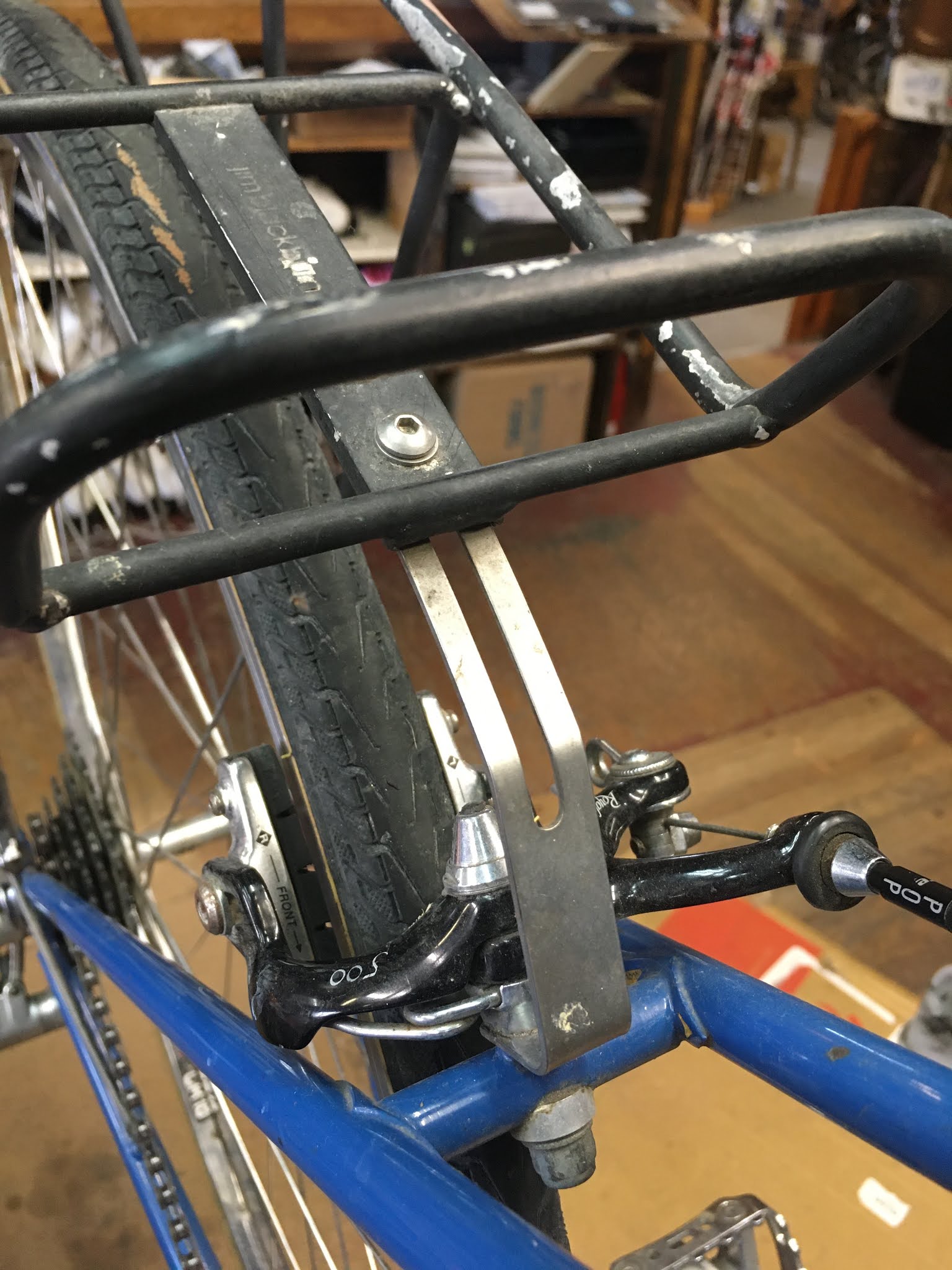
The mountain bike era began using brakes like these Dia Compes. Technology advanced rapidly with higher demand, leading to brake arms that allowed for pad height adjustment as well as every other angle in alignment. But you're limited by the immovable placement of the post itself. If it's low enough, you can use a modern brake to get the pad in range with good alignment to the rim. You can see here that the mechanic who made the wheel swap years ago just angled the pads down because that was all he could do. He didn't built the guy a decent 27-inch wheel, even though there were rims available. Do it cheap, don't do it right. Right?

I ordered some linear pull brakes and the drop bar levers designed to go with them, hoping that the range of vertical adjustment would make it work. I also built the guy some 36-spoke wheels with wider rims to replace these 32s with Mavic MA2s. The MA2 was a nice enough rim in its day, but narrow for a wider touring tire. I've been getting good service out of Sun CR18s. Not only does the wider rim support the tire better, it moves the braking surface closer to the brake arm. I hoped that the combination of factors would allow the use of 700c wheels.

I could have gotten 27-inch rims for the new wheels, but the selection of rubber in 27-inch isn't as good. It's a crap shoot these days. When I geared up for touring around 1980, and when this guy did just a few years later, 27-inch seemed like the better choice for touring in North America, because 700c had not taken over. Performance clinchers themselves were fairly new technology. We figured that you could probably find a 27X1 1/4  just about anywhere at that time. Now, though, you're more likely to find a dedicated bike shop in the hinterlands, and 700c has become the road/hybrid/gravel norm. You can't plan for every contingency.

I also dug up an old mountain bike crank for the bike, with nice forged arms and 5-bolt chainrings. Things were coming together. But the brakes weren't going to work. Those mounting posts were just too high. With the pads all the way down, they still had to be angled down to get anywhere near the rim. And it wasn't near enough.

After consultation, the customer decided to go with a Surly Long Haul Trucker frame, onto which I would put all of the upgrade and restoration parts. The crank I found for him is the same model I have been using since 1992, when it started out on my Stumpjumper, then moved to the Gary Fisher frame with which I replaced the Specialized, and later went onto the Surly Cross Check I've been riding since 2000. It's one of the few accidentally durable things made by Shimano. It probably helps that I'm not much of a sprinter. Even chasing a truck draft I seldom get out of the saddle.

Into this whole lineup of touring bikes came a near-neighbor of mine (less than 4 miles apart is right next door in rural areas) with his 1970s Raleigh Competition. He's another person who "used to work in a bike shop" and is still enjoying the swag.
It's all Campagnolo Gran Sport, with the less-common three-bolt crank.

The handlebars, a solid 40+ years old, are bent down slightly on one side. That's a bad sign, considering that the handlebar industry recommends replacement every three years. We all know that expiration dates are mainly designed to get you to buy more stuff, but I have seen older handlebars snap off next to the stem after two or three decades. When they outright droop it's a good hint that you might want to renew that particular critical piece. Other than that, the job is just a straightforward  overhaul and some tires from this century.

Into the midst of all this archaeology come the day-to-day weird jobs like this John Deere pedal car with the cranks falling out.

Hell has nine circles. So does this thing.

The pulling threads on the right side are twice as deep as normal, for no discernible reason. But the fun doesn't end there. The threads were also buggered in a way that made it impossible to get the crank puller to thread in at all. This is after I had to remove absolutely every piece of shrouding from the fully enclosed drive train to undo every nut and bolt to take tension off the chain.

I removed the left crank arm and slid the BB out through the right side, since it was falling out that side already. Then I braced the right crank arm in the vise so I could gently and precisely persuade the  axle to drop out of the crank arm, using a drift and a small sledgehammer.

The BB is mounted to a bolted-on bracket that was attached backwards to the frame, so that the BB cartridge couldn't be installed the right way around. Normal use would unscrew it from the frame. I unbolted the mounting bracket and reinstalled it the right way around. The people who assembled this thing clearly did not understand its bike-derived components at all. And I don't know how they ever got the chain on it, because I had to add a half-link just to get it onto the sprockets.

Speaking of not understanding bike parts, this has been the year for people putting the pedals in the wrong crank arms. When it won't go in straight and it's binding up like a bastard, why do you keep graunching on it? But they do. Then I get to extract the pedals -- if they haven't fallen out of the stripped-out holes already -- and either re-tap or replace the crank arms. One of those cases came in just last week. It's one of those repairs where you can't really give an estimate without trying to fix it first, to see if there's enough metal left to tap.

Still in the crank and pedal department, one of the local riders is a lad -- now an adult -- who spends hours a day riding all over town on whatever mountain bike he is putting to the test at the moment. He isn't an official product tester, but he definitely puts them all through the wringer of long, continuous use. He's not a jumper or a sprinter. He just goes. And goes. And goes. When he finally brings a bike in because the gears skip or the shifting is funky, we'll discover something like the bottom bracket shell completely broken loose from the seat tube. Worn-out chains are just par for the course. It's the special touches that elevate it from the mundane. This time, his chain had fallen off the front, and neither he nor his father could get it back on. Something was jammed up. Well I guess so.

He was "just riding along." The crank arm bolts are tight. Something inside ain't right.

And there it is:
The axle is snapped right off. At least it's a simple fix. We plugged in a new BB cartridge and off he went again.

Trainee David wanted to adjust the bearings in his XT pedals before an upcoming 'cross race. I helped him figure out how to get in there.

Modern bike componentry comes in two forms: stuff you can't take apart, and stuff you can take apart that will make you wish you hadn't. This is the latter. Of course you can find chirpy forum posts about how easy and fun it is, from people who claim to do it every one month/six months/year, but it's seldom more obvious that no manufacturer actually wants you to fix anything than when you try. The left pedal has some irreducible slop in it, either from a worn (not readily available) bushing or from the loss of an equally unavailable rubber seal. The rubber seal shouldn't be structural. None of the forum chirpers refer to it as load bearing. But David's has vanished somewhere in the vastness of the New England cyclocross circuit, and now the pedal clicks and wiggles no matter how tight the adjustable bearings are. The metal bushing is present, and looks about the same as the one in the right pedal. The pedal shaft itself is a bit worn, possibly from riding too long with a loose bearing. But the right pedal bearings were equally loose before we adjusted them, and that pedal is tight and smooth now. The only obvious difference is the lack of the rubber seal in the left one. And you can spend hours poking around on the Internet to see if anyone really knows, without ever finding out for sure.

The Campy Gran Sport pedals on the old Raleigh are classic cup and cone bearings. Campagnolo Record pedals were so securely closed that they would run smoothly for years. On that level of Campy, pedals and bottom brackets had a reverse threaded section that expelled dirt as you rode. They didn't do it on the lower models, but you're still not dealing with microscopic bearings sitting in an almost imaginary race. Step-in pedals have higher cornering clearance and other added values for the competitive rider. We've all been trained to beat things up and wear them out rather than keep them going through years of appreciative, moderate use. Repair attempts these days are usually just a preamble to justify replacement. You keep it up as long as you can afford it.

These are the darkest nights, even though they are not the longest. The trees have not entirely gone bare, so the forest shadows are dense black. These are the spookiest nights as well. Half naked trees raise bony arms against what you can see of the sky. Any wind makes the branches creak and rattle like a marching skeletal army, while dry leaves skitter like rats on the forest floor you can barely discern even with a good light. The sight of another person sparks a moment of misgiving rather than sociability. What's anyone doing out here now? Only a weirdo would be out in the woods in the dark. You guzzle some caffeinated courage before heading out on the lonely ride toward home.

Friday, April 12, 2019

Not many people could do my job. But who would want to?

On the Facebook page of a sort-of-young mountain bike rider, he made reference to the three whole weeks he spent working for a bike shop. He dismissed most of the bikes he had to work on as “shit.” It was a classic example of the arrogance of a category-specific rider who ranks the whole world based on his personal choices in technology and obsession.

The arrogant cyclist in any category is a common enough character to have become the stereotype of all bike riders as viewed by our hostile audience. Almost any reviews of a bike shop will mention one or more examples of dismissive conceit. And wherever non riders encounter riders, someone’s feathers will be ruffled. Disregarding the small percentage of hardcore non cyclists who will always find a reason to hate, we cyclists have to admit that a sizable percentage of us do ride in stupid and offensive ways. It is certainly not the majority, but it’s hardly rare. Riders who are impressed with themselves will expect everyone else to be equally impressed.

I love pulling off a good maneuver just as much as anyone. And when I ride the multi-use path I try to maintain my flow and give the pedestrians only as much as I have to for safety and basic courtesy. Based on the expressions on most of them, it’s never enough.

As for shit bikes, most people have the bike they feel they can afford. In 1980 I tried to work the sales floor at the shop where I worked at the time, to see if I could get more people to buy better bikes. Once in a while, it worked. But most people’s eyes would  glaze when I tried to get them to buy up from nutted axles, steel rims, and vinyl vasectomy seats. That was when we sold mostly just ten-speeds and three-speeds for adults, and coaster brakes and BMX bikes for kids. When I reentered the bike business in 1989, I had more success convincing customers to aim a little higher. Even during the recession of 1988-‘92, people seemed to be able to scrape up the money for a mountain bike. But that boom is long gone, along with solidly built bikes that cost $600.

Some shops are lucky enough to be able to specialize in one or two categories they particularly like. To do that, you either need a source of independent wealth, or a strong customer base in your favorite market segment. In a rural town, you need to attract a lot of people from outside the area to finance your dream shop. Otherwise, you will have to make your living by servicing the bikes you call shit.

Youth makes a mechanic arrogant in two ways. On a basic level, young adults are automatically susceptible to arrogance as a matter of simple biology. It’s the time of life when animals try to establish breeding territory and compete for mates. Humans are complex creatures. We filter our simple urges through our technology and experience to form our self image and world view. I would be willing to bet that the vast majority of bike shop snots are males between age 20 and 40.

Anyone stupid or trapped enough to have stayed in the bike business for more than two decades has probably had all the arrogance crushed out of them. We can despise WalMart bikes because they are truly a ripoff and a danger to the people who get stuck with them. But there’s a whole world of bikes that would bore and annoy a young firebrand or a bike snob, that still have value and deserve a measure of consideration.

My opinions on bikes are shaped more by economics than by the cutting edge sophistication of their technology. I definitely prefer working on some things more than others. The tweaky new stuff is stupidly expensive and kind of a pain in the ass. Really cheap stuff presents its own challenge. Working on something twenty years old can be a relief. The people who taught me about bikes instilled a respect for the craft. It's a point of self respect to be able to work on whatever anyone throws at you, and to know something of the history and evolution of our machines.

Young riders and mechanics are handicapped by what they’ve never seen. The world begins for them at the point where they began to pay attention. Every generation goes through the same thing. A set of assumptions is provided. Only a minority will look beyond that. Even then, their analysis has to work with their grasp of basic principles. The basics for a bike nerd starting out in the mid 1970s are all cup and cone bearings and things that secure with lock nuts. Someone joining up in the 21st Century may have had some cheap equipment with cup and cone hubs and a fake sealed bottom bracket, but they surely aspire to something with all cartridge bearings, hydraulics, and electronics. Road, mountain, or other, sophistication afflicts all categories. A fashionable conceit can afflict each of them as well.

Modern riders are resigned to the idea that the components they buy and the tools they buy to work on them are all going on the junk pile in a couple of years, to be replaced by the compete set of new stuff they buy, for as long as they can afford to buy. Addicts spend money on their habit. Dealers keep feeding them stronger and stronger doses. If your riding style involves frequent crashes on rough surfaces, nothing will last long anyway. Some burn hot and short. Some endure.

Monday, April 24, 2017

That nice Holdsworth

A woman brought in her late 1970s Holdsworth touring bike to be renovated for another few decades of fun, reliable riding.
It dates from the early Japanese era. The frame is British steel, but the only European components are the Campagnolo Record high-flange hubs, the Brooks Professional saddle, and the Sedisport chain.

She loves her Brooks Pro. It came in looking a little dry after years of storage, but it was not warped from neglect and abuse.
I polished its copper rivets with some Simichrome. Later in the process I hit the leather itself with some Proofide.


I adopt improvements as they come along, so I recommended aero brake levers and interrupter levers to provide a more upright control position in traffic or on a rough road. Other than that, it was a straightforward overhaul and new tires.

Campy front and rear hubs. Suntour Winner six-speed freewheel.

Reynolds 531, of course.

"Holdsworthy."

Modest but reliable derailleurs were made entirely of metal, back in primitive times.

Nice lugwork on a production frame.

Ready for the next adventure.

The geometry of the bike is very similar to my Cross Check. There's no secret wizardry to frame angles, fork rake, and stay lengths. A frame designer will consider details of rider size and the intended use of the bike. Criteria for these are well established. A bike like this one will carry a moderate load and provide a comfortable ride, without being too sluggish. Short of racing, this is a good all-around road design.

Skinny steel tubing makes it easier to compare frames side by side. And because steel fabrication was -- and is -- economical to set up, we could be enjoying a bounty of adaptable designs in steel for many applications. You can still find them if you know where to look. But of course the cutting edge competitor will need the latest weapon for the bloody and expensive conflict represented by racing. And the misplaced notion that racing represents the highest form of technique and technology will lead to non-racing bicycles executed in more exotic materials than mere steel. Even aluminum has gone seriously down-market since the turn of the century. Metal in general has a quaint image as a holdover or a throwback. But it holds its own among serious tourists and utility riders of all sorts.

Wednesday, September 14, 2016

Stuff no one needs to know

The bike business isn't a career choice. It's something you get sucked into and trapped in.

Small shops have traditionally been owned and operated by bike enthusiasts who wanted to share what they liked. This is, apparently, a terrible business model if you want to be profitable. The ragtag survivors of the industry press have produced thoughtful articles about how we should all be more businesslike.

As true as that may be, the far reaches of the bicycling universe are still served by small shops staffed by poor idiots who didn't know when to give up and move on. We've stuffed our heads with things no one needs to know.

In the 1990s, our shop's advertising tag line was, "we really ride!" The mountain bike boom had brought a lot of weak players to what looked like a feast of easy money. The happy salesman chatting you up in a big shop might very well have to go find a caustic grouch in the repair shop just to put air in his tires. While some top racers were notoriously mechanically inept, you do much better as a rider if you know something about the machinery, and much better as a problem solver with the equipment if you really ride.

Experience comes with time. It's vital in a repair shop, where the equipment coming in could be weeks or decades old. You can learn a lot from books and videos, but they're not as good as personally witnessing the evolution.

Imagine being a veterinarian and the animals are evolving visibly, drastically, from year to year. The old ones aren't dead yet, but the newer ones have extra eyeballs, or six legs, or you have a dog with gills...

It takes more than intelligence, and lots more than theoretical engineering to keep the nation's bike fleet operating. Newer isn't automatically better. I know, I beat the crap out of that concept relentlessly, but I do it because it is true. It is the most important truth about bikes. Old stuff -- not ridiculously old, but not fresh from the mold -- can keep going for years, and serve you well. You just have to know how it works. And that's where you need that witness to evolution.

My colleague in the repair shop is a fully grown retired engineer. He missed the runaway evolution of bicycles in the 1990s. He's constantly getting ambushed by weird problems with old componentry that can be nearly impossible to diagnose if you didn't go through the maze with it when the industry first inflicted it on the riding public. Some of it never worked and never will, but most of it can be coaxed to function far longer than the manufacturer ever wanted it to.

Just as the dead vastly outnumber the living, so do the old bikes vastly outnumber the new ones. The continued popularity of fixed-gears indicates how the old ways can persist and be built into new machines. If you know where to look, you can find friction shifters. You can assemble your own cassettes, for ultra-personalized gearing, as long as you are willing to forego brifters, and relinquish forever the idea of a manufacturer's technical support. We don't need no stinkin' tech support!

People pay huge money for a 300-year-old violin because the qualities that make that human-powered musical instrument great have been worked out for a long, long time. Machinery like a bicycle cannot age as gracefully as a fine violin, but the qualities that make a well-fitted bicycle the perfect machine to convert human effort into forward motion have been worked out for a long, long time...relatively speaking.

Well below the Stradivarius level, your basic bicycle can provide decades of use with proper care. Perfect for a courtesan or a priest to ride after supper.

Wednesday, May 11, 2016

Blast from the past

Yep. It's just not training unless your upper lip is stuck to your top teeth in a rictus of agony, moistened only by occasional vomit.

For all my insistence that I do not want to flail myself through a training schedule, I rode to work this morning thinking about options to put tighter gearing on the road bike. Certainly not higher gearing, I assure you. But closer steps in the geezer range I can push will make the pain more micro-adjustable.

It might be kind of a hoot to throw a straight block 6-speed on the old Campy Record rear hub I took off when I built the cassette wheel that's on there now. Swapping wheels is quicker and less grimy than changing cassettes. For flat-road intervals, how many gears do I need? I certainly don't need an enormous big meat gear.

The danger of training is that I might become stronger. Then I plateau, fall into half-fast syndrome, and have to climb the pain ladder to a higher rung to keep from getting stale.

I'm pretty averse to pain, so suddenly discovering masochistic drive in myself is not a huge worry. In any case, closer steps in the freewheel or cassette will make life better. Either that or just keep slogging with what I have, remembering that this is only for a couple or three weeks, in all likelihood.

When there's nothing to do right now, one can't help but think.

I'll go through the cog stash when I get home.


Tuesday, September 22, 2015

The Bike that Never Was

A woman in town wanted a road bike to leave at a place she regularly visits in Maine, so she wouldn't have to transport her regular bike back and forth.

A good used bike is like a glass slipper: it's no use if it doesn't fit. We don't see the flood of trade-ins we used to get in the 1990s, when everyone was dumping their road bikes to get mountain bikes. Some places probably do a brisk trade in used bikes, but few of them make it all the way to our backwater anymore.

I had a couple of frames hanging around. If one of them fit her, I said I would try to scrape up the parts turn it into a bike.

The frame that fit had a bent fork. But I had a fork that would probably work. The frame had a crank, derailleurs, a headset and seatpost.

We got pretty lucky with wheels and brake levers. I kept running into blockades and then surmounting them somehow. The only things we had to buy new were the handlebars and interrupter brake levers. Oh, and a chain and cables. And she wanted a good women's saddle. That was the most expensive item.

On second look, my replacement fork didn't look all that great. I remembered I'd bought the Park Big Honkin' Pry Bar, so I figured I would take a shot at straightening the fork that was on there.

The Park BHPB-1
Lacking a fork jig, the straightening process was an art project. The first time through it looked pretty good until I put a wheel in it. Even then it wasn't too bad...until I tried to make it better. The quest for near perfection, as always, was a trapdoor into Hell. I tried to quit at least a half a dozen times before it somehow ended up better than some 1970s production bikes were when new.

The bike isn't ready to roll out yet, but we're down to the rigging and details.

I don't even remember where I got the frame. As I worked on it I noticed things that make me think it had been improvised by Bill, a mysterious man who had been the team mechanic for cantankerous old geezers around town until his death from cancer several years ago. The frame before me might have been ridden by Crazy George. Crazy George's riding habits did not kill him. He was run over walking in a crosswalk one early winter night, going from the library to the church across the street. A van hit and dragged him. He lingered for weeks at Maine Medical Center before finally succumbing. This is how it is to be elderly and non-motorized.

Crazy George would have ridden the bike with its bent fork, helmetless and headlong. Bill would have kept it running as best he could with parts he scrounged. I am only doing the same thing, with better parts and tools. The improvisations I have upgraded were all cleverly done. They showed knowledge of how a bike should be, not just superficial applications of whatever hardware-store bolt will sort of fit the hole in need of filling.

Because a bicycle is a collection of parts, I can keep an eye out for a better frame and fork while my client rides this one. Nearly every part will transfer to any decent frame that comes along.