Showing posts with label bike lights. Show all posts

Monday, September 27, 2021

The only thing we have to fear is each other

 As the season of darkness settles on us in the northern hemisphere, bike commuters have to decide whether to continue or suspend their activities until the sun returns again. The biggest danger in night riding is the same as the biggest danger in daylight: motor vehicles.

Cycling is scary enough in full daylight. We hear all the time about riders injured or killed, often by drivers who evade prosecution by leaving the scene. Even if the offender is tracked down, the penalties for ending a cyclist or pedestrian's life are usually laughably mild. If you want to be reminded over and over again how cheap life is, just try to get around without an armored vehicle.

Just recently, a rider here in New Hampshire was killed by a hit-and-run driver. She was a retired police officer training for a benefit ride. As luck would have it, there was enough information from the scene for police to track down the driver and start putting together a case against him. The assault occurred around 10:30 in the morning. That should be prime time for drivers to be awake, aware, and observant. Last I saw, the maximum time he could serve in prison for killing someone in this way was seven years for negligent homicide. And who ever gets the maximum sentence? Maybe a cop killer will, but it still seems like way too little. And if she'd lived, paralyzed and incapacitated, the penalty would be less, because "thank God no one was killed."

Crashes occur. For the most part, operator error is to blame. Even if the cause is defective equipment, it's probably because someone wasn't maintaining the vehicle properly. Look at you own life and think about how many risks you have gotten away with over the years. I most definitely include myself. You get going, driven by a real or imagined sense of urgency, and your visual field narrows as your speed increases. We are remarkably good at making quick ballistic calculations on the fly, but when it fails it can fail spectacularly, as the accumulated risks all converge at once. The unintended consequence could be as mild as a bent fender or as grotesque as a pile of crushed and shattered vehicles, with brains and entrails splashed across the highway. Oopsie.

A bicyclist has no shell of metal, plastic, and glass to take the impact. Any contact tends to be a serious one for the cyclist, simply because of the size and mass of the vehicles involved. Even when cyclists hit each other, the ground is the next stop. There have been fatal crashes where only cyclists and their surrounding environment were involved. Cyclists have struck and killed pedestrians. On popular paths, conflicts are common, because the bicyclists and pedestrians directed there are not a placid herd of grateful plodders. They exhibit the full range of personalities, including the aggressive and the oblivious.

When I lived in a more urban environment, 1979 to 1987, I commuted by bike exclusively, because I did not have a car. The season of darkness is not as long and deep in Annapolis, Maryland, as it is in central New Hampshire, but I did have to ride in the dark a lot. I equipped the bike with the best lights I could get at the time, and I had no problems. But the built environment has a lot more ambient light at night. My commuting route changed as my residence and workplace shifted to different cross-sections of the general area, so sometimes I had short stretches of unlighted road, but they were also not busy at the time. Now all the roads are busy down there, and what were dark and empty stretches are obliterated by lighted sprawl.

Up here, my route is much longer and follows roads that are almost entirely unlighted. The longest part is on a two-lane rural highway with a narrow shoulder. Where it enters Wolfeboro it is narrower, with more bends, and no shoulder. I'm fortunate to live north of town. The route in and out of Wolfe City from the south is much nastier.

Coming out of town, when I will be in the dark in the fall and winter, I could use the Cotton Valley Trail for part of it, and I did, for several years. Before that was an option, and recently, since the pandemic made the trail crowded, I have ridden an indirect but safer route out of town, that bypasses the bendy bit of Center Street. Inbound on Center Street, drivers are compressing and slowing, which makes them more attentive to obstructions like a bike rider. Headed out of town, they're decompressing, speeding up, and have far less patience with some sweaty idiot interrupting their flow. Yes, they need some character education, but since it's unlikely to work, I choose not to do it with my flesh. I evade. However, I have to rejoin the route out where Route 28 assumes its highway configuration, with longer sight lines and a bit of shoulder. The only way I can completely evade the motoring public is to quit riding.

Park and ride options are contrived, because the only places to hang a car are off my direct route. Competition for parking increased when the pandemic sparked the boom in outdoor activities like biking and walking. And as winter deepens the parking places are not plowed out.  That may change as winter activities on the trail system developing around the Cotton Valley Trail expand, but then competition for parking increases even more. And an unattended vehicle may invite theft.

If the only challenges were weather and darkness, I would not hesitate to ride the whole route through much of the winter. Snow and ice make wheels impractical, but most winters are not completely snow covered from end to end, especially in recent years. I have studded tires for one of the bikes rigged for commuting. Without motorists, would there be any incentive to keep the roads clear? Maybe if bike transportation was the norm, or at least much more common, some sort of taxation method would fund road maintenance. Extra points if it didn't involve tons of corrosive substances to melt the ice. Cyclists already pay taxes, but if we were more major beneficiaries of the road network it would be reasonable to make sure that we paid an amount that addressed our actual strain on resources. And just rolling the snow to a firm, frozen surface would give non-fat studded tires a good enough grip. If it's softer than that I'd ski to work.

I've noted before that drivers seem to become more aggressive when cloaked by darkness. It didn't seem that way in Maryland, but it certainly seems that way here. The highway stretch is actually not as scary as Elm Street, which has some tight turns and undulating hills. Traversing the glacial plains, the topography isn't rugged, but it's not flat, either. The road makes a convenient connection to Route 16, so it funnels traffic from as far away as Maine. It's not bumper to bumper busy except on holiday weekends, when it seems to have become a popular bypass for drivers trying to get around backups on Route 16 southbound. Then they all jam up trying to get back out of Elm Street into the crawling southbound flow. At the hours that I use it, I only have the normal local traffic to deal with. But the sparse traffic contributes to the problem of motorist impatience.

In the darkness, motorists are blinding each other with their headlights as they charge toward each other in the narrow space. If it's only a couple of vehicles in each direction, they will endure a moment of tension as they try to negotiate the gap in the radiance of their dueling floodlights. Add a bike rider, and it's just too much to ask of poor drivers who have to put up with so much frustration in their lives.

Day or night, my riding style is heavily influenced by the competition for space on the road. I have never ridden in a place where motorists would peacefully accept a cyclist claiming lane space at a comfortable, relaxed pace. Years of riding will make you smoother, more efficient, and generally faster, but age takes its toll. In nature, you'd be the gazelle that gets dropped by the herd and provides dinner for the lions. Until that time, you develop your own style to keep friction at a manageable level. Riders who are scrappy and enjoy friction will ride in a way that they know will antagonize the motoring public. Or they might ride without regard to laws and conventions because they consider it a right of sorts, and accept the friction as part of the cost. I prefer to try to facilitate everyone's flow as much as I can without subordinating myself -- or cyclists in general -- to the motoring majority. There's a certain bending of the law that helps everyone to keep moving. It's not a zero-sum game. It's a negotiation.

Not everyone deals reasonably. The motorists hold the upper hand in a contest of force. A cyclist has no defense against someone unreasonable. Every driver around you has a personal set of rules that they're applying to you. It seems to me that one limit that some of them set is sunset. When I was much younger and faster, I would routinely ride the commute into October, with only marginal lights. I detected few hassles beyond the normal ones that come with riding on the roads. I carried less back then, and rode a lighter bike. But even then I shut the game down before mid October. I would push it until I could no longer pretend that I'd made it home before dark. Now, with really functional lights, but an older engine and a heavier bike, I would ride happily in the darkness, but it puts me into forbidden territory with these few but regular fellow road users on my route who have decided that I don't belong there after sundown. No alternate route avoids the worst part without a long detour. Is the living free worth the increased risk of dying? Any road cyclist who tells you that they don't think about the possibility of getting maimed or killed every time they go out is either lying or has no imagination at all.

Tuesday, March 03, 2020

The convenience of Daylight Relocating Time

Daylight Relocating Time arrives this coming Sunday in the states that observe it. Let the whinging begin!

I get that it's disruptive. It may get worse as we age. But throughout my childhood I looked forward to the later daylight. As an adult racing cyclist, I found it very useful as well, for training rides after work. Even without training in the mix, it extends the safe(r) period of riding on the road by putting daylight where a lot of us have to use it, in that span between quittin' time and supper time.

If anyone with the power to set policy is listening, if you decide to stop playing with the clocks, please leave them in the DST position, for this late daylight. I have had to ride in the predawn darkness at times, but riding toward and into the coming day is still better than having to deal with early sunset. Or we could adopt Universal Time overlaid with local time, so that things that need to be scheduled will all be on the same clock (see you at "14:00" for that morning meeting!), but each locality has the option of responding to its own photoperiod and sun angle in a more natural way. Sounds like a mess, but at least it would be a novel mess. And whatever number we set on our alarm clocks, we wouldn't have to shove it one way and then the other twice a year.

I think about this today, because it's totally beautiful outside, and I was considering a bike ride. The weather looks conducive for the coming week, and the long range forecasts indicate that the pattern may have shifted for good. Even more importantly, a man at the conservation commission meeting last night, whose family has been here for generations, wished us all a "good mud season" as we adjourned, meaning that, in his experienced observation, this winter has run its course. That means that any saddle toughening I go through now will probably be good for the rest of the season, unlike years when I make false start after false start and go through that "kicked in the ass" feeling multiple times.

The hitch today was that I was up late last night after the meeting, so I got a slow start this morning. And the best of the day came after the sun got up far enough to put out real warmth. There's no point in going out when it's still in the 30s when the middle of the day will be so much nicer. But it's also my last day off before the work week resumes, so I have a list of things that need to get done, plus some residual paperwork from last night's meeting. I calculated the time needed to gear up, get out, and put everything away again, and substituted some ski-trudging as the quicker and easier activity to launch.

On the subject of freezing and thawing, I might actually plan to ride when the temperature is below freezing, if my route includes dirt roads. We're entering the notorious mud season. Even though the scant snow cover means that the mud season will be short and mild, dirt roads will still be better for riding when an overnight freeze paves them for a few hours.

Daylight Relocating Time would have allowed me to knock off a bloc of time-sensitive chores and still have enough light for a worthwhile ride before sunset. We're not quiiiiiiiiite there yet. It's close, but DRT would make it a very comfortable margin.

The frost heaved roads don't present much of a problem to me actually piloting my bike, but they do make drivers even more erratic as they bob and weave through the hummocks and holes. That occupies more of their attention than the unexpected sight of some bike rider's lights in the dusk. All through the winter I have seen pedestrians in the dusk and darkness, while I was driving, presenting what they think are adequate lights. In every case the display has been more confusing than anything else, even if it was bright. None of them were bright enough to stand out against the glare of oncoming vehicle headlights blasting me at the same time I was trying to keep track of the flickering fireflies of foot traffic.

I know my bike lights are bright enough to gain me a measure of respect on the road, but they're still a lot smaller than car and truck lights, especially some of these new trucks that have four low beams blazing at all times. Whoever is responsible for designing those should be strapped in a chair with his head in a clamp and his eyelids held open with alligator clips, and be forced to stare into that sociopathic wall of light until his eyeballs turn into raisins. Right next to him should be whoever is responsible for the shitty light dispersal pattern of LED headlights in general, staring into a bank of those. They just made a bad situation worse.

Tuesday, September 24, 2019

Vulture overhead

As I rode to work on Saturday, a vulture took off from below the guard rail to my right as I pedaled steadily up the long north slope of Route 28. With heavy wing beats it gained altitude gradually. Thus, it remained close above and in front of me for what seemed like a very long time.

"Don't shit. Don't shit. Don't shit," I muttered as I held my own pace. It finally got up enough to bank away and climb above the trees.

Closer to town I saw a bedraggled bouquet of flowers, still in its plastic sleeve from the store. It had been lying there a while. I wondered if the purchaser had forgotten it on the roof of the vehicle, or if it was evidence that the love offering had been rebuffed.

As days shorten I have been using my lights during the last part of the evening run. I noticed that the standlight on my tail light had stopped working, so I ordered a new one of those. The standlight comes on when the bike slows below the speed at which the dynamo hub can produce enough juice to  power the lights. These rigs used to involve bulky battery packs. Now they work off of a little capacitor inside the light itself. You wouldn't even know it's there. It's a crucial safety feature. The old light had seen eight hard years of use.

A customer talking to me about riding in traffic assumed that I always rode with a blinky tail light, day and night. I explained to him that I had stopped running it in daylight, because motorists seemed to have gotten numb to them. He observed that on bendy roads with alternating open areas and tree cover they were still useful to catch the eye of a driver going from glare into shade. That seemed like a really good point, so I have resumed flashing when I'm riding in a situation like that. Outside of that, though, the novelty seems to have worn off. And it creates another opportunity to blame the victim if someone does get hit and didn't have a blinky operating at the time. The same goes for please-don't-kill-me-yellow. We have to dress up like a clown piloting a UFO just to try to catch the attention of the zombies behind windshields.

Overall, drivers haven't been too bad. But you never know if you're experiencing a temporary, favorable anomaly or if it's really the beginning of a large scale trend of improvement.

Tuesday, December 25, 2018

Dinky little lights

The early onset of snow and ice forced me into the car more than a month sooner than in past years. This has given me a lot of time to look at fellow road users through the windshield, the way the vast majority of road users view those of us who aren't in a motor vehicle.

I've seen the whole range, from people with no lights to people with conspicuous outfits combining illuminated and reflective elements. The more brightly lighted are certainly more noticeable, but even the most conspicuous is hard to see.

I've discussed the drawbacks of aggressively conspicuous lighting before. That's a different problem. What I noticed most recently is the way night lighting and reflectivity for non-motorized users fails to define them even if it makes them quite noticeable.

Starting at the dark end of the spectrum, pedestrians and cyclists start right out with different minimum recommended lighting. Way back when I was a kid, my father said we should carry a flashlight when walking the dog at night, so that drivers could see us when cars came by. Flashlights are a lot better now, and pedestrians are a lot rarer. I appreciate it when I'm in my car or on the bike and people on foot have a light. But from the car it still doesn't provide instant and definite positioning. The same goes for cyclists with the minimum required lighting, or even a notch better. Any oncoming motor vehicle blasts out the smaller lights of the non-motorized travelers and narrows the space in which to pass safely. More than once I have pulled over and stopped completely rather than go forward into the visual field of blaze and blackness. Any normal driver will just bull through and hope for the best.

More powerful lighting definitely improves the situation for a bicyclist at night. The most powerful head and tail lights define you as a vehicle better than in daylight. But the sheer size of the headlight is never as large and definitive as the lights on a car or truck. If you're on a road where it's inadvisable to take the full lane, you're off to the side a bit, ambiguously lighted and generally moving more slowly than the large, motorized sensory deprivation tanks in which most teens and adults spend most of their lives in developed countries.

The lights on motor vehicles are designed not only to allow drivers to see where they are going in the absence of other light. They also define the shape and size of the vehicle. They are a symbolic language and an aid to navigation. At a glance, a driver can identify the other vehicles by their lights, determine their direction of travel and approximate their speed. Non-standard lighting causes immediate confusion. You will notice this at accident scenes where emergency vehicles are in unusual positions and emergency responders with reflective vests and lights are moving around a scene, particularly early in the response, when drivers are still flowing through the area. You'll see it at construction zones. You'll see it when a motor vehicle is escorting people on foot who might for some reason be using the public right of way for something like a long-distance charity relay or similar event. I have been unable to dig up a link to a story about it, but I recall years ago -- pre-internet -- that a mixed group of fraternity and sorority students were doing a charity run, escorted by a truck with floodlights on the back of it. They were in the right lane of a four-lane, divided highway when a driver ploughed into the runners, killing several. The white floods on the back of the escort truck made it visible, but not identifiable.

At highway speeds -- and even at the lower speeds -- drivers need automatic cues that trigger automatic responses, because they are so conditioned to business as usual. Are they wrong? Of course they're wrong. Drivers should be on the alert at all times for unusual circumstances that require them actually to pilot their craft. Wrong they may be, but they are also normal. The vast majority of the time, they only encounter each other, normally lighted and operating within a fairly narrow range of deviations. Even the speed changes and weaving of a texting idiot fall closer to the norm than the dinky little lights of a bike or pedestrian, or the bright but unfamiliar look of a motor vehicle engaged in non-standard activity.

Take your super-equipped rider with fully reflective garments and lots of lights. You will trigger reports of space aliens, but you still don't give drivers a quickly assimilated spatial reference that they can use to set up a seamless pass. You're just weird looking. I don't say that you shouldn't do it. Just don't be surprised when it fails to provide anything close to perfect safety and confidence. On the approach, even that display can be obliterated by the lights of oncoming traffic. And it didn't really claim your space in the first place. The illuminated human outline of a full reflective suit does reinforce that you are at least humanoid. But that very spectacle might lead to target fixation, as the driver gravitates toward you, gaping in fascination at this apparition floating through the darkness. You're little better off than the rider with just a really decent head and tail light, reflector leg bands and an odd couple of blinkies.

Are there statistics on this? Probably not. Someone would have to care, and get the funding for the study, tabulate and publish the results. I base my conclusions on my own observations as a prisoner in my car, going off to grub for my pittance each day.

Out of the car, we riders and walkers have adapted to the night. It's easy to forget how invisible you are under even the best of circumstances. That's why I don't feel like a pampered pet of the machine age, wallowing in my privilege as I loll in the recliner and pilot my chariot. I feel like I'm making a sacrifice for the team, performing anthropological and sociological research by spending time as a motorist, and studying its effects both physical and psychological. I would prefer to spend more of the time as a brave outrider, facing the elements and making the world a better place one pedal stroke at a time. But the world isn't there yet. Someone has to guide the transition.

Autonomous elements in a semi-autonomous vehicle would improve the passing situation independent of lighting at night. If motor vehicles had sensor systems that could identify the size, speed, and direction of any object in their space, both oncoming and overtaking vehicles could take over from their meat pilots to slow down and make space for a bicyclist or pedestrian. With the push for fully autonomous vehicles, and new models advertising range-finding features, this could be a reality fairly soon. Meanwhile, most of us poor schmucks have to drive vehicles from the current fleet of rust buckets, and depend on our own poor senses to get us safely around.

Evolution could be hastened -- albeit harshly -- by equipping the newer vehicles with weapon systems that would identify and destroy older motor vehicles and their occupants, thus reinforcing the de facto minimum financial threshold for full participation in society and making the roads and highways safer at the same time. I'm not saying this is a good idea. But I guarantee that someone, somewhere, has been thinking it, along with plenty of other judgmental prescriptions for "improving" our species. Real classic antique cars would have to be equipped with transponders to mark them as better than old junkers driven by low-income dregs.

Of course in America the powers that be would rather keep requiring low income people to dig up some kind of personal transportation, preferably a junky car, than expend public monies on public transportation or alternative transportation infrastructure. There's no profit in that stuff, and profit is God.

Monday, October 09, 2017

Observation from the darkness

A few weeks ago, I observed in a post about aggressive driving in early autumn, that motorists on my route seemed particularly irritable on a small secondary road near or after dark.

Murphy's Law as it relates to motorists passing bicyclists states that the drivers will synchronize their speeds so that the pedaler and the motorists are all squeezing through the same space at the same time. In daylight this is annoying enough. At night, it is particularly hard on drivers, blinded by oncoming headlights, trying to find a safe passage. Those of us who drive, think about how often you maneuver on faith alone, because the glare has eliminated all sight of the roadway at a time when you really can't stop. Now put your pedaling self into the picture.

For the majority of situations, a decent set of lights and some added reflective material will make a cyclist adequately visible. A decent set of lights also provides enough light for the cyclist to see the road ahead. But when the road is narrow, a little hilly, and bendy, a cyclist presents much more of a challenge to drivers.

By the law, cyclists in many jurisdictions have the right to take the lane to prevent passing. This is a good idea a lot of the time anyway. It isn't always a good idea, though. You have to develop your own judgment about when to herd, and when to let 'em run.

Unfortunately, impatient local drivers will perform the most insane maneuvers to pass a cyclist, day or night, on my route. But even the ones who are somewhat more likely to take a moment will seldom take more than a moment before launching themselves around me. This factor more than any other impels me to change to the park and ride when daylight grows short. Faced with the sudden threat of each other, motorists will blame the easier target: the guy on the bike.

Is it a form of surrender, to give up the road because motorists don't have the patience and judgment to behave decently around other road users? Yes. But the death or injury of a cyclist would serve no purpose. It would not advance the point of view that motorists should learn to drive with more generosity. Someone would point that out, but it would join a jumble of other assertions that would leave us all where we started -- except for the poor schmuck who had gotten slammed by an armored vehicle.

Evolution moves slowly, on a broad front. We can each help it along in ways we'd like to see, but ultimately an individual's survival comes down to moment-by-moment combinations of skill and luck. Accumulated skill can enhance luck, but uncontrolled variables will remain. If you want to see what the future turns out to be like, you have to survive to get there.

Monday, September 25, 2017

September is Aggressive Driving Month

September Driver Aggression was a little late this year, probably because the protracted summer-like weather made it easy to forget that the month had arrived. It really hit this week, though.

One hallmark of autumnal aggression is impatience after sunset. I always get honked at more when I'm operating with the lights on, and the honks tend to be a little sharp. With the generator head and tail lights, and two additional blinkies to the rear, plus reflector leg bands, I'm not hard to see. But drivers seem pushier when they pass. This continues after September. On my route, it's worse on the secondary road between Route 16 and my home in the woods than it is on the highways or coming out of Wolfeboro.

I have not commuted anywhere but here since the late 1980s, so I don't know what other riders may experience. When I commuted year-round by bike in the Annapolis, Maryland area, between 1979 and 1987, the percentage of jerks seemed pretty stable, day or night, in any season. During my bike commuting period there, it was getting steadily more urbanized and sprawled out. Of course this new growth was designed around motor vehicles exclusively. There might be token signage and a bit of width designated for cyclists in a few places, but the motorists knew that they were the top predators in that food chain. I don't think any of my old racing buddies still ride around there anymore. When I would visit from up here, even though the motoring public actually seemed less aggressive than during the early 1980s, the traffic volume made riding stressful. To be dangerous, drivers don't have to be maliciously aggressive, just self-centered and unaware.

Drivers may think that a cyclist can't see them as well in the dark. The opposite is true: a motor vehicle has powerful floodlights on the front of it, and it still makes as much noise as ever. I hear them and I see them, or at least I see the light thrown by them.

The closer passing and increased tendency to honk make me think that drivers believe that the darkness cloaks their identity. I suppose that is somewhat true, since most people's license plate lights don't work. But I have a terrible time seeing into cars and trucks in daylight, let alone at night, because of the reflections on the glass. In a lot of developed countries, hitting a cyclist day or night is basically a freebie. They don't need to be cloaked. Reasonable doubt shines down on the whole encounter.

Since I've had close encounters in the dark even when the motorist and I were the only vehicles on a stretch of rural road with decent sight lines, I think that the darkness and seclusion might also stimulate predatory instincts in some borderline folks. And I'll bet that a lot of us are closer to that borderline than we will admit even to ourselves. A twitch of the steering wheel is all it takes to assuage a little impulsive blood lust. So a super low traffic volume is not necessarily a selling point.

I've mentioned before that I feel helplessly conspicuous, riding on a trail in the dark, with my bright lights making deep shadows outside their glare. When I don't need to be seen by others, night vision goggles would be the better choice. And here we go with another gear purchase. More likely I rely on statistical probability and just keep on with the visible illumination.

Monday, August 15, 2016

Visibility liability: look-away lighting

On the park and ride commute on Saturday, I was riding on one of the causeways of the Cotton Valley Trail. It's dead straight, dead flat, contained between the rails, and highly popular for the morning exercise of dog walkers, joggers, strollers, and the elderly.

Up ahead, coming slowly toward me, I saw an elderly woman using a walker. We've passed before. She lives around here. She's actually a really good sport about accommodating riders. Depending on the distance between us and options for pulling off, she or I might stop. She moves v-e-r-y slowly, as you might expect.

Beyond Walker Woman my eyes were assaulted by a strobe so bright, with a flashing rate so rapid, it was like being tasered in the retinas. The rider with this light was as far behind Walker Woman as I was in front of her. We were both riding slowly. Walker Woman made the call to pull aside at a bench. I made my way carefully to her and onward toward Taser Strobe Guy. When I reached him, I remarked on how annoying his light was, but I had no time to linger and elaborate. I was on my way to work.

I wanted to ask why he felt he needed such an aggressive and hostile light on a path where he would encounter no motor vehicle traffic. I also question in general the effectiveness of a light so nasty that you want to avoid looking at it and whatever it is attached to.

A study of lighting on snow removal vehicles determined that flashing lights make it harder for an approaching vehicle to judge distance from the vehicle with the flashing light. I've also observed that the fiercely aggressive, bright flashers on emergency vehicles make it very hard to see where to go when passing through an emergency scene, even at a crawling speed. I use my flashing lights very sparingly now, and use steady mode for cruising. To be noticed and dismissed is about like not being noticed at all. A bicyclist should assume they have not been seen and plan accordingly.

If the strobe is a conscious act of aggression, I can understand it even if I condemn it. We all get frustrated at times. Some of us are frustrated at all times. But something that is of dubious value in traffic is of no value whatsoever on a separated path where you are only pissing off fellow non-motorized users.

In an added twist, Taser Strobe Guy came into the shop a couple of hours later to have us check out his rear derailleur. I did not check the bike in, but I did do the repair. I also did not preside when he picked the bike up. He had a scornful attitude toward the skill needed to adjust his shifting. I did overhear that. Maybe he overcompensates for a mechanical inferiority complex by insulting the people on whom he relies to keep his machine working. There's another poor strategy to go with his aggressive overuse of strobes.

Friday, July 03, 2015

Devise and Conquer

A bike mechanic should do more than absorb and repeat the industry's latest technical information to keep pushing the wave of product rollouts down the long shore of history. The master of the craft knows you have to deal with a lot of other stuff that washes up in front of you after drifting derelict or perhaps breeding in the depths.

A minor challenge that has bubbled up in the last decade is, "where do I put the blinky light on this bike?"

The lights themselves usually come with various mounting options. Some of them actually solve the problem effectively. But the combination of seat height, seat bags, and other factors can make the mounting more of a token gesture. Why have an in-your-face flashing light when you end up mounting it down around hubcap level?

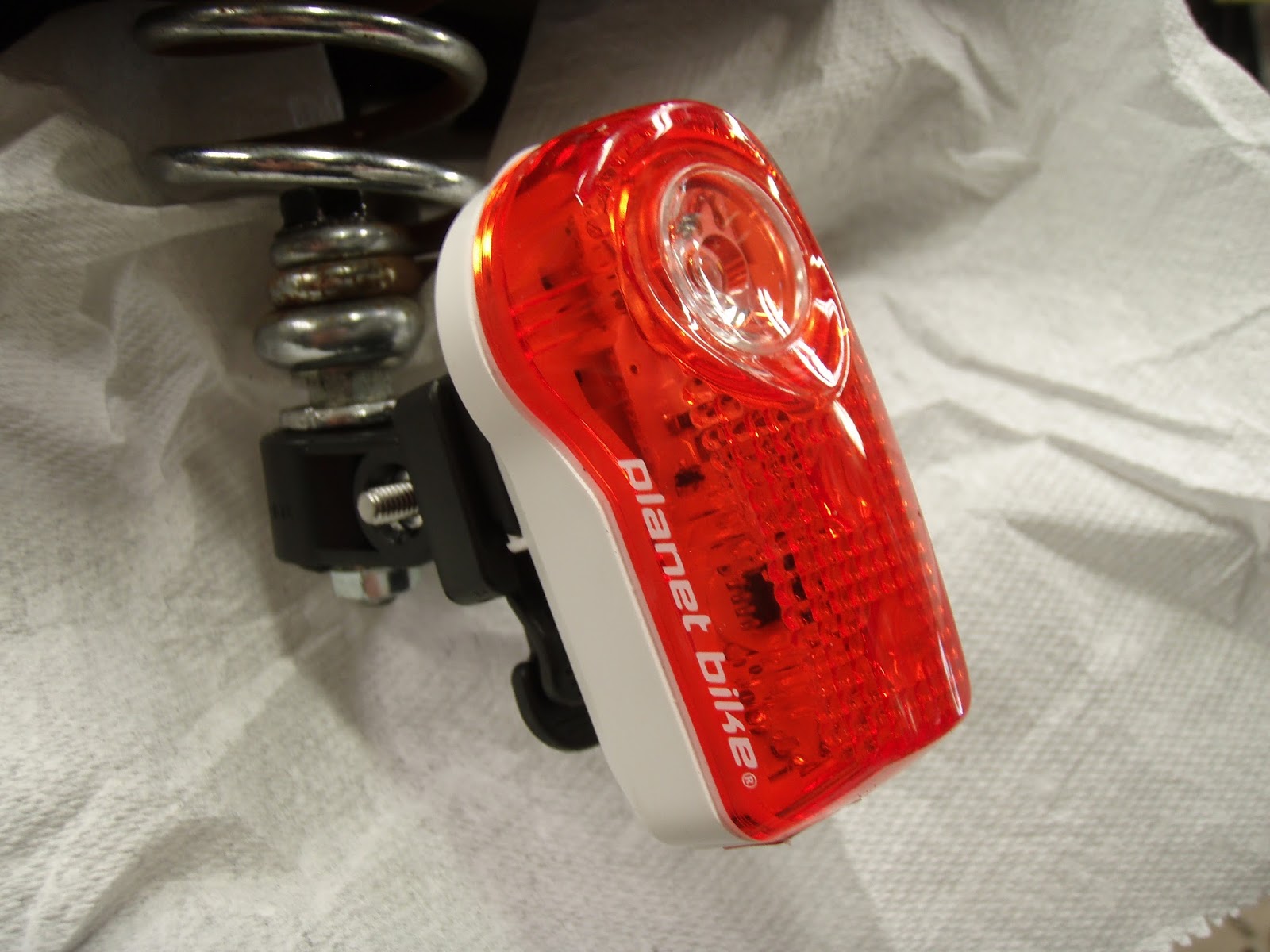
Yesterday I had to put Superflash lights on two low-priced bikes with sprung seats and suspension seatposts. This is a combination that makes on-bike mounting difficult, especially with the trend for frames with low stand-over clearance. The suspension mechanism on the post and the thickness of the cushy saddle mean that the solid part of the seat post may be buried in the frame. Even if a bit of it shows, it may be so low that the light is practically eclipsed by the rear tire.

Your average blinky user will not clip it to their clothing. That's too much to remember. They want the light on the bike. There it will remain, while its first set of batteries dies, bursts and destroys the circuitry. So I should not care whether the light is in the best possible location. But I can't help trying to do things in a neater, more functional way if I can.

After studying the bikes yesterday I realized I could take a bolt out of the seat spring assembly on the left side and devise a mounting point that would take the seat stay clamp provided with the light.

Step one: longer bolt. The nut has a step on it which will engage the hole in a washer that will form the top of the mount.
A metal washer and a rubber faucet washer go on the bolt next.
At this stage the bracket is assembled with a section of aluminum ski pole, a bottom faucet washer, a bottom metal washer and a nut to hold the whole thing together.
Here is the light bracket in place.
It's Superflash!
And there you have it. Ready to blink.
 
The rear rack limits how low the seat can go with this rig, but that would be as true with any other seat post mount. Mounting to the seat stay just puts the light down in the ground clutter.

Not a momentous accomplishment, but a nice little craft project.


Thursday, November 13, 2014

Fool the eye

Yesterday's rides featured visual phenomena.

It was the first day of the regular firearms deer hunting season. Pickup trucks were stuffed off the sides of the road everywhere. It's not a day to wear your brown coat and white mittens and prance around flapping your hands. I wore my usual school bus yellow jacket and added a blaze orange flag to my trunk pack. Nothing on my usual ensemble suggests the color of a deer, but a bit of orange helps seal the deal.

Nothing you can do about a stray shot. But that's true in any season.

A few hundred yards down rail from where I enter the path I saw a couple of runners ahead of me, out at the limit of sight. They both seemed to be sporting please-don't-kill-me-yellow vests. A wise precaution.

In due course I caught up to them. I discovered that only one of them wore PDKMY. The other one's jacket was merely a light color in the yellowish greenish whitish family. My brain had assigned the same intensity as the other runner's much brighter clothing when I saw them from the farthest distance. The illusion persisted until I was just a few yards behind them. Then the duller jacket suddenly faded, like a wet gleaming gem turning into a plain dry pebble.

If you aren't wearing real high viz, apparently you can stay near someone who is. Or perhaps the duller jacket was from Chameleon Wear, Inc., a company about to launch its line world wide. It would be nice if the eye-insulting PDKMY would moderate to a gentle hue when you got close to it.

The evening's optical trickery was less benign. I don't think I broke any ribs, but one arm was under me when I hit, concentrating the force and creating bruising that makes every breath painful.

It was one of those crashes where you get up giggling like an idiot afterwards. Sure it hurts, but it was also too stupid to take seriously. Here I am, well up in my 50s, stuffing it in a corner in the dark.

The only real turns on the Cotton Valley Trail are in the vicinity of the Allen A Beach. The path leaves the rail line to go over to the beach parking area, parallels the parking lot and then winds its way back to the railroad corridor. I guess I don't know those turns as well as I thought I did.

The powerful lights on my night-equipped bikes throw enough illumination to provide more context than the average battery-powered groper. The lighted area goes far enough ahead and spreads to the side enough to alleviate the illusion of being stationary in the dark behind a patch of light with things suddenly appearing in it. But in the Allen A turns the trees are close. The variegated brown leaves now covering the ground break up the light, reducing its power to provide a readily interpretable image. They camouflage the outline of the trail. Suddenly, in one of the bendier bits, I was headed for the weeds.

The trail is not wide. In the instant that I recognized the problem and tried to snap back into the proper line I was only able to avoid riding off down the little dropoff into the rough and land my crash on the smooth -- but hardened -- trail surface. After the initial impact on my arm and chest I somehow ended up on my back. I felt the bruising of my chest, but I knew I wasn't going to see any bones sticking out through my flesh or anything. The laughing set in as I checked over the bike and my small cargo before resuming my journey. Ouch! Ha ha ha ha! Ow! Snort!

I don't know why it seems so funny, but I continued to stab myself in the chest with mirth for the rest of the evening whenever I thought about it. There's something peculiarly funny about certain ways of biffing.

Friday, October 31, 2014

Halloween tricks

Heading down from my parking spot this morning I was shooting a short video of the scenery when I spotted heavy equipment up ahead. I left the camera on for the pass.
Stuff like this illustrates why I use the mountain bike for these commutes. The Cross Check could handle the majority of conditions, but when I'm on a schedule I want to be ready for any likely complication.

Close in to town I came to the next trick for the day, this fallen tree.
The real trick is that it was still there at dusk. It had sagged lower, so I couldn't fit beneath it while pedaling. Probably no one will ride in the dark, but if they did they would pile into this thing for sure. I wrestled with it for several minutes trying to figure out some jujutsu that would let me shove it aside, but I got nowhere. Someone else's efforts may have lowered it from its morning height.

On the ride out as dusk deepened to darkness and I left behind the two or three other human beings I'd seen on the path I got a solid whiff of brimstone. Nice touch. No idea where it came from.

I rode undisturbed by human or wraith until I reached the long straight stretch of track leading to Bryant Road, where I leave the path to head up hill. Far ahead I saw a white light. I could not tell whether it was on my side of Bryant or beyond. Below it I saw a strange shimmering. I was headed toward it anyway, so I knew I would get a better look. It held my gaze the way a light in the darkness does. The upper light was no doubt someone's headlamp, but what was that wavering business down below it?

Finally I was close enough to tell that the shimmery bit was the legs of a dog walking in the edge of the high intensity light, fur gleaming silver as the legs moved. Cooool.

Friday, December 06, 2013

Separate but better

I've been stuck in the car this week because of evening meetings and sketchy weather. It reminds me how much I hate being stuck in the car.

On the bike I use the rail trail to get out of town. For the dark season park-and-ride I use about six miles of the trail. Slouching along in the darkness can be a trifle lonely, but the kind of peer pressure you get when you're in a car among other motorists is not company.

The trail route takes me to quiet roads, mostly dirt, to where I park the car. Then the first part of the drive continues on dirt and minor paved roads, limiting my exposure to the people who always stick to the roads with the highest speed limits. You will get the occasional flaming jerk on a back road, but it's a lot easier to pull off and let them blaze on when you're not flying between the guardrails at 60. If I'm on the fast road it's because I need to go fast anyway, like in the morning when I'm invariably late to work.

If I have to drive the whole commute I will use the highway to go home simply to get the unpleasant task of driving finished as quickly as possible. Sometimes I'll divert to a dirt route, but since driving itself is not all that enjoyable I have to balance the peace of the circuitous route with the extra butt time in the driver's seat. I keep wishing I was on the bike.

If tonight's snowstorm stays well south I should salvage one bike commute out of the week. The night meetings are over for another month, except for music on Thursdays. It all comes down to the weather.

Once my park-and-ride gets shut down I have to figure out how to fit a ride into each driving day. With the great lights and studded tires on my path bike I can ride after dark. We'll see how that goes. It's pretty tempting just to go home and drink beer.


Saturday, November 23, 2013

A little laughter, a few moments of terror...

Actually, the terror was a couple of days before the laugh.

On Wednesday I rode the park and ride commute on the Cotton Valley Trail for the first time in a week. A digestive complaint had kept me from eating or sleeping well for several days, so I ventured back out cautiously. The morning ride put me in a good mood for the day. I looked forward to the return trip in the dark.

Still unable to pound down my normal quantities of food and not entirely sure I was completely clear of the intestinal ninjas that had been ambushing me, I rode conservatively, but some sections encourage a little friskiness. There's one bit where the trail crosses a road, goes a few yards level, then hops up and over a small knoll. Coming down the back side of the knoll I always enjoy the acceleration and the way the generator light burns bright white.

The path runs outside the tracks here. Outbound, the tracks are  to the left. Just across them are a couple of houses on wooded lots. I could see lights inside and out on the house that sits closer to the tracks. I heard barking.

No big deal. I hear barking from houses along the trail all the time. This time, the barking went from a questioning woof to deep, aggressive, rapid barking. Crashing sounds in the undergrowth indicated that a large dog was charging me from the blackness to my left.

"Hey, dog," I said in a loud but friendly tone. Then "Hey! HEY! HEYYYYYY!!! GET YER DOG!"

As I bellowed for the dog's owner I was sprinting forward. Outside the light from my headlight all was blackness. Even with a good helmet light anything outside its beam would be in black shadow. I couldn't waste time or attention trying to see the beast that was thrashing after me. All I could do was crank as hard as I could and hope the stupid dog didn't crash into me or chomp down on any part it could grab.

In several years of incorporating that section of path into commutes in all seasons I have never had a problem there. Yesterday and today's rides followed the placid pattern I had come to expect. But now I have to be a little more alert in case the mysterious hound returns.

One day on, one day off: On Thursday I drove to work because that's the day I pay a musician to be my friend. I don't have time to do the bike commute in any of its forms and still get to the string band's meeting place on time.

Yesterday the weather was showery. The morning sleet almost convinced me to skip the ride, but I went for it instead. The dirt road and path were still frozen from the previous cold weather. On the evening ride the top layer had thawed, so it was like riding on flypaper. The tires didn't sink into glop but they stuck stuck stuck, demanding a full grunt from every pedal stroke. It was a real thigh burner.

And so we come to this morning. Things had frozen up again. My digestive system was still behaving itself. I was doing okay on time. The sun was out. Great.

As I started down from my parking point I did not seem to be getting as much speed out of the descent as I usually do. Maybe the road was still a little fly papery. Maybe my first cup of coffee in four or five days was making me tach up a little. I kept pushing, down and down until I got to the path.

Maybe my seat was too low. It felt a little low. It had felt a little high when I started using the mountain bike commuter this fall. Maybe I raised it last winter when I started wearing the Snow Sneakers and needed to raise it again now that I had gone back to them. I pulled one foot out of the toestrap so I could put my heel on the pedal to check leg extension. It seemed okay.

As I brought my foot back around to slip into the toeclip again I heard a weird metallic click as my shoe caught on something projecting from the bike. I discovered that one brake spring had popped out from my rear brake, probably from shoving the bike in the car and dragging it out again in a bit of a rush. A brake pad had been rubbing the rim since I started.

Wow, was I fast after that! At least until I hit the blasting headwind on the causeways where the path goes along the lakes. But headwinds in the morning are often tailwinds on the way home. And so it was.

The evening commute gained a whole lot of atmosphere when a thick snow squall moved in as I was starting from the shop. It was a snow shower at first, steady but light. It thickened after I got out of the downtown area and headed into the darkness. But that wind was behind me. The snowflakes flared in the headlight beam. Occasional big ones in just the right spot flashed brilliantly for an instant. The cone of floodlit snow streamed toward me as the dusting whitened the path. A wild evening.

Wednesday, July 10, 2013

Lighting Priorities

This summer we've been having a lot of this:
With permanently installed lighting I can switch the headlight on when approaching intersections. I do that even in clear weather when approaching a couple of bad ones. My route isn't busy enough to make daytime running lights necessary. The sudden appearance of the light may increase its effect as I enter the maneuvering zone.

Sometimes it's nice to run the light just to add some warmth and brightness to the dreary scene.

On the open highway in fog I appreciate the power of the Superflash blinky taillight. I don't use it in good weather because the sight lines are mostly good and I wear bright (but not harshly bright) clothing. In reduced visibility I want to give overtaking drivers as much time as possible to realize a slower vehicle is there.

To reach distracted drivers, someone needs to invent a device that will broadcast a text alert to any cell phone in active use within 100 yards. Don't bother trying to get idiots to improve their driving habits. Just send them a text of your own. "Cyclist ahead! Eyes on the road, doofus!"

Saturday, December 15, 2012

Last ride of 2012

Today's 15 mile commute was probably the last bike ride I'll take before 2013. Tomorrow a snowstorm is supposed to move in with some pretty thick stuff before the end of our work day. Next week and through the week of Christmas, holiday needs are going to keep me in the car. By the time it's over I bet my park-and-ride parking space will be a snowbank. I'll need to come up with other ways to reduce my driving and maintain some semblance of fitness.

The night was crisp and cold, 26 degrees at the start. Jupiter and a scattering of stars reflected from the water and fresh ice of the lakes. A thin crescent moon settled toward the western horizon. My headlight flooded the trail with blue-white light.

People on the path have commented on the power of that light since I started using it. Wednesday night, four teenagers in a cloud of cigarette smoke, standing along the trail in town said, "Hey, that's a bright light! It looks like a car or something!" Farther out a miniature schnauzer ran up to me yapping, followed by a bigger, smooth-coated dog. The people with them also remarked on the brightness of the light.

Last week a police car drove up quickly to the crossing at Whitten Neck Road. It pulled in as I approached the crossing, then turned and drove away. I wonder if someone had called me in, thinking a motorcyclist was poaching the path. I love pushing that big light around. At a walking pace it reaches nearly full intensity, but I get to see it burn brighter and whiter as I speed up.

As winter advances I might figure out how to do some ski commuting from a closer parking place to town, provided it's plowed out. Or I might just drive all the way and take a walk. With free use of the groomed trails, one might think I could do that, but the temperature swings we've had in the past several winters make night skiing unrewarding if not outright hazardous. There's no chance I'll get any of the good stuff during the day. So a morning trudge on whatever is on the rail trail sounds like the best bet. The scenery is pretty and most of the dog doo will be frozen.

Thursday, November 08, 2012

Chillin' on the bike

An icy wind blew the brown leaves around as I loaded my bike for the morning commute. My tendency to overdress had finally coincided nearly perfectly with the plunging temperature.

It was 27 degrees -- that's -2.7 for you Celsius types.

The dirt road from my parking spot drops almost continuously for a mile. It is now well-packed. At 27 degrees it was also solidly frozen. I've hit 30 mph on that section, but cold air must really be more dense than warm air, because I can't seem to crack 27 mph anymore. I might be sitting up more because my eyes are tearing so badly from the cold air that I can't see where I'm going. Knocking off three miles per hour will definitely soften the blow if I hit a tree, right?

The big difference since last week is the total darkness on the evening ride. The snow held off for me, so I wasn't riding in whiteout squalls, but the north wind still played hard. It gave my clothing another test as the temperature dropped from its afternoon high of around 33 down toward the upper 20s again. The route back out to my car is a long, gradual climb of more than seven miles. The few little declines are offset by the steady grade up the last mile.

Miniature surf crashed on the rocks of the long causeway beside Lake Wentworth. I chased the patch of light from my headlight through the darkness. Leaving the windswept lake I reentered the forest. Leaves swirled in the puffs of wind.

Last week I almost hit a deer on the path during the evening ride. I spotted the one to my right and remembered that they seldom travel alone. I saw the one coming across from my left just in time to lock up the brakes. The deer stared into my headlight.

"Sorry," I called. The deer looked at me strangely, like an apology was the last thing it ever expected to hear from a human being. It ambled on across the path to follow its companion into the darkness.

On another evening, or perhaps the same one, I spotted the mysterious Dusk Walker at the far limit of my headlight. This tall, gaunt man walks on the path in the evenings. He never seems too pleased to be disturbed, even by a polite cyclist who always slows down and says good evening. Now that the darkness has fully settled in my light announces my approach. Its power surprises people. I saw Dusk Walker looking at the growing light around him while he was still 100 feet or more ahead of me.

Once the snow comes I will have to park somewhere else if I can find a place at all from which to launch a ride. More likely I will park closer to town and ski the remaining distance on the days it suits the schedule. It's all the skiing I'm likely to get, but that's absolutely fine. I love it when a mode of transportation that most people consider recreational turns out to be practical. It's a matter of attitude.

Monday, October 15, 2012

What you see

Driving out my rural road this morning to go to Portland to pick up a piece of furniture, I slowed suddenly.

Draping down from the trees was a thin black wire hanging in a low loop across the road. It was probably a telephone line or television cable, not a power line, but even so I did not want to snag it. I maneuvered around it.

The cellist used my phone to call the local police department. I keep the numbers for every police department in the area on speed dial in case I need to phone someone in for harassing me on a bike ride.

Further along on our journey, in one of the small towns like Kezar Falls or Cornish, I saw a car in the lane in front of us, waiting to turn left. A gap in traffic should have permitted the driver to go, but the car did not move. The driver had noticed a blind man walking up the sidewalk, swinging his cane, about to step into the driveway.

Both these items were much harder to spot than a bicyclist riding in a sensible lane position in traffic. True, the blind guy was wearing a please-don't-kill-me-yellow vest, but he was on a sidewalk well separated from the street. An eager driver might have launched into the gap without seeing the small, crushable human toddling into range. And the black wire presented a real challenge. In spite of that, before I could no longer see it in the rear view mirror I saw another motorist notice it and avoid it.

That being said, I have caught myself overlooking obvious large objects when I was driving or riding my bike simply because the timing of my glances and their arrival meant that I looked away just as they were coming onto the scope. That meant I did not pick them up until my sequence of glances reached their quadrant again. It's a good argument for taking one last look, and for waiting to launch until after that look is completed.

Riders shouldn't worry the most about being seen by someone in their lane, going their direction. Blinky butt beacons provide a little security for a minor danger compared to the threat of drivers crossing a cyclist's path.

The biggest dangers on the road are the result of peer pressure. People who want  to go fast press other people to go fast. Going fast reduces reaction time and narrows a driver's field of view. People hurrying through their maneuvers are more likely to overlook objects that don't fit their filter size. But it seems to me that "I just didn't see him" should never be an excuse. It may describe circumstances, but not extenuating circumstances. The next question should be "why not?"

Cyclists behaving unpredictably or operating in a consistently unhelpful manner: cutting quickly, riding against traffic, blowing through intersections -- need to be held accountable for their part in causing accidents and ill will. The problem is that the cyclist is more likely to be in no condition to present their side of the story in a serious accident. Given the chance, human nature will make a driver try to find a way to avoid responsibility for a crash. The myth of cyclist invisibility and the image of cyclists as careless or reckless gives them a lot to work with.

It's amazing what we can see when we want to.

In Germany, blinking lights are illegal on bicycles. I believe this is because in Germany bikes on the road are not a crisis to be announced with hazard markers, they are an expected part of the traffic mix. They need to be rationally lighted to see and be seen among road users who accept them as normal. They don't need emergency vehicle lighting because their presence is not an emergency.

We see when we look.

Wednesday, October 03, 2012

The World is Plunging into Darkness! Prepare!

Half the world, anyway. It's called fall and winter. Daylight is below 12 hours in the Northern Hemisphere now, and shrinking steadily to the long night of the Winter Solstice. It's time to light up. Try it, you'll like it.


Dynamo lighting completes my mountain bike commuter. It opens up options for dirt road and trail cruising, too.

The rack I scavenged looks like an Axiom. It has a tail light bracket built in. It also has two savage spikes on one of the side supports, perhaps to hold a small tire pump. I've already punctured my hand, pulling the pump hose off the valve stem after inflating my tire. Before I saw those off and then discover I have a use for them I'll try sticking wine corks on them


Right after I took these pictures of the Cross Check I improved the tail light mounting with two old-style reflector brackets in place of the P-clamps I had used in the original setup. The reflector brackets hold the light more correctly perpendicular to the road. The P-clamps had a tendency to creep a little and tuck the light under, aiming it ever so slightly downward. It was visible, but its imperfection nagged at me until I found a better way.

Speaking of better ways, for the most unprotected span of wiring on the mountain bike, under the rack to the tail light, I found some clear plastic tubing to use as a conduit. I did not want to run the wire down the side rail of the rack in case I put panniers on. The top hooks would chew the wire.

Dynamo lighting is really cool. We have an account with Peter White now, so our shop can sell these fun, effective lights to our local clientele, but so far I am our best customer. I would buy at least one more set of the Busch and Muller IQ Cyo R Plus headlight and Toplight Line Plus tail light to mount on one more frame that takes 700c wheels. Then I could transfer the dyno wheel from one bike to another. I already got the spare connectors.

Hey, when the sun goes down at 4 p.m. you can stay out half the night and still get to bed at a decent hour.

Monday, March 19, 2012

Calendar winter, temperature summer

Yesterday the temperature hit 77 degrees here in central New Hampshire. I rode in shorts and a jersey.

Spring-like weather is nice. In what we would have considered a normal year we don't expect to see much of it until May. Early warm spells on a day or two in April would usually be punished by weeks of retribution. It was all part of New England's famously character-building climate and terrain. So anyone who has lived here for more than a couple of years enjoys the pleasure of nice days with an uneasy eye on the horizon.

Last year the nice weather burst upon us in March as well, but it followed a somewhat normal winter, with feet of snow and a spell of subzero cold. It is a rare spring that progresses so agreeably without some harsh setback. Following a nonexistent winter it feels unearned. On second thought it feels like a justifiable reward precisely because we got no real winter to let us enjoy normal winter activities. Even so, it's hard to set out on even a short ride without the usual layers and spares one carries for cold weather expeditions.

Had I been a devoted indoor trainer I might launch the full commute right now. Instead I let the season  get to me. I'm laying down some base miles before I jump into the whole route.

The second trip down the Cotton Valley Trail found it much better and still far from good.  The ice was more rotten, the dirt still squishy. That was before these days at 70 degrees could work on it. I wallowed to town from my parking area and trudged back out in the evening, diverting again onto pavement for most of the return trip.

Parts are arriving for the generator wheel for the mountain bike commuter. It's good to have options. Effingham and the surrounding area have a lot of dirt roads in rough shape. A mountain bike with night capability could prove interesting beyond the commute.

Wednesday, January 18, 2012

Cross Training Sucks

With the arrival of an unusable but significant amount of snow, followed by a deep freeze, it has become Nothing Season. Roads are icy while cross-country ski trails don't have enough base depth for the groomer to till the icy coating into skiable granules. This forces the working cyclist into creative training strategies.

Because the kind of weather we're having doesn't encourage anyone to come into our shop we have long hours in which to pursue other activities. Employees and our rare visitors track in a lot of sand and salt from the parking lot and walkways, so I decided to take a few minutes to vacuum it up.

The vacuum cleaner seemed suspiciously heavy. When I extracted the bag it felt like something you could pile on top of the levee to divert flood waters. When I searched for a replacement I found an empty package. Apparently one can't just nip down to the hardware store to get new bags for this model. Even though it was obviously full to capacity I would have to use it anyway. I did extract the big hair and lint wad hanging from the inlet before placing the sand bag back into the vacuum.
When I finished the bag weighed 12 pounds. I would have thought it was heavier. The floor is somewhat cleaner. On the plus side, I burned more calories and got a bit of an upper body workout maneuvering the overweight vacuum around the sales floor.
Late last week, temperatures plunged below zero for two nights. It was so chilly in the shop that I wore my Bob Cratchit gloves while doing inventory. The heat seems to operate by its own rules. Some days are chilly, regardless of whether the day outside is particularly frigid. Other days it pays to dress in layers you can easily shed. This does not seem to correspond to solar input or the compressors operating in the basement. Sometimes the wind direction seems to make things colder, but the same wind direction does not always have the same effect.

Who really cares?

Over the holiday weekend the place was so dead I was running up and down the back stairs. Then I was walking up and down the back stairs. Then I had to stretch my legs to keep from cramping. My colleague George wants to set up a trainer we can ride when things are quiet. That's starting to sound good. Usually I listen to motivating tunes through headphones but I might work up a good spin by pretending I can get away from the "easy listening" station that gets pumped through here all the doodah day. Sirius makes the computer get stupid and the CD player is busted. We can't get really sweaty, though.

I did order another light set from Peter White. For the moment I can install it on any bike that will take the dynamo wheel I already have. Later I can build the 26" version to get the trail commuter fully operational. I'm really starting to groove heavily on the racks, lights and fenders thing. It does raise the stakes in case of theft. That bothers me as it would bother anyone who was making beater car levels of investment in what is far from a beater bike. Theft is not a huge issue around here, but I do think globally while acting locally.

Tuesday, December 06, 2011

It's Brilliant!

After nine months with the dynamo hub, I still love it. It adds weight and resistance that a removable battery light wouldn't, but you would have to remove the battery light to save the weight. So that just leaves resistance.

A transportation bike is going to weigh more than a sport or competition bike. Even mountain bikes are using exotic materials and evolved designs to reduce their weight compared to bikes with similar features from a decade or more ago. But the transportation category includes cargo bikes and heavy tourers, so we quit worrying excessively about every gram when we started down that path. Or road.

In 1980, when I worked at my first bike shop job and thought it was a temporary thing while I got a more illustrious career in order, our tribal elder and wise man -- he was 32 -- told us that a generator adds about a gear's worth of resistance when it is operating. He said this as he was installing the classic Union bottle generator onto the Motobecane he was configuring as a fixed-gear commuter with racks and fenders. We were all assembling different forms of the same thing. Most of us, with limited budgets and more of a focus on racing, used completely inadequate lights.

When I got a better job (relatively speaking) the following year, I invested in my own Union generator, and later acquired a Sanyo that drove off the tread face of the rear tire, rather than the sidewall. The increase in resistance never seemed as clear-cut as "a gear's worth." Does that mean a one-tooth jump or a larger increment? Even in the days of anemic incandescent bulbs it was great to have a fairly steady light. With Union's battery pack accessory it would even stay lit when the bike stopped. Any resistance it might have added was never enough to discourage me from flipping the lever to activate the light.

The specter of resistance still haunted me. When I moved to my present home and faced a 14- to 15-mile hilly ride each way for my commute I carried as little as possible on the bike or myself. The season of darkness ended my riding each year.

When powerful battery lights emerged as mountain bikers pushed into the darkness, they offered amazing illumination compared to any battery or generator light I had previously encountered. But then the problem of battery life became more important. When your light is already pretty feeble, its dimming seems less dramatic than when you start out with something that lets you read a newspaper at 50 yards when it's fresh, but leaves you groping in its dying glow when the charge runs out.

Rechargeable batteries needed careful handling to avoid over-discharging them and over charging them. As battery and charger technology evolved, we were told that running the batteries out was no longer a problem. So-called smart chargers eliminated the problem of frying the batteries if you left them baking too long as well. After using some of them I remain unconvinced, especially about the chargers.

At best, rechargeable batteries have a finite life anyway. They can only survive a certain number of charging cycles. So you go through a period of diminishing efficiency as the battery nears the end of its functional life.

Cold temperatures also diminish the power of many batteries. When I used my mountain biking light as a headlamp for night skiing I had to tuck the battery inside my clothing. When I took cold rides with the battery mounted to the bike it would suffer from the exposure. The battery lights I have on my helmet now don't work as well in sub-freezing temperatures. But then, who does?

The SRAM iLight hub dynamo I chose had very few reviews on the Internet compared to the Shimano, Sanyo and Schmidt hubs. Schmidt is the gold standard: expensive but excellent. Shimano is often rated as the next best choice. Shimano has prospered for decades making the second best item in many categories, bringing them to market at a price significantly lower than the top brand. Now they are recognized as a leader by many. Love 'em or loathe 'em, they do put out a lot of useful items along with container ship loads of technofascist whizbang garbage. I try to avoid them when I can because of that, but they're so huge that they end up providing things their major competitors won't.

Shimano made my job easier when choosing a hub because they did not offer a 36-hole hub that was not set up for disc brakes. SRAM did. So did Schmidt, but I work in a bike shop. I'm not pulling in Schmidt money. We have an account with Peter White, importer and distributor, but even with that it's an investment.

The SRAM seemed like it was a bit better than the Sanyo for comparable money. In particular it seemed to have lower drag with the light off. That resistance is the price you pay for unlimited light.

A 36-hole hub is probably overkill for my commuting routine. I went with something that strong in case I take a heavily loaded tour. Since I can imagine putting dynamo lighting on almost every bike I own now, I could see building on hubs with lower spoke counts for some of them.

Because I have not ridden with the Schmidt or Shimano hubs, I can't say if I would find them easier to push. The Schmidt certainly has impressive numbers, especially with the light turned off. However, I don't go without the advantages of the dynamo hub just because I could not afford the very best.

If you have a frame with a dynamo bracket already built onto the stays or fork, you can mount a sidewall generator like the Busch and Muller Dymotec 6 I used initially. I had problems maintaining alignment because of the tires I use and the way the add-on mounting bracket clamps the seat stay. Rather than continue to put a hurt on the frame tubing I went to the hub. With the sidewall generator you have zero resistance with the lights off. The downside is that you have to make specific arrangements to improve performance in wet weather. The wire-brush roller for wet conditions can mess up a tire pretty quickly if you don't have it lined up right. Also, most tires do not have a real dynamo track molded into the sidewall. German brands are more likely to, because of Germany's lighting requirements for transportation bikes. It's not a feature most tire makers highlight in their product descriptions in North America.

If you go with a dynamo instead of battery system you can get accessories to charge and power your small electronic devices so the electricity you produce during daylight won't go to waste. Some lights also come with daytime running lights now.

I have noticed that motorists show more respect when I run the big light. Something about its power seems to put me on a more equal footing. Fewer oncoming drivers leave their high beams on when I have a light that makes a bigger impact on them. It's aimed down where I need it, so it does not blind anyone driving toward me, but it clearly gets their attention even when I'm not running flashing lights on the handlebar to enhance visibility.

The wide Toplight Line Plus tail light probably helps for overtaking vehicles, but I never ride on the road without my full array of flashing tail lights as well. The Planet Bike Superflash pounds out a sharp warning that commands respect even when the sun is up. As the centerpiece of a night array with two flanking flashers it probably makes me look like an official vehicle. The bluish tint to the Beamers in flashing mode on the front of the bike may subliminally suggest police lights to drivers who chronically have a guilty conscience anyway.