Showing posts with label mountain biking. Show all posts

Wednesday, January 07, 2026

Parts replacement versus "mechanicking" again

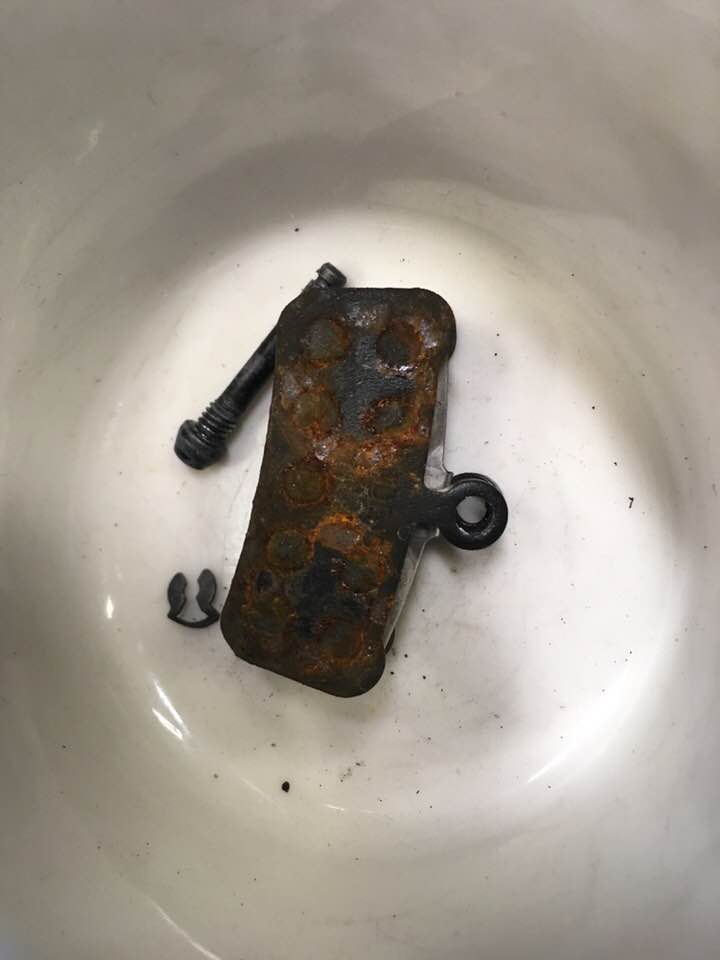
 A rider brought in his fat bike because he had accidentally burped out one of the caliper pistons in the SRAM G2 Ultimate front brake. So it's a four-piston caliper with three stuck, one on the floor, and no juice left in it.

I figured I had one shot to do it economically with what he had: reinsert the rogue piston, juice the system with fluid I didn't mind losing, and use the usual pressure tactics to dislodge the other pistons. This meant trying to do at least a semi-effective fill and bleed to get any kind of pressure from the lever.

The procedure failed because the piston seals for the runaway were too damaged to hold the fluid. It gooshed out around the piston too quickly to impart any force on the remaining pistons. There is no back door way to get those bastards out of there. I can reassemble and keep trying, or troll through YouTube videos, but the shop's hour costs about $80.

This is yet another example of how the industry and its technolemming devotees have set themselves up for ever more expensive repairs for the sake of taking a bike ride.

One more time with the old chorus: Mountain biking started out as relatively cheap fun on beater bikes. Certain visionary riders saw that it could be so much more as long as money was no object. Money, and the precious life hours of mechanics who know better, but are stuck in this futuristic nightmare.

It fits right in with every other dystopian horror we're living through.

I've got one more thing I can try that might save this particular bacon before I report to him that he can tinker with it at his leisure or get a new caliper and start fresh. We'll see how it goes.

EDIT TWO HOURS LATER: The one more thing worked. It worked smoothly enough that it wasn't even too pricey, relatively speaking.

Tuesday, January 25, 2022

The rantings of an irrelevant old man

 My frank appraisal of the backroom bike operation in town caused considerable angst in the upper management, who fears malicious reprisals of some sort. He grew up in this town. He has long experience with the kind of vindictiveness and long-held grudges that shape so much small-town life. I moved so constantly and lived in communities of such different sizes that I got used to being anonymous and quickly forgotten. I relate to ideas much better than I relate to people. I tried to assure him that the people involved in the subculture in question quit caring what I think shortly after the fat bike flap of several years ago. They've comfortably written me off as a decrepit old fart who is no use to them in any capacity. Why should they feel the slightest distress? I'm irrelevant.

Mountain biking went from a way to expand bikeable territory to a way to limit it when the machines evolved to the point where they function best on contrived courses, many of which are very expensively built. A highly advanced trail network was being built in town last fall, thanks to a deep-pocketed donor who expected to benefit directly from it. Construction ceased with the onset of winter, and other issues. I don't know if there are plans to resume. Other than that, trail support groups have joined the long lineup of nonprofits constantly fundraising to do what we used to do for free. We just happened to do it on the existing unpaved roads and trails that were already out there. Some of those fell under the protection of snowmobile clubs, to which a fair-minded rider might contribute with money and labor, but other lines sprawling over miles of countryside were old Class 6 roads and logging roads. These included public rights-of-way and private corridors that the landowner left open to public access. The more adventurous and skilled rode on hiking trails of varying degrees of difficulty.

The bootleg trail movement in these parts started with pockets of activity in the White Mountain National Forest and other tracts where the builders felt they could get away with it. Some of these evolved into legitimate cooperative ventures with the Forest Service or whatever entity was in charge of the land in question. And specialized trail builders and administrators began the laborious process of putting together a road system for the off-road rider. Even on existing trails, the needs of the wheeled are quite specific, and differ widely depending on whether the rider is headed uphill or down.

The riding that we did for free is not the riding that is favored today. Today's riders need those trails and need those bikes and need to pay whatever it costs to have both. We used to say of our recreational athletic habits that they're "cheaper than drugs." I'm not so sure anymore.

It's significant that the hot shop for technical mountain bike service is also a hot shop for technical downhill ski service. Mountain biking and downhill skiing are both heavily dependent on areas specifically built for them. Downhill ski lift ticket prices have gotten pretty staggering. I don't know how much it costs to ride a mountain bike at a pay-to-play venue, but the costs of buying and maintaining a mountain bike have certainly dug into users' wallets. And you need to be able to transport yourself and your large bicycle to the playgrounds you want to visit.

Original recipe mountain biking was for the masses. Mountain biking today is for the financially superior. Sure, you'll find devotees who build simple lives around it...for a while. But they might have to finance their habit by working in the industry in some way. It becomes more and more insular. The working-class hangers-on may have to be mechanics skilled in the style of machine that the majority favors, or trail builders, or become instructors, like the golf pros, tennis instructors, personal trainers, yacht captains and crews, personal chefs, personal assistants and other support staff in the service economy.

Saturday, January 22, 2022

The Competition

 Two local beer joints are run by mountain bikers. Both of them have toyed with the idea of starting a shop to cater to their specialty here, but only one of them has actually done anything.

The backroom shop started as a service facility, but recent social media posts indicate that the proprietors might be selling new bikes on a limited basis.

I absolutely love this. They will find out the difference between beer customers and gear customers. If somebody drinks until they puke, they don't come asking for a refund or warranty. "Hey, that last beer was only in my stomach for about ten minutes! You should at least comp me my next one!" However, a person with a history of fraudulent warranty claims on bike frames is still a rider in town. Maybe it will never be a problem. Maybe they'll stonewall anyone who tries it. They're in a good position to take a hard line, because they're just playing store. They won't live and die by their reputation. They'll play at this as long as it's fun, and then quit. Maybe that's how all specialty bike shops should be, since the equipment is ephemeral, and there are lots of ways to quit riding.

The hobbyist shop or the cutting edge techno hangout may turn the bike shop business into something like the restaurant business. A shop will start up with no clear long-term plan, just serving its specialties until their quality slips or the economics catch up with them or they just get tired of it. It'll be the hot place for a few years at best, and then vanish. Another one will already be taking its place.

When we first heard about their operation, it was based on sending the technical repairs to a guy up north a ways, who does earn his living as a bike mechanic, doing a lot of boutique work for the disposable income crowd. The shop puts technology front and center and passes no judgment on expense and complexity, and the relentless march of obsolescence. He's staked out the technological territory.

There are two ways to ride out a period of technological ferment: Replace your bike frequently, or pull way back to solid simplicity for a few decades to see where it all goes. It depends on your goals for riding. I'd decided more than two decades ago that mountain biking was a nice hike spoiled. But someone into the modern style of mountain biking will be enslaved to the technology, because you definitely can't ride that way on the kind of old, simple bikes I own, any more than you could be competitive in road racing with a vintage steel bike with friction shifting.

I can think of a lot of ways that the backroom bike shop could operate, but with no reliable intel from the inside, I will probably never know. For instance, they could piggyback on a real shop's wholesale supply orders to get parts. But then do they take a markup, or bro deal their friends, undercutting every legitimate shop in the area? Or do they make their customers dig up the parts, and only supply the labor and whatever know-how they have, as well as the work space?

The great part is, I don't need to know. All I have to do is deal with whatever comes through my door on a given day, and keep my own simple fleet running for as long as I have the energy to ride it. What happens next door stays next door...except for what gets trumpeted on social media, but you know that's always buffed up to look great, regardless of what's really going on. Time will tell. It always does.

Monday, November 01, 2021

Trailbuilding as commercial art

 Our energetic trail builder has a creative past, with forays into music and design. His other traits, which sustained him through a hitch in the Coast Guard and other adventurous occupations, also include considerable organizational ability if the subject interests him in some way. Thus his career has included a lot that was not overtly artistic. But an artistic sensibility shapes his actions rather than mere soulless athleticism or mercenary pursuit of maximum monetary gain.

While the trails are built to technical standards using proven designs, lines have to be chosen based on observation of the local terrain. Mountain biking is unnatural, and a consumerist activity, but its environmental impact is low because the features have to coexist with the natural forces at work on them. And animals like finding easy passageways through the vegetation, as any trail builder soon sees. Ancestral routes often used game trails, as humans evolved from slightly removed to dangerously removed from the natural order of things. Game uses human corridors now, as well as their own herd paths. Nature just keeps going on as best it can, in spite of or in step with human activities.

Art, in cultures that don't make it central and therefore don't understand it, is presented as touchy-feely, and the province of flakes, charlatans, and generally impractical people. This is a disservice both to art and to the generations of young people who eschew practicality if they feel an attraction to their imagined world of art. Art needs to be presented as a practical subject and used not just to develop powers of observation, but to address in the same way that reading, writing, and arithmetic are addressed, the basic skills of construction that go into creating a work of art. Don't wait for expressed interest. Just put it out there and see who runs with it.

Maybe they're doing that now, but they weren't doing it when I was a kid. Art classes dealt with important things like perspective and composition, but didn't get into the actual handling of the tools. And art was an elective, so you had to decide -- before you were old enough to know how much it might matter to you -- to ask for it.

One book I read around 1979-1980, as I was first trying to launch a career drawing pictures and writing stories, stressed the fact that an artist can benefit significantly from being businesslike, and that artists through history had done so, although exceptions abound among the famous names whose birth and death dates turn out to be depressingly close together. A lot depends on luck. I don't mean the luck of finding work and getting compensated for it. I mean the luck of having innate personality traits that aid a person's curiosity in finding the right questions to ask. Nature and nurture come together to shape a young person.

The trail builder's crew commands a decent price, but it's not going to propel any of them to fortunes. They take pride in their skill and in their product, born largely of experience as riders, even if some of them have aged out of the most risky maneuvers. It's art, but commercial art. It's a kinetic sculpture that the viewer enters and forms a part of. It's more than that, of  course. But it's all inspired by creativity and expression through movement.

Tuesday, June 29, 2021

The difference between culture and subculture

 When mountain biking boomed and took the bike industry with it, to levels of social popularity really never seen in the industry's entire history, it made biking -- particularly on mountain bikes -- part of the general culture of the country for almost a decade. Mountain biking was accessible, affordable, and widely appealing.

As the activity evolved, its tributaries exerted their influence and ultimately narrowed its focus, turning mountain biking into a subculture.

Culture is inclusive. It draws from social connections outside of itself to weave a discrete activity like riding what was then considered an off-road bike into the general lifestyle of a majority of people. Only a minority of participants actually spent a lot of time on technical trails, but the bikes were affordable and fun to ride, with a popular configuration. They were simple enough to modify readily to suit an individual rider's preferences. The bikes were everywhere, along with a general sense of belonging at least to some degree to a vast and accessible community.

Subculture is exclusive. It develops its own language and customs, designed to exclude the masses in favor of the qualified. Anybody with the money can buy the equipment, but it takes knowledge and experience to become a recognized member of the group.

Fragmentation is inevitable as personal styles gravitate to each other. Tribal affiliations form around specific types of riding. Within these tribes, hierarchies develop. In mountain biking, rank depends on exposure to personal injury. Whether it's overuse injury or crash injury, the group is isolated from the main stream of society by its adherence to technical off-road riding, and further narrowed by its adulation for participants with no sense of personal safety. The biggest risk takers are the most admired. Below them are the riders of lesser skill and daring, who may be completely content at their level. Some of them may pose or aspire to higher status, but many of them just enjoy their personal best and are happy to be part of the scene. It's safer than riding the road, while at the same time perceived as ballsier because of the public spectacle of stunt riders performing sick tricks and even releasing the videos of their spectacular failures. How else will the audience appreciate the extreme risk involved in being a true master of this thing that doesn't need to be done?

Not every category of biking forms a subculture. Mountain biking and BMX are strongly subcultural. Recreational path riding isn't subcultural at all, except to the extent that not everyone in our general culture rides a bike at all. But path riders and urban transportation cyclists don't have the special clothing and conscious pursuit of fitness and technique that other disciplines of riding have. Any category that uses special shoes and pants is a subculture at this point. At the height of mountain biking's cultural saturation, bike shorts and shoes were darn near mainstream, but they aren't now. Whether you wear tight, shiny shorts with a chamois or proudly display your disdain for aerodynamics and crotch padding with your off-road attire, it's generally tailored to riding. And flat shoes for shin-gouging flat pedals are still "biking shoes" just as much as pointy little hard-soled things with a cleat on the bottom.

Mountain biking now depends on constructed courses. The better ones offer trails with varying degrees of difficulty, in order to attract and maintain the interest of riders who will inject money into the subculture's economic sector to help support the interests to the minority of elite performers. This is much more vulnerable to economic fluctuations than the old exploratory style of off-road and dirt road riding that we pursued in the early years. We had to worry somewhat about land closure, but one's vulnerability was directly proportional to one's addiction to a certain kind of terrain.

When I gave up mountain biking near the turn of the century, it was to build a bike that would get me through just about any public right of way depicted on a map, before anyone had decided that "gravel" was a category and tried to exploit it as a profit center for the struggling bike industry in the wake of mountain biking's collapse. I'm still riding the same bike more than 20 years later, on the same type of publicly accessible right of way. Some of them are too deteriorated for regular practical passage, but most are useful connectors, and I don't concern myself with whether they are paved or not. I also don't have to worry about whether they will be too muddy. Most of them are kept clear and passable at least half the year by some government entity at the state or local level.

The Surly Cross Check was eminently practical. Naturally, it generated very little interest. In that way it was similar to the Pugsley -- ancestor of the fat bike movement -- in the way that it languished for many years, developing a slowly growing following before hitting a critical mass and contributing to the birth of a category that the industry could claim suddenly to have invented. I wouldn't ride it slam-bang down rough trails, but it gets me around on a lot of interesting roads less traveled. It used parts that could be mixed, matched, and substituted, for ease of maintenance and better odds of repair if you happened to need it somewhere far from home. It would fit nicely into culture, if culture should embrace simple bikes again.

Monday, June 07, 2021

Some dildo on a road bike, and other workshop trivia

 I had not yet had occasion to unwrap a set of these bars. Be the "envy" of your ride group. This manufacturer has an eccentric way of securing the bar tape at the end of the drops.

The mushroom cap is permanently affixed. After you make the first wrap at the end of the bar on your way to spiral up to the tops, the flexible cap flips down into the position you see here. Below shows the cap in the open position as I prepared to remove the old bar wrap.


In no particular order, here are other observations and problems solved:
Short rider with small frame complained about her basket dragging on the tire. I remembered that we'd salvaged this little front rack that attaches to the cantilever brake bosses. It actually fit without interference from some other component. Always nice when something works as intended. Advantage to rim brakes.

Here's a rarity: Back when Shimano first entered the rotating shifter market, they actually made changing a cable easy. They soon spotted their error, and the later models are almost impossible to open at all. They love to make puzzle boxes out of their shifters.

And now a reminder of why I hated crank arm dust caps. They almost invariably ended up bonded to the crank arm so thoroughly that they needed to be chiseled out. Or, if you were lucky, one or both of them fell out and disappeared. Good riddance. Especially in the early mountain bike era, anything that stood between you and checking your crank arm bolts was a bad idea. From the late 1980s through much of the 1990s, we replaced an uncounted multitude of left crank arms for riders who hadn't kept up with that vital bit of regular maintenance. The coming of socket-head crank bolts with no dust cap significantly reduced the problem, which freed up the bike industry to devote more attention to creating many other problems for their addicts loyal customers.

While we're in the neighborhood of the crank, this Shimano replacement crank displays a copious application of the pus-like grease that congeals into earwax in early versions of their under-bar pod shifters for mountain bikes.

A little grease on the threads of a crank bolt and under the flange of the head of it is a good idea to help torque it down. But this much grease is way too much. It will get onto the flats of the square tapered bottom bracket axle, compromising the security of the crank arm. Shimano started advising techs to grease the drive side flats of their cartridge BBs in the 1990s during The Great Cheapening, because over-tightening the crank arm against the face of the BB bearings  -- while bad for the crank arm and less secure overall -- helped hold the basically defective design of the bearings in place. While the design of the cartridge BBs has been quietly improved without acknowledging fault, the practice of over-greasing right crank arms remains. Left crank arms -- the ones that fall off more often if bolts aren't properly torqued -- remain completely neglected by them. It falls to individual mechanics to clean up after them and install things correctly to survive for as long as possible in a throwaway society. Do not grease the flats of square tapered bottom bracket axles. Do grease the threads of crank arm bolts. That is all.

A customer attempting to keep a used bike in service brought in his $25 great thrift store find. It was a Schwein mountain bike from the last few moments when Schwinn almost pulled back from the brink of collapse with some decent and well-reviewed machines. The bike he bought was one of the lower-end models, but still a decent platform to fix up and use for a bit of fun cruising and retro trail riding. There was just this mysterious bit of duct tape wrapped around one fork leg...

You may have spotted the guilty secret concealed in a sliver-gray wrapper, but below it is shown fully revealed:

 The fork leg was completely broken. All that held things together was the tape around the outside and the internal parts of the cheap suspension. Silver tape. What can't it do? 

Specialized was kind enough to send us one of the three ebikes we had ordered prepaid back in January. 

What do you think? Do they want me to update the firmware? They have a groovy website where we're supposed to connect with all of the electronic brain stuff. After we updated that interface as directed, the screens we got in the firmware updating process didn't look like the examples in their help and guidance area, and it was never clear whether we had actually succeeded, or if the bike didn't really need it after the hysterical admonitions of the included printed material. 

To compound the annoyance, this expensive machine came in a smudge-attracting matte mint green. Matte finishes are stupid. Light-colored matte finishes are downright sadistic.

The workshop continues to be buried in repairs. El Queso Grande declares that he's never seen anything like it in his almost 50 years in the business. I still wonder if it only seems worse because we can't fill our staffing needs. Leafing through a journal from 2005, when we still had Ralph, I found an entry referring to how buried the workshop was during the early summer rush. EQG likes to go on short conservative rants about the corrosive effects of government generosity and the shabby work ethic of teenagers, but the reason that we can't hire people right now is that they think the work is dirty, complicated, and boring. And they're right. Any youngster thrilled by the new stuff will have no patience for the old stuff. Anyone not thrilled by some aspects of bikes or the bike business won't be lured in by the awesome salary, high prestige, and sex appeal.

 REMEMBER: THIS NEVER HAPPENS

EQG is undefinably agitated by the incentives some employers are offering to entice people to sign on with them. He mentions seeing reports on the news of college tuition incentives, bonuses, and prizes. He rightly asserts that a little place like ours can't compete with inducements like that. But once the novelty of the perqs wears off, you're still left having to do the actual job. And I don't think anyone in our immediate area is offering anything like that anyway.

The young whiz kids are great and all, but a fully functioning bike shop still needs some poor old gray-haired bastard who's pissed away his life at this, and has simply seen a lot of stuff. Or the bike business in general has to cut its ties to its past and leave the maintenance of the derelict hulks still in service to the back street and home garage outfits where someone has the tools and knowledge and can be bothered to use them.

The good news, if you could call it that, is that the pandemic bike boom is already winding down. The lack of bikes to buy has now become widely known, so anyone whose interest was marginal already will be looking for something else to do. Anyone who remains interested still faces a treasure hunt that could yield nothing. No bike means no new participant. It may not be the bike industry's fault exactly, but it's still their loss. Also, with the reopening of many activities and venues that had been unavailable during the height of pandemic restrictions, people are returning to their established preferences as much as possible. Those preferences had verifiably not included biking. With the exception of ebikes, which are really a low level of motor vehicle, the bike industry was not growing, regardless of what the evangelists of mountain biking will tell you.

A low-end ebike will provide more satisfactory performance to a budget-minded customer than a low-end mountain bike will. Neither is a particularly good investment, but the low-end mountain bike is pretty well guaranteed to be beaten into junk within a couple of months of vigorous trail riding. A cheap ebike, with care, might last for years. Thus the two categories belong pretty exclusively to the higher income brackets. It remains to be seen how long higher income brackets will remain viable in the face of all the balancing factors that are increasingly hard to hold back. These include both natural and social forces.

An article I read recently about the social, economic, and environmental impact of mountain biking referred to riders coming not only from the traditional high earning professions, but also from workers in occupations like construction and landscaping. Participation in an expensive activity lasts as long as you are willing to devote your funds to it. The fact that no one disses you for being a dirt worker as long as you can hold your own on the trail does not make the activity egalitarian. Anything with a buy-in of thousands of dollars up front, followed by ongoing consumption costs is not open to all. One section referred to a study that showed that 2/3 of mountain biking tourists in a particular area had annual incomes of $70,000 or greater. Another reference listed average household income as $100,000. You gotta bang a lot of nails and mow a lot of lawns to play in that league. You also can't afford it if you make your living fixing bikes. Not for long, anyway.

Thursday, April 15, 2021

Reverting to winter


Anyone who has lived in northern New England for a while knows better than to put the shovel away before May. Maybe June up in Aroostook County, Maine.

The forecast for the storm moving in tonight and lasting into Saturday is for 4-8 inches of snow, with a lot of rain mixed in. The snow is good news for depleted ground water, because it hangs around and percolates in, rather than running off into streams and rivers, to make its way back to the ocean. There will be some of that, too, which is good news for lakes that had not ended the winter brimming with excess. Local rapids stopped rushing and were merely hurrying slightly, months before they were due to be so quiet.

Several inches of gloppy wet snow isn't such good news for biking. It will melt quickly, making the interruption brief. It's worse news for trail users, whether on the stone dust rec path or the constructed courses of mountain bike trails.

Back when we mountain biked on found surfaces, we rode on anything. The trails were mostly woods roads, what we referred to as "double singletrack" because the ruts created parallel courses that you could sometimes ride as separate entities. In many places, even though the road was wide enough for a truck, the surface was made of New England's signature jumble of rock, so it was plenty technical. We also rode on snow machine trails, wherever they were not routed over something that absolutely had to be frozen. Rotting ice, mud, wet rocks and logs were just routine challenges to the early season mountain biker. We came home chilled, wet, and grimy, as did our machines. Sometimes we would find motorized mud aficionados buried to the wheel tops -- or worse. As the trails dried out the surface would stiffen as it had been left. Users would then wear it down into dry season configuration just by negotiating the ruts and ridges of dried soil. Where the soil was sandy, some wetness helped compact it to make it easier to ride on.

Depending on when the snow retreated enough to make riding on trails possible at all, we would begin like this:

Then the bugs would come out.


Now, mountain biking groups of various levels of organization, from a few friends with hand tools and leaf blowers, to non-profits small and large, go to lengthy trouble and expense to construct courses that they are understandably protective of. Trails will be closed due to mud. As much as road biking was being called "the new golf" a few years ago because of all the rich lawyer types getting into it, mountain biking is much more the new golf, with its $4,000-$10,000 machines and professionally constructed courses. We road riders still just go out on whatever we find, and can have a completely satisfying experience on a bike that's 40 years old. Just not in the next few days.

Fat bikers will chuckle indulgently. I suppose it's a tortoise and hare situation: they can go out and maintain their 7 mph every day, come what may, and rack up more distance than riders who wait for firm conditions and go faster for less time. Probably not, though. And if you want to have a fat bike in the lineup just for the conditions at which it does the best, you end up investing in a bulky bike that needs to be housed when you're not using it, and transported to the riding venue if you don't hop on the pedals right from home every time. Even eBay deals started out as something some idiot paid full retail for, somewhere. Chances are, you'll throw down $1,000 and more -- sometimes a lot more -- for your blimp-tired bomber.

Tuesday, February 25, 2020

Winter to the end

The two toughest months of winter around here are March and April.

No matter how substandard the principal months of winter may have been, nothing is going to get warm and nice until well into May. Maybe July. Although astronomical spring doesn't officially start until the equinox in late March, meteorologists consider March to be a spring month. With the change of daylight in the second week of the month, the mornings will look like January, but the afternoons will look like April. There will still be nothing to look at, but you'll be able to see it.

There have been exceptions, but the only ones I can think of were 1988 and '89. And I was a lot younger then, spending most of my spare time in winter hanging out in harsh mountain environments until the season shifted enough for me to get back into bike commuting and a bit of sport riding. My sense of what was cold and nasty was probably considerably influenced by that.

In 1990, I began riding the commuting route between my little spot in Effingham, and my jobs in Wolfeboro. In 1992, jobs became job, but the schedule was still usually at least five days a week. Because the roads around here are not well suited to bicycling in winter weather, I did not push my luck in snow, ice, and darkness. Even with improved lights and studded tires, the danger in the dark and frozen months is much greater as roads are narrowed and drivers are less patient. And they weren't all that patient to begin with.

My precarious economy depends on the money I save by using my bike to commute in the nicer months. I will get out there before the weather is very inviting, because it's the best way to get in shape while reducing car use. It also means that I have more of the rest of my time to devote to other things I think are important. But the best of it is definitely high summer, when I don't have to deal with layer upon layer of snug-fitting clothing for the ride at either end of the day.

Commuting takes place in the margins of the day. One of the cruelest things about early season commuting is that the middle of the day might be stunning, but the morning is frozen and the evening is raw.

Park and ride commutes salvage some riding when I might need a car for other things at either end of the day.

Trail-dependent riders have to deal with difficult or impossible riding conditions as whatever we got for winter melts away. As mountain bikers have to invest more and more money in engineered trails, they're actually voluntarily staying off of their own riding surfaces when heavy use would rut them up horribly. Meanwhile, the road is just the road. Frost heaves are much less of a problem on my bike than in my car. Potholes are a problem for everyone. Even there, I manage to skinny past most of them with only minor course corrections. Stay alert!

Back in the olden days, when we just went out and rode our mountain bikes on whatever we found, other users were doing way more damage than we were. The only limit on our willingness to ride in slush, ice, and mud was our willingness to clean our bikes and ourselves afterward. Indeed, one of our local riders who slunk off from the mountain group in the late 1990s said that he "just got tired of cleaning (his) bike all the time." I was already starting to think of mountain biking as a bit of a good walk spoiled, so I was fine with the group's focus shifting back to the road.

After a couple of seasons making the effort to join the Sunday road rides, I flaked off from them because it was interfering with my commute. My life's work turns out to have been riding to work.

I have chosen employment based on whether I could ride to it. I was so committed to the concept that I would actually show up for job interviews on my bike. Later on I drove like a normal person. That alone did not seem to enhance my success. I got some, didn't get others. I have ridden my bike at least a few times to every job I have ever held. The better world for which I strive is one in which bikes are fully legitimate, accommodated users of the public infrastructure. You should be able to pedal to virtually all locations that you can reach by other individualized transportation, without fearing for your life from the negligent and hostile acts of other road users.

Yeah, I know: people are shit, and you will always be in some peril because of this. But there could damn sure be less of it. It dulls my joyous anticipation of commuting season, but just one drive to work behind some idiot drifting down Route 28 like they're piloting a hot air balloon reminds me of how completely unimpeded I am on the bike. The drifting idiot at 43 miles per hour isn't slowing me down when I'm giving it all I've got to maintain 17. More likely 15.

All that lies far ahead, beyond the laborious crawl through whatever late efforts winter throws at us, just to reach the drab gray weeks that follow. Hey, if it was nice here it would be crowded.

Friday, January 31, 2020

To see ourselves as others see us

Hard to believe that anyone in the technical mountain biking community bothers to read any of my rants, but apparently some do. Hey there.

Things written or said for rhetorical effect will focus on specific aspects that support the central thesis. It’s the basis for editorials, legal arguments, and marketing. The benefits of a drug are repeated loudly and clearly in the commercial, while the side effects are recited in a hasty blurb in a low tone.

When I say things that are true, bluntly summing up actual events, it might compose a picture that looked different from someone else’s angle. This is the unsettling effect of seeing ourselves as others see us. That doesn’t mean that everyone sees you that way, only that the dots can connect to create that image. But I went too far, and I apologize.

As an unsociable person, I lack the instinctive understanding of the needs and desires of sociable people. In every activity to which I was exposed growing up, advancement in the activity itself was primary. The social aspects were secondary. It was an unrealistic point of view. For a few hard chargers, achievement is a primary goal and benefit. But among normal people, the social side is much more crucial. It explains a lot about where I’ve landed, and the rough and desolate landscape in which my life will end.

In the case of off-road biking in any season, I’m not alone in my laments but I’m certainly in the minority. Around here I’m definitely alone in criticizing the avalanche of expensive and complicated equipment burying small shops and cutting the tech support cord for riders trying to get a long service life out of their stuff. I don’t see that it generates much public support or sympathetic interest for cycling in general. But I suppose that nothing can do that. We might as well each ride in our chosen style and let the world burn if it's going to.

As stated in the post before this one, cycling is being gentrified. Its greater value as a tool of social evolution is falling victim to its short-term attractiveness to an industry bent on exploiting it as a consumerist bait station. The technofascist element has its hooks into every category. It has the most to work with off-road, followed by high end road and its offspring, “gravel biking.” But the collateral damage shows up in the reprehensible quality of middle and low end componentry as seen on a lot of path bikes, hybrids, and entry level mountain bikes from companies that should be ashamed to have their logo on something like that. Like an asteroid on a converging trajectory, nothing can stop it. Actually, more like the deferred consequences of environmental destruction, it would take too many people to understand and agree all at once. We would prefer an asteroid, that we could maybe blow up with one quick nuke and go back to enjoying ourselves.

Monday, January 27, 2020

The Victim of a Badass Image

Mountain bikers have had to deal with trail closures and public censure since their segment of riding became immensely popular in the 1980s. With its roots in "clunker" bikes that were often built by crafty roadies looking for some alternative fun, it began with a sense of humor and a touch of bravado. But by the late 1990s it was taking itself seriously. Bravado evolved into foolhardiness. You had to be increasingly crazy to achieve respect.

The evolution was gradual. It began with bigger and bigger risks, and intensified with converging streams of influence that had little or no road riding background. Where early offenders were mostly just too high spirited, mountain biking specialists developed their own brand of self righteousness that's just as offensive as the shiny Lycra snobbishness they abhor in roadies.

As big air and moto-style courses came to dominate the public image of mountain biking, the image of the rider changed with it. Fitness became secondary to skill. Skill became synonymous with the ballistics of managing your machine and body on a gravity-fed plunge through a field of obstacles.

Google fed me this blog post by Josh Cupit, from 2018, titled, "What happened to mountain biking?" Knowing nothing about the author, I went to see whether his observations echoed mine. Instead I found that they represented quite succinctly the ferocious attitude that has purposely made mountain biking less inclusive and more vain about its bloodthirstiness and masochism. For instance:

"The core of mountain biking, for me, has always been the challenge and the danger. If I wanted to insulate myself from any hazard or pitfall, I could take up road biking, or gravel riding, or jogging. Or golf. Mountain biking is an escape from the mundane and unyielding predictability that life offers. It’s the only place I can feel a sense of danger, and that’s what I love about it. And it’s not synthetic danger, or theoretical danger; I experience the thrill to the fullest because I’ve experienced every conceivable ramification of my own failure to control my bike."

The fact that he cites road biking as devoid of danger is laughable considering how many mountain bikers I've talked to who are phobic about traffic. But paradoxical assertions are a common affliction among humans. You know: "The food's lousy here, and you can't get seconds."

The kid was born in 1994, and started mountain biking in 2006, so he missed all of mountain biking's early evolution and its attempt to be a unifying and attractive activity for cycling in general, not a fortified enclave of trail warriors seeking honorable wounds. Every young generation finds its good old days in the years in which the previous generation has already seen everything going to hell in a handbasket. He went from good old days to handbasket by the time he was 24. It's so cute that he considered 12 kilometers a long trail. In 1994, the group I rode with regularly knocked off 12 -17 miles of trail on a ride after work. And most of us were old codgers in our 30s.

I could dismantle the lad's essay point by point, but there is no point. Anyone who follows the link and reads it will interpret it through their own sympathies. Only a handful of people will probably ever know if he grows up and what he grows up into. Instead of just bitching about the fact that his idea of the sport has fallen victim to the disposable income of people he considers athletically and philosophically inferior, he should be bitching about an economic system that considers that kind of disposable income normal and desirable.

The current problems with trail closure on the Kingdom Trails system in Vermont are a direct outgrowth of the badass attitude that leads some riders to be offensive punks. Take away their trails and all they have is craft beer and an attitude. These are the kind of rider who hurls obscenities at slower riders on a recreation path when someone asks them to slow down and pass more discreetly.

The fact that mountain biking has become resource intensive and highly dependent on control of land access means that a few assholes can ruin it for everybody. A few assholes can ruin any activity, but certain activities expose their assholes more than others. Assholes riding on the road create a bad image for all pedaling road users. Anywhere large numbers of people interact, abrasive people will leave their mark. But mountain biking made more of an effort than any other branch of bike riding to cultivate a badass image. It now reaps the consequences.

Competitive people tend to be more self-absorbed and offensive than the average person. Complaints abound around roadie venues where young racers exhibit what they consider to be a European sophisticated casualness about changing clothes next to the car, and public urination. Cycling brings out competitiveness in a lot of people, and stimulates it in anyone already inclined that way. "I'm not a racer, but I can get up (or down) this hill faster than you." The elation of small victories accumulates into an unconscious sense of superiority. Arrogance follows. To quote young Mr. Cupit again:

"This is why I’m so disappointed in the current state of mountain biking. Having worked in bike shops for years, I’ve heard the company lines about inclusiveness, and how “more riders is good for the sport.” But it’s not. It’s a clever marketing line to sell expensive carbon bikes to people whose doctors only recently informed them that golfing isn’t a sufficient form of cardio.

So I’m not the slightest bit sorry that I don’t want to give up my source of adventure so that Phil the golfer and his buddy Pete (who nearly ran a 10k that one time) can feel sort of adventurous for the three rides they go on before realizing that they’d much rather be at home watching the game. I don’t accept that the trails I bled into as a kid should be sanitized so that people can feel safe while participating in a sport that, by all rights, should be anything but.

Unfortunately, it’s not up to me. Forces larger and more powerful than I am have steamrolled my local trails to the point that I can (and have) ridden them on a ‘cross bike with slick tires and a 53/39 crankset. I passed a businessman on a carbon Santa Cruz down one of the descents, and nothing about the experience was the slightest bit exciting. My local trails are dead.
"

This lament proves my point that most mountain biking is inspired by fear of the road more than a desire for the challenges of the trail. Cupit laments the gentrification of his neighborhood without recognizing it as such. The genuine badass wants his personal battlefield to keep its deadly potential, while the larger forces of social and economic evolution demand that the frontier be tamed and settled. You can't stop the spread of settlement. You can only try to direct the style in which it is done. This is why humans have to learn to get along on this planet or annihilate each other in an orgy of violent refusal to do so. So far, we have been encouragingly unwilling to go to that extreme. But we have to find things for the badasses to do, so that they'll leave the rest of us alone, and feel sufficiently cleansed to behave themselves between adrenaline fixes.

Tuesday, September 10, 2019

All bikes are road bikes

The invention of the wheel led to the invention of the road. The evolution of the wheel led to the bicycle. The evolution of the bicycle hastened the evolution of the road. The invention of the mountain bike led to the term "off-road bicycle." But that term is incorrect. Except for a few natural surfaces, any route passable on wheels has been constructed. Sometimes the engineering and effort are obvious. Other times the enhancements are few and subtle.

Even on the wide open plains of the American west, traversed by wagon trains of settlers, ruts indicated the common path. The early routes may have been called trails more often than roads, but they served the general purpose. Anything that rolled was well advised to stick to the road most traveled.

Every category of modern cycling has its intended road. Some of them may be called paths or trails, but they were all built. Even a skilled technical mountain biker riding a rocky hiking trail is following a line created and enhanced for human travel. Any natural feature that an adventurous cyclist might attempt, like a dry -- or not so dry -- stream bed is imitating the qualities of a roadway sufficient to the passage of the vehicle using it. Or so you hope as you launch down it. Most of the time, riders use constructed facilities.

With construction and maintenance comes cost. Public roads are financed through taxation. Every adult pays something into the collective coffers, regardless of what motorists might think about deadbeat cyclists who clot things up and pay nothing. The costs are hidden in prices we routinely pay, and folded into our total tax burden. This also includes some public cycling infrastructure, as well as unpaved trails in parks and other public lands. Networks not funded publicly have to charge admission or rely on donations, unless they're completely clandestine operations on land where the builders and users hope they will go unnoticed or at least be tolerated.

None of these concepts are new. I was just reminded of them a few days ago when one of the fat bikers from last winter's trail poaching incident greeted me in the hardware store. We said nothing about controversial matters. It just pulled my mind back to the dispute, and the fundamental principle that lies beneath it.

Bike riders always have to defend their access to ridable surfaces. A couple of times during my years in Maryland, some legislator or other would introduce a bill so restrictive that it would have made cycling on the roads nearly impossible. Only the concerted legal efforts of organized cycling clubs managed to beat back those threats. There may have been more since I left. Getting bikes out of the way is a recurring theme in countries dominated by the automobile. When mountain biking surged in popularity, resistance to them surged proportionately. There's even resistance to building recreation paths and converting rail lines to trail corridors, when local land owners fear that these roads for the unmotorized will attract riffraff.

When bike riding is outlawed, only outlaws will ride bikes. But unlike the outlaw with a gun, the rider can't carry concealed and only whip it out as a deadly surprise. When you're riding a bike, you're right out there, balancing on two wheels. Your odds of passing unseen vary depending on the size and popularity of the road you are using. A trail might see so little use that you could come and go with no one to know. The fat bike poachers outed themselves by posting vain selfies on social media. The weather had kept the legitimate users off of the ski trails that day. A skier might have happened by --  the snow conditions were fine -- but it was a stormy day in late winter, both factors that reduce attendance. On a nicer day, there you'd be. And at any time on a trail or road, some other user may come along. Enough people had to be interested in the first place for a road to get built. Then a rider has to consider whether their use is permitted at all, and what their welcome might be like.

The fatter the tire, the less you need a refined surface for it, but any wheel has limits. Most of the time you do need some sort of road. We're all road bikers in some form.

Thursday, April 18, 2019

Thrill seekers and thrill avoiders

Yet another former road rider came in yesterday, looking for a bike to use on dirt roads and mild trails. She doesn't want a sit-up-and-beg path bike, with high handlebars and a bar stool seat, but she doesn't want the current version of a mountain bike, with high-volume, low-pressure tires and lots of suspension travel. She also explicitly said that the "gravel grinder" category hadn't attracted her. We discussed some options and she went off to do more research. What she ends up riding is not as relevant as her motives for buying it. She is surrendering, retreating, and regrouping away from the battle zone that the roads have become. She makes an interesting comparison to a rider who came in about a week ago.

A pleasant, friendly, lean and muscular tattooed dude came in to check the shop out. He asked about trails in the area. I gave him the rundown on local attractions, from the rake-and-ride stuff in Sewall Woods and Abenaki to the professionally built course on Wolfeboro conservation land off the Cotton Valley Trail just beyond Fernald Station. He asked about "features." I directed him to the Wolfeboro Singletrack Alliance website, where he found pictures. He summed up the riders in the photos as "kind of lycraed-out, but okay." He liked what he saw of the features. The designer and builder of the trails has ascended to trail builder heaven in Bentonville, Arkansas, which gives you some idea of his capability.

We moved over to the sales floor. He looked at our modest selection of mountain bikes, priced at only a little over a thousand dollars, and slightly higher. For all of its reputation as a money town, most of the year-round residents in Wolfe City are scraping by like everybody else. Somehow we've all let ourselves grow accustomed to the shrinking dollar, so a thousand dollars doesn't raise an eyebrow the way it used to. Forget whether it should. It doesn't. We do have less expensive bikes, but they wouldn't hold up to much really sporty technical riding. Thanks, bike industry!

As we talked about the bikes on the floor and riding in general, he seemed to be trying to appreciate our similarities more than focus on our differences. He talked about the rush of surviving scary maneuvers on the trail. I talked about holding my line on the commute with a tractor trailer inches from my shoulder. He equated the adrenaline rushes, but he seeks his, whereas I am just as happy not to have any. I've never been much of a thrill seeker, even when I was taking risks. I deal with them when they're sent my way, but I don't miss them when they aren't. If he sees a commonality, it does improve relations. It does no good to belabor the wasteful extravagance of purely recreational riding -- no matter how ballsy -- on a trail to nowhere.

Am I judging? A little bit. But I remind myself that human existence is entirely pointless, so how individuals spend their brief span is up to them. I happen to ask myself what the social costs are, whenever I do anything. That does not mean that I am able to eliminate them from my own activities, merely that I note them and try to balance my personal gratifications with a nebulous concept of the greater good. I've noted before that we tend to compare our pastimes to the whole menu of available gratifications, and find our place based on how bad they are for the public more than how much actual benefit they provide. The recreational riders support their position by saying that they offer more potential bait to get a sedentary species out of its chair and into some physical activity. To that extent they are doing good. I look beyond that, though, to the ghettoization of cycling, chasing us off of the public right of way and onto closed playgrounds, where we can be a good little special interest, rather than a tool of general well-being and the humanization of the developed landscape.

On my initial road rides this season, drivers have been totally mellow. But I have not gone on the worse roads yet.

Years ago I made the choice to expend my aggression and fitness on transportation cycling, regardless of where life took me. It was pretty easy in a small city with commuting distances under eight miles one-way -- sometimes well under. In many ways, my best apartment was the grubby, unheated slum I lived in for a year, less than a mile from where I worked, with no hills in between. I could do my time in the salt mine and then sprint home to eat my unimaginative meals and forage in my imagination for what I hoped would be popular ideas. Now the riding distance is much longer, the terrain vastly more challenging, the meals slightly more sophisticated, and the ideas still elusive. Transportation cycling provided a baseline of riding even if I didn't have time to train for racing or take a tour. I didn't have to make time for a separate activity. I merely got to expand my riding when time and finances allowed.

Road cycling should not be a separate thing. Rider accommodations should be fundamental to road design and driver education. We've let the roads turn into motor speedways. I understand the addictive appeal of driving like an asshole. I don't have to drive for very long to turn into a complete asshole. Mind you I probably have more of a pre-existing tendency that way, but I can tell from the behavior of other drivers that I am not a rare case. It's so easy to punch the throttle. Peer pressure joins the weight of your foot, easing the gas pedal down harder. Time is short, risk is cumulative. Go faster just one more time to get where you need to go. Everyone else is doing it. You have no choice unless you insist on it.

As someone naturally combative -- regardless of whether I am good at it -- I tend to persist. Stick an elbow out. If someone passes you closely, lean in to block the next one. But it's not a war. The car has the clear advantage in actual combat. It's a contest of wills. And it shouldn't even be that.

Monday, April 08, 2019

Time sneaks by

From 1989 to 1999, bikes evolved rapidly, but stuff from the 1970s and '80s wasn't impossibly obsolete. Some frame dimensions had changed, but a steel frame from the early '80s could be cold set to the new rear hub width fairly easily. A rider could make a few upgrades without having to invest completely in a new bike. Mountain bikes -- being a newer category -- were evolving more dramatically, but a rider could still keep a bike going for quite a few years with decent care and a few spot improvements.

Shifting systems and full suspension brought an end to this. Shifter compatibility was already making life difficult from the first introduction of Shimano's Rapidfire and road STI products. Competing companies each had different standards, all vying for market control. The retro-grouch mechanic can only do so much to throw a wrench into the bike industry's plans. And the emergence of full suspension really put the pressure on everyone's wallets trying to keep up with the state of the art.

As the 21st Century dawned, riders who had dropped out for various reasons would return, from school, or military service, or family commitments, or busy work schedules, looking to get back into some of the fun they remembered.  I call these people Van Winkles, after the Washington Irving character who slept for 20 years. They are always astounded by how much technology has changed and prices have gone up since the last time they looked at a bike. A few of them embrace the new and shell out for the new stuff. A good percentage of them just junk the bike and find something else to do for fun. Or they buy lower-quality stuff because it's "new," so it must be better than fixing something old.

This season has already brought several Van Winkles out of the forest. It's interesting to look at the old equipment and compare it to what it evolved into.

This 1995-ish Rockshox Quadra fork was made during the transition from forks that could be fully disassembled to forks with one-piece crown and stanchions and one-piece lower tube assemblies. The crown and stanchions on this generation of Rockshox are bonded, but the lower legs are not only removable, but interchangeable right and left, so you didn't have to keep track of that during service. The innards are identical in both sides.
Because the legs are interchangeable, the fork ends have dual "lawyer's lips" to retain the wheel if the quick release skewer falls open. Not only that, the inner set will help retain the wheel if a skewer outright fails. You could view this as an evolutionary step toward the through-axle.

Another Van Winkle brought in a Cannondale F900 with a Lefty fork, from the early 21st Century. The fork appears to be functioning okay, but it has a brake problem.

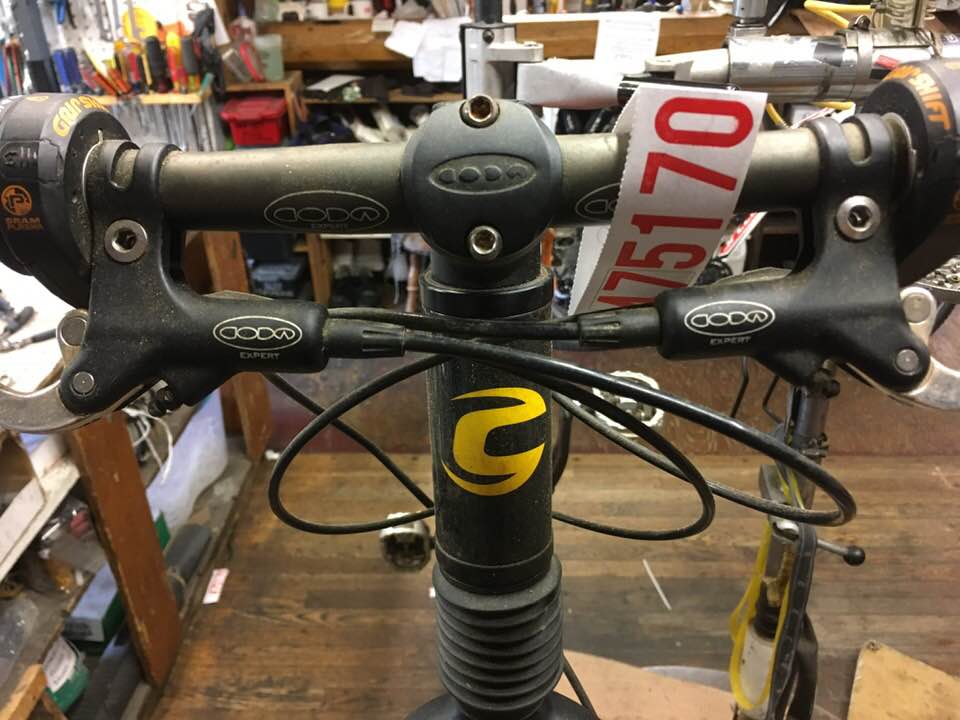
The early disc brake era was marked by the same kind of experimentation as the early suspension era. And Cannondale was notorious for trying to design their own shit from the ground up. Anyone remember their motorcycle? Don't feel bad if you don't. The unfortunate experiment was very brief. According to what I've read, it wasn't brief enough. So this fairly okay hard tail mountain bike with its weird, one-legged fork and the proprietary hub that goes with it has CODA disc brakes. I think you can actually find pads for them, but not much else. They made a huge secret of their brake fluid formulation (mineral oil). Their literature at the time said it was "designed by NASA!"

The front brake on this F900 has lost its will to live. We should be able to find a brake that will mount to the tabs on the fork, but Cannondale decided to use a 171mm rotor. What the hell kind of size is that? The rear is 151. And they mount with four bolts. So changing out the front brake will mean changing out the front wheel. You can get 6-bolt Lefty hubs. You can get carbon fiber Lefty forks that get great reviews. So this machine can be recovered...for a price.


Here's where my Van Winkleism comes into play. Once we stopped selling Cannondale, I stopped paying attention to all their weird bullshit. I worked a little with the early CODA brakes and Lefty forks. But when we dropped the line I was happy not to have to explain and apologize for a lot of their spec choices. The Headshok design was very smooth, but too limited in its travel to appeal to the emerging class of rider that would settle for nothing less than 100mm of travel, preferably 120. The Lefty was a way to move the mechanism out of the head tube, where it could stretch its legs -- er, leg -- a bit more.

Even though the Lefty is still in production, forget the 26-inch wheels. Looks like the hubs you can get and that stub axle are still compatible, though. I can build this guy a wheel on a six-bolt hub. It all comes down to money. Does he want to do the rear wheel at the same time, to get ahead of the inevitable failure down the road? That has a 151mm rotor, also mounted with four bolts, so it would require another wheel replacement. Or maybe we can get someone to machine some 160 rotors to fit that four-bolt mounting. That sounds practical, doesn't it?


The rider fits the classic profile of a person who invested in something state of the art, intending to enjoy it for a long time, and then got diverted by life and never got to use it much. The bike has storage dust on it, but no trail dirt. The rear cassette is shiny and clean. So he wants to get something out of his investment now. It will be the usual treasure hunt. I'll gather information and lay out his options.

A lot of mountain bike riders around here had not been cyclists before the mountain bike craze, and a large percentage of them did not become the kind of addicts that the industry mistakenly identifies as its best bet for high-volume sales. Did the heads of the bike companies want to shrink it back to aficionados with whom they could identify, and chase the rabble out? Or did they really believe that their expensive and excruciatingly sophisticated products were so beguiling that the briefest exposure would trigger an irresistible craving?

Civilians believe that they will find expertise in the shops, and that a high price always indicates a worthwhile investment. Through the 1980s, especially in road bikes, that was largely true. I have a couple of frames, and a lot of componentry, that dates from later than the '80s, but it's all pretty retro stuff. My current road bike frame was built in the 1980s. This is the perception that most non-cyclists have of bicycles: simple, lovable machines that they can own for years and keep in shape with minimal maintenance. Even riders who bought into the mountain bike boom in the 1990s didn't think about how all of those moving parts and sub-assemblies in the suspension, and the fidgety-widgety disc brakes brought with them perishable substances like shock oil, brake fluid, and elastomers. They didn't spend enough time with the bike industry to realize how they were being herded and fleeced.

In defense of the bike industry, they're only partly soulless bean counters. They're also smitten with their technology, and love to solve the problems that the most obsessed and hard-driving riders are encountering. I remember an article in either a consumer publication or Bicycle Retailer back in the mid '90s, complaining that the industry was focusing too hard on racers and not enough on the people who were just out for a good time on a mix of technical trails and milder paths and roads. Riders wanted to be able to mix it up. Early mountain bikes would do that a lot better than the technical marvels of today. Nowadays, if you want a go-anywhere off-road bike you have to know that you're probably looking for a "bikepacking" model rather than the catch-all "mountain bike" that no longer exists. And your bikepacker model will have more piercings than a goth teen with a big allowance. They're keeping the braze-on industry in business.

In another archaeological moment, El Queso Grande dug up this publication from 1990, laying out the perilous predicament of mountain biking in the USA (mostly the western USA) as a result of rude and reckless riding by those hooligans on fat tires.
Because I was on the East Coast and completely out of touch with the industry from 1981 to 1989, I knew very little about how mountain biking was evolving. I had a racing bike, a touring bike, and a commuter fixed gear. I knew mountain bikes existed, but I hadn't been close to many of them.

The fixed gear was my path and trail bike, to the extent that I found anything like that in Annapolis, Maryland. One of my commute options bushwhacked from a dead-end street onto the grounds of some Navy housing, but it wasn't as much fun as threading the corners on the regular streets, and not much shorter, either. I didn't look for trails as such until the cyclocross series started around 1986, and we all built ourselves some form of 'cross bike. Even then I could take it or leave it. Only moving to actual mountains made an actual mountain bike interesting.

Here in New Hampshire, there was a little bit of friction from a few landowners, but we had no shortage of places to ride. Event promoters ran into snags when they tried to direct large numbers of participants onto a course and discovered who actually owned what, and how they felt about a thundering herd rather than a trickle of riders. The same thing happened when riders would try to produce a guidebook for their area. Other than that, the problems were generally limited to riders trying to use designated wilderness areas in the National Forest, and the first few unsanctioned singletrack builders here and there. I was interested to see how early mountain bikers managed to offend existing trail users the way the invasive fat bikers have been riding over the toes of cross-country skiers in a microcosm of the first wave of mountain biking many decades ago. Everything is smaller than it used to be, except for the bikes themselves.

The answer for three-season off-road riders has been to acquire land or use rights, and build their own closed courses. Fat bikers are following suit, either by using existing connections to the three-season rider category or by developing their own landowner relations. Before you can have a trail, you need a place to put it. That's why you can't really afford to piss anyone off. A strong arm only gets you as far as your arm will reach, for as long as your strength lasts. The promoters today are stressing the economic benefits of attracting people who have already been willing to shell out at least a thousand bucks for their ride, and are eager to find places to use it. And a thousand bucks is the ante. The real players are plunking down twice that much, and more. Lots of people have that kind of coin, right?

Fewer and fewer every year. But don't believe the dying canary on the floor of the mine. It just has a negative attitude.

Thursday, August 30, 2018

Hydraulic Fracturing

El Queso Grande texted me on Tuesday night to say that the workshop was slammed and that several sets of hydraulic disc brakes awaited my healing touch. The repair shop continues to challenge my intellect while depressing me in general. I keep thinking that if I was a real mechanic type, sucking on a Gauloise and not giving a shit about actually riding, I could simply take pride in fixing whatever was dumped in front of me. Or if I was young and smitten with the technology -- or not young and still smitten with the technology -- I would still feel like I worked in the candy store. 

Given the choice I'd take the Gauloise. It reflects my attitude toward the consumerism and the subcultural tribalism that has fractured riding. Less than once a year something comes through the shop that I might actually desire. In truth, all I really desire is to keep my personal bikes rolling in their present form, and be able to replace each as necessary with something as close as possible when the time comes.

Just as the perfect metaphor for consumer goods marketing is cocaine, the perfect metaphor for any service occupation is sex work. Certainly in my case, I now have to handle a lot of fluids I don't want to, and stick things in places I'd rather they didn't go.

I mean brake fluid and internal cable routing, of course.

Speaking of internal cable routing, a local rider was in a crash when last Sunday's group road ride literally ran into a couple of dogs on a back back road in Ossipee. Riders have snapped forks hitting a squirrel, but this guy managed to get halfway over a Jack Russell terrier before the chainring stopped everything. The rider was banged up but able to continue the ride to get back to Wolfe City. (We haven't heard a report on the dog.) He brought me the bike to check over. His wheels needed truing. His bar tape was shredded on one side. We would check any frame and fork carefully after a crash, but with carbon fiber the stakes are higher. Because carbon is an all-or-nothing material, any crack is a serious crack.

Everything seemed remarkably good. Maybe it would have been worse if he'd hit a squirrel. I put the wheels back on and ran it through the gears. The front derailleur was rubbing the chain on the big ring. The rear derailleur was imprecise. I snugged the cables up. Things were better, but not quite perfect enough. Drive trains with 10 and 11 speeds are very sensitive to minor inaccuracies. Electronic shifting avoids the problems of cable-actuated mechanical systems, but introduces its own set of problems.

With internal cable routing, you don't get to see much of the cable. This creates the mistaken impression that the cable is protected, when it is really just inaccessible. Everything looks so clean, so aerodynamic. But what you really have are a bunch of little holes into the interior of your frame. It's a Roach Motel for dirt. Dirt makes shifting unreliable.

I turned the bike up in the work stand to check the bottom bracket cable guides. They're the Achilles heel of internal cable routing systems.
At the very bottom of the bike, closest to the ground, the cables emerge from their little tunnels to be routed to the front derailleur through a short little tube, and to the rear derailleur through a longer sewer. Any attempt to clean this area will simply drive little dirt ninjas deeper into the interior of your frame. Your best chance is to change the cables completely, which is a time consuming and finicky task with internal routing.

I blew dirt away with a lateral burst of air from the compressor. Depending on Bernoulli to help me out, I have used directed air on numerous occasions to suck dirt away rather than blow it in. But under the bottom bracket you have openings in at least two directions at odd angles, so you can't really blast away with any method. Or you can try the shop vac.

The shifting seemed acceptable after all that.

The day had started with one brake job after another. The owner of the first bike had taken his wheel out and then squeezed the lever. He'd managed to pry the pads apart and put the wheel in, but said that the brakes didn't work. Every brake job gets written up as a bleed these days, but after I reset the pistons and cleaned the pads and rotor it seemed to be working fine. The gears were a different story. The bike is a Rockhopper 29er, just old enough to have external cables, but they're in full-length housing. The SRAM rear derailleur didn't want to fold up enough to drop the chain onto the hardest cog. Fine silty dirt and a few crashes have stiffened up the pivots so that the return spring can't retract the parallelogram completely. And fully housed cables aren't really better protected from contamination; the housing seems to produce more drag than shelter.

Next up was a double bleed on a Specialized Stumpjumper 6-Fattie that really emphasizes the evolution of mountain bikes into motorless motorcycles. On the plus side, it had SRAM brakes that take the Bleeding Edge tool, which does seem to make the process somewhat easier. I think I only had to redo the rear brake once. The pads were worn an ambiguous amount, so I put in new ones, which stiffened up the lever feel even more. Because I never get to work without interruption, meticulous procedures take even longer.

One interruption came from a customer who had brought his Orbea Orca to have a skipping problem checked out. The chain was so worn, it skipped on the derailleur pulleys. Changing chain and cassette seemed to set things right, but then he rode it and had more problems. I explained that we would ordinarily have started with cables and housing, but that the chain issue had seemed obvious, and cables and housing would have meant stripping off his sexy bar wrap. I'll sacrifice what's necessary to get a job done, but since the look of the bike was obviously important to him I didn't want to shred the cosmetics unnecessarily. Then, as we were examining the bike in the parking lot, we turned it over and found a crack in one chainstay. This was probably not the cause of the chain problems, because the ding from which it originated was small and fairly fresh. The bike did not flex or make scary noises. He's pursuing replacement through Orbea, and came in to discuss riding position and fit issues. That's never a short conversation.

The last brake bleed had to wait until this morning. The bike came from Bikes Direct to the Repair Shop. I assembled it in early July. The rear brake calipers are already a rust pit.

The bike has SRAM Guide R brakes, nominally the same as the ones that behaved reasonably well on the previous day's Stumpjumper, but these have conventional bleed ports. That calls for a slightly more cumbersome procedure, but I've done it before. The wrinkle this time is that the rider and his buddy tried to bleed the system themselves before giving up and bringing us not only their original problem but the results of whatever they had done.

The lever was whacked out. We had to reposition a couple of parts just to set it up according to the instructions to begin the actual bleeding. I'm not sure how they got things as jammed up as they did, but I could not get fluid to go through the system no matter what I did. I finally faced the fact that I was going to have to open up the lever to see why the piston did not want to move.
This isn't all the parts. The real business was still stuck inside the lever body.
Supposedly, when you take out a spring clip and a washer, you can reach in with the tippy tips of needle nose pliers and extract that piston. I couldn't get it to budge. I tried everything, even things that will put your eye out if you do them wrong. Eventually I was able to poke something through from the brake line end of the lever and push the piston out, but it's a very stiff fit. And between whatever they did, and what I had to do to get it out, it ain't going back in.

Of course all parts for this lever are out of stock for at least three weeks.

So there went a couple of irreplaceable hours of my life. I spend most of my time now working on equipment I would never advise anyone to buy, for a riding style that doesn't interest me in the least.

Motorless motorcycles.

If anyone ever did all the maintenance that the fine print tells them they should, they would never have time to ride. But biking is supposed to be cheap. The biggest expense is the bike, right? They're cheap to fix. There's no motor. How hard can it be?

The owner of the Stumpjumper asked me, "Is it a real pain in the ass to work on these things?"

"Yes," I said. "Everything takes longer, so we're making less money, and it's still expensive for the rider. So how's the ride?"

"It's great!" he said. "Wonderful!"

"Well there you have it then."

Even from supposedly reputable brands, low end bikes are shockingly shoddy. The upper end is staggeringly expensive not only to purchase but to maintain, if you really use it hard. Even if you want to settle for fewer features but well made componentry, it's a treasure hunt to find parts, and you'll need to know how to do your own work.

Biking has no use for elder statesmen. Expertise is only good for a short time. Does anyone in mountain biking today care what the pioneers of the sport think? Only if those pioneers repeat currently popular opinion. You're only as good as your last ride.

Sunday, July 08, 2018

Prehistoric

When bikes like this Cannondale come in, I feel like a veterinarian in Jurassic Park:
Early versions of a new phase of technology automatically look primitive and weird, like the bones of a giant sloth. As the bike industry moved aggressively toward disc brakes and a full commitment to suspension, each of their experiments looked futuristic for about a week. Once a format settles down, the changes become more subtle. All high end bikes are on a conveyor belt of obsolescence, but the critical differences are easier to overlook until you need to fix something.


Cannondale liked to invent their own stuff. Their technical curiosity is laudable, even if their results might not have been. To boldly go where no one has gone before...except for several other innovators who did it better. But beyond one company's specific early mutations, the products of the entire era are more abandoned than the the more settled technology of 1970s ten-speeds. Companies vied for control of the market with implications of exclusivity. For instance, the Coda brake fluid bottle calls it  a race-proven synthetic blend. They don't say whether it is glycol or mineral oil, implying that it could be some third thing that you can only get from them. Years later, the mechanic trying to decide which juice and bleed kit to use gets no help from the label. Forum posts on line indicate that it's mineral oil. Fortunately, I did not have to bleed them. Chasing air bubbles is a finicky, fiddly, time-eating task.

The rotors are held on the hubs with only four bolts. Good luck finding parts for that.

The crank has an aftermarket bash guard, an accessory that came and went and came again.
Crank manufacturers have embraced the concept now, so they are common. The crank shown here also exhibits the five-bolt, 58-94 BCD that was briefly everywhere, and now is almost nowhere.

This bike was over the threshold of the new age, but only barely. The equipment has evolved as mountain biking has split into subcategories. From a common ancestor, the genus has spawned numerous species. Each one requires habitat in which to flourish, and riders with money on which to feed.