Showing posts with label driving season. Show all posts

Tuesday, January 20, 2026

Heavy traffic on Route 28

 The joy of being in the motoring public continues. It struck me the other day that it only takes three cars to completely screw you on Route 28: one slow one in front of you and one coming the other way in each of the only two passing zones worth bothering with. There's a third passing zone, but that's just a pointless gesture most of the time.

I've documented before how drivers who amble along on the open road portion of the trip will speed up once the road narrows, with houses, driveways, people, and pets possibly popping in from the sides. Whipping around someone in the last passing zone before Wolfeboro won't usually get you enough of a gap to avoid being tailgated by the last idiot, who is now treating the road like a video game.

This morning was an exception. On impulse, I zipped past a floater in that last zone and dropped him like he was in reverse. I would have lost several minutes if I had stayed behind him.

There were more than three cars this morning. Oncoming traffic was fairly heavy for around here on a non-vacation winter weekday.

Every time I drive to work I think about how much smoother my trip would be on a bicycle. Not in winter, though. Ice and snow encroach, narrowing lanes. It takes half an hour to put on all of the clothing to make the ride, another 20 minutes to peel it off at work. Then a half hour to robe up for the return trip in the dark. And if anything happens to you, it only confirms the public impression that you had it coming.

There are workers who have been getting around on e-bikes all year round in this area. They mostly ride them like low-powered motorbikes. One of them hit a deer last winter. Others have come to various misfortunes. They choose it out of necessity, not principle.

The winter e-bikers mostly ride fat-tire versions. They pay a lot less overall than they would to have a car, but they have to pay something, whether it's their own time and a little bit of money to do their own work, a moderate sum to get a shop or other technician to do it, or the lump sum to replace a bike when they've finally thrashed it to death. They don't come into our shop much, but they might have other options in the subculture that's developing around their vehicles. They don't usually resort to us until the bike is completely fubar.

If I wanted to be enslaved completely to my fuel bill, I could drive to work all year. I would lose my mind. And the parking situation gets very competitive during the summer. It's bad enough when winter conditions are good, although who knows what will happen as the economy provides less and less disposable income down the pay scale? We might have fabulous conditions for winter playtime, and hardly anyone with the time and budget to play. We just passed Martin Luther King Day, the January three-day weekend, and took almost no calls to check on our ski conditions. Granted, conditions were pretty meager, but that's never stopped people from at least asking.

The second home crowd, many of whom have third and fourth homes as well, centers on the summer. We might see one or two of them between Labor Day and Memorial Day, but the lake in liquid form really drives the economy here. The peak is from the Fourth of July into about mid August. That has shrunk considerably since the 1990s.

The denser traffic and tight parking really make me glad to be on a bike during the busiest part of summer, but I'll already have been out of the car for at least a couple of months by then.

Sunday, November 02, 2025

Driving Season

 The vast majority of the time, when I arrive at work by car I'm in a bad mood. It's a rare morning when I haven't been held up by someone oozing along in front of me, often exacerbated by some flame-brain six inches behind me, as if I could somehow get the obvious car or truck in front of both of us to go any faster or get out of the way.

I've written before about how the drivers who ooze along the highway then race into town like they're strafing infantry columns or something. The metaphor I used was attacking the Death Star. Sociopathic in any case. Or someone I finally managed to pass comes flying in behind me, probably gloating about how I didn't get very far, because I don't like to drive that way in the tight confines of streets with pedestrians, random pets, and other drivers compressed into them.

One diversion amuses me once I get into town. It's called Lid Game. It's very simple: try to bypass or straddle every access lid or storm drain. It started when the road was in worse shape, so these features were more prominent, and I drove a car with lower ground clearance and worse suspension. It's become a habit now, a minor challenge and diversion. I thought I was the only idiot entertained by it, but then I saw another driver playing it down in New Jersey when I was on a road trip. It will never be as popular as pickleball, but I appreciate seeing another player anyway.

When I'm on the bike, drivers might kill me, but they don't slow me down. I slow down in town traffic because it's better than sprinting through every gap, hoping nothing goes wrong. That may feel like a flex, but no one is impressed, and most of them just think you're a jerk. I try to inspire more curiosity and whatever respect a habitual motorist might summon for some bonehead who doesn't have the sense to drive. Keep up. Move smoothly. Maneuver predictably.

Over the years I tried various ways to keep doing at least some of the commute by bike. They end up taking as much time, or more, than just riding the whole route, and don't save any car mileage. In Annapolis, Maryland, a network of streets provided alternatives, and the terrain was pretty uniform. Driving was always the worse option in the colonial era roads and streets there. Here in rural New Hampshire, alternate routes diverge widely from the direct route.

Sunday, March 09, 2025

Consistency, fitness, and junk food

 As Driving Season winds down for this winter, I endure the last few commutes in which I am completely at the mercy of whoever is in front of me. It will probably be more than a few, given our typical weather, but the trend is clear. Daylight Relocating Time has started.

Bike commuting time in transit is much more consistent than driving time. I've written about this before. My average speed follows a predictable curve, increasing to a peak in July before tapering as the summer drains away again into autumn. As age takes its toll, I don't know from one season to the next whether I will make it to the previous year's high range. Just feel it out carefully and settle into a moderate, steady pace. Don't stress the cardiovascular system or the joints. Whatever the average turns out to be, I can set my starting time to get me to work more or less on time. Usually less, but that's not the fault of biking. I can have just as little enthusiasm for punctuality when I'm trapped in the car.

Bike commuting was part of a long-term, open-ended strategy to provide consistent exercise around scheduled employment while saving lots of money and burning off my consumption of snack food. Lots of money is a relative term. I've never earned lots of money in my life. But I haven't pissed away a lot of it on motorized activities, particularly getting to my various jobs. Having my winter job at a cross-country skiing shop and touring center has helped somewhat with the winter interruption to cycling, but I can't count on getting out there as regularly as bike commuting. I even wrote a song titled Snacking out of Boredom and Depression about the toll that the dark and frozen -- or inadequately frozen -- months can take.

Learning to bake has given me greater control over the ingredients in what I make, but it has also made it a lot easier to slap together sweet comfort carbs. And I'm not quitting. I built a whole lifestyle and career around not having food discipline, dammit! At some point, your consciousness ends as your energy is recycled into the universe. Have a damn brownie. Have two. Then go run or ride around.

The rest of my diet is generally pretty healthy: meals made with few ingredients, a high proportion of non-meat items. It looks even better if you count maple syrup and coffee as fruit juices. Oh yeah, and chocolate is from plants, too. I just need to get out there and burn it off. It's all fuel.

Wednesday, October 09, 2024

The steady creep of crap...

Like rising sea levels, a steady tide of brake fluid, shock oil, and tire sealant laps higher and higher. On it float the carbon fiber fuselages of high-priced industrial flotsam, while the currents of the murky depths carry along the aluminum offerings. Dragged along the bottom is a spreading tangle of cheap steel frames and flimsy mid- and low-end parts. Brand name and no name products jostle in this festering stew.

There never was a dike against it, but if there had been there would be a lone, drowned mechanic with his finger stuck in it. The surge came right over the top. But there was no dike, so there's just me and my finger, which I have been giving to the industry since the early 1990s. I'm still treading water in this great oceanic garbage patch, trying to rescue the few who are not swimming avidly away.

Hey, if you're going to lose anyway, you might as well have some fun with it. I used to find energy in the belief that I could have some wider influence. Fantasy has played an essential role in human survival. It just functions differently under the influence of different eras. We can tap into each other's imaginations like never before in this period of individual social media participation overlapping with professional productions in a range of legacy media and their evolved, evolving forms. As many as a few dozen people might read this essay. That's a bigger crowd than I could draw if I was raving in a public park anywhere within a short bike ride of where I live or work. Good return on my time, says the lazy man.

Bike season is winding down around here. Enthusiasts are still riding, but the frenzy of summer has gone to sleep until next year. By then we will know if we're going to be living in a smog-shrouded theocracy or be zigzagging toward the flickering image of a world where people are trying to get along with each other rather than get on top of one another. Service work still drops in a job or two at a time. The shop converts to ski season as autumn progresses. It's still only cross-country skiing, so we never get mobbed. As long as people can use motors to get them up a hill, that will be their preference. It's true with increasing numbers of two-wheeled "pedalers," too.

A guy in the shop last week said that he was getting an e-bike that would go 50 miles per hour. I figured he was full of sht, so I looked around online. I found quite a few ads for e-bikes that will do 50 mph. It's absolutely not legal, but the police have much more pressing matters to worry about. There are thousands of bikes on the road, and no effective means to keep track of them. This is a good thing in many ways. I don't like the idea of omnipresent surveillance, even if it does permit jackasses on rule-beating motorbikes to pretend they're on a machine that they would ever power by pedaling alone. I figure that they will sort themselves out on their 50 mile per hour mopeds.

Riders with power assistance do present a hazard to path riders, both recreational and transportational. Few act with malice, but insensitivity hits just as hard. Any vehicle operator becomes velocitized. You get used to your flow through the scenery based on the feedback you get through the contact points with the machine. We drive our cars at what seems like a sedate speed, while a pedestrian walking on the side of that road perceives our vehicle as hurtling past them. Riding an analog bike, 15 mph feels pretty zippy. Twenty feels downright godlike. Throw a little power assist in there and you can legally push close to 30 mph. Juice up the moped and you get into survival mode.

Survival mode is sneaky. You are in it before you realize it. You may be within your own reaction time to negotiate the road in front of you as you see it, but have no margin for the unexpected. It happens on an analog bike as well, but almost always on a downhill. The other place you can get into trouble is when larger vehicles are slowed by their own traffic congestion, and a bicyclist is tempted to fly past them or even cut between them at full speed. Filtering is fine, but trying to show off with a power play will get you smacked sooner or later.

As daylight shortens, my bike commuting season comes to an end. I will become flabbier and grouchier (if you can imagine that) as the months progress until next spring releases me to see how much strength my aging body still retains. The problem isn't the darkness, it's the lights. The floodlit behemoths I share the road with blind each other with their headlights and make me disappear. The imperative that motorists have, to pass any cyclist without pausing, means that they will shove through in that tunnel of glare and blackness wherever we encounter it.

There's also a slight uptick in malicious behavior under cover of darkness, but the major issue is insensitivity and impatience.

If I had a good place to park for park-and-ride commuting, I could continue for months, gaining at least some of the advantages of fully car-free transportation. Unfortunately, the local cyclist ghetto, the Cotton Valley Trail, runs off at an angle, so I end up driving almost the whole way to town, or equivalent distance, to intersect it at various points from which to continue by bike. And it's the Cotton Valley Trail: an active rail line masquerading as a multi-use rec path. The rail car hobbyists have the right of way, and some of them can be real pricks about it. Others are kindly ambassadors, but you don't know which is which when you both enter a railed section. On the other end of the speed range, not one single pedestrian is ever glad to see someone on a bike. Add a dog on a leash and your stock drops even further. I'd rather be out on the road with the armored personnel carriers whipping past me. It's much less personal.

Too late this morning as I sit under a cat, but maybe I'll try a few rides from the shopping center three miles out from my house. That cuts off the worst stretch for night riding. But the challenge points up a major issue for anyone with a motor vehicle: where can you leave it? They do lock. They're hard to remove casually. But anyone annoyed at your presence can do a whole lot of inconvenient things short of completely removing your expensive appliance. Pick the right wrong place and you could even lose the catalytic converter. That's become a new hazard at some hiking trailheads in the area.

For now, it's time to displace the cat and finish getting ready to load the car. Driving is so brain-dead easy compared to riding a bike. It's a habit-forming sedative in that way, but side effects include joint pain, stiffness, irritability, inattentiveness, weight gain,... see package insert for full list.

Tuesday, March 05, 2024

The towel is thrown

The Wolfeboro Cross-country Ski Association picked a good year to institute snowmaking. But it wasn't a great year. Atmospheric conditions were so poor for snowmaking during December that we had nothing to offer during the Christmas vacation period, which is one of two major blocs of income for the ski business in the northeast US. Downhill areas fared somewhat better, particularly ones a bit farther north, with more elevation to augment the less than ideal temperature and humidity. And then we had record-setting rains in January that caused flood damage to trails for every winter activity.

By February we had the snowmaking loop up and running, but it hasn't survived the first week of March. Snowmaking isn't magic, and key sections of it lost cover in the warm weather that has dominated the winter. The trails are closed and the shop has gone to spring hours. Even if we get a late March blizzard, it will be falling onto bare, saturated ground in many areas.

In a strange twist, I had more opportunities to get out for a concentrated workout in prime time this winter because of the wretched conditions. I haven't come into a bike commuting season with this good a fitness base since we shut down the shop at Jackson Ski Touring in 2009. Up there, with trails right outside the door and a narrower scope of operations, it was much more convenient to rotate each of us out on many days to get that beneficial shot of conditioning. It enhanced our efficiency and kept our credentials fresh, while also providing a great launching pad for the next season's riding.

The ski/bike alternation changes muscle use in ways that help the cyclist more than a year-round cycling routine would. But in the transition from one to the other, you notice what you're missing. At the start of skiing I would have to build upper body strength and all of the steering and stability muscles that take the rest of the year off. At the other end, going back to the bike, I find myself in the lower portions of a hill climb with only my legs to propel the machine, carrying all of the muscles used to push the ski poles now providing mostly non-functional weight.

In addition to the ski sessions, I got out once or twice a week to climb the neighborhood mountain. The trail is listed in an old Appalachian Mountain Club guidebook as 1.4 miles to the summit. Elevation gain is 1,144 feet. The trail climbs gently for about the first third, and then steepens. A preliminary effort brings you to a traverse of a couple of hundred yards along a contour to reach the base of the most rugged section. Above that the grade lets up slightly on the way to a more or less level few yards approaching the summit. There's a fire tower that is not abandoned, but is usually unoccupied. During the winter there is never an observer. The trail is popular enough that the footway is reliably packed down. People do it in a variety of inappropriate footwear, but so far none of them have had to be evacuated by emergency responders. 

From the first hike in late January until the most recent one yesterday, the surface has been different each time. The first time it was a well packed snowshoe trail firm enough to go up without wearing the snowshoes. It's very rude to posthole a trail, stomping deep footprints into it because you don't bother to bring snowshoes. Going up it's easy to place your feet lightly and commit your weight gradually. I wore snowshoes to descend, because your body weight always arrives with more force as you step down. 

Snow fell before I got out on the second hike, but other hikers had a few days to pack it down before I got there. From that point on, no new snow was added. When the weather stayed somewhat cold, the trail changed only a little. I did see the tracks of one intrepid skier one day, and on another the unbelievable signs that someone had ridden a bike down it. I didn't see clear signs that they had ridden up it. And the tires didn't look super wide, almost like plus-size, 3-inch rather than full fat. Mixed in with tracks from snowshoes, hiking boots, and ice creepers were the prints of street shoes and sneakers. 

I was going to begin riding this week, but the forecast indicated that I won't be able to be consistent enough with it to make the initial discomfort worth it. I banged out one more tower hike instead. This is prime hypothermia season. Temperatures above freezing, ranging either side of 50°F (10°C) fool a lot of active people because we need very light layers while exerting, and may feel comfortably warm for a few minutes after stopping. The temperature on the summit that cloudy day was solidly mid 40s. I felt quite comfortable on arrival. I put on a fleece jacket because I knew I would want it soon. Indeed, with a fairly light but persistent breeze I soon felt like I wanted more clothing than the fleece. Rather than dig out the extra gear, I gathered up my stuff to head down. But I had the layers if I needed them.

Hypothermia gets you when you don't expect it. You get cold on a winter hike, it makes sense. We do hear about poorly prepared people who get into trouble and even die out there in the winter. But most people have some idea that they should bundle up a bit at the height of winter. It's in the transition time, into early spring, when acclimated outdoor types might overestimate the mildness. It happened to me one April day decades ago, on a cloudy afternoon with some showers in the forecast. I set out around the mountain on the fixed-gear, wearing sufficient clothing for the best of predicted conditions, but with nothing extra in case things deteriorated. They deteriorated. Sprinkles began before I has half a mile down the road. Those turned to a steady rain. I kept going. The route is all or nothing. There is no way to cut it off. Once you reach the halfway point on the far side of the mountain you need to keep going the rest of the way.

Theoretically I could have gone up to one of the sparsely distributed houses along the route and asked for shelter, but apparently I would literally rather die than bother anyone to bail me out for my stupid decision. I don't know what kind of shape I would have been in if my spouse at the time had not thought to go out and collect me. She correctly guessed my route and drove it the opposite direction to intercept me. These days I am alone most of the time, so I have to pay closer attention to the list of essentials any solo traveler should have.

The roads will now present the best venue for consistent activity for maybe as much as a couple of months. Back when mountain bikes were relatively cheap and definitely simple, we rode on found trails rather than courses designed and constructed at great and ongoing expense. We would charge out on the rotting ice of snow machine trails and woods roads, crashing into icy water, grunting though deep mud, and laughing about it. Not anymore, though. You don't put in hours of labor on loamers, or thousands of dollars on more elaborate trails and then go ride them when they're wet and soft! Horrors! And the bikes themselves demand such loving care to keep them ready to throw off of 9-foot drops that you don't want to crap them all up with a bunch of abrasive silt on mere dirt roads. The gravel demographic might be a tad more open to muddy roads. Fat bikers might try their flotation on some of them as well. My fixed-gear is still coated with adobe from my ride on New Year's Day, when the dirt part my favorite local loop was sloppy from the rain we'd gotten during Christmas week. Mud season has to come sometime, but I try to avoid having to do too much cleaning over and over again.

If I can get straight into commuting, I won't have to ride the muddy dirt roads or stick to the entirely paved options to get base miles before undertaking the more serious effort of lugging my tired old ass and my day's load of crap to work and back. My 30-mile daily commuting distance puts the day's effort into the realm of a real ride, even though it's split roughly evenly into 15 miles morning and evening. That work day in the middle keeps me on my feet. The rides are also in what passes for rush hour around here, so I'm dealing with hurrying drivers on all sections of the route. I need to be combat ready.

Fortunately, most motorists just want to get past a cyclist with the least delay. A honk, a yell, a thrown object -- these are impulsive acts not meant to delay overall progress. If a rider is careful to offer no greater offense than the mere audacity of claiming some space on the road, the vast majority of drivers just want to go by and get on with their lives. Only their fellow motorists inspire the urge to have a tank battle right then and there. But that's a story for another day.

Monday, November 21, 2022

Miles per gallon

 As someone with a conflicted relationship with motor vehicles, I have tried to spend as little as possible to buy one. But I need one because of the distances I have to cover in challenging conditions, so they can't just be thrashed pieces of junk.

For the past several cars, I've picked up ones that various members of my family were discarding as they contributed to the used car market by buying new ones. It was an agreeable parade of small Ford station wagons, which mostly succumbed to the long months sitting in the dirt driveway while I'm using the bike for transportation, and the inexorable rust that consumes all New England vehicles that face the tide of brine flooding our roads every winter. The price tended to be pretty affordable, which suited my underlying reluctance to chip in much of anything to the moto-centric culture and polluting, speeding, jostling, sprawling environmental disaster that is transportation in America.

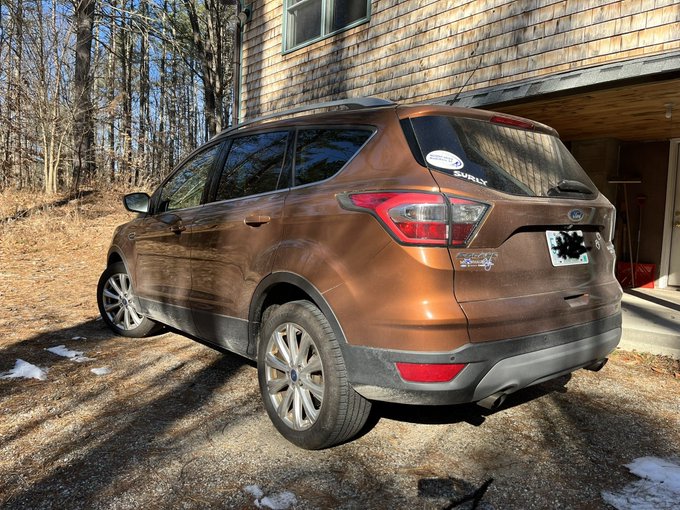
The latest -- and last -- of this line sits in the driveway now. It's far more car than I would ever buy, but the gas mileage is as good as the last Ford Focus that finally rotted out underneath the bodywork. Behold The Shuttlecraft:

"Nice car," a friend and colleague said as we headed out after the last zoning board meeting.

"Thanks. I had to kill my father to get it," I said. Dad was a Ford man. He died at the end of May. My mother is 93, and has decided to quit driving because, as she says, "I'm 93 years old. If anything happens, it will be my fault even if it isn't my fault." My sister is on hand to drive the two of them around. So this car, this space craft full of electronics and automated features, was available for ...really cheap... just as my mechanic was telling me that he couldn't sticker my old car anymore because the frame was almost gone.

There's a lot to get used to.  The speedo and tach are analog, but all other data comes at the driver through two screens. One is a small one centered above the steering wheel. The other is the now ubiquitous touch screen in the middle of the dash.

In the cellist's Honda CR-V, she can punch up a readout that tells her about fuel consumption: miles remaining at current rate, and miles per gallon. She has to ask for it. In The Shuttlecraft, that display is constant. I suppose I could turn it off, but I find it fascinating.

Miles per gallon tells you about the energy required to accelerate a mass against the force of gravity and the other factors that inhibit forward motion. As a cyclist, you have an intuitive -- and very tactile -- awareness of the toll that hills and headwinds demand. Through the readout in The Shuttlecraft, I can see the dramatic difference between uphill and down, and any acceleration. Going down a hill, the mpg readout will max out at 99.9. Woo hoo! Going up a hill it drops to lows like 11, 9, 7, or sometimes 3. It just drains. And any short hops or stop and go driving drops the total from a creditable 30-31 down into the "sorta might be okay" upper 20s. The Focus was surprisingly no better, especially with snow tires, but the Shuttlecraft is undeniably more of a bourgeois armored personnel carrier. It's really hard to find a nice small station wagon these days but I still wish Dad had had a bit more varied taste in cars. A nice Passat wagon logging 40 mpg, perhaps.

Well, po' folks can't be choosers. In an alternate timeline, I stayed in a more built-up area and never bought a car at all. But then I'd have to live in a more built up area. Nature called.

Around here, I've fallen in with the tree huggers to try to defend a natural environment where there still is one. When I moved here, it was the country. Now, 35 years later, it's more like heavily wooded suburbia. That makes our efforts all the more important, because the economy depends increasingly on subdividing large parcels of land and increasing population density. More roads aren't being built, but the ones we have are getting a lot busier all year. Residential development is piecemeal for the most part, a house here and a house there, but larger tracts are proposed as the state grapples with a lack of "workforce housing." Workforce housing is a nice way of saying shacks for the scantily paid grunts who perform the essential but disregarded tasks of actually making civilization and the economy run. If it had existed in Annapolis in the 1980s, I might never have moved away. But Annapolis was obliterated by explosive, poorly planned development. I saw it coming and ran for the hills, literally.

Ironically, the tree huggers do a lot of driving. It's the norm. In rural areas, the distances demand it. In winter country, however degraded the winter might be, the weather favors a heated, enclosed vehicle, too. Some of the environmental folk have electric or hybrid vehicles, but most of us drive used, internal combustion vehicles. Their designs reflect the American norm. Mine is hardly the largest. You can only be so much of the change you want to see before you are so far beyond the leading edge of societal evolution that you're just a freak out there, with no infrastructure and no momentum of social change behind you. So for now, the environmentalists drive to work and drive to public hearings and educational presentations and off to their environmentally appreciative recreational activities.

When I get out of the car every spring, I immediately have less time for other things. Commuting takes at least twice as long. It provides beneficial exercise, but cycling is not complete exercise. A bike rider needs to do weight bearing, stretching, and resistance exercise to preserve bone density and avoid muscle imbalance. And the route takes me longer and leaves me more tired than it did when I was in my 30s and 40s, or even early 50s. Freedom isn't free. It's an investment decision no matter what type of freedom you choose.

Thursday, March 11, 2021

Hot air balloons and X-wing fighters

Commuting by car sucks. Riding a bike may have its hazards, but getting stuck in traffic is not one of them.

Driving to work in the icy months, I may have a sweet, fast run or I might get stuck behind a hot air balloon.

Hot air balloons are vehicles floating down the road unhurried, like colorful canopies blocking sight and passage, drifting at the whim of the wind while their contented occupants survey the scenery. Ranging anywhere from five to 25 miles per hour below the speed limit, this puts them well below the customary average speed for people who need to actually get somewhere. I make a special effort not to fall into the trap of impatience. Tailgating never made anyone speed up, ever. All it does is raise the blood pressure of the tailgater. Sometimes it also raises the ire of the tailgatee, but this seldom leads to the desired increase in speed. More likely it leads to an exchange of gestures, profanity, or lead. I might follow a bit snugly as we approach the better of the two surviving passing zones. If the zone is clear, I launch the pass. If not, I settle back. There's a third zone, but if you've been held back that long, don't bother, because just over the rise, the hot air balloon will miraculously transform into an X-wing fighter attacking the Death Star.

At the point where I think about throttling back because the road is narrowing and structures sit closer and closer, not to mention that small animals and people might pop up, the X-wings tighten their formation and scream into the canyon at a speed that was too slow for the highway and is murderously too fast for the tight confines of Center Street. They always drop me. Then they probably pat themselves on the back because they made good time.

On my bike, I don't care how someone is driving on the highway, as long as they give me an adequate amount of room and pass without comment. When we get into Center Street, the X-wings have to slow down for me, because hitting me would make them late for work or their hair appointment or shopping or wherever they're going. Scrubbing a little speed and giving anywhere from four to 18 inches of passing clearance gets them by without too much interruption. Think of me as flak from the Death Star's cannons. Just dodge the burst and keep flying.

As I've noted before, my time in transit by bike is much more consistent than when I drive. The road feels long sometimes, and sometimes hostile, but I feel more grateful to be alive, even when I'm tired and hungry. Daylight Relocating Time arrives this Sunday. Winter seems to be in decline. It's getting to be time to get reacquainted with the bike seat.

Monday, February 25, 2019

TIT

Driving season always gets me thinking about Time In Transit. I've written about it a number of times before, but a new entry puts it back on top of the pile.

The recent vacation week marathon required that I not only arrive on time, but early, to prepare the rental area for the coming day. A lot cannot be done the night before, because rental gear is being returned wet right up to closing time. The boots in particular have to be laid out with air space around them, so they can dry, before being tucked back into the close confines of the boot shelves. This could be a few pairs or 30. Or more, if we had a phenomenally big day. Thus, I am shooting to arrive a half-hour early to brush off the dried mud and rack the boots. After the boots I hang the ski poles. They are hung on pegs close set to fit as many as possible into the rack. I try to rotate them so that the same few aren't always going out. Then there might be snowshoes to brush off and hang, as well.

On a good day I can drive to town from home in 20 minutes. On a really good day, I might shave that down with a bit of sociopathic speeding on the highway stretch. That in itself demonstrates the creeping sociopathy bred by driving all the time. I will ask myself whether I am behaving like someone I would want to share the road with on my bike. The answer is a conditional yes. If there are cyclists, I amend my driving to cooperative mode. But absent any fellow pedalers I am easily lured into speeding, and playing the entire paved surface for cornering lines. I drive the way I ride.

On a bad day -- the more typical circumstance -- I get behind someone driving slowly, perhaps erratically, and the oncoming traffic eliminates any chance to pass legally and safely. I do not pass illegally and unsafely, though I do admit to the temptation. The highway department has eliminated two or three passing zones, all of which I had used over the years. I miss them.

The difference in transit time is considerable when I get behind someone pokey. If you take 20 minutes as the benchmark average for an unobstructed run, 30 minutes is 50% slower. I always have trouble with calculations like this, because 10 minutes is 33.33333% of 30 minutes. And 30 minutes is not an unreasonable transit time. When cycling, I prefer to be passed by someone going for 30 minutes rather than 20. On the other hand, if the road is clear enough for a clean 20-minute trip, the faster driver has plenty of room to give me space, and most of them do. It only gets ugly when traffic is tight and a speeder is still trying to push it. That's when people pull out to pass coming right at me, or try to pass in gaps that they should have declined. I will say that such shenanigans are fairly rare.

So there I am in bike season, riding along the highway at a steady speed. My time in transit varies very little. A major delay, like a flat tire, will blow the average completely, but if all goes well I can count on completing the inbound run in less than an hour. Even a ten-minute variation from a 55-minute average TiT is only about 18%. Most of the time, my longer times in transit are from route variations.

Weather can make a difference to drive time. This has been a somewhat snowy winter for commuting. But the difference still hinges more on traffic than on absolute driving conditions.
With a decent set of snow tires and years of experience, a driver can move along pretty well with no one else on the road. It's definitely below the dry pavement average, but still satisfactory. I've pushed through some pretty deep unplowed fluff with only front wheel drive, given a decent set of tires. But get behind someone handicapped by bad rubber and anxiety, and the drive turns into a slog. And not all snow is created equal. When the plow trucks have been on it, they may leave behind a fairly well scraped surface with exposed pavement or they may pack it into a skating rink worse than it was before they attended to it.

Winter conditions would have a big effect on bike time in transit. In years past I have made a few winter commutes, when the weather was not snowy, so the only obstacles were cold and darkness. You can dress for cold and light for night. I would also only ride on work days when my schedule allowed me to complete the whole route before nightfall. My interpretation of "nightfall" was loose enough to put me into dangerous dusk, but I was inexperienced and thoughtless enough to go for it. But the game changes when you add snow, ice, slush, and wide, deep puddles of brine. Whatever your legal rights to the road may be, when you force the interaction between motor vehicles and bicycles you will arouse feelings not easily addressed in the time you will have available to debate them with a steamed motorist.

Pushing the beginning of the season, I have set out in adequate conditions from home, only to find the highway coated with ice on the height of land on Route 28 coming into North Wolfeboro. Even worse, the shoulder might be coated, but the travel lane clear, forcing me to squeeze in with the flow of commuters driving to work, or risk falling beneath their wheels if I stay to the right. There's no good place to be in a situation like that. I reiterate that in some circumstances the assertion of legal rights will create more ill will than acceptance among the motoring public.

Studded tires are a limited answer. The metal provides sketchy traction on pavement, and wears down, so you might not have as much of it as you would like when you finally get to ice. The tires are heavy because of all the metal, and they're not cheap. And if you've ever had to fix a flat tire that's stiff, cold, wet, and studded with metal spikes, while hunkered down in a snow drift, as passing motor vehicles spray you with salty splather, you're not eager to repeat the experience. All the while, the clock ticks on your time in transit to work.

I've used studs on my park-n-ride path commute, but in virtually every year the snow has arrived deep and soft, and hung around until mud season. And the "park" portion becomes very difficult because many path entry points are not plowed out.

In full-on bike season, I run into traffic delays when I use the rail trail inbound. I run into some delays outbound as well, but I'm not shooting for a fixed arrival time. Because the path is very badly designed, improvised around the strictures of an active rail line, all users are crammed between the rails for much of its length. I have written a lot about its disappointing shortcomings, to no avail. The rail car club has disproportionate leverage, and bikes are at the bottom of everyone's priority list. Inbound on the path I can be forced to a walking pace as I accommodate pedestrians who all give me the stink eye anyway.

On wider paths, a rider can still encounter pedestrian volumes that fill the available space, as well as slower riders. Is the answer more lanes?

In urban and suburban areas where the majority of people drive to work, commuters allow for traffic by leaving earlier. More traffic? Leave even earlier. Super commuters living more than an hour by car from their place of employment have to pad their expected time in transit to allow for the time they know they will spend at a steaming standstill in normal morning gridlock. If by chance they get all the breaks and arrive at work early, congratulations! They've just flushed that free time down the toilet of gainful employment. I speak from the point of view of someone who wanted to have a life, not just a job and possessions. So time means different things to me than it might mean to them. From a purely biological standpoint, we all need only to reach maturity, find a mate, reproduce ourselves, and die. That makes everything else a luxury. It sounds pretty grim, though. If we're going to be that simple, I say we just go all the way back to photosynthesis. It's self-contained and solar powered. We wouldn't be bothering anyone. Make the world safe for stromatolites again.

Monday, January 28, 2019

Motorist Logic in Action

Conflicts with bicyclists and pedestrians are just symptoms of the selfishness and poor judgment motorists routinely exhibit toward each other. In addition to being a means of conveying people and their stuff from place to place, motor vehicles also serve a function like the pads worn by American football players, or ice hockey players. Motoring is a contact sport.

In the past two days I have gotten to witness two classic examples of motorist logic on my morning drive to work.

On Thursday, the weather was warm and wet. The landscape was shrouded in fog as the snow pack sublimated into vapor. Along with perhaps eight or ten other drivers, I came up behind a state highway truck winging back the plow drift along Route 28. The speed limit for most of that part of 28 is 55 miles per hour. In good weather, that means most of the locals are doing 60-65. Because the weather has not been good, the road surface was a mix of chunked-up wet ice, slush, and bits of exposed pavement, slathered with sand and brine. Average speed had been about 45 until we all caught up to the state truck. That vehicle was going about 18-25 mph. Its bulk filled the lane as its side blade bounced along the shoulder, shoving the snow further back to make room for whatever else the winter might deliver.

We were on a long, steady climb. The center line is double yellow. The height of land is a narrow crest, so the approach is blind from both sides. In spite of fog, unsteady traction, and the blind hill crest, impatient drivers went one after another out around the plow truck. There was no skill involved. The drivers had no way to judge whether it was safe to pass. It was a complete gamble. But these suicidal lemmings weren't just gambling with their own lives. They were also betting the lives of anyone who might be coming the other way.

No one happened to be coming the other way just then, but 28 is a busy road, especially on a workday morning. Passing there and then was a selfish and stupid move. Unfortunately, those traits are common.

Today, on a different part of 28, we were all moving along much better on mostly dry roads, when I saw a big work truck pull partway off the travel lane and throw it in reverse. A plastic container had blown out of the truck bed. The driver's automatic reflex was not to pull safely off the road and walk back, it was to back up against traffic. Driver's ed was a lot of years ago, but I definitely remember being told quite emphatically that you do not put it in reverse and back up on a highway. But we are a motoring culture. We drive as close as possible to our destination, and walk as little as possible. Of course you stay in your truck and back up against oncoming traffic to try to rescue your unsecured property from the center line of the road. No other driver will fault you for behaving completely normally. What else is a driver supposed to do?

The driver's selfish and dangerous maneuver increased the chances that another driver would hit the item that he was hoping to rescue, as we all tried to work around truck and its lost cargo.

In both cases, drivers were doing things that they shouldn't have done, that lots of people do anyway, and that most people get away with. It only reinforces the custom, because drivers so seldom suffer any consequences.

A motorist in free flight will react negatively to any obstacle that breaks the flow. The same fixation on forward motion prompts a driver squeezing past a cyclist or blazing around a plow truck on a blind hill crest in the fog.

Interestingly, the driver backing up on the highway to suit his own convenience has a philosophical kinship to the cyclist who rides against traffic and ignores one-way streets. It's the same kind of personal relationship with the law and right of way in either case. "It's only me, it's only here, it's only now." If everyone else would lighten up -- and adapt to my personal wants -- everything would be fine. A chunky truck going backwards on a highway has a bit more leverage, but the self-centeredness is spot on.

The cyclist who rides on the sidewalk is analogous to the driver who pulls into a designated cycle lane to get ahead in traffic or to park. These equivalencies are not meant to excuse the behavior of either side, only to emphasize that the problems are not motorist or pedaler problems but human problems. Wrapping the human in a motor vehicle makes the offenses worse because of the damage that the hard outer coating can inflict on softer opponents, but it's pilot error in either case.

We all want to flow smoothly to our chosen destination. Cyclists like to maintain speed. We take advantage of our small size and maneuverability to bend traffic rules in ways that actually enhance our safety and make traffic flow better. But some of us abuse the power and commit gross infractions that don't end well. If the result isn't an outright crash with injuries or death, it is at least a bad public relations move, with far-reaching consequences in the bike-hating community. Everyone bears some responsibility for making a multi-mode transportation culture work. However, the bigger the vehicle, the greater the responsibility.

Tuesday, December 25, 2018

Dinky little lights

The early onset of snow and ice forced me into the car more than a month sooner than in past years. This has given me a lot of time to look at fellow road users through the windshield, the way the vast majority of road users view those of us who aren't in a motor vehicle.

I've seen the whole range, from people with no lights to people with conspicuous outfits combining illuminated and reflective elements. The more brightly lighted are certainly more noticeable, but even the most conspicuous is hard to see.

I've discussed the drawbacks of aggressively conspicuous lighting before. That's a different problem. What I noticed most recently is the way night lighting and reflectivity for non-motorized users fails to define them even if it makes them quite noticeable.

Starting at the dark end of the spectrum, pedestrians and cyclists start right out with different minimum recommended lighting. Way back when I was a kid, my father said we should carry a flashlight when walking the dog at night, so that drivers could see us when cars came by. Flashlights are a lot better now, and pedestrians are a lot rarer. I appreciate it when I'm in my car or on the bike and people on foot have a light. But from the car it still doesn't provide instant and definite positioning. The same goes for cyclists with the minimum required lighting, or even a notch better. Any oncoming motor vehicle blasts out the smaller lights of the non-motorized travelers and narrows the space in which to pass safely. More than once I have pulled over and stopped completely rather than go forward into the visual field of blaze and blackness. Any normal driver will just bull through and hope for the best.

More powerful lighting definitely improves the situation for a bicyclist at night. The most powerful head and tail lights define you as a vehicle better than in daylight. But the sheer size of the headlight is never as large and definitive as the lights on a car or truck. If you're on a road where it's inadvisable to take the full lane, you're off to the side a bit, ambiguously lighted and generally moving more slowly than the large, motorized sensory deprivation tanks in which most teens and adults spend most of their lives in developed countries.

The lights on motor vehicles are designed not only to allow drivers to see where they are going in the absence of other light. They also define the shape and size of the vehicle. They are a symbolic language and an aid to navigation. At a glance, a driver can identify the other vehicles by their lights, determine their direction of travel and approximate their speed. Non-standard lighting causes immediate confusion. You will notice this at accident scenes where emergency vehicles are in unusual positions and emergency responders with reflective vests and lights are moving around a scene, particularly early in the response, when drivers are still flowing through the area. You'll see it at construction zones. You'll see it when a motor vehicle is escorting people on foot who might for some reason be using the public right of way for something like a long-distance charity relay or similar event. I have been unable to dig up a link to a story about it, but I recall years ago -- pre-internet -- that a mixed group of fraternity and sorority students were doing a charity run, escorted by a truck with floodlights on the back of it. They were in the right lane of a four-lane, divided highway when a driver ploughed into the runners, killing several. The white floods on the back of the escort truck made it visible, but not identifiable.

At highway speeds -- and even at the lower speeds -- drivers need automatic cues that trigger automatic responses, because they are so conditioned to business as usual. Are they wrong? Of course they're wrong. Drivers should be on the alert at all times for unusual circumstances that require them actually to pilot their craft. Wrong they may be, but they are also normal. The vast majority of the time, they only encounter each other, normally lighted and operating within a fairly narrow range of deviations. Even the speed changes and weaving of a texting idiot fall closer to the norm than the dinky little lights of a bike or pedestrian, or the bright but unfamiliar look of a motor vehicle engaged in non-standard activity.

Take your super-equipped rider with fully reflective garments and lots of lights. You will trigger reports of space aliens, but you still don't give drivers a quickly assimilated spatial reference that they can use to set up a seamless pass. You're just weird looking. I don't say that you shouldn't do it. Just don't be surprised when it fails to provide anything close to perfect safety and confidence. On the approach, even that display can be obliterated by the lights of oncoming traffic. And it didn't really claim your space in the first place. The illuminated human outline of a full reflective suit does reinforce that you are at least humanoid. But that very spectacle might lead to target fixation, as the driver gravitates toward you, gaping in fascination at this apparition floating through the darkness. You're little better off than the rider with just a really decent head and tail light, reflector leg bands and an odd couple of blinkies.

Are there statistics on this? Probably not. Someone would have to care, and get the funding for the study, tabulate and publish the results. I base my conclusions on my own observations as a prisoner in my car, going off to grub for my pittance each day.

Out of the car, we riders and walkers have adapted to the night. It's easy to forget how invisible you are under even the best of circumstances. That's why I don't feel like a pampered pet of the machine age, wallowing in my privilege as I loll in the recliner and pilot my chariot. I feel like I'm making a sacrifice for the team, performing anthropological and sociological research by spending time as a motorist, and studying its effects both physical and psychological. I would prefer to spend more of the time as a brave outrider, facing the elements and making the world a better place one pedal stroke at a time. But the world isn't there yet. Someone has to guide the transition.

Autonomous elements in a semi-autonomous vehicle would improve the passing situation independent of lighting at night. If motor vehicles had sensor systems that could identify the size, speed, and direction of any object in their space, both oncoming and overtaking vehicles could take over from their meat pilots to slow down and make space for a bicyclist or pedestrian. With the push for fully autonomous vehicles, and new models advertising range-finding features, this could be a reality fairly soon. Meanwhile, most of us poor schmucks have to drive vehicles from the current fleet of rust buckets, and depend on our own poor senses to get us safely around.

Evolution could be hastened -- albeit harshly -- by equipping the newer vehicles with weapon systems that would identify and destroy older motor vehicles and their occupants, thus reinforcing the de facto minimum financial threshold for full participation in society and making the roads and highways safer at the same time. I'm not saying this is a good idea. But I guarantee that someone, somewhere, has been thinking it, along with plenty of other judgmental prescriptions for "improving" our species. Real classic antique cars would have to be equipped with transponders to mark them as better than old junkers driven by low-income dregs.

Of course in America the powers that be would rather keep requiring low income people to dig up some kind of personal transportation, preferably a junky car, than expend public monies on public transportation or alternative transportation infrastructure. There's no profit in that stuff, and profit is God.

Tuesday, April 10, 2018

Rationing gas since 1979

As the human species bumbles toward the ugly end of the petroleum era, the slower students in the class are working harder and harder to extract and transport the remaining reserves of something we should have cut back on using about 40 years ago.

I did start cutting back almost 40 years ago. It was mostly an economic move, but I considered broader benefits as well. The 1973 gas crisis hit about four months after I got my driver's license. I got to enjoy just that brief time of 28 cents a gallon regular and 70 mile per hour highway speeds, and then bam: gas prices doubling, lines around the block, rationing. It was the future we'd been told was coming when the finite oil reserves finally ran out. Sure, it was an artificial preview, but I had read enough about non-renewable resources to get the idea that a love affair with the automobile might not be a long-term relationship. By 1979, I was well prepared to go car free to maximize whatever meager income I could garner with a brand-new degree in creative writing.

The writing degree was starting to pay off by the mid 1980s. At that time, I married into a car, but it was obvious that the average wordsmith was not going to be rolling in dough, and I had yet to establish myself as above average. I still used the bike to get around as much as possible. What driving I did looked like part of recreational activity but actually supported my work as an outdoor writer.

I never cracked the middle ranks, let alone the top ranks, of outdoor writers, because I never took the kind of cool trips anyone wants to read about. I drove less and less. You need a car in rural New England, but you don't need it all the time. In driving season, I go to work, I go to music class, and I run whatever errands I need to on my days off. In bike commuting season, the car sits for days at a time. Rationing. Whenever I have considered working somewhere far from home, I calculate the cost of having the job against what I would expect it to pay. I factor in the time spent sitting in the car, not getting to ride at all, buying gas, pumping out fumes, getting weaker by the day.

I'm always considering how I can avoid driving. It's bad, in a way, because I'll find that I haven't left my house in a couple of days if I don't have a pressing reason to go out. It reinforces an unhealthy tendency to avoid people, even when I like them. That, and I continue to try to hold space open for my creative ideas, as the odds grow worse and worse that any of them will ever amount to crap. I don't know what to call most of what I do, or where to send it for consideration. There are millions of other people shopping their opinions around. Maybe I'll make some more coffee, have a snack...and will you look at the time? I have to get laundry done before my work week starts again. And the cats need to be fed.

In the old 28 cents a gallon days, my father used to like to go for a drive in the evening. He'd call me like a beloved pet, and we'd tool around for an hour or more, talking. It was like stoner chat without the weed, philosophical rambling and chance observation. When I was in my early 20s, my bike rides with a close friend were that sort of unplanned exploration. We rode around for a couple of years before we ever started mapping out routes beforehand. We'd just ride and talk and see what was down this road or that, and eventually figure out how to bend it back toward our starting point.

I find it is less fun completely alone. Some people glorify solitude and their undiluted enjoyment without the demands of a companion. It can be a good way to think, if you have something you want to think about. But it can also be rather bleak.

Commuting is okay alone. It's utilitarian. I hardly ever see other riders during that time, because most other riders drive to work around here. The few who commute by bike come in on different vectors, and at different times. If someone is out for an evening training ride, they're usually going the other way or hammering. By evening, I'm in no mood to hammer.

Saturday, February 25, 2017

I hate sharing the road

Driving season is grinding me down the way it always does. Sitting behind yet another ambling piece of flotsam as I'm trying to get the hell to work on a two-lane highway with lots of curves and steady traffic, I pine for the freedom of bike commuting. The vast physical, emotional, and psychological benefits outweigh the little bit of death fear that always accompanies cycling among motor vehicles.

Every year, I explore the motorist mindset. I absorb and radiate the impatience of the throttle-pusher forced to curtail speed because other legitimate users are on the road. The idiots staring at their phones, who somehow think that their weaving and speed changes aren't totally obvious make me wish I had a device with which to break in and blast them with a loud reminder to pay attention to piloting. One guy was so bad, I flashed my high beams at him repeatedly whenever I saw his face turn downward toward the touch screen. Flashflashflashflashflashflash! It seemed to work. He may have hated me, but at least the finally gave up on his phone until our paths diverged.

Critiquing other road users has become more dangerous this week, since New Hampshire did away with concealed weapon permits, releasing any gun owner to carry a concealed weapon with no restrictions or oversight. Hell, everything became more dangerous. Gun lovers like to say, "an armed society is a polite society," but fear creates reticence. The idea that anyone might be armed means that  speaking up when you see an injustice now calls for a higher level of courage. No one need fear that they will be stopped and questioned because law enforcement caught sight of a corner of a gun butt.

I've considered packing heat in the past. I had a concealed carry permit under the old system, but I did not renew it when it expired. Now I don't have to worry about the permit, but the reasons to forgo armament remain. If you pull it out, not only do you have to be ready to use it, you will have increased the chances that you will have to. Anyone even catching sight of a weapon you are carrying may use it as justification to take preemptive action. And guns weigh a lot. I'll be better served by an extra bottle of water.

Speaking of water, I've been hydrating desperately since the kidney stone. Unable to afford the defective product known as health insurance, I have to treat myself for things as much as possible. When I consulted my primary care provider a couple of weeks after the stone passed, because I still had residual twinges and wanted to get at least a cursory examination, she did not recommend investing in the expensive and inconclusive imaging procedures that might detect remaining stones until I had pursued many weeks of assiduous hydration. I had told her that the twinges were gradually subsiding. They ramp right up when I let myself worry. Those with the most to fear in America's pay-to-play health care business have the most incentive to suppress those fears, so that stress does not trigger the illness that will ruin everything.

The good news is that beer turns out to be a health beverage. Do not exceed the recommended dosage.

Lacking the resolve of my younger years, I find it hard to get my 10,000 steps a day. We're about two weeks away from Daylight Relocating Time. Depending on the weather, that may enhance exercise opportunities attractive enough to overcome my depression. I have to hope that the hits have outweighed the misses in this hit-and-miss winter, when I begin to lay down a more regular rhythm of effort and recovery on the bike.

Thursday, February 25, 2016

Thursday's lunch bag

Nearly the only advantage to driving season is the huge cargo capacity the automobile has relative to the bike.

I drive on Thursdays even into bike commuting season, because I go to a music group in the early evening.

To charge up for it, I would swing by home to brew up an espresso when I grabbed my fiddle and fed the cats. Then the group voted to meet a half-hour earlier to accommodate people who drive in from much farther away than I do.

Now Thursday's lunch bag is much bigger:
No screwing around about the afternoon jolt here.

When the workshop gets busy, things will be too chaotic to allow such indulgence. It works for now, though.

Friday, January 29, 2016

The impact of peer pressure

Every year in this country, dozens of people take up transportation cycling, while thousands get their license to drive.

During driving season, I think about these things as I wait to emerge from the steel shell and return to the the sane and satisfying pace of pedaling.

Yesterday, I was chatting with a fellow bike commuter who has had two serious impacts in the past two years. In the first instance (not HIS first by any means), he failed to control the lane and got right-hooked by an impatient and oblivious woman in an SUV. He has a headlong personality, so he can be hard to convince when his negligence might have contributed. And the right hook indicates the motorist's inability and lack of inclination to look for vulnerable users in the death slot before turning.

The second crash was fully the motorist's fault. The driver of a pickup truck made a methodical left turn in front of the cyclist, who was fully in the lane that time, and sitting up, wearing bright colors and all the rest of the safety mantra.

Motocentric mentality absorbs the majority of road users. I need to use the faster vehicle myself in this rural area, where at times I need to go from one place to the next faster than I can pedal it. In my early 30s I would reel off a 50-mile day of assorted errands, but that left no time for other things, like keeping a marriage intact.

Even now I have three cats by my second marriage. While the cellist is away chasing the orchestra dollar, I have to be there for our family. That limits my urge to roam.

Most people assume they have to drive and want to drive. The fact that they are far more impeded by a slow motorist squarely in the lane in front of them for mile after mile than they are by a cyclist or two that they have to slow briefly to pass safely does not get through to them. The slow idiot in a motor vehicle is at least a fellow motorist. They might flip them off, flash the lights, or -- occasionally -- shoot them, but they're at least driving, albeit driving annoyingly badly.

As an experienced cyclist I feel the peer pressure emanating from motor vehicle as they pass. I've been fortunate to avoid major impacts in the past 29 years, but I assume no immunity. Eternal vigilance is the price of a relatively intact skeleton. Scars are cool and all, but injury and healing are expensive and cost you a lot of down time.

I fear legislators more than I fear fellow road users. New Hampshire has fairly enlightened bike laws, but no law is set in stone. Even if they were, there's a whole industry devoted to arguing over interpretation. Laws oppressing cyclists, forcing things like riding to the far right at all times, or even mandatory dismounting for the convenience of passing drivers deserve to be ignored, but they legitimize aggression by motorists, when aggressive motorists already need no excuse. Lawmakers succumb to the peer pressure of the motorist majority to suppress the rights of the pedaling minority.

Any discussion of the cyclist-motorist interface quickly leads to a full-spectrum discussion of advocacy and infrastructure. Have at it. I have to get to work.

Wednesday, October 07, 2015

Nothing new about driving

As we roll into the part of the year where I have to do more driving, I see all the usual things.

A trip that takes less time feels more tedious.

Driving may be faster, but it isn't instantaneous.

Being in the lane with other motor vehicles is way more stressful than being able to let them go by or thread their tangles on a small two-wheeler. When you're driving, you might go for miles on a bendy two-lane road with some impatient jackass six inches behind you because you're speeding, but not speeding enough. You may impede the progress of some superhero who can see in the dark, or through fog, and wonders why you can't.

You might be on a straight road and still end up tightly followed by some lonely person who wants to be close to you.

Then there's the other side of the relationship: the driver in front of you who does 45 miles per hour for the whole stretch in which 60-plus would be totally fine. This is usually the same driver who continues at 45 once you get into town and the speed limit drops to 30. It's not a good idea, so you can't say it averages out unless you have terrible judgment.

The best driving in driving season is during a big snowstorm. Little snowstorms are dangerous. Big snowstorms are just a pile of fun, especially if the snowbanks have lined the road with frozen guardrails. I don't mean one should let it rip with no sense of responsibility or personal safety. But big storms finally reduce motorist numbers, provide an entertainingly slithery surface and attractive visual effects. It's really peaceful, wallowing along by yourself.

I'm not impatient for snow. It comes when it comes. Sometimes it doesn't come at all. Other times we get more than we need, and at totally inconvenient times, too. Last winter, for instance, our customer base was too buried to leave home, and each major earning period was either wiped out by warm weather (Christmas Week) or buried by a blizzard (every other holiday period).

The car creates a false sense of security along with very real creature comfort that can be downright tranquilizing. I'm glad I don't drive too many places. There are compensations to relative poverty. One of them is fuel rationing. If I don't have to go somewhere, for work or a utilitarian errand, I don't go.

After a couple of months I'll be a pretty typical Type A asshole behind the wheel. I control it, but I can't deny it. That's always been a big reason I keep going by bicycle. I can let out pent-up emotions to the limits placed by my physical condition. When I can get out to flail around the ski trails, that serves the same function. I've even observed that I act like the worst kind of Boston driver sometimes out there on the trails. Pass left, pass right, follow too closely until I get to pass... total jerk.

Knowledge is power. Once the realization dawns I know I have a responsibility to control myself. The metaphor of driving helps there. Be cool, be cool. You gain nothing worth having by acting like a jerk.

The bridge periods are the hardest. I treat the need to flail with bad fiddling and whatever scraps of my old conditioning program I can force myself to perform.

Wednesday, September 17, 2014

Mix it up

Those of us who get most of our exercise from transportation may find ourselves falling into a routine of the same activity over and over.

I used to mix it up, even in the commute. I had a deal going that allowed me to paddle four miles and walk at least a mile and a half as one alternative. The drive to Lake Wentworth, the paddle and the walk all together took at least an hour and a half each way. It was great fun, but I had to give it up. It ate too much time. But I have few options to insert walking into my commute. So I end up riding the bike every work day.

I'm not complaining, just observing.

By riding every day, more or less, I always use the same muscles in the same way. I stress the same joints. When I take a rest day it helps restore things, but the first day back on the bike doesn't feel as good as the second. The effect is the same with two days off or three.

Until this week.

With the shop closed on Sunday for a while, I gratefully accept the extra day to myself, pay cut and all. I come out of the summer with a lot of chores to finish before winter. I used to ride for fun or go paddling or hiking on days off, but American puritan guilt has finally worked its way into my brain so I don't enjoy anything that can't be related to work. I don't say this is a good thing. It has simply happened.  But on Tuesday, the middle day off, I got myself to go for a couple of hours of moderately strenuous bushwhacking up the mountain behind my house.

Logging has changed the vegetation. Where I used to be able to see quite a distance under the canopy of a mature forest,  now logging cuts of various ages have grown into impenetrable sapling hells. Side light from the open areas has increased the density of understory foliage in adjacent areas. Navigation has become quite tricky. With the prevalence of Lyme disease in the area I don't like to get too cuddly with the underbrush until we've had some hard freezes and shed the leaves. So while one could just shoot a compass bearing and shove on through,  it doesn't appeal to me. It's also been a banner year for ground nesting hornets. I don't want to be tangled in a thicket and suddenly notice the angry swarm I've kicked up.

All this led me to a circuitous path avoiding natural obstacles and an unfortunate house built by people who used to have a cabin in a hollow and now have a château on a ridge. It's amazingly well concealed, but it's still up and out there. It used to be easy to avoid the cabin, which was seldom occupied anyway. They're okay people, but I don't go into the woods to socialize. And I don't want to intrude on their privacy either.

When the forest was all mature and the going was good I used to be able to reach the ridge top in an hour or less. This time I did not aim for the summit. There was plenty to see lower down and it was plenty of work to get there.

The next day was rainy. I had things to do indoors. So the hiking day was bracketed by rest days. This morning I rode with none of the creakiness I have when the pattern includes only cycling,  random physical labor and rest. I felt rejuvenated.

This is not a new idea. I merely note how the experience reminded me that it works. In my ideal living situation I would get to mix it up routinely, walking for some errands and riding for others. But I hate to give up a place so rural that I can stand in a grassy clearing in the woods and hear the wing beats of a raven 60 feet above me. So while I'm here I'll have to declare the walks medicinal and justify them that way.

Wednesday, April 02, 2014

A study in motorist psychology

If you want to understand a culture, live in it for a while.

I had not lived as a motorist since high school. I began my transition to predominantly cycling as I started college. Its advantages compounded over the years so that I came out of college car-free. Although motor vehicles made their way back into my life, I have considered myself a bicyclist who drives sometimes rather than the opposite.

This long, cold, snowy winter combined with other circumstances to make me a driver. I'm not proud of the tendencies that too easily turn me into a dickhead behind the wheel, but I'll use my own descent into hell to illuminate the psychology of the habitual driver.

Let's start by saying bluntly that there's no excuse for rude and dangerous piloting no matter what you're steering. I know myself well enough to head off the behavior even if I lack the spiritual advancement to avoid the desire to act impatiently or aggressively in the first place. But immersion in circumstances that inspire the feelings gives the analytical mind plenty to consider.

The average driver steeps  in a broth of impatience.  The situation that made me a driver this winter also made me concerned with scheduling.  Transit time suddenly mattered more than it had for years. On the bike my travel time is very consistent. But in the car it can vary ten to 25 percent due to circumstances beyond my control. That's a significant range. So leave earlier. That's the simple answer.  But what if the normal chaos of life delayed departure? We can still save this if everything goes right! Let's go!

Peel out of the driveway and the blockers move in. They take many forms. School busses are obvious.  Stoners, texters and the inexplicable weavers, wobblers and wanderers mysteriously sprout from the very heaved and potholed pavement itself. Maybe an opportunity to pass comes up. Probably it does not. All the while I wish I was on my bike.

I don't live in a six lane highway kind of place. It's two lane blacktop, baby. Not that it makes a huge difference.  We all know that more lanes just breed more traffic. The impatience that afflicts drivers acclimated to Gridlock Land probably springs more from the hideous realization that they're pissing away years of their lives sitting in traffic. That's right,  buddy.  You're growing old and dying in the driver's seat, delicately holding ridiculous horsepower to a crawl.

Cars represent independence to people. How ironic is that?

So the big revelation is that motorized transportation is a perfect  breeding ground for judgmental resentment.  Drivers judge each other.  They act aggressively. And there we are, one more thing. And we're small, slow and without armor. Time to vent!

This is obvious. Obvious, obvious, obvious. But put yourself in that frame of mind. Really absorb the character of the undiluted habitual driver. After only about three months I could feel the beginning of a sense of entitlement trying to take hold. Think how pernicious the infection must be in people who act on impulse without questioning their motivation.

Generations have grown up with the automobile as an undebated necessity of life. Look both ways before crossing the street,  kids. You don't want to get in the way of a driver! Let's get going!  We want to get a good parking place. Road trip! Hippies started bike touring. Questionable people.

Argue all you want about the true demographics of cycling. Drivers don't see statistics through their windshield.  They see things that might slow them down. You don't have to be the worst offender to draw their ire. You're an easy target. That's all that matters.

Thursday, February 06, 2014

Whoa

Every driving season I reach a point where I know I've crossed the line. I catch myself driving faster, taking risks, getting impatient, trying to cram one more thing into the schedule. Or maybe I'm just trying to make up for a late start. In any case I start to drive like a normal person instead of a sane, considerate one.

I've been lucky so far. No one's gotten hurt, although I'm sure some have gotten pissed off. If someone drove like me around me I'd want to see them upside-down in flames around the next bend. When I catch myself going too far I slink off to a quiet corner to reflect on my sinful nature and emerge with a renewed vow not to let myself be a dick. It usually holds up for about a year. Then I hit the dead-ass middle of driving season again, when I'm about fed up and still months from relief, and I slip to the dark side again.

The answer, of course, is a zen-like detachment from desire. Or, in other words, "chill the f*** out, dude." Accept whatever rolling road block has been cast before me. Forget that in biking season it would all roll past me while I continued at my best pace unhindered...and un-tailgated. Because the flip side of being stuck behind a blockade of meandering boneheads or old farts is being the meandering bonehead or old fart. But on the bike I keep my human flotsam mostly out of the way on the parts where someone could reasonably drive fast.

Daylight Relocating Time kicks in on March 9. That's just over a month away. The weather may not cooperate, but if it does, that date marks the beginning of bike commuting opportunities in my particular schedule. That brings its own challenges, but at least it gets me out of the car. If we're still getting wintry precipitation I won't be able to charge right out there. And it's always a good idea to cultivate mental discipline. No matter what happens, self control is vital.

Chill the f*** out, dude.

Saturday, January 11, 2014

Windows

Rain dots puddles between crumbling sheets of ice on the parking lot.  The temperature has drifted up to 34.5 from 31. Occasional downpours grow more frequent as we work up to this afternoon's flood watch.

It's a good day to look out windows.

After our little piece of the Polar Vortex rolled off of us the prediction of warmer temperature made me keep an eye out for winter cyclists. I don't blame anyone for staying in their burrow when the temperature is 3 and the wind is 30. But the way many riders correlate temperature with their desire to ride means that they come out in the greatest numbers when the roads are the sloppiest with briny silt.

Oh yeah. I want me some of that.

Granted, the greatest numbers are none too large. But still, the majority fixates on warmth rather than the advantages of subfreezing temperatures.

A lot depends on how much water has been around.  Extensive ice will call for studded tires. Most riders don't make that investment.  Most motorists don't even make it. So road crews have good reason to try to eliminate ice from the travel way.

Winter conditions for anything are tricky. This is true of cross-country skiing,  hiking, climbing, walking your dog, taking out the garbage, and anything else that takes you outdoors. That's why the living is easy  enough in summertime to warrant having a song about it.

My favorite winter riding conditions are a sunny day with light winds and a temperature no warmer than the mid 20s. If the sun is strong it may melt some ice and snow,  but not enough to be a total slop fest. You can wear enough layers to be able to vary them as conditions require.

All my physical activities have been imaginary for about a month.  I have no trouble convincing myself I have better things to do than ride a trainer. If I could ride home on a  bus equipped with treadmills that would be perfect. Exercise would be back in "drive time."

I've always liked just looking out windows on a crappy day.

Been thinking as well about one of the schisms in cycling, between the Transportationists and their self perceived antagonists, the contemptible Recreationists. As someone who will do nearly anything on or from a bicycle I hate that riders have to divide into camps. But I understand it as well. My faction is the people without factions. It's fun to ride in many ways.  Just not today.  It's gross out there.

Thursday, December 12, 2013

What a grunt

The studded snow tires turned out not to be the best tool for the snowy path yesterday. Even though there was no more than a couple of inches of snow in the deepest areas, cold temperatures had kept it dry and unconsolidated.

The ride started promisingly enough on a well-packed dirt road. The bike slithered a little, but the tread or the studs caught quickly as the surface varied between loose and frozen. But on the trail nothing had packed the snow. Foot traffic had made the texture irregular, but nothing was firm. The bike fishtailed and jerked. The soft surface ate all my energy, like running in loose sand. With a temperature in the teens I was soon soaked with sweat from the effort needed to keep the bike moving and maintain course.

This went on for the better part of six miles at an average speed 50 percent slower than when the trail is firm and fast.

I planned to offer to buy my coworker Jim the craft brewed beer of his choice from Beveridge's, a craft beer (and soap) shop in our building, if he would drive me back to my car at the end of the day. There was nothing fun about the ride. I mean the weather was nice, the sun was out, but the relentless labor to gain every yard when the route was essentially downhill all the way to town indicated that the return trip, uphill, on conditions unlikely to have improved, would probably be much slower. I'd been pushing it, leaving the dog home by himself for the normal length of my bike-commuting day. Now that day looked like it could be at least an hour longer.

Unfortunately, Jim had walked to work. To make the situation worse, late customers kept us more than half an hour after our normal closing time. I would have to get myself back up that hill.

Somehow, heavy foot traffic on the inner portion of the path had managed to pack it somewhat better, though it was still irregular, requiring constant steering. I was tired from the morning grunt and the long day at work, so the improved surface only provided a temporary advantage. I was soon sweaty again, even with fewer layers on than in the morning.

With steady effort I reached the car after almost an hour. I tossed the bike in and hurried on home. The dog had endured eleven hours of confinement without springing a leak. He was the hero of the day. He got pets and treats until bedtime.

A day like that emphasizes the "do or die" aspect of rural bike commuting. With basically no transportation alternatives that don't involve inconveniencing another person, the rural commuter has to choose a mode and make it work. I could have whined to people until I finally got someone to give me a lift, but it might not have gotten me there any sooner. And I saved the beer money I would have used to bribe Jim so I can spend it on myself. So many beers. So little time.

A fat bike might have handled the soft stuff. I don't have one to try, so I don't know if the rolling resistance of a four-inch tire would cancel out the flotation in the bothersome fluff. And I know from interviewing a fat bike rider who was doing winter commutes that the fat tire does nothing for you on ice. Then you need fat studded tires, which can retail for more than $200 each.

A woman on cross-country skis was not going faster than I was, but she wasn't working nearly as hard, either. Who would have thought that a scant inch or two of snow would yield a skiable surface? And the cold is preserving it amazingly. It's kind of the perfect setup: not enough snow to close out the parking at various trail access points, but enough to slide on if you have some beater skis. If I can get myself going early enough tomorrow I'll give it a shot.

A weekend storm may bring a real accumulation. Then, ironically, I won't be able to ski anymore because I won't have a place to dump the car. And until the snowmobiles pack the rail trail I won't be able to bike it with my merely normal-width studded tires.

Nature always has another trick.