Showing posts with label funky old bikes.. Show all posts

Tuesday, April 29, 2025

Correcting a long held misconception

 Conservatism in its best sense means a cautious acceptance of change. Changes have to represent actual improvement. Things get murky from there, as various factions debate what is an improvement.

Science is conservative in its insistence on peer review and repeatable results. The method is methodical in the strictest sense.

Evolution of technology throws ideas into the world to fend for themselves, often with very little testing beforehand. Get something so it sorta kinda works and throw it out there for eager early adopters to risk their lives on. That approach dominated the 1990s mountain bike tech boom. Companies competed not only to invent and refine parts and systems that actually worked, but to market whatever they made to an eager and largely uneducated public, to make customers pay for the R&D. Let riders in the field break stuff on their own dime rather than pay for exhaustive testing before unleashing the next latest and greatest transitory offering from the firehose of obsolescence.

During this time, I judged each new thing on the totality of its merits: initial function, longevity, and serviceability. Some was good. A lot was bad.

Drive train manufacturers each defended their proprietary shifting systems, which meant that we had three or four different freehub spline patterns duking it out in the marketplace for a couple of years. While I agreed that the freehub concept put the rear axle bearings in a better position to support the axle, I recalled that freewheel threads had seemed like a pretty universal standard. And that is the misconception that got corrected last week.

I'd been fortunate in my time as a rider and novice mechanic never to encounter a freewheel thread disparity. In the 1970s, anyone who tried to do their own bike work learned about nationalistic thread pitches and other variations, like Italian bottom bracket shells, weird tire sizes, things like that. Because I didn't read myself to sleep with Sutherland's every night, I missed a lot. One or two of my bikier friends had copies, but I only looked into them when I needed specific information, like spoke lengths for a wheel I was building.

So: last week I started in on a complete overhaul for a customer's 1980s Panasonic road bike. I was told that he had done a lot of his own work, but wanted to have the bike gone over professionally before a big trip he was planning this summer. The bike was old enough actually to be serviceable, so I had no misgivings. It looked well used, but not too weird.

At some point, someone had installed a sealed bottom bracket, so I wouldn't be opening that up. The pedals didn't look serviceable, either. The BB is central, often the first place I'll start. Pedals that do have serviceable bearings are the pickiest components to work on because the ball bearings themselves are tiny, and adjustment can be hard to secure. I chose to start with the rear hub.

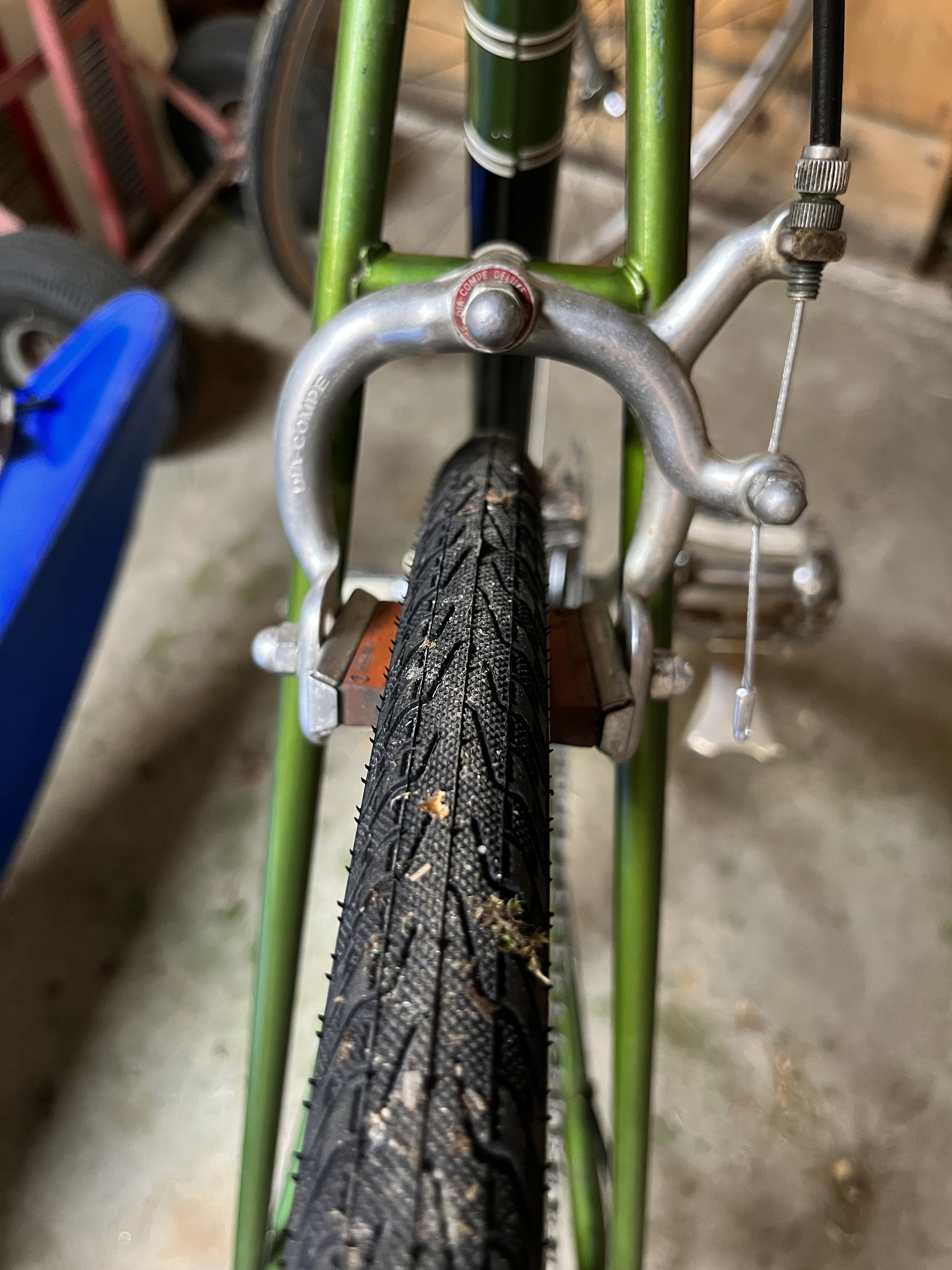
The wheels don't match. The front has a Joy Tech hub and Araya rim, probably original. The rear wheel had a Campagnolo Record hub and a Mavic rim. The freewheel looked like a Suntour two-notch Winner 7-speed. But no brand name was visible, and the notches looked slightly atypical.

Suntour freewheels can present problems, especially the four-notch models. The tool has to be very carefully secured. The two-notch models are generally more robust, but you can't rush them.

I secured the tool in the deep recess presented by the seventh cog, so I couldn't see what was going on in there. The tool slipped when I applied leverage with the big Park wrench. I examined the damage and determined that the tool couldn't seat fully. I dug in a bin of other old freewheel tools for one that looked like it would engage more fully. No luck. It didn't mar things, but it didn't budge the freewheel, either. I started examining the various elements of the puzzle more closely.

I'd had to remove the locknut, spacers, and hub cone from the drive side to get the tool to seat. Markings on the cone indicated that it might not be English thread. That sent me to Sutherland's to look for all possible variants of the Campy hub, and freewheel threading. And there it was: French threads don't play nicely with any other type of threads. This rider had an English thread hub and had graunched a French thread freewheel onto it. It can't have gone on smoothly. That thing is never coming off.

Best guess from internet image searching, it's a Maillard.

You can overhaul a hub without removing the freewheel...sometimes. This is one of those times. It won't be as clean or quick as a complete disassembly, but it will be better than the loose and crunchy mess he had.

As I removed cones from the axle, I felt that they presented continuous resistance. This could have been from crud in the threads. But no, I noticed a tiny curl of metal coming off as I painstakingly unscrewed the cones and fought them off over the slightly buggered threads that had held in the dropouts. Once I had the axle out I could see that someone had ham-fisted the Campy cones onto a generic Asian axle. Yeah, you could do it, with steady force, as long as you don't care about the damage to the threads. The axle was also too long for the 126mm spacing of the rear triangle. I dug up a new axle with appropriate threading. 

Replacement axles used to be very reasonably priced. Now, however, very few people must be buying them, because they're stunningly expensive. Like, they were between ten and twenty bucks retail all through the 1990s and early 21st Century. Now they're more than $40. You could buy a functional Shimano RS400 rear hub for about the same money. Now, if you were fixing up something that was really good in its day, a $40 axle might make sense, especially if you enjoy thumbing your nose at the industry. The cost of a good time just keeps going up. Inflation.

The bike may originally have had only six speeds in the rear. I can't tell from shifter clicks, because the right-side downtube shifter is permanently jammed between the index and friction settings. It makes a scraping, rasping sound when you shift it. I would recommend friction shifting anyway, because it allows you to use any freewheel or cassette that will fit in there. Number of speeds doesn't matter. All of my road bikes have personalized 9-speed cassettes running with 8-speed chains.

The controlling factor on chain width, aside from whether you get interference on the cassette, is whether the front derailleur cage fits closely enough to shift efficiently between chainrings.

My acceptance of a technology reflects a constant cost-benefit analysis. The new crap might offer some specific advantages, but are they worth it for the average rider compared to the added expense and pain in the ass that they bring? The stone age simplicity of nice bike componentry from the 1970s into the 1990s provides reliability and durability to general purpose riders of all types. Racers and technical specialists, regardless of competency, will need the more temperamental, expensive tools and weapons at the cutting edge. The rest of us can have a sporty good time on the old-fashioned stuff, or a facsimile made from the remaining offerings still on the market.

In conclusion, any time you thread things together, don't keep going if they don't go smoothly. Find a copy of Sutherland's. Check out Sheldon Brown's old site. If you have multiple options in your parts stash, feel around for a combination that works easily. 

Sunday, April 06, 2025

And on to the next dream...

 After finishing the e-bike stretch cruiser it was time to replace the shifters and crank on a beautiful late-1990s Dean. The bike might actually date from right after the turn of the century. We've been seeing it in the workshop nearly every spring or summer for a long time. I built those wheels more than ten years ago. Maybe so long ago that we looked up parts in a printed catalog and placed orders by phone.


The picture above shows the bike after its recent changes. Originally, it had a Campagnolo Chorus crank, Record 10-speed brifters, and Centaur derailleurs. I vaguely recall that we had already upgraded it from 9-speed to ten-speed by the turn of the century, but we did work on a number of Campy-equipped bikes. Campagnolo actually provided instructions for changing some internal parts in a brifter to change the number of speeds. And, of course, the internals were completely repairable. But the shifter bodies and so many internal parts on this bike were now so worn that repair would have cost a lot more than a new set of brifters.

A lot of years had passed, but Campagnolo had always been the leader in backwards compatibility. You can buy quite a few parts for a 25-year-old shifter, although some of them are being phased out. During that 25 years, the parts fit models that spanned more than eight years, which is phenomenal in the post-Shimano era of technological hyperactivity.

The rider wanted lower gearing than the 53-42 chainrings on his existing crankset. Campy's 135mm bolt circle limits how small a ring you can fit, and they have to match that proprietary bolt pattern. Back when Campy's BCD was 144, other manufacturers copied it. Then Shimano and the Japanese makers brought in the 130 bolt circle diameter, and the industry shifted to that. This meant that you could put on the 53-39 combination that became the de facto standard for road cranks for years. You could even get a 38 for the inner ring, but few did.

When compact road cranks came in, they used the 110mm BCD that mountain bike chainrings were using. Mountain bikes still used triple chainrings. Road compact cranks were designed for just two rings up front. While the young and strong would combine the new little 50-tooth big ring with an 11-tooth cog for the hardest one on the cassette, the 50-34 combination that was most common served as sort of a secret granny gear for riders who were starting to feel a little faded as age took its toll.

So many years had passed before the owner of the Dean felt the need to gear down that a nice compact double for ten-speed was tricky to find. I also recommended trying to match the aesthetic of the old steel frame rather than sticking some aerospace monstrosity on there. I suggested, and he agreed, to get a Velo Orange Grand Cru Drillium crankset. It was actually a little more retro than the bike, but it's also fairly affordable and distinctive compared to the monotonous hellscape of soulless modern componentry.

It's actually made by IRD. But Velo Orange has their Grand Cru badge applied to it, and they deserve support for being such a friend to the retro rider.


The owner dropped the bike off in late March, 2024. I was able to get the brifters and bottom bracket right away. The crank was shown as out of stock for a month or so. The customer was willing to wait. That ETA got kicked down the road a month or two at a time, all the way to the end of the year. We nearly lost the job entirely, but I had contacted Velo Orange directly by that time, to confirm that they were still going to have the cranks at all. We got the customer to hang on. The crank finally arrived a week or two ago. We were still in ski mode, so I didn't start the job right away. We were also buried in the stretch cruiser project, which had been plagued with its own spec problems, but those had resolved more quickly.

As I dug into the Dean, I discovered that the slop in the shifters had been masking slop in the derailleurs. They were very floppy. That led me to look at what we could get for Campy 10-speed derailleurs.

Nothing. That's what we can get for Campy 10-speed derailleurs. Not a zippin' thing. Zippity doodah. Zilch. Nada. Campagnolo has abandoned their faithful long-term customers actually worse than Shimano. Shimano at least still makes some 10-speed road derailleurs for mechanical shifting, with brifters to match, for those who are addicted. For the friction shifters, the truly free, we can buy whatever derailleur we like the looks of and can afford. But for the brifter-dependent, the company that launched the industry into technofascism still has a little lifeline hanging out for the laggards still nursing their older stuff.

Funny: fascism was actually invented in Italy, and the Italian company was the slowest to adopt technofascism. But they're racing to catch up now. Be sure to shell out massive bucks for their 12-speed electronic stuff. It's kind of nice to see them back to duking it out for pro team spec, but the game has no soul anymore, so what are we really winning?

Way way back, in the 1970s and early 1980s, you could actually get every part of a Campagnolo derailleur, separately, to replace what might have gotten bent or cracked in a crash or a workshop mishap. It was treacherously easy to strip the threads on a front derailleur swing arm when tightening the cable anchor bolt. Good thing you could buy just the arm, install it, and pledge to use a lighter touch after that. You could also crack the clamp band, tightening the derailleur on the seat tube. Again: press the rivet out, replace the band, put on the new one and be more sensitive, you clod. Do you caress your lover with those awkward, loutish hands?

Well yes, yes I did, which explains my long spells of monkish solitude, but anyway... You can't get parts to rebuild a derailleur anymore. Long gone, though I do recall seeing them as late as the early 21st Century. I'll have to dig into my archive of Quality catalogs. QBP's print catalogs used to provide such complete tech information that we could figure out a lot of repairs and compatibility puzzles just from what they included about each product.

I had recommended that the customer stick with Campy because of their legendary durability and product support. Seems like I should have investigated them a little more deeply before charging ahead with this job. The customer and I were both trying to extend the life of existing parts rather than junk stuff and start over. Now, if he isn't satisfied with how this thing shifts, we have no option that doesn't cost him a chunk of change to take a different tack.


These shifters seem less substantial than they used to be, and the upshift thumb lever impedes removing the rubber hood to mount the brifter or run cables.

They also only fit 4mm shift cable housing, which means that we can't fit them with the easier-running 5mm which cures so many shifting problems.

Just like Shimano, Campy declares that their shifting systems and drive trains have to be completely matched, 11-speed with 11-speed, 12-speed with 12-speed, end to end. While I would be inclined to test them, trying to graft in 11-speed derailleurs with these 10-speed brifters, the lowest priced front derailleur retails for about $60, and they don't even list an 11-speed rear derailleur. So then we're experimenting with a 12-speed rear derailleur costing more than $200. Or we go on the hunt for good used, and new old stock.

If we talk him into friction barcons, he either eats the cost of the 10-speed brifters and buys some nice brake levers on top of the barcon price, or he uses the brifters as brake levers only, which looks kind of weird and accentuates our defeat at the hands of the technofascists. And all of this is just so that we can graft in whatever derailleurs he wants to try. Whatever derailleurs he wants to try includes pretty much anything on the market if he shifts in friction. They just have to have the gear range and chain capacity to match what he has. And friction shifters will be much more forgiving of the slop in the old derailleurs. He could just keep running those until they totally flop off.

I'm insanely loyal to old machines that I've grown to love. Aided by my own mechanical knowledge, friction shifters, and access to parts, I will keep my own stuff going for decades. I provide the same service to any customers or friends who want to cultivate and maintain the ancestral riding skills. It bums me out deeply when a customer decides to euthanize an old bike because they fall for the lure of the new and exotic, or just decide that something old isn't worth spending money on. I can't afford to rescue any of them, let alone all of them. And I always feel guilty if my enthusiasm for bike immortality and persistence in the face of a challenge leaves them with a result that they're not delighted with.

The industry makes it increasingly hard. Any of us interested in the deathless bike need to pay constant attention to keep track of something that might have been replaceable that has now turned into a vital organ to be preserved. Friction shifting can cover a lot of situations, but it can't work around systems that the industry completely abandons, like certain chainring sizes, or cassettes for proprietary freehub bodies. I'm looking at you again, Campy. While it's contemptible on one level that the entire rest of the industry adopted Shimano's Hyperglide spline pattern, it does create a de facto cassette standard that makes mix and match a lot easier.

I do have a Campy-equipped carcass in the shop basement that might yield donor organs, but it might be 9- or even 8-speed. It's that old. I have defended it against many a clutter purge over the years. Vindication would be sweet. I'm not into losing to the industry and the throwaway mentality.

Tuesday, May 30, 2023

The Overhead Paradox

Customers will say that a high repair estimate is more than they paid for their bike. This implies that the bike is not worth fixing. But if you bought a good bike and took good care of it, it should last you fifteen, twenty years or more. If you have been paying someone else to work on it, of course you will end up paying more in service than you paid for the bike originally. But, given the general deterioration in quality and a rate of price inflation that has been romping merrily past the general consumer inflation rate since long before it was fashionable to bitch about it, the bike you buy for the same number of now-inflated dollars will be absolute trash compared to your old bike.

The exception, of course, is if your old bike was trash in the first place. The real trash tends to take itself out of the running just by wearing out completely, or dying of exposure as it's dumped out in the weather. But even a modest bike is worth fixing if you like it and it meets your needs.

Our first impulse at the shop is to figure out how to fix whatever anyone brings in. We've learned over the years to identify the few that can't be made good because they never were good, but anything with a shred of quality triggers the impulse to bring it back. Unfortunately, the shop itself costs a certain amount to run. I guarantee you that I see a tiny fraction of our hourly labor charge, but the rest of it goes to the keep the whole business solvent. More or less solvent, anyway. We have overhead. This leads to the paradox. A well established bike shop provides a meager living to a technician smart enough to do the work and stupid enough to keep doing it for a long time. Experience lives here. We've accumulated tools and parts so that we can work on anything back to about the 1950s, but we're still in the game, so we have co-evolved to deal with the whole time line through the decades to the ridiculously over-engineered bullshit of today. 

The ideal bike mechanic is also a highly skilled machinist, like my friend and mentor in Florida. She grew up in a machine shop and did time in retail bike shops in the Orlando area. She and her late husband set up a machine shop at their own home and withdrew from the retail scene. This meant that they could offer all kinds of specialty services without the overhead of a store front. Shops in the area still use her as a resource for the jobs that would tie up a work stand for too long and call for skills that the average transitory young bike mechanic will never even have known about.

I am not a skilled machinist. I grew up moving constantly, reading books and wondering what it would be like to live in one place long enough to have roots. We were not going to have a Bridgeport, a band saw, lathes, and other heavy, stationary tools in the garage. And my father was an officer, the military equivalent of white collar management. We were herded toward careers with cleaner fingernails. I was not a tinkerer. We engaged in some tool use, but only to repair or refurbish something we owned, not just for the sake of working on it. This mostly meant paint and planking on a wooden sailing dinghy more than working with metal and grease and oil. My gateway to mechanics was the used 10-speed I bought in 1975. It held no secrets, wearing its drive train on the outside.

I like classic bikes because they don't require a lot of work. The type evolved through the 1990s, gaining some actual improvements even as the technofascist complexities came to dominate. If I think about it long enough I can pinpoint the last change that really was an improvement. Probably interrupter brake levers. Just about everything since the early years of the 21st Century has been mostly either to make a previous bad decision work a little less badly or a classic example of "just because you can doesn't mean you should."

The overhead paradox mostly affects owners of older bikes and cheaper bikes. I've had customers go ahead with an expensive repair even after I told them it was a poor investment, because they had some attachment to the bike. I've had customers abandon a decent candidate for repair because they didn't want to spend the money on it, preferring in some cases to buy a new bike of lower quality just because it was new.

Most new bikes today have some form of the same features at every price point. Cheap bikes have flimsy derailleurs, stamped sheet metal chain rings, way off brand cable disc brakes, and heavy, floppy suspension. Bikes that still have rim brakes might have stamped sheet metal brake arms that shouldn't even be legal. To get reasonably robust examples of the modern idea of componentry, count on spending more than $1,000.00. If you're really going to try to ride like you see in the videos, spend more than twice that. Working on any of that will take time and require treasure hunts for parts, but less of the old-school skills that will die with my generation. And how much does it really matter when civilization itself may coincidentally die about the time my generation does anyway? The Baby Boomers lived as if they would be the last generation to need the Earth's resources, and it's looking like a self-fulfilling prophecy. Sure, other generations have followed and reproduced copiously, while guzzling a large share of what's left, but the Boomers set the tone in the 1980s. The values have been passed down long after they should have been replaced with more thoughtful progress.

Meanwhile, we're still here, and riders are bringing in beloved old steeds in need. One rider brought in his old Puch road bike from the 1970s.

                                                     It was 100 years 50 years ago
He's been riding it more or less like a "gravel bike." It will do it, because the roadier end of gravel bike geometry is basically like a general purpose touring bike from the 1970s: a little slack, a little long, with room for a somewhat plump tire. Of course the modern form has evolved into more specific geometry suited to loose surfaces, allowing for wider tires, and designed around the current ridiculous 1X drivetrains. But his old rod would do what he wanted for far, far less than a new bike with modern problems. I put on interrupter brake levers and aero primary levers, along with 27X1 3/8 knobby tires. Off he went, happy with the improvements.

On Sunday, I volunteered at the Makers Mill, a community "makerspace" that hopes eventually to offer a work space for community members to make and repair things. They offer classes in various skills ranging from textiles to woodworking to welding to jewelry making, as well as art classes. I helped them a little with their initial planning for the bike work area. With all of the YouTube experts in town who smugly avoid our shop, I figured that there was a deep pool of expertise waiting to bury them in helpful mechanics. Turns out that those people are apparently too busy elsewhere.

The problem with something that inexperienced people think is really simple is that they meet someone who knows a little about it and they assume that's all there is to know. Thus the person who knows a little must know more than enough. Volunteer organizations are staffed by whoever is willing to show up on a regular basis. Who has the time and the desire? That's who will be there. I am not the one with the most time. But I have been there enough to rip the lid off of the crypt of horrors that is the true depth of arcane bike knowledge. And they have hardly seen any of the really demonic new crap.

Late in the afternoon on Sunday, the owner of the Puch arrived at the Mill, hoping that we could snug up his brakes (I had had to fabricate cable knarps to make new bridge wires for his vintage Weinmann center-pulls)

The brake adjustment was simple enough. And oh, by the way, his seatpost seemed to be kind of stuck.

I had not messed with his seat position when I worked on the bike before. I clamped it in the work stand around the seat tube of the frame itself, suspecting that the OEM seatpost was probably too short to extend far enough to hold the work stand clamp anyway. I had not determined that the post was rusted into the frame, but the news did not surprise me. I might even have dripped a little penetrating oil down along it so that he could try to dislodge it later. 

Later had now arrived. I had advised him to go after the seatpost with a pipe wrench and not worry about destroying it. He'd chewed into it, but had not moved it. These struggles don't usually end well for the seatpost. We crushed this one in a big vise as we tried to twist it loose. Then we sawed off the protruding part before attacking what remained in the seat tube.

Stuck seatpost removal is always like trying to dig your way out of a jail cell with the handle of a spoon you stole from the dining hall. It's a grim, long process of scraping. We enlisted the Mill's machinist, but he's not a bike guy. I provided some guardrails to protect vulnerable parts of the bike while he addressed the generic problem of an aluminum tube stuck inside a steel tube, cemented by rust. We were hampered by the fact that the machine shop there has mostly a motley assortment of donated tools with lots of duplications of things that were not the right size for the job at hand. We managed to cut down and chisel away some of it, but more remained beyond the reach of the tools we had. The machinist took the frame to his home lair where he will work on it with his more extensive resources.

Because the Sunday event was free, the owner of the bike was not paying for the two or three people working for almost two hours on his soluble but time-consuming problem. Thus we sidestepped the overhead paradox. The cost was borne by the volunteers working for free. I did get some food and social credit for it, and I was happy to help keep a worthy old bike on the road, but I would starve to death if I did it all the time.

Used bikes can be great if you know what you're looking at. Prices fluctuate depending on demand. A seller who knows what they have, dealing with a buyer who accurately assesses the bike's value, are liable to settle on a higher price than if a generic scavenger just sells it as "a bike" to some random rube. But even then, the buyer might be a hard chiseler who doesn't know the value, but is determined to hold down the price, or a knowledgeable enthusiast who is also determined to hold down the price. Or the generic scavenger might have an inflated idea of the price, aided by a time in which used bike prices are running high, like in the demand surge of 2020.

The overhead paradox affects modern stuff as well. We had a jammed 11-speed pod shifter that I might have unjammed, given enough time, but a new pod cost less than my time. New shifter pods for seven speeds and up cost about as much as we charge to open up an old pod and clean out the congealed grease, which is usually all that is wrong with them. But the procedure takes longer than yanking the old pod off and slapping in a new one, so when the shop is buried it's a better option if we have the part in stock. The unfortunate consequence is that a fixable shifter pod goes to the landfill. The small businesses at the bottom of the economy end up bearing the major responsibility for stemming the avalanche of waste getting dumped into the environment. The bicycle industry doesn't support the activity of bicycling, it supports itself. Bicycling is just a side effect.

For the moment, we're too dumb to quit trying to fix things that people want fixed, but upper management can no longer ignore the mounting costs. We have no handy off-site magician like my friend in Orlando, but we can't afford to be that magician as much as we used to. I have a lot of tools at my own secret headquarters, but the shop still has a few more tricks that I haven't invested in, and I don't want to burn too many of my days off doing what I do on my days on. I would much rather teach skills (and a jaundiced attitude toward tech-weenie bullshit) than be a servant to the willfully ignorant. The owner of the bike should make at least part of the journey with me. At the end of it, they should come out more independent than when they started. If I can learn this crap, anyone can, but knowing it does make you more valuable. No, any idiot can't just do it, but any regular person can learn it if they can bring themselves to focus on it. The citizen rider becomes the citizen mechanic and a freer person as a result.

Thursday, August 25, 2022

A bike on demand

This was a test of the Emergency Beater Bike System.

The cellist wanted me to have a bike in Delaware, so that we could ride when I visit her during the school year. Each of the bikes I already built has a specific profile. Even if I haven’t used a particular one in a while, I might. And the least used is the hardest to replace. I needed another bike, and quickly. We were heading south in about a week.

Any good bike mechanic has a bike’s worth of pieces around. This is true whether you’re a professional or just an enthusiast. If you’ve gotten very far into doing your own work, you’ve collected parts, and perhaps frames, and wheels.

The first frame I pulled out was a sporty little Univega road bike from the early 1980s. I’d used it in 1994-‘95 when my primary road frame needed repairs. I inventoried parts on hand and brought home the ones I needed. But at the beginning of assembly I discovered that the 700x28 tires would never fit. The 28s were barely wide enough for an urban exploration bike. I needed a different frame.

Fortunately, someone had abandoned an intact Raleigh Grand Prix from about 1972 and I’d brought it home as a fixed gear prospect. Between what it already had and my archive of parts dating back to the mid 1970s, it should go together as fast as I could slap the parts on. Right?

Of course not. Maybe building a complete gruppo on a perfect new frame designed for it, but not in the gritty world of junk-box custom. 

The frame was designed for 27-inch wheels. I had a set left over from a touring build in 1980, complete with 6-speed 13-28 freewheel. The drop bars were coming off, in favor of flat bars. Drop bars are better for longer distance, but then I’d need primary and interrupter brake levers, and lots of other refinements that would take too much time. I was retaining a lot of things on the bike that I would have discarded for a fixed gear build. A fixed gear conversion is more of an unbuild.

Accepting the 42-52 steel cottered crank, the low gear is 42-28. Delaware is flat, right? I should be able to run those chainrings with a 13-18 corncob. But that’s poor gearing for leisurely exploring.

Wilmington is in the mountains of northern Delaware. That 42-28 is none too low.

Thinking I was home free, I put 1 1/8 tires on the wheels and slapped them in. That’s when I discovered that the fork was a little bent, and the front brake for some reason didn’t quite reach the rim. I was out of time, so I needed to solve this with parts on hand.

I had a long reach side pull brake, but it had a rear center bolt. However, center bolts are easy to swap on center pull brakes, so I moved the original rear center pull to the front and put the side pull on the rear. I’d straightened the fork ends adequately, so the wheel sat straight. The bike was ready to ride with 18 hours before we hit the road.


This Simplex front derailleur was one of the first upgrades I ever bought for my first road bike in 1975.

This slightly worn and probably slightly bent 1990s derailleur is totally fine to shift in friction.
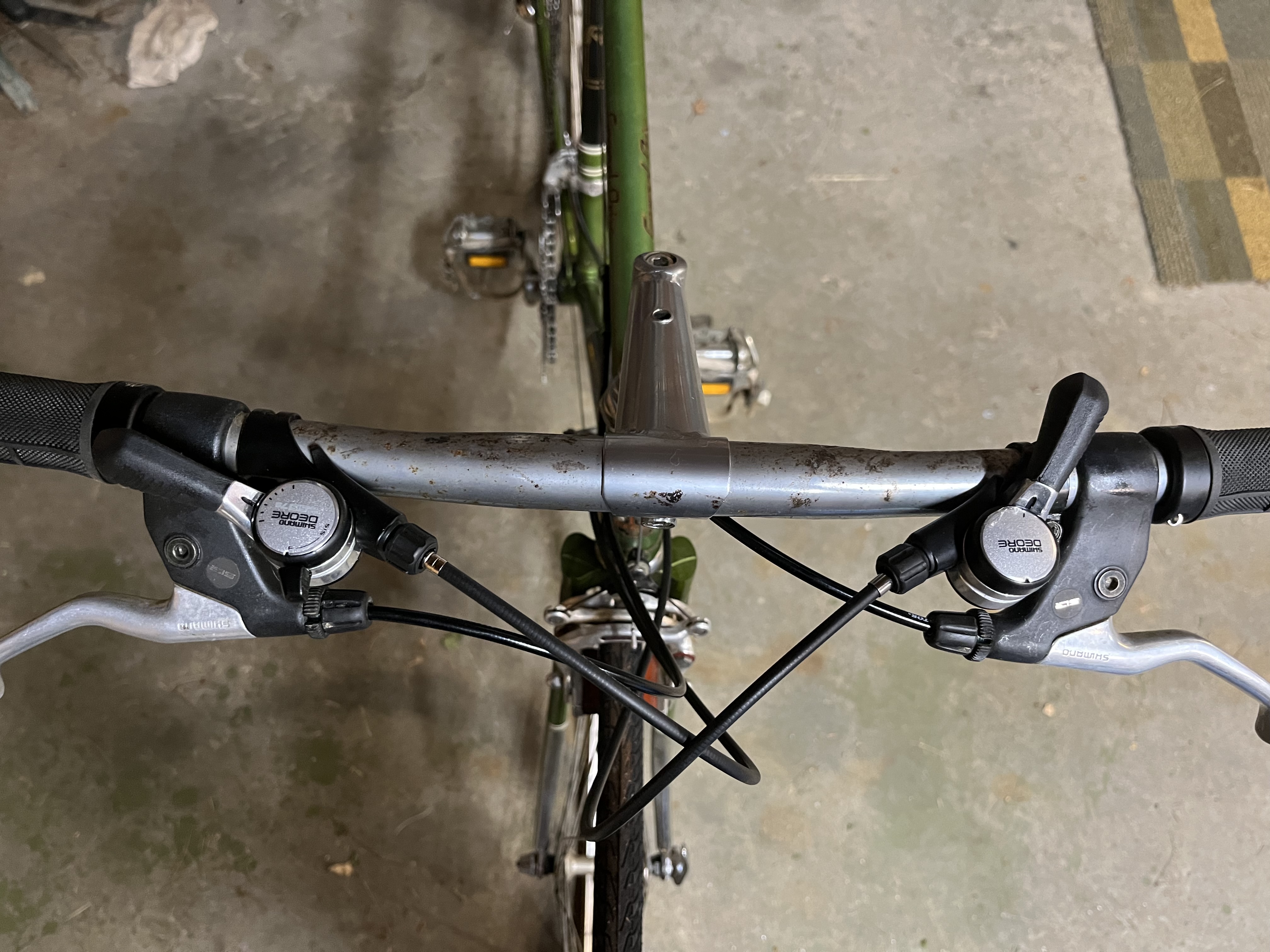
The whole mess is controlled from this circa 1991 mountain bike dashboard.

The bike will return to the lab in the winter for refinements and upgrades, but nothing too fancy. Meanwhile, it met the urgent need.


Tuesday, July 27, 2021

There's no tool like an old tool

 This thing has been getting workout this summer:

The 70-year-old BSA was followed by a 50-year-old Raleigh Sprite. The owner of the Sprite said that he had bought it new and loved the bike, and had ridden it everywhere for years before it got hung up in a barn somewhere for many more years. When it came in, it was thickly coated with bird crap. The estimate to return it to rideable condition was several hundred dollars. The owner initially said that maybe it was time to say farewell, but called back later to tell us to go ahead. 

In the early 1970s, it was up to you to figure out how high to put your stem. 

No max height/minimum insertion line here.

The bike hadn't seen new grease in any of the bearings since the early 1970s. I may be wrong about that, but if it was ever overhauled it was probably no later than the late 1970s. The bearings are all designed to be serviced. But everything needed extensive cleaning. Hence the hefty estimate. And I told him at the outset that it would not be like new.

The bottom bracket was full of tiny seeds and a small acorn that rodents must have dropped in through the opening in the top of the straight steel seatpost. 

The bottom bracket axle had a little engraving on it. It looks like it might be a picture of a rider.

I was too busy to document the whole thing. Another three speed from about the 1960s waits in the queue.

Other jobs included fixing the control lever for a guy's dropper post on his Trek somethingorother. The special screw had fallen out, so the lever was all afloat.

The threading is easy. There are basically only two thread sizes for parts and accessories, and this was the smaller one. As a shorthand I call it "water bottle thread." We have lots of bolts in varying lengths for the many applications in which they're used. About a 12mm button head with a couple of washers would do, except for the difference in diameter between the shaft on which the lever mounts and the inside diameter of the hole on the lever itself. Because the unit is only available as a complete assembly, the Internet could not tell me what the regulation innards look like. I scrounged around until I found a donor for the bushing I envisioned.

Who remembers Cannondale's annoying Force 40 brake enhancing cam from the early 1990s? We have a bag of these lying around. I pressed the pivot bushing out of this one and cut it in half.

The improvised bushing fit perfectly. 

Another rider's weekend saved.

On to the next thing.

What the hell is lianium?

This stem was on a bike that a young guy was building for himself from items he'd ordered online. He could do most of it, but wanted us to cut the fork and check a couple of other things. Lianium? Maybe it was supposed to say titanium. Sort of like what happened to this knockoff of a Shimano freewheel:

Here's what they're ripping off:

****

Top-routed cables led to a variety of approaches to the direction of cable pull on front derailleurs. There are front derailleurs made for the cable to pull from above, as well as models with a cam arrangement that will accommodate cable routing from above or below. But when top route cables were a new concept, designers used a directional pulley at the bottom of the seat tube to run the cable around and up to the traditional bottom-pull derailleurs that everyone had to use. This method is still in use, along with all the others.

The directional pulley is supposed to rotate smoothly on that rust-encrusted, deeply pitted bushing, which was smooth and shiny before the bike was ridden in wet and wintry weather, and probably cleaned with a hose. Between parts that are not available because of the pandemic disrupting things, and parts that were never available as replacement bits, recovering crudded-up pieces like this has become routine.

Lots more has gone by without a picture or notes in the relentless flow of repair work, but some things merit a moment to immortalize. The owner of this bike balked at the complete estimate to make it even remotely safe, including replacing the broken fork.


She insisted that she only rides it very mildly with her kiddies, and has been doing it with the fork in this condition for years. Then when she picked the bike up she said she was taking it to Highlands mountain bike park, but she "would only go on the easy trails." Hopefully her kiddies won't have to learn to spell "quadriplegic" any time soon.

Monday, July 05, 2021

Century-hopping again

If it has pedals and still rolls, sooner or later we get asked to fix it. I'm waiting for someone to bring in a stone wheel with a wooden crankset mounted through the center of it. At the same time, we're expected to keep up enthusiastically with the ever more costly and less durable offerings of the bike industry to its hostages customers.

One day recently, the leap was directly from about 2011 to the late 1940s.

This beast has had maddeningly imprecise shifting since it was new. Its owner was told several years ago by another shop that the only chain it should ever have was a particular Shimano model that had just been discontinued. They didn't tell him it had been discontinued, only that our shop had put on "the wrong chain," and that he should only ever use the magical CN7900 or something. His bike had Dura Ace ten speed, from when ten speed was the top of the line. Now it's middle class. The magic chain has been gone for a long time, and his particular specimen is totally thrashed. The bike shifts sluggishly, severely handicapped by the internal cable routing and forced use of 4mm shift housing, due to the configuration of the cable stops. This bike was never going to shift well, and now it shifts worse. The customer told us to leave the worn out chain and cassette on there, because he is emotionally unready to let the talismans go, even though they clearly do not work anymore. Maybe he'll score some artifacts on eBay or someplace, to eke out a few more years of acceptable mediocrity. We'll install whatever he asks us to.

Immediately following this 21st Century marvel of engineering was this BSA Streamlight in pretty rough shape:

The customer wanted to restore it to rideable condition. It hardly seemed possible for less than several hundred dollars, but when she described her intended use I agreed to the most basic repairs as long as she understood that the bike would not be very safe for extended riding or steep hills. It's nice to bring it back from complete oblivion to limited use.

Bikes can be hard to date accurately because records are often lost or incomplete. This is true of even a seminal brand like BSA. It's "just a bicycle." Starting at the back of the bike, I saw the Sturmey Archer hub, blackened by a coat of greasy dirt, and wondered if the bike was a latter-day knockoff. They're still made in India. It seems like a strange bit of nostalgia for the British Empire. However, the obvious age of the bike overall favored its authenticity as an original. But did it predate the TI buyout in 1957? The Sturmey Archer hub would say no. But when I scraped away the grime I found a date code of 1979. That indicated that this was a replacement wheel. The trigger control on the handlebar was also much later than the rest of the bike, having a plastic lever. This rear wheel and control had been added later.

Everything forward of the rear hub moved back in time.

The fully enclosed chain case has access ports at the rear dropout and around the crank itself to provide sufficient access for routine work like fixing a flat tire or replacing a chain.


Rod brakes are weird. I guess they're a step forward from a spoon brake that presses on the tread face of the tire (tyre?), but it still seems like a heavy, cumbersome rig compared to cable-actuated brakes. The way they meet the rim is interesting, too. They're less affected by a wheel knocked out of true, but they're less powerful overall. Then again, compared to early caliper brakes on steel rims, the difference in braking power isn't that large. Brakes were something you used to slow yourself down before the inevitable impact with something solid, especially in wet weather.


The rear brake is in really rough shape, but it not only still worked, it was still adjustable. I would not have thought that penetrating oil would recover the rust-encased lumps that vaguely resembled threaded connections, but it not only did so, it did it quickly and easily.

The trim on this bike would have been very pretty when the chrome was new.

The dynamo hub really set the date range for the bike. 


This style appears to have been made from the late 1940s to about 1950. The lights are gone from the bike, but the hub came in handy for research.

You can even find brake pads for the rod brakes, though not from any of our usual suppliers. The sun truly never sets on the British Empire. Some, but not all, parts seem to be available for the linkages, too. Meanwhile, the pads that the bike has are adequate for the kind of short-hop, mild terrain riding the owner wants to do around the village and the campus of a private school.

The bike was actually much easier to work on than any modern marvels from the 21st Century. It was from back when people were so stupid that they built things to last, and to be maintained. I guess that's why the old companies either went out of business altogether or sold their names to modern managers who would milk the image of tradition and slap the label on modern dispos-a-bikes at all price levels. Durability does not help cash flow. Stuff that lasts and is repairable satisfies demand too thoroughly. 

Remember: the business model for modern consumer goods is cocaine. It's expensive, addictive, and creates a compulsion to replace it even when you know it is ultimately destroying you. That's true of just about anything sold in the last 40 years. Sometimes there's an evolutionary excuse for it, as when personal computers and mobile phones went through their early development. Even that technology has reached a point where it can't drive forward as aggressively, because too many users are lagging behind, and the industry can't afford to burn them off. But still it tries. In the bike world, a slowing effect accompanied the near stagnation that had settled over the general industry before COVID, while specialty areas catering to addicts continued to dangle enticing offerings before them. And smokeless mopeds have continued to grow based on the dreams and illusions of a large susceptible population.

Monday, September 28, 2020

Fifty years of bike technology in a typical day

 This scrappy old street dog is actually only 48 years old, according to its owner, but fifty is a nice round number. And on any day we might see stuff at least that old, or older.

Looking at the Nishiki head tube badge, I didn't notice for a while that the bike was actually "Produced for American Eagle." 


Interestingly, little color accents on the fork blades are German colors, not American. There's nothing red, white, and blue anywhere on this bike, at least not all together in one spot.

Für deutschen adler?

The bike is designed for touring. Lots of people were happy to ride something like this across the continent in the 1970s. The owner said that it came with fenders and a set of lights. He did not keep those, but the bike still has its randonneur handlebars.

Randonneur bars are kind of brilliant. The tops rise from the center and are sometimes swept slightly back. This provides higher hand positions and back angles for the rider, but still mounts to a stem with a negative rise, for better handling overall.

Because the steering axis of a bicycle is not vertical, stem angle changes how the steering feels. The shape of the connection changes how your weight controls the system. A stem that drops forward of the steering axis tends to center itself better than one in which the stem rises above 90 degrees to the steering axis. The steeper the rise, the more noticeable the effect. You can get used to anything, but once you know you can't overlook it. It's very annoying. That's why on so many of my bike builds after the advent of threadless headsets I left the steerer tubes long, piled up the spacers, and mounted stems with an angle of 90 degrees or less.

The bike industry reinvented the randonneur bar, as seen on some Specialized Roubaix models and elsewhere. The newer version has a wing top for more comfortable hand support, and rises more abruptly. They can do this because stems almost all have open clamps to allow for more weirdly-shaped handlebars that no longer have to thread the needle of an old-style single-bolt clamp.

You could really go on a Safari with this bike, or so the name implies.

Double eyelets on the fork would take fender stays and either a front rack or the more common handlebar bag with bungee cord stabilizers that hooked in down at the dropout.

The crank says American Flyer


The rear derailleur was bent. This was repairable in the Dark Ages of friction shifting:

Less repairable was the Suntour freewheel.


 I liked Suntour freewheels, but they had a tendency on occasion to disassemble themselves while you were riding, allowing the innumerable tiny ball bearings to fall out along many yards of highway. You could theoretically purchase replacement ball bearings and spend a meticulous hour putting the freewheel back together, provided that the pawls hadn't also escaped, but more often you would just buy a new freewheel and graunch down on the outer plate that held the whole apparatus together before trusting it. But the failure could be catastrophic. The worst case I saw was on a climb in Northern California, near Rockport. The rider's freewheel on his loaded touring bike came apart and cracked the flange of his nice Campagnolo Record hub. He and his riding companion had to camp on the side of the road for the night and hitchhike back to the nearest bike shop the next day, to get a wheel and freewheel so that they could resume their northward journey.

Time traveling forward to the present, the 21st Century is represented by this tubeless road wheel:

Tubeless tires for bikes barely make the slightest bit of sense for mountain bikers who could be riding on serrated ledges and over a certain size of angular stones while running fashionably low pressures, but even there I hear them lament that they burped a tire on one of those hazards and ended up with a flat tire anyway, often harder to reinflate in the field than a stupid old inner tube would have been. Your magic juice can leak out, making a seal to the rim difficult or impossible to attain. This is why tubeless riders carry a tube with them.

Setting up a rim and tire for high road pressures really highlights the absurdity of applying the latest fad to every category of bicycling. Road pressures severely challenge the sealing technology that evolved at very low off-road pressures. The process makes gluing tubulars look almost casual.

Gluing tubulars is potentially very messy, but at least you can see what you're doing. Move deliberately and methodically and you will succeed. 

Mounting road tubeless puts you at the mercy of microscopic discrepancies that somehow manage to be immune to the properties of the drippy sealant you have to pour into the casing. The setup shown in the picture, on the first attempt, was okay up to about 60 psi. It would not hold anything above that, no matter how I waved the wheel around to distribute the sealant. It was leaking into the rim somewhere. 

The original stem looked cool, but the rubber seal area at the base of it was rectangular, meaning that it covered less rim along one dimension than the other. Also, the rim tape had not bonded well enough, even though that was hard to judge by looking. I replaced the stem and peeled the tape, deep-cleaned the rim with alcohol, and then baked the wheel in the convection oven we use to heat-treat skis for glide waxing, to dry it absolutely thoroughly. That seemed to do the trick. The tire settled in at 90-100 psi and held it to the end of that day. I declared victory and called the customer. He said someone would be in to pick it up for him. My work week ended, and I left for three days.

When I returned to the shop, the bike was still hanging there. I pinched the front tire. It had gone down to squeezably soft. I reinflated it and heard hissing into the rim. Resisting an urge to take a fire ax to the goddam thing, I tried tightening the lock nut at the base of the stem. The hissing worsened. I removed the groovy plastic shim included with the wheel and went straight for lock nut against rim. Before tightening that, I removed the lock nut and pushed the stem into the rim so I could inject sealant around it to coat the base of it. Then I tightened the stem, re-seated the beads, and inflated the tire. It eventually seemed to hold quietly. I had barely walked away from this when the customer's father came in to get the bike. I said nothing to him or to El Queso Grande, who was handling the transaction. The tire was rock hard and seemed ready to ride, but I guarantee it will be back within a day or two. I can decide then whether to go for the tire levers or the fire ax.

The tubeless department had been getting a little chaotic, so I found a bigger receptacle for our tubeless paraphernalia.

The three-speed that this rim tape came out of may have been much older than fifty years.

I could barely make out some inscriptions in Aramaic on these scroll fragments.

A smokeless moped with a flat tire provided official acknowledgment that ebikes are mopeds:


An old Cannondale showcases the destructive interaction of human sweat and aluminum:

When I attempted to coax a stuck ferrule out of the cable stop on the frame, the stop popped off instead, because the aluminum was so oxidized. The deterioration is eating into the frame itself.

The frame also has some nasty dents from chain suck. It is now destined to be recycled into beer cans. Cheers!

The parts shortage this season led us to farm old inner tubes when common sizes went out of stock and would vanish instantly from suppliers' shelves when they became available again.


On to the next thing: This visiting rider said that he was having a heck of a time getting his gears to stay adjusted. At first he focused our attention on the front derailleur, because it's one of those Shimano models where you have to follow a six-page PDF of instructions to hook up the cable and set the tension. Eventually, though, he also mentioned that the rear shifting was incorrigible, too. Shimano's higher end mechanical shifting systems seem designed primarily to make people want electronic shifters.

The bike wins the award for Worst Internal Cable Routing, but that's a highly competitive category. I don't expect this entry to hold the crown for long.

The bike had those crappy brown-coated cables that get abraded almost immediately. Cable fuzz causes drag, especially inside the standard undersized 4mm shift housing.


This bike did have a full cover over the bottom bracket cable guides, protecting against a major entry point for dirt and water in internally-routed cable systems. The hatch cover was full of carbon dust from the cables abrading the cable guides, and a thick dusting of cable fuzz that had worn off of the wires themselves. 

Step one is always to yank out the brown cables and get some 1.1mm stainless wires in there. Step two is often to replace the housing with 5mm if the frame will allow. But when I was trying to thread the new cables I discovered that he had a bigger problem than cable fuzz and skinny housing.

The problem turned out to be the cable stop on the top tube, where the shift wires enter the frame for their dark journey through the mysterious interior.

 
That little doohickey inside the tube is supposed to be on top of the tube. It managed to fall inside, but would not come back out the same way. I had to remove the fork, which fortunately gave me access to the inside of the top tube. 

If you own a bike like this, expect to fork out a lot for repairs.
 
Someone had wrapped Teflon tape around the cable stop to try to wedge it into the hole in the top tube, but that merely reduced the width of the flange that is supposed to keep the stop from dropping in. I peeled the tape away, and reduced the size of the opening from the back edge, where the stop has a longer flange, to enhance the overlap of the narrower flange across the front. It was a bit of a hack job, but much of what we do is meatball surgery for riders who not only need a bike repair, but have limited time. This is bike service in a resort town.

We do have our year-round residents. I believe the doting Dad who wanted us to change the grip-style shifter on his daughter's 24-inch mountain bike to a trigger-style shifter endures the winters with us and doesn't just cherry-pick the summers.

The close-reach kid levers on the brakes don't leave a lot of room for the index-finger lever of the shifter pod.

Finger trap made in China.

Fortunately, kid fingers are small enough to work in the space available, and the pivot of the brake lever keeps it from pinching down on the upshifting finger. A larger lever, shut down to accommodate the daughter's diminutive digits, would end up just as close.

Two department store bikes came in at separate times for separate things and I noticed these helpful stickers on the fork:

We have frequently seen cheaper bikes with the forks mounted backwards, either by the owner or by a disinterested grunt at a big box store who was numbing his way through the assemblies for a management and clientele that don't know the difference. This sticker may help to reduce the frequency of that error.

After a brief hiatus immediately after Labor Day, repairs have picked up again, though not to the flooding volume of spring and summer. And many of the problems continue to be weird and time consuming on top of the lottery odds of finding parts that you need.