Showing posts with label Categories. Show all posts

Friday, January 09, 2026

Working sick

 When I tested positive for Covid last Saturday evening, management scheduled me for the next two days off to see if I could recover fully before they absolutely needed me the following Tuesday.

Mind you, I had already felt functional enough to return to work after the previous bonus days off when I was really feeling sick. The positive Covid test automatically made me feel sicker again, but I wasn't really. No fever. Some congestion. Very occasional cough. Not too different from how I feel in the winter anyway. Indeed, years of testing negative because I felt a slight scratchy throat or a somewhat persistent sniffle had given me excessive confidence in my lonely habits of social isolation to avoid infection of any kind.

My life is a one-man show. The cellist has her career, which takes her away for months at a time. I'm left to manage the estate. Nothing gets done unless I personally lay hands upon it and do it. In the winter, that means all snow removal and firewood splitting on top of the usual grocery shopping, cooking, cleaning, cat care...

During prior, more conventional illnesses, I knew where I stood by how I felt. Colds were colds, flu was flu. Norovirus was the devil's work. All known quantities. This Covid shit is something else entirely. As complacent as the public has grown with it, it still presents surprises to each individual who gets it, especially for the first time. Which of the more optional symptoms will you get? The puking and diarrhea? The blood clots? The deep respiratory infection? The long drag of joint pain and brain fog?

My recovery slowed, but did not reverse. My sinuses produce a more alarming and disgusting product than the run of the mill snot of a normal winter. The cough last night, after I had to put in two or three hours with the snow thrower after I got home from work turned deep, vibrating my rib cage. My brother, who has been through it himself and cared for others around him warned me about pushing too hard. But if I don't push enough when the situation demands it, I won't be able to get out of the house.

At work, I wear a mask. No one says anything, but I catch varying reactions ranging from mild alarm to humorous contempt. Anyone who thinks I'm being silly is welcome to a snot rocket in their coffee cup. But even a sympathetic reaction marks me as weakened. Just as an animal, I hate to appear weakened. And, having this still-new-to-science disease, I am weakened, and no one can tell me how much. Maybe what I feel is pretty accurate. Maybe I'll drop through into something really debilitating. Roll the dice!

The sickness coincides with a period in which I will be working six days a week indefinitely, because our year-round part timer quit, and our seasonal part timer only wants to work three days. It's impossible to find anyone to work here, not because of inherent character flaws in the working population, but because the job is chronically low-paying and weird. At each point that we've had to hire someone, from the mid-1990s into the early 2000s, we had some degree of "cool factor" to attract someone young and intelligent. We have no "cool factor" now. I have no idea what would make anyone want to work here. Apparently, no one else does, either.

The shop itself is an evolved product of its specific environment, as independent shops so often are. "The Industry" tries to analyze shops like ours from outside, so that they can set expectations and pressure us to move product. They don't want to listen and cater to individuality. They want to predict production quotas and dump merchandise. Meanwhile, in through the other door walk the customers, with whatever they think bikes are, or looking for whatever they think bikes should be.

It's winter now, so most of the business is ski related. That's another whole realm in which we chose our specialty -- cross-country -- and try to please as many customers as possible. Just like the bike industry, the categories of cross-country skiing have gotten more separated, more complicated, and more expensive. A shop has to guess how many of what kind of skier of what height, weight, and experience level will come in, and how much money will they be willing to spend. We've gone from having a little bit of everything to having not quite enough of hardly anything. Except for having way too much of some things no one seems to want.

Day will follow day in an endless grind in which the day of the week itself will become almost meaningless. It only matters to me because of how it affects customer behavior. Weekends tend to be busier and more festive. Other than that it's just a bleak plod toward the grave. I can still make myself useful to a few people. You're only worth what you contribute to society.

As the only person who cleans up in the workshop or maintains any of the equipment, being here nearly every day helps me stay on top of that, and the trash. I've already cleaned up a lot of the neglect that accumulated while I was away for almost a month caring for the cellist. Part timers don't have to care about the long term effects of their lax habits. They know that we're grateful at this point just to have a relatively sentient being who can cover things in a rudimentary fashion while the full-time people try to catch up briefly on sleep and laundry. Frankly, I'm just as glad not to have to clean up after some of the well-meaning slobs who have deigned to "help" us over the years. But it's going to grind me down.

Life is just a journey to death anyway. No one knows how long it will be and how comfortable or uncomfortable. Dreams are just dead weight. All anyone really needs is a job to go to and a place to rest up between shifts. The sooner you cauterize away any notions of fun, frolic and creativity, the better you will be prepared for reality.

Thursday, December 18, 2025

How I know I’m not a real cyclist:

 Facebook feeds me cycling pages one after another. Worship of new technology and “n+1” dominate the content. Even among fanciers of the retro, people with large collections boast about their hoards and receive lavish praise.

I have no desire for more bikes than I have. I don’t want to get rid of any, but it’s already hard to find time to ride each of them. I could cut it back to one or both of the Surly Cross Check variants if I had to. That said, I put a lot of miles on the beater fixed gear. The vintage steel road bike is nice. The converted mountain bike commuter still might come in handy.

Particularly when it comes to the older bikes, I’m grateful for the collectors who preserve large numbers of the versatile steel frames from the 1970s to the ‘90s, especially those without vertical dropouts. They represent a resource, not a museum of superseded technology.

Because I started working on bikes in the mid 1970s, I view frames and parts as elements to combine and reshuffle. I could never afford a fancy complete-gruppo bike. It was fun to piece together something competitively functional within my budget. Some new features did represent actual improvements, so I incorporated them as I could.

My first “ten speed” was a used Peugeot. The first summer I had it, I put on a lighter alloy crank to replace its original steel Stronglight, and my friend and mentor Diane did a lot of fancy drill work, as well as hand painting all of the decals after a rattle can repaint. She also pinstriped it and added some personalized details.

A few years later, I’d picked up a used Eisentraut frame to build a second bike. That led to a few extra bike parts lying around. So I picked up a used Raleigh Super Course frame to build a sporty urban assault 5-speed like my racing buddy Mark had built. That quickly morphed into a fixed gear.

Those three frames formed the basis of a modifiable fleet. I raced one summer on the ‘Traut, then put a rack on it and slapped in the touring wheels I’d built, to ride for three weeks from San Mateo, California, to Eugene, Oregon. Back east after the tour, I put the race gearing and sewups back on it.

The Peugeot turned into a cyclocross bike that spring. Then I moved and took a different job, so it became my fixed gear commuter with fenders and, eventually, generator lights. The Super Course was my stripped down training fixed gear. 

When the Eisentraut got its first frame cracks (chainstays), I got a Grandis frame to build up with the parts from it. I raced that for a couple of years before Diane and her husband put new chainstays into the ‘Traut. Pinched for cash, I sold the Grandis frame, with a different parts kit, to a triathlete.

See how this can work? Three frames became half a dozen different bikes as needed. Good luck doing that with today’s excruciatingly specific designs.

My first mountain bike was someone else’s trade in at the shop. I swapped out the solid rear axle for a hollow one — same hub — to have both wheels quick-release. Put on sportier tires. Longer stem. Good to go.

Next, in about 1991, was a Specialized Stumpjumper, the first brand new complete bike I’d gotten in 20 years. It needed a couple of things, mostly just that longer stem. 

The Stumpjumper was a tad small. I wanted a steel frame, but none of the other mid-‘90s index-shifting crap. Working in a bike shop has some advantages, like employee discounts. A 1996 Gary Fisher Aquila had a decent frame. I transferred everything from the Stumpjumper that would fit, and sold the Stumpjumper frame with the rejected Gary Fisher parts.

The Aquila evolved as the 1990s reached their end. It finally grew fenders and a rear rack around 2009. So it’s been at least two bikes all by itself. More than that if you count its mountain evolution prior to the commuter conversion.

According to the algorithm, I should be a lot more acquisitive. I should always be craving one more. I did build one more to leave where my wife works for months at a time, so I wouldn’t have to transport a bike to and from. But it was another build on an old frame. With unlimited funds my answer would be the same. It’s an art.

Sunday, April 25, 2021

The benefits of neglect and obscurity

 Being forgotten by the technological world for decades was one of the best things to happen to bicycling. The machinery evolved very slowly, which made bicycles a reliable device and a reassuring piece of stability in a changing world.

 When I started paying attention, in the mid 1970s, no one seemed to be clamoring for space-age advancements. Kids born in the 1950s received their bikes as something their parents had received in almost the same form. Some kids born even later received the same actual bikes. My older brother wanted an "English racer" three-speed because our family had been introduced to the works of Arthur Ransome as soon as we were old enough to read. The characters in those books, when they weren't on the water, were likely to be getting around the English countryside on classic black bikes that you could still buy at a shop near you in the 1960s. Much might change in the world, but bikes were your living connection to history. Not only that, they worked perfectly well as personal transportation.

When the "ten speed" came on the scene, it didn't strike me as a wild new concept, only a more advanced existing concept of which I had been previously unaware. It also seemed like risky magic to encourage your chain to jump off the sprockets, after all my years when chains popping off was a greasy nuisance. I was very slow to adopt. However, as with other vices from which I initially shied, I embraced this one emphatically when I was finally corrupted by the right exposure. Indeed, the derailleur had existed in the form we would recognize for almost as long as Arthur Ransome's children's books. Whatever prompted the 1970s bike boom merely thrust it into the American public's eye, somewhat the same way cross-country skiing became the cool new thing around the same time.

Bikes through the 1980s -- meaning mostly road bikes -- had an aesthetic that seemed to span the 20th Century. Steel frames held together with lugged joints might have elaborate curlicues and cutouts or showcase the precision of smooth spear points, but at a distance the general configuration would convey instantly the bike's purpose and connect it to its heritage. By the 1990s, essayists like Maynard Hershon might gripe about its "19th Century" technology, but the stuff still works.

Check out some of the details on this Richard Sachs. The bike's owner is the real deal. She's been touring on it since she bought it new in the early 1980s (or earlier).

These cutouts are on the inside of the fork. 

Downtube friction shifters pull the derailleur across  a five-speed freewheel.

The rear wheel sits in long horizontal dropouts. This allows for all sorts of modifications and improvisations that you can't do with VD (vertical dropouts).


 Check out the original Blackburn rack from when the original Blackburn guy still had anything to do with the original small company by the same name.

Even the saddle is original.

I wore out several Avocet saddles until you couldn't get them anymore. I know she's logged some serious miles, but she probably hasn't crashed as much as I did, and perhaps has a smoother style. Her gearing is realistically low for a load-carrying bike.

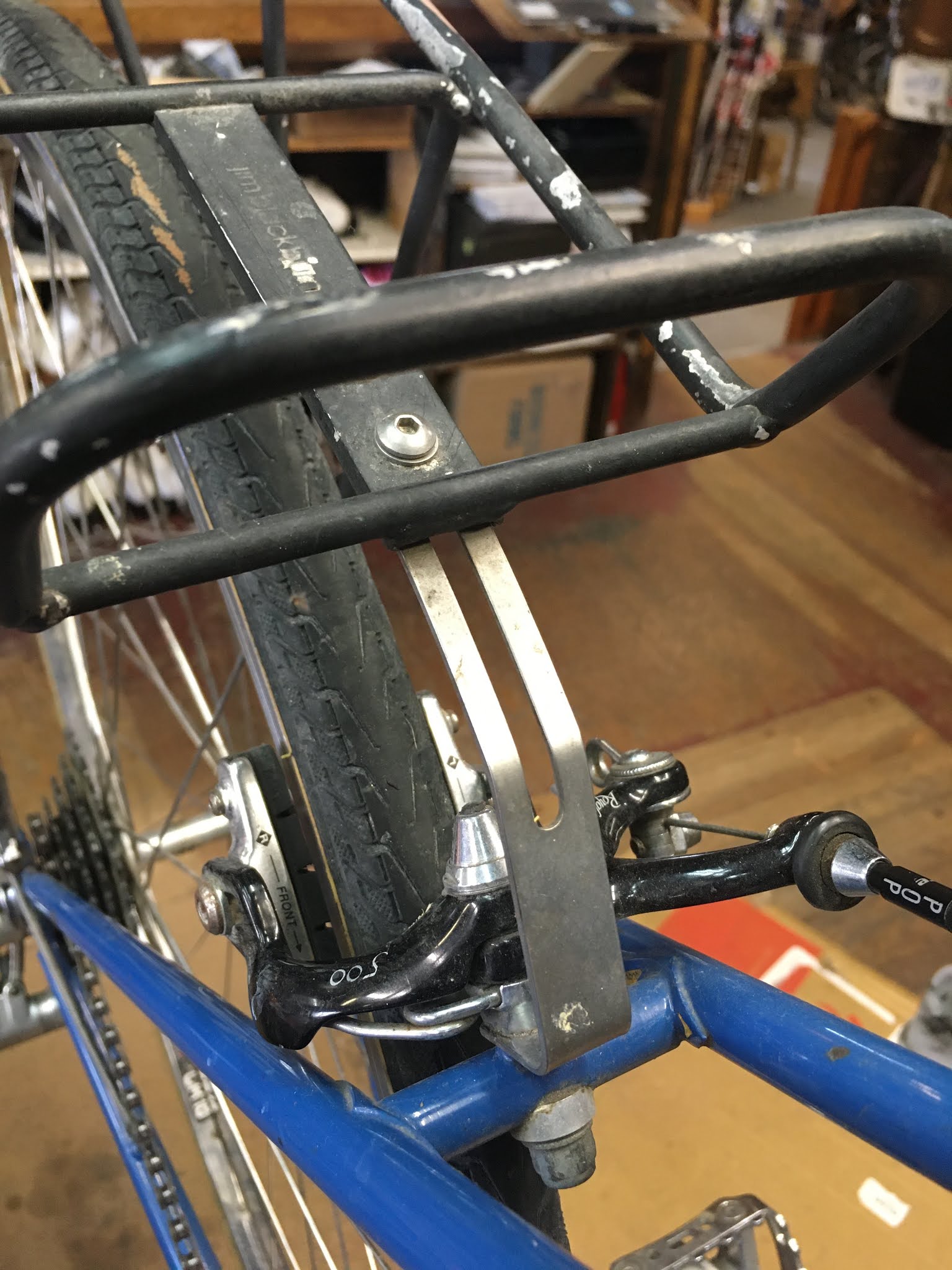
The cam on these Gran Compe brakes actually opens up wide enough to get the tire through the brake pads, unlike the token range of much newer -- and not cheap -- offerings here in the dying days of the Age of Rim Brakes.

Old plastic Silca frame pumps tend to crack at the threads. You can repair a minor crack by wrapping the barrel with filament tape. This pump has that repair. I don't know how much she's had to use it in that condition. I finally gave up on mine and got a Lezyne mini pump.

Before the Sachs I had a bike called a Sketchy on the stand. In a color strikingly similar to Surly's "Beef Gravy Brown," which was one of the Cross Check colors around 2011, this bike was apparently a hip item around that time. Made of lighter weight, more upscale tubing, it completely lacks the touches that make the Cross Check such a great basic platform on which to build a wide variety of bikes, such as the above-mentioned long horizontal dropouts. The Sketchy had VD, and shapely but highly inefficient curvaceous chainstays that would completely prevent the use of fenders with plump tires.


What's a nine-letter (two-word) phrase meaning "overrated?"

Until FSA got rid of the needle bearing version of the Orbit UF headset, that was the answer, at a tiny fraction of the cost, to the issues that the CK headset purports to fix. The CKs are serviceable, but what a pain in the ass to get in there, just to have ball bearings  -- albeit in a sealed cartridge -- anyway. Tapered roller bearings were the best for headsets, which is probably why they disappear almost as quickly as they appear when a company offers them. The Orbit UF stayed on the market for several years before they went on the angular contact bandwagon. So they're still a good deal for the price, but not as good a deal.

Despite its unfortunate modernist touches, the Sketchy at least used a steel frame with basically round tubes. The aesthetic is not at all classical. It doesn't look like art, the way lugged frames did. The Cross Check has a welded fame, but the dropouts have a classic shape, and the forks have an external crown that gives them a classic look as well. The Sketchy fork looks like an old suspension bridge tower. It's kind of cool in its way, but it looks heavy.

The bike business seems to be able to support a number of limited-edition boutique builders who do their thing for a while and then move on. As long as they build to fit off-the-shelf componentry, you can keep the frame going almost indefinitely. Whatever it is, if it works for you, it's a good bike. 

This old Manitou fork showed really bold marketing in naming a new model (at the time) for what planned obsolescence would soon turn it into:

As we charge forward into the battery-powered future, a category called "hunting bikes" is on the rise. Camouflaged smokeless mopeds are becoming a popular vehicle for some hunters to use to get into the woods and fields in pursuit of their quarry. Back in the 1990s we had a customer or two who embraced the mountain bike as a silent approach vehicle for hunting, because they were quieter than ATVs and didn't produce stinky exhaust. But you had to be willing and able to pedal. Now a wider range of hunter can take advantage of not only pedal assistance but also pure motor power on some models. They're being sold through hunting and fishing stores, assembled by people who may not have a lot of familiarity with the basics of bike mechanics. Or the customer might have bought it online and had to assemble it themselves. Such was the case with this behemoth:

What have we gained by junking reliable simplicity? I still prepare for hostility and negligence before every time I venture out on the roads. This is true even in a car. Are the few riders retained or recruited by electric motors or enticed by technological ephemera enough to offset the general loss of people who don't grow up with bicycles as a normal part of their life, with the option to continue into adulthood?

Bike categories have forever altered the concept of what is possible under pedal power. Mountain bikes started out as just bikes. Modification piled onto modification in rapid evolution, but it was only the same process by which bicycles had developed from the beginning: largely trial and error. Only when the type was firmly established did the engineers really focus on seriously designing the machines of today.

As for the road, the demand for technology is more driven by fashion than function. Shifting systems since the onset of indexing have increased precision when they work, but also increased the demand for precision in their construction and adjustment. Road riding could still thrive if all of that went away, just as road riding could thrive if disc brakes went away, along with carbon fiber frames and 52 different bottom bracket standards. Mountain biking, on the other hand, is entirely dependent on its suspension technology and gearing systems to make the preferred style of riding possible. Some mavericks might sing the praises of a hardtail versus full suspension, but almost no one -- and perhaps no one at all -- is extolling the virtues of a fully rigid frame and fork. Fully rigid bikes have been relegated to another category, like bikepacking, in which they are still the weirder option, or fat bikes, which have always been a weird option.

Millions of riders logged millions of miles before there were through-axles, disc brakes, electronic shifters, and 1X drivetrains dragging tinfoil chains across 12 cogs (or more) spanning a range from 10 or 11 to 52 teeth. Some things could safely be rolled back and advanced along different lines with only gains for the riding public.

Tuesday, June 30, 2020

More service activity

By the end of the week, it's all a blur.

A road bike customer asked whether we could get him short cranks because he's got some sort of calcified tendon problem, and can't bend his knee far enough to get around a pedal stroke on 170mm crank arms.

A quick dip into internet research brought me immediately to Bikesmith Design, a machinist who specializes in exactly what our customer needs. In fact, our customer's brother or brother-in-law or friend or something went to an event in Minneapolis years ago for HPVs and met the machinist, who was already working on shorter cranks because HPVs need them to fit into the confined spaces within fairings on recumbent human-powered speed vehicles.

I got the machinist and the customer talking directly to each other so I could get on with other items in the deluge. Eventually, a couple of sets of little cranks arrived, with detailed instructions for our customer to follow as he explored the limits of his bad leg. One set was 85mm long. Mark, the machinist, suggested that the customer use the 85s on a trainer, because they weren't strong enough for real rides on hilly roads. There was a detailed process to determine what the final crank length should be, as well as a set of 100mm cranks that were fully cleared for road riding. The customer opted instead to have us mount the 100s right away, so he could go try them on the road.

Short cranks don't just lower the top of the stroke, they bring the bottom right up close, too. I raised the seat as much as I could, but the post wasn't long enough to cover 70mm. I sent the customer away with a longer post so he could make the swap after feeling out the new riding position. His fork is cut really short, so the best I could do to bring the bars up was flip the stem. If he reconfigures the bike permanently he will need to replace the fork to get a longer steerer. I don't recommend steep rise stems, and I definitely wouldn't put a big clunky stem raiser on the carbon steerer of the existing fork.

The owner of the Specialized Turbo Como 3.0 ebike we recently assembled came by a few days later and said that she'd had a problem with it not running right. "I just turned it off and back on again," she said. "Then it was fine." Hilarious. The bikes are so computerized that now you can use the classic advice: "Hello, IT department, have you tried turning it off and back on again?"

We assembled another $10,000 mountain bike. This one was shipped here by its owner so he could ride with his buddy, for whom we had built up the new one a couple of weeks ago. Here was a bike that he had owned and ridden for a while, and it shifted like crap. These wide-range drive trains with the 42- or 50-tooth large cogs make all kinds of noises and move really stiffly anyway, but this one looked like it had never been adjusted properly. Nothing was bent, but it threw the chain right over into the spokes without hesitation.

When the owner picked that bike up, he spent the entire time with his phone up to his ear as he monitored an important call.

The heavy hitters are here. One guy called asking for "several road bikes." I was stunned into silence. The pandemic bike frenzy has been big enough to get a few minutes of national news acknowledgement, as well as lots of coverage in the cycling media. But the caller might have been spending a few weeks or months on a private tropical island, having a cleanse and a digital fast. I gathered my wits. They may be few, but they scatter far when I drop them.

"You said 'several road bikes.' Is that to rent or to buy?" I asked.

"Oh, yeah, sorry. To buy. All of my kids are big enough now that I wanted to get them nice road bikes that they won't grow out of."

I explained about the current shortage. Because I believe in providing as complete a picture as possible, I always start by explaining that the bike industry has been in decline for close to 20 years. Next I point out that the coronavirus broke out first where everything gets manufactured these days, torpedoing production before interfering with shipping and distribution as it swept around the globe. Thus, already small planned inventories were reduced even further because factories couldn't meet production targets, just as the public suddenly decided to rediscover bike riding after a long period of neglect. And they all got here a couple of months before you did, my unfortunate friend.

That may seem like a lot of unnecessary detail, but anything less makes the bike industry look sloppy and negligent, and retailers look like slackers. The bike industry is tech-obsessed and self-sabotaging, but they're not sloppy or negligent about it. It isn't even entirely their fault that the public lost interest at the end of the 20th Century. The mountain bike boom had already lasted almost twice as long as the 1970s ten speed boom did. The true believers in the surviving form of mountain biking were always a minority, but they were firmly enough addicted to form the nucleus of the addict pool that the industry farms today. The general population changed hobbies the way they always do.

Now they're back. We'll see where it goes. I doubt if it will last a year, let alone ten or fifteen. Meanwhile, our particular shop operates in an area where most of the categories have attracted a handful of adherents who come in on a regular basis to keep our brain cells challenged.

The owner of a Yamaha smokeless moped that he bought last year from somewhere else had had it shipped to us to assemble. This year, he brought it in because "it's making a grinding noise when I pedal hard." This is the same guy who didn't notice that he had Biopace chainrings for the first ten years that he owned his mountain bike, and then brought it in one day concerned because the chainrings had somehow turned oval. It was conceivable that he had only just now noticed that a mid-motor ebike makes noises when the motor engages. However, grinding might be a sign of something actually amiss. He mentioned that he'd read things on line from owners of the same brand who complained of grinding noises.

The Yamaha is light enough that I can actually lift it into the work stand without my little block and tackle rig, as long as it's early in my work week, and I got almost a good night's sleep the night before.


There was play in the bottom bracket. Or was it the bottom bracket? The crank axle disappears into the motor housing, engaging who knows what in there. I could see the face of a sealed bearing on each side. The play wasn't in those bearings. The motor itself was shifting. Under hard pedaling, this could cause gears to engage improperly. The owner said that he had tightened the mounting bolts and the noise had become worse.

I put a wrench on the bolts. They did not want to turn. They seemed bottomed right out. So I undid them, greased the dry threads, and reinstalled them. They torqued down properly instead of binding up. The motor no longer wiggled. There was a faint trace of play in the bottom bracket bearings themselves, but I couldn't do much about that. It was almost imaginary.

The bike made no alarming noises on a test ride. I called the customer to report that we had finished with it, and suggested that he should start a warranty claim with the original dealer if it made any further noises. I had also changed the chain, which was worn almost to the end of the gauge, and absolutely black with grimy lube.

The rate of repair check-ins seems to have slowed. In any normal season we would get these pauses, sometimes long enough to be alarming, but this is not a normal season. There's a blend of exuberant wealth, sober caution, and reckless, pent-up sociability. The people with money seem very happy. The reckless are ready to run out and embrace life, which sounds great until you consider how they are also exporting death and expecting everyone to be okay with that. Color me cautious, but I'm not going to bother to confront anyone outside of my job, because I don't need to get coughed on by some psychopath.

Monday, March 30, 2020

What Price Respect?

Google fed me a link to this opinion piece in Cycling Industry News, titled, "It's time for the bike industry to have some self respect." In it, James Stanfill president of the Professional Bicycle Mechanics Association, lays out an excruciatingly detailed case in favor of continuing training and qualification standards.

Stanfill makes some great points about what makes bike shop work a temporary phase for workers who pass through the industry on their way to something that actually pays decently. However, in his call for retailers to reallocate their budgets to cover the frequent training and retraining needed to keep up with modern technology's rapid pace of obsolescence he assumes that a shop has the money to reallocate. He also assumes that consumers will be willing to pay the higher prices that go along with a general rise in overhead. Bike shops don't have CEOs making billions who can give up their bloated compensation to redistribute the wealth to the workers. The industry as a whole will have to figure out how to get customers to respect them, before we can afford to adorn ourselves with our own new self respect.

Key to that "self respect" is Stanfill's assertion that shops need to be able to measure and present their qualifications to assure entities like insurance companies that they are meeting standards of safety and competence when providing highly complex equipment to the public. He also calls on mechanics to seek professional training and certification where available to make themselves more desirable to this new breed of self-respecting shop. Be ready to fork out on your own for a recognized training course because you take that much pride in being a bike mechanic. What was once a pretty good gig for someone with a modicum of mechanical aptitude is attempting to become a career path akin to auto or aircraft mechanics.

In capitalism, if you don't have plenty of money you are a failure and deserve to die. But in the real world, many areas with a small population have been served by small shops that were able to subsist for decades on a pretty slim margin with incremental investments in tools, and an experiential approach to learning about new things.

For a century, bike shops came in all sizes. Frequently they were small places, sometimes ill-lit, and merchandized by people more attuned to wrenches and grease than to point of sale marketing. Experienced mechanics could train new mechanics at the work stand. What mattered was the quality of the merchandise and the mechanical work, not whether they had a stunning atrium, or row on row of fashionable clothing. If you rode a bike a lot, you appreciated the rough practicality of basic black wool shorts.

All things evolve. Changes can bring improvements as well as unhelpful complexities. They are driven by the desires of existing enthusiasts, but also by public interest. When bikes were simple and people were content with it, a rise or fall in demand only meant changing the rate of production. Things would go obsolete as better things replaced them, but within a narrow range of functions. Weird derailleur systems gave way to the parallelogram, and then to the slant parallelogram. Caliper, cantilever, and drum brakes coexisted using the same basic leverage ratio. Every system of a bike was closely enough related to its forebears that you could figure out a lot based on what you already knew.  You could get deeper into it and become an inventive machinist if you wanted to, but you didn't have to.

Mountain biking pushed a lot of improvements in durability and function as bikes were subjected to consistently rough use. Prior to that bikes had received plenty of mistreatment and neglect, but they weren't advertised for the purpose, the way mountain bikes were. The bike industry had to back its claims with machinery that could withstand the kind of boisterousness that the pioneers of clunking had established as the standard. On the road or trail, user groups appeared to have a contentious relationship. In research and development, designers were borrowing from both categories to improve each of them. Versatile riders were doing both on- and off-road riding to improve their abilities.

All analyses lead back to the stresses placed on retailers and repair facilities by relentlessly mutating technology and category specialization. So I won't flog that again. I merely note that your chances of finding a place that can take care of your particular bike needs get slimmer and slimmer in the face of economic reality. Bike shops will become dependent on climate and population density to maintain a large enough size to remain viable in all categories, including smokeless mopeds. In addition, consumer costs will rise to reflect the greater expense the retailer faces. Training and higher wages cost money. That money comes entirely from consumer spending. When consumers can no longer afford to spend in sufficient volume, they will receive less of something in return, whether it's product selection, service quality, service speed, or the convenience of having any kind of shop within 20 miles.

For the moment, such vast numbers of archaic bikes remain in use that a small shop can eke out a living from the customers who need work on those. As they inevitably dwindle away, the next wave of well-used crap that replaces them will have increasingly esoteric needs, more difficult to meet.

Tuesday, August 20, 2019

Trash talk

The 1990s were ugly. The sudden influx of cash from the mountain bike boom led to a surge in incompetence and dishonesty. People would drive many miles to check out different bike shops, in search of a little lower price or a particular brand that the magazines or their friends told them was the only one to buy. Shops a hundred miles apart -- or more -- would badmouth each other’s work.

The bike business attracts competitive people. I showered plenty of napalm on other shops’ bad workmanship. The apparent easy money in the mountain bike market led to a surge in "bike shops" and increased bike sales through more generalized outdoor sports stores. Between the unprepared merchants and mechanics, and the bike industry's own rush to dump poorly designed and barely tested products into a market loaded with consumers unable to judge the merits of the so-called new improvements, there was plenty to criticize.

With the fragmentation of the bike market, all that seemed to have subsided. Overall participation dropped, and the riders who continued to ride fell into multiple categories, none of them dominant. Addicted bike collectors with sufficient funds and time might ride in several categories, but those riders are a minority. Special interest riders seek the shops that specialize in their interest, or patronize large shops that can afford to have stock in each category, and staff to cover the range of complexities. You hope so, anyway. A lot of it is just absorbing and regurgitating industry propaganda, as it was in the darkest years of the mountain bike boom. There was no time to study it all in depth, as it blasted out of the firehose. The term "retro-geezer" was coined at that time, to describe cranks like me, who critiqued the avalanche of temperamental junk that creates six problems to solve one.

The parallel lines of complicated machinery ridden hard by novice enthusiasts is ushering in a little resurgence of trash talk. Our shop is in a town with a year-round population under 7,000. Of those, only a small handful will use anything non-motorized for recreation or transportation. This is America, and normal people drive. We draw from surrounding towns, but they have even smaller populations. This makes it impossible for us to stock in depth in any category except the most basic recreational path bikes, and even that market seems to have gone a little soft this year. When one of our customers does business voluntarily or involuntarily with another shop, they sometimes share that other shop's scathing assessments of our work and knowledge. And I silently critique every bike that comes through my work station from some other mechanic's hands. I just don't bother to share my observations with the customers. I share them profanely and profusely with my fellow mechanics, on days when there are any, but that's as far as it goes.

Trash talk was a symptom of the hyper-competitive bike market of the 1990s. Now it is a symptom of the competitiveness born of famine. But competitiveness itself is a symptom of the belief that there's something to win. Part of what has driven fragmentation is habitat loss. Bikes are looking for places to thrive, or at least survive. It's Darwinian speciation, as the basic pedal-powered ancestor adapts to specific niches: varying levels of technical trail; gravel roads; sedate paths; roads; BMX tracks; freestyle parks. Shops don't shape customer interest. Customer interest shapes shops. We fight a constant battle to remain competent and relevant.

Friday, March 16, 2018

There is no cycling anymore

I heard a rumor today that a bike shop in a nearby town, known to specialize in mountain bikes, was planning to relocate to Wolfeboro. The owner of our shop is wondering how that will affect us.

Back in the 1990s, we withstood the attack of relentlessly undercutting competitors. That was when I noticed that competition is not really good for consumers, as we had been taught to believe. Competition weakened all the competitors, so that customers had less selection and less competent help. Our shop survived by preserving margins and performing top quality service. It didn’t hurt that we had a couple of mechanics who were smart enough to figure out how to work on the avalanche of new componentry, but dumb enough to keep trying to live on bike mechanic wages. The riding public in Wolfeboro was very well served in that time, especially when the biggest undercutter put itself out of business, and freed us up to stock more goodies.

At the time, there were mountain bikers and there were roadies, but they weren’t quite poles apart yet. Cross-country mountain bike racers were training on road bikes for aerobic fitness. But the subculture continued to evolve. The industry, fully committed to the drug dealer model of consumer marketing, kept spawning new categories to narrow the segments of the market and deepen the bite that could be taken from each addict’s wallet.

Around the time our latest looming competitor opened up in the next town to the south, the mountain biking subculture had already dismissed us as outsiders. Without even dropping by to see if we could be brought up to speed, our few remaining mountain bike customers went to the new guy.

I’ll admit outright that I had lost interest in mountain biking. None of the new equipment entices me to reconsider. The category concept really crushes small shops, even from the service angle, because customers tend not to trust someone they don’t see participating in their subculture. Also, our own sense of the componentry suffers from our inability to use all of it. Our slogan in the ‘90s was, “We really ride.” Road or mountain, we had put in the hours. Now, with every division a specialty of its own, a small shop faces an insurmountable challenge. You have to choose a specialty.

Sensing this well over a decade ago, I suggested that we stake out the practical tourist and exploratory rider demographic, as well as keeping a stock of path bikes and kid stuff for the casual recreationists and moderate fitness riders. Upper management did not commit to the concept. So here we are.

Word is, the competitor is not hurting for money. It always makes things harder when you’re fighting for your life against someone who is in the game just for a hobby. It’s yet another kick in the nards for the mythical “free market.”

All this takes place at a time when bikes are still being treated as toys and banished to segregated playgrounds. Cycling has not heeded the advice to join or die. Within the ranks of all pedalers, each subculture makes its own separate treaties with government and public opinion. Each pulls separately on the funds and expertise of any business trying to continue in the industry.