Showing posts with label experiments. Show all posts

Thursday, September 13, 2018

This could be yours

This stem, custom made in the early 1990s for a guy who is about 6-foot-14 1/2 inches tall, has been abandoned by its owner as part of a weird mutant bike built at the family compound on an old Sterling frame. He scraped off a bunch of the family's old junk on us, most of it early '80s road bikes with enormous frames.

They're a tall bunch.

The whole bike isn't worth much, but it has a couple of parts that could be useful for a home mechanic who wants some solid components from before The Great Cheapening. For instance, it has a forged crank, 74-110 BCD. Probably 175mm crank arms, so it's too long for me. And the derailleurs  are made of actual metal. It has top-mount, indexed thumb shifters with friction option. Early production mountain bikes were practical. They had indexing for convenience, but could be switched to friction if the indexing went out for any of a number of very possible reasons. The earliest models didn't even have indexing, because the first crack of dawn of the mountain bike era arrived just as index shifting was starting to make its way onto road bikes.

Plenty of room to mount your electronics on that long stem. Hell, sling a hammock.

They had this first-generation Rock Shox hanging around. A full inch and a half of travel! Ooooooh! Pump it up to about 12 psi. The first shock pumps used plastic syringes. The air valve was a rubber plug like you'd find on a basketball. And shock forks had to have a stop for the bridge wire of cantilever brakes. Check those crown bolts before every ride! You don't want the fork legs falling off, or the fork suddenly shortening so the tire hits the fork crown.

This bike has to handle very weirdly. That stem is totally crazy. I had a 150 on one bike, during the long stem era. Lots of mountain bikes had short top tubes, long stems, and narrow bars. Frame design evolved in the mid '90s, to longer top tubes and shorter stems. As evolution continued, stems got even shorter as bars got wider. I just packed a Karate Monkey for a guy who had sold it to someone on the west coast. Its handlebars are 31 inches wide. That's just ridiculous.
Too bad they're 31.8s. They would make a great combination with the crazy long stem.

Friday, March 23, 2018

The misunderstanders write the history books

Dredging around on the interwebs for a certain specific mutant mountain bike from the 1990s, I found a site depicting bikes of that period, viewed through the perception of young modernists. Discussing the flat, narrow handlebars we ran back then, these analysts said that we did it to reduce weight. This is entirely inaccurate.

The mountain bikes of the early ‘90s had short top tubes and long stems. We cut the bars down for better clearance on narrow trails, and to reduce unnecessary steering leverage. No one today understands bar ends, either. I don’t miss bar ends, because I bought a late ‘90s frame with a longer top tube, and put wider bars with more sweep on it, but I also don’t ride off-road in the 1990s cruising style anymore. Back then our rides were little journeys, not a series of linked stunts. We actually chose to challenge ourselves with long climbs, and liked riding cross-country.

The inheritors of mountain biking, the children of parks, ramps, moto-style courses and highly evolved suspension, have come up with their own narrative about a world they never knew. It doesn’t matter. Mountain bikers can pick and choose which antecedents to honor. It’s a young person’s game, so it will always exist in the present and recent past. The machines of history will be judged by the standards of modern riders who have not had to fumble through the period of discovery and refinement.

The older I get, the younger I realize the ages are that I once thought of as old. But if your sport is highly likely to tax your body’s ability to heal quickly, it is a young person’s game.

Back when cycling was just cycling, riders pedaled as best they could over whatever surfaces they had. The first bike ride across the United States predated the first official transcontinental road by about 30 years. And that was on a bike with skinny tires and no suspension. Really differentiated speciation didn't afflict us until the late 20th Century.

Granted, bicycling innovators experimented relentlessly, and forms of suspension can be seen from the beginning. At the start, roads themselves were often little more than trails in some places, or a set of ruts that would be dusty or muddy depending on the season.

The first mountain bikes continued that time line of branching but still related lines. The basic objective was the same: get from point A to point B over a given type of terrain. Riders in different regions, with different backgrounds, took the basic form and mutated it to suit their local conditions and tastes. Are your trees close together? Cut your bars down.

Commuting in the city, I had 38cm drop bars on my fixed gear so that I could slip through skinny gaps. On my open-road bike I had 44cm drop bars. When I started commuting over longer distances of open road, and didn't need to thread the needle in a tight cityscape with close traffic and parked cars, I put wider bars on all my bikes. It's called adaptation. Riders who adopted the mountain bike as an urban platform also modified their bars based on those considerations. Riders who visited our rugged, forested part of New England from the wide-open spaces of the golden West often had bikes adapted to plush singletrack through open range and meadows. But even they exhibited slightly narrower bars than the current norm, because of the top-tube-to-stem ratio I already cited.

Different brands adopted the longer cockpit gradually, taking a couple or three years to shift every company's offerings to the format now viewed as normal. Stems shortened. Bars widened. Riders wanted to sit up a little higher for better weight distribution and a better view down the trail. With suspension, you don't want to risk being way out over the front end of the bike. With full suspension, you can  and should stay more neutral on the bike anyway. And of course suspension has bred its own nuances of kinetics to propel the bike. Once you embrace the expense and complexity of a fully modern mountain bike, you might as well take advantage of everything it has to offer in return for its need for maintenance.

The website also dismissed threaded headsets as a misguided carryover from road biking. The article states that the pounding of mountain biking would make the locknut and top cone loosen up. If the headset had been properly adjusted and secured, it would not loosen. The major problem is that the explosion of bike business led to an explosion of shops, and a need to hire lots of "mechanics" while still trying to pay them dirt. Legions of inexperienced people came in who had no idea how a locknut works, and no patience. And why should they, when they just took the job to get the employee discount on schwag, and their employer was trying to nickel and dime them?

I ran threaded headsets without a problem until the turn of the century, when you could hardly find good quality product in quill stems and threaded headsets. The threadless headset is very convenient to work on, but it makes adjustment of bar height an awkward yank a lot of the time. Young riders on their stunt machines don't mind being locked in at an aggressive angle. Riders looking for a little more relaxation end up with a stack of spacers or a stem with a dorky rise that makes the bike steer funny.

Their picture shows someone adjusting the threaded headset without a stem in place, which will result in a headset that binds once the stem is installed and tightened. That kind of makes my point that the vast majority of people getting into the game in the 1990s knew the latest thing, but they didn't know everything. And now the current archaeologists look back from what they know and guess about what they see.

Thursday, February 22, 2018

Coming Soon: Moped Monthly Magazine!

Someone dropped off a pile of back issues of Bicycling. One of them included a special section devoted to ebikes.
Check out the Buyer's Guide to Sidewalk Motorcycles, and articles like "Hate to Pedal? Who Doesn't?" Read reviews of selected accessories, like helmets, gloves, and weightlifting belts. Find out why your smokeless moped must have electronic shifting and computer controlled suspension.

I don't mind if people want to invent labor saving devices. But I don't recall the Bicycling Magazine of the 1970s reviewing mopeds. The fact that the power is provided by an electric motor seems to blind people to the fact that this is not a bicycle, except in the sense that the original term for motorcycle was motor-bicycle. Yes, it has pedals and uses a lot of the same componentry. That in itself is a problem, when a 50- to 75-pound vehicle is using a suspension fork and brake system designed for something that weighs 25- to 35 pounds. Wheels and tires are gradually mutating to reflect the actual loads involved. This leads to other problems when the motorcyclesque tire for a given smokeless moped gets dropped from production. I ran into this working on a couple of massively heavy models from A2B. The only tire available to fit the rims is definitely not for a 75-pound behemoth. The rubber will melt away.

The bike industry, desperate for cash after they destroyed the mountain bike boom, is grasping at every straw, including electric wires. I suggest attaching those to the genitals.

You can't stop progress. You also can't stop diarrhea.

Electric vehicles are great. They are a separate thing and need to be considered as such. Quit dumping every whacked piece of crap with pedals onto hardworking little bike shops. Improvement is one thing. Over-sophistication is something else. The minority thrilled by space age, temperamental componentry is vastly outweighed by the people who want a relief from that crap, who were perfectly satisfied with simpler mechanisms, well made, and ask only for safe riding conditions.

It's still winter here, but a pretty crappy winter, so I have too much time to think about the next season and the technological marvels that are imposed on us in a deeper and deeper pile every year. Tool up! Study up! One or two people might need something annoying and expensive worked on! Meanwhile, all the older stuff still needs its routine attention.

The industry's ideal is to make bikes that are addictively attractive, that can't be serviced. Customers will buy them, ride them into the ground, and replace them eagerly, because we all have that kind of money. What happens to the carcasses of the dead? Who cares? Maybe someone will develop a feel-good, token recycling program to salvage the 10 percent of the content that can be. And environmental groups will start reporting on how the remaining detritus has been pulled from the gullets of the last few whales, or something.

Friday, July 03, 2015

Devise and Conquer

A bike mechanic should do more than absorb and repeat the industry's latest technical information to keep pushing the wave of product rollouts down the long shore of history. The master of the craft knows you have to deal with a lot of other stuff that washes up in front of you after drifting derelict or perhaps breeding in the depths.

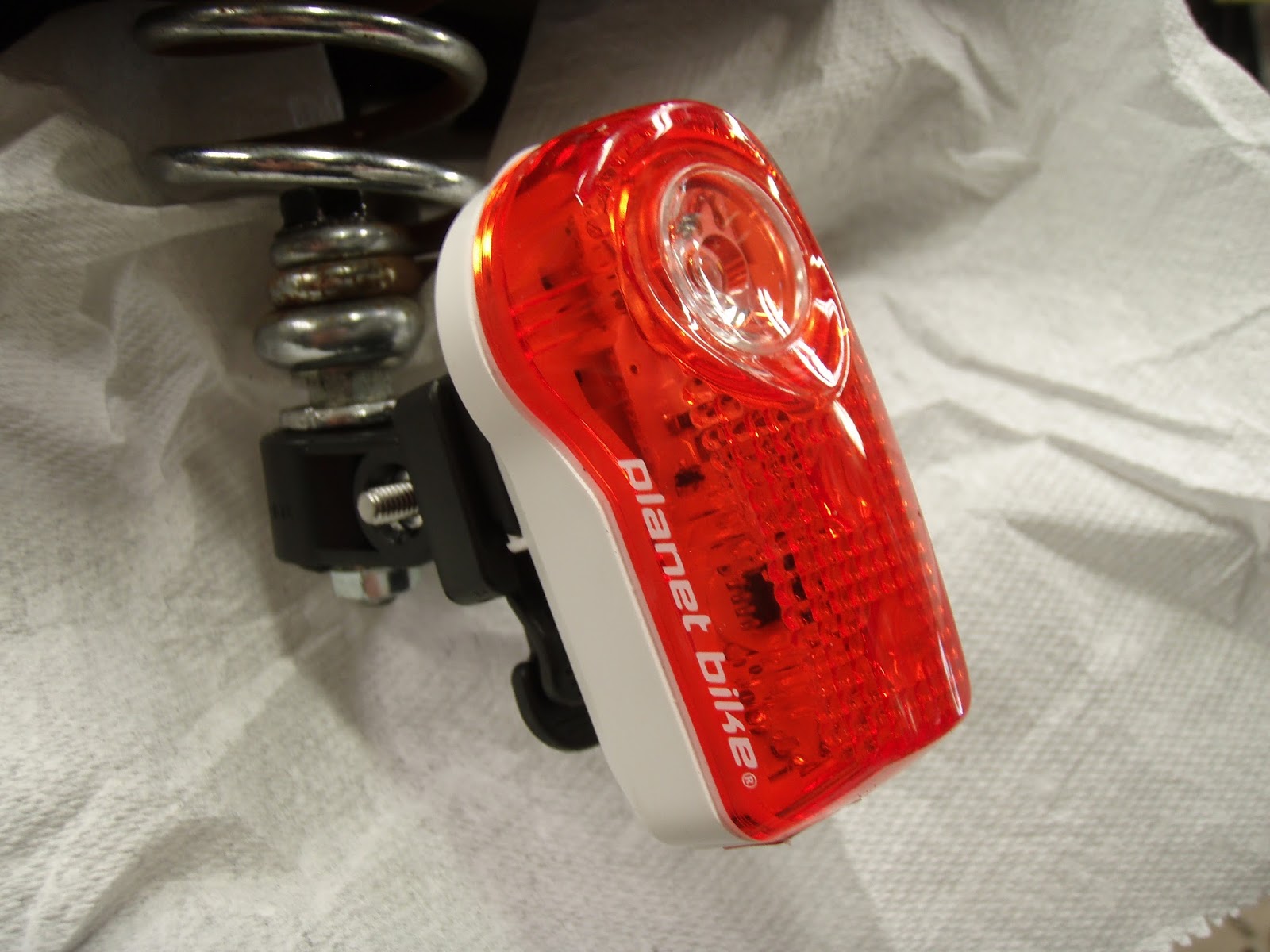
A minor challenge that has bubbled up in the last decade is, "where do I put the blinky light on this bike?"

The lights themselves usually come with various mounting options. Some of them actually solve the problem effectively. But the combination of seat height, seat bags, and other factors can make the mounting more of a token gesture. Why have an in-your-face flashing light when you end up mounting it down around hubcap level?

Yesterday I had to put Superflash lights on two low-priced bikes with sprung seats and suspension seatposts. This is a combination that makes on-bike mounting difficult, especially with the trend for frames with low stand-over clearance. The suspension mechanism on the post and the thickness of the cushy saddle mean that the solid part of the seat post may be buried in the frame. Even if a bit of it shows, it may be so low that the light is practically eclipsed by the rear tire.

Your average blinky user will not clip it to their clothing. That's too much to remember. They want the light on the bike. There it will remain, while its first set of batteries dies, bursts and destroys the circuitry. So I should not care whether the light is in the best possible location. But I can't help trying to do things in a neater, more functional way if I can.

After studying the bikes yesterday I realized I could take a bolt out of the seat spring assembly on the left side and devise a mounting point that would take the seat stay clamp provided with the light.

Step one: longer bolt. The nut has a step on it which will engage the hole in a washer that will form the top of the mount.
A metal washer and a rubber faucet washer go on the bolt next.
At this stage the bracket is assembled with a section of aluminum ski pole, a bottom faucet washer, a bottom metal washer and a nut to hold the whole thing together.
Here is the light bracket in place.
It's Superflash!
And there you have it. Ready to blink.
 
The rear rack limits how low the seat can go with this rig, but that would be as true with any other seat post mount. Mounting to the seat stay just puts the light down in the ground clutter.

Not a momentous accomplishment, but a nice little craft project.


Wednesday, November 13, 2013

Fun with an old axle

I needed a hole punch for some shim material, so I ground down an old axle.

Later I realized I could try it as part of a noodle bender to create a better shifter noodle using parts at hand.

It's not working all that well, but it's a first attempt. Working with noodle tubing without a noodle nozzle I will be able to use two axles to support the tubing at various points as necessary. I found a nozzle-less noodle in a parts bin.

Tinkering marches on.

Tuesday, November 12, 2013

A Ridiculous Struggle

The next version of shifter noodles is ready to be tested.

A 4mm ferrule does fit over the metal pipe of a brake noodle. I replaced the junction ferrule with the 4mm ferrule and placed a Jagwire in-line adjuster over that. I shortened the housings leading into the adjuster from the handlebar and hooked the cables back up. Could it be that easy?

Millimeters matter. The shifter noodles did not swing smoothly with the adjusters on them. The front brake came up against the shift cable going into the stop on the left side of the head tube. The rear shifting was still unreliable.

After a few hours in a cold garage, trying different possibilities I almost gave up and stuck it together with doomed housing going straight into the head tube stops. But I hate to let go of a good idea, and shifter noodles are a good idea on bikes with these infuriating defects on the head tube.

I tried using a short section of flexible brake housing on the front shifter cable, since it doesn't require perfect indexing. The springy shift housing pulled the flexible housing out at an awkward angle. The part that leads into the cable stop has to be rigid to feed the cable around the tight curve at the head tube.

In the end I had to grind off a couple of millimeters from the cable stop on the left side to make just enough space for the bars to swing unimpeded. The computer wire had to be led straight up the front of the brake cable to preserve the clearance.

Here's a crude video overview:
Shifter noodles designed for the purpose could be shorter, with a tighter bend. It would be tricky to re-bend a brake noodle without crimping it, but I guess that's the next phase of the experiment.

The real cure on any of the afflicted bikes would be to saw off the stupid head tube cable stops and put on a set of stops where they will actually work. But the industry wants to move into electrical shifting anyway. Batteries not included, of course.

Thursday, November 07, 2013

The wrong way to put on a Cannondale Headshok boot

While I was replacing the air spring O-rings in a customer's early-21st Century Cannondale F600 I noticed that the fork boot had a rip in it. The Headshok has many fine qualities, but it all goes to hell if the boot does not remain sealed against contamination. The needle bearings on which the fork slides so smoothly get all gritty and crunchy. Then you have to rebuild the fork. That will force you to face some of the more vexing idiosyncrasies of the design.

I had not done a boot replacement in years. The last Headshok that needed a boot was on a bike already so beat that my field-hospital repair was good enough. I cut a section of inner tube and slid it down to cover the tender parts. But a little research found a source for real pleated shock boots with nice little clamps, at a place that styles itself as "The Cannondale Experts."

When the boot arrived yesterday I knocked the fork out of the frame and started trying to work the boot down over the large diameter outer tube of the shock to reach the skinnier part it is supposed to protect. The boot has a large end and a small end. Unfortunately, the small end is supposed to go on the bottom, making the boot basically impossible to stretch over the larger diameter seat at the bottom of the upper tube, where the larger opening gets fastened when the boot is in place. Lubing it and working gently with various blunt objects was getting nowhere.

Not to be defeated, I turned the boot inside out so I could lead with the large opening. Once I had it down on the skinnier part of the shock I was able to roll it back right side out with the help of one more blunt object. Ta daah!

I looked on line today and all the advice I saw said you have to tear down the fork to change the boot. But in case you don't want to bother, do it the wrong way. It worked for me.

Tuesday, November 05, 2013

Shifter Noodle Update

The Serotta tri bike on which I installed the shifter noodles  in April came back for some adjustments, including shifting problems. The junction ferrules I installed did not stand up to the twisting of the housing, so the linear wires of the housing were starting to push through. When that happens the shifting will not stay adjusted. The tension keeps easing as the housing collapses.

The rider also wanted to replace the old Deore XT derailleur I put on there to handle her wide-range gears with a newer model that might work more precisely on her 10-speed cassette.

Ten-speed is about to get shoved way down-market, along with derailleurs mechanically operated with cables. Did you spend thousands of dollars on a bike with a ten-speed cassette and mechanical shifters? Sucker.

The next stage after SIS (Shimano Index Shifting) and STI (Shimano Total Integration) is SMEGMA: Shimano Mechanical-Electrical Gear Manipulation Apparatus.

Until SMEGMA gets applied to every bike and imitated throughout the industry, we in the mechanical trade still have to keep people's old garbage more or less working. So I'll be upgrading the shifter noodles to try to make them as close to trouble free as anything can be.

The New XT derailleur has no cable adjuster on it. The system has no other adjuster, so an in-line adjuster may help as I try to replace the failed ferrules with something more robust. Lots of ideas jostle in my brain like clowns in a tiny car right now. We'll see who gets out the door first.

The solution may include 4 mm housing. A 4 mm ferrule might fit inside the junction ferrule of a standard brake noodle. Or I might try flat-wound housing, used on brake cables, because the progressive, bar-con shifters are not quite as fussy as brifters. And I will need to incorporate an in-line adjuster on the right side, at least, because adjusting the rear shifting without a fine-tuner is a huge pain.

Tomorrow I'll start collecting potentially useful bits for the next phase of experimentation.

Friday, April 26, 2013

Full frontal noodlety

Here's a short exploratory video of the shifter-noodle arrangement and some better pictures of the final version. It's on its way to St. Croix next Thursday for the St. Croix International Triathlon.

Gripping stuff here:
Mumbling in a cold garage...but it's at least as good as the subject matter deserves.

Here are the stills:

Friday, April 12, 2013

Off-label use of brake noodles

Head-tube cable stops are one of the stupidest things ever put on a bike. Only a few misguided builders are still putting them on some road bikes, but many bikes are still in use from the period when they were the height of fashion. They replace the minor problem of cable rub with the massively worse problem of tortured cable housing leading to premature failure.
I've tried various tricks to extend the lifespan of the cable housings and improve shifting performance. This week I'm working on a Serotta I set up several years ago. Since then the rider bought fancy-zoot new carbon fiber bars as part of several upgrades. I didn't get to install them because of some scheduling issues, so she went to the triathlon shop where she has some sort of sponsorship. They have a great reputation. They specialize in fitting. But their mechanical work is strictly by the book, as far as I can tell.

Housings in head tube cable stops bend abruptly when the rider swings the handlebars further than a few degrees to either side. This can happen in low-speed tight turns or when stuffing the bike into small spaces, like the back of a hatchback or a small SUV. The book has nothing to say about this. Obedient mechanics just keep replacing housings and sending riders back out to develop shifting problems.

The new bars on the Serotta have internal cable routing like the old ones did, but the housing exits from the aero extension a little farther from the head tube now. The way the bars are shaped at the outer end, the housing HAS to run inside and go out through the hole provided.

The other shop had tried a sweeping curve, but still had a tight kink at the stop. I fiddled with different lengths and angles for an hour or so until I had a brainstorm.
Brake noodles direct a cable around a curve. If I could find the right radius and get the housing length right, the noodles would be able to change angle, rotating in the stops in a way that regular housing cannot.

The junction ferrules on brake noodles are drilled for brake cables, which are fatter than shift cables. To insure that the linear-wire shift housing wouldn't push through the junction ferrules I replaced them with junction ferrules designed for shift housing. It was a little tricky feeding the plastic liner of the noodle through the smaller drilling of the new ferrule, but it eventually fit.

To make the installation less conspicuous I put shrink tubing on the noodles.
Today I actually modified the system. The first noodles were both Jagwire, with a short bend. I replaced one of them with a slightly larger-radius noodle so they could swivel more easily past each other. It looks basically the same. The added clearance is only a couple of millimeters.

Noodles probably wouldn't help with older STI levers on drop bars, but now that everyone is routing their cables under the tape the housings exit closer to the headset. That means the cables come in more vertically, which would probably feed into the noodles successfully.

I will be conducting more experiments. I doubt that they will end up in the book.


Thursday, January 17, 2013

Passing the Time

Two or three days at 50 degrees got rid of all that pesky snow we were planning to use to earn a meager living for a couple of months.

The shop is running on a skeleton crew. On many days we see no more than two or three customers.

Last Sunday I brought my rollers to work. Big G wasn't ready to try them, but he observed. I would hop on for a few minutes just for something to do. I brought them again today.

At least no one interrupts while we do inventory. It's a monumentally tedious task. One benefit of a bad economy is that we have fewer things to count. This means we also have fewer things to sell, although slow categories still show large stocks of things like ski wax.

Ski wax has no other uses. It makes lousy candles. Trust me, I tried. They burn really fast. So maybe we can melt down all the wax blocks and dip scrap lumber in them to make fire lighters for people with wood stoves and fireplaces. We won't recover our whole investment, but we can get something.

Looking out at the half-frozen lake I just had an idea for a pedal-powered amphibious vehicle. I was trying to imagine a pedal-powered hovercraft when it morphed into a pseudo-hovercraft. Imagine an inflatable boat around a bicycle. The pedals drive a wide, flat paddle wheel that also functions as a drive track on land or ice. It would be sort of like a pedal-powered half-track with pontoons.

Anything crazy has already been invented. The crazier it seems, the more likely you can find it in a You Tube video. I'll have to poke around a little before I waste time sketching anything.

In the early 1980s I drew up some concept sketches for a fast pedal boat for commuting by water in the Annapolis area. I had no money, so I never tried to build anything. This new idea is less elegant but might offer a new vehicle for the kind of mixed glop winter has been delivering.

It's something to think about, anyway. Beats wondering when the flu epidemic will slam us.

I swear I remember a time when winter was fun. Now we just stand around in our store waiting for someone to want something we carry and hope they're not carrying something we don't want. Slim compensation for the lack of customers: no one is coughing, sneezing or otherwise exuding pathogens on us.

Sunday, August 05, 2012

Exorcism update

On the bike that kills front derailleurs we installed a Shimano Sora 9-speed compact crank. Brand new. Fresh start. The bike now shifts perfectly, according to the owner, who retrieved it and test rode it a few days ago. We're on to new crises now.

Our illustrious leader got his Shimano Ultegra rear derailleur to shift successfully on a SRAM 12-32 cassette, launching us on a little spree, defying compatibility recommendations. A customer venturing into hill climbs from her familiar realm of triathlons got the 12-32 treatment. The Zipp 404 wheel on which we put the cassette functions very well on her Surly Pacer and extremely adequately on her Serotta. Who woulda thunk it?

Monday, July 30, 2012

More unholy experimentation

Moving from approved and tested treatments to experimental therapies on the Bike that Kills Front Derailleurs, I wondered if the 9-speed SRAM PC 951 chain might fit just loosely enough on the FSA chainring to get sideways and jam there. The ring was technically only for 10-speed systems, which is a bummer if you're one of the poor saps who bought in when 9-speed was state of the art. Would a 10-speed chain work on the cassette?

Yes it would. The 10-speed Connex chain I slapped on for a test shifted perfectly well on the 9-speed cassette. It also jammed on the chain ring at least as badly as the 9-speed chain I removed.

Okay, let's go the other way. Maybe the floppy, sloppy fit of an 8-speed chain would allow it to slide off the chainring without a hitch. But would it fit the 9-speed cassette?

The 8-speed chain shifted and ran almost perfectly on the cassette, but jammed on the chainring as badly as the other candidates. It was only sluggish shifting between one set of cogs on the cassette, requiring just a little extra nudge at the brifter.

Ten-speed cassettes are probably more finicky about chain width. And of course Shimano now has its asymmetrical chains and drive systems supposedly requiring them, in case you want to give them a tighter grasp on your cogs.

I'm sticking with 8-speed chains and friction shifting.