Summer seemed to arrive sooner and last longer around here 20 years ago. It seemed to crank up at Memorial Day and go pretty steadily until Labor Day, with some peaks and valleys, but all on a pretty high plateau. Whatever has contributed to the decline, the shape has been distinctly different since shortly after the turn of the century.
Summer now is Fourth of July weekend, and August. Depending on the year, July might stay a bit active, but August is as close to crazy as we ever get anymore.
This summer, I left for a vacation trip at just about the worst possible time. Because the cellist has limited time at home with her out-of-state employment, we had to schedule the trip when she had the chance. I knew it would put me on the long-term shit list with my employer, but the cellist has limited time in more ways than one. I spend most of my time disappointing someone. I just have to choose who it will be. So I returned from the trip feeling like the guy who sneaked out of the Alamo before things got really bad, to hit the saloon and brothel. In reality my goals were more lofty than that, but the siege mentality of a small shop with inadequate staff leads to high stress and exaggerated emotions.
Because so many schools go back in session before summer technically ends, the crowds should drop right off this week. Because some schools are making a point to start after Labor Day, we might see more residual activity in this period of tapering. After Labor Day we'll get the early September rush of people who make a point to take vacation after the crowds are gone, when hospitality businesses might be offering discounted rates. That's what I used to do, decades ago, when I took vacations.
Has summer travel always been a business? Back 12,000 years ago, or even just three or four centuries, did seasonal travelers interact with fixed populations in ways similar to the economic exploitation of today? Exploitation sounds like price gouging, but it isn't always. It's just a matter of harvesting a resource when the resource is available. I've used the metaphor of hunting migratory herds to describe our handling of regular cycles of tourist business. We don't actually kill and eat them, and wear their hides -- except perhaps in some of the more remote hollows of the mountains -- but we extract as much as we can from them when they're here, knowing that they will be gone in a few weeks.
Showing posts with label tourism. Show all posts
Showing posts with label tourism. Show all posts
Tuesday, August 20, 2019


Monday, August 13, 2018
Unnecessary dangers of the Cotton Valley Trail
Now that the Cotton Valley Trail is complete from Wolfeboro to Wakefield, bike use has increased steadily. It was already a popular ride, but now it actually goes somewhere instead of just out into the woods.
The Cotton Valley Trail has always had more problems than the typical multi-use path, because of the rails left in place for use by the rail car club. The rail car club beat out the non-motorized users when the right of way became available, so all other uses have to bow to them.
Due to the chronic lack of funds for things that actually improve the quality of life for ordinary citizens, there was never enough money to upgrade the trail corridor to safely and pleasantly accommodate the incompatible uses of walkers and riders sharing space with motorized conveyances that of necessity hog the entire width of the rails. In many places, the space between the rails is the only improved surface.
When I was a kid, we used to play on railroad tracks, including bridges. We understood all too well that if we got ourselves killed out there we would be in big trouble for interfering with the smooth operation of the railroad. And if we interfered with the trains and didn't get killed, we would wish that we had. But those were real working railroads.
For years we had noticed that the rail car people seldom put their vehicles on the tracks on the section that runs from Route 109 east down into Wolfeboro. The tracks were removed completely from the mile-long Bridge-Falls Path from downtown Wolfeboro to Center Street in Wolfeboro Falls. From there, the path was sited next to the rails out to the public boat launch at Mast Landing. The path goes between the rails at that point and stays in that nerve-wrackingly narrow space all the way across the first causeway to Whitten Neck Road. After a brief, enjoyable diversion a few yards away from the rails, the path goes back between them for the second, longer causeway across a section of Lake Wentworth.
When you asked the authorities in charge of the trail what could be done to make the crossings safer and the railed sections less stressful, you'd get a mumble of excuses about how the rails had to be there because they were there and to shut up and be grateful. Meanwhile, injuries have piled up, ranging from abrasions and contusions to broken hips, cracked ribs, and the occasional collapsed lung. And the rails almost never see a rail car. In the latest raft of excuses, we were told that the rails are there so that the rail car people can help with mowing and maintenance. The rarity of those work details hardly seems like it's worth the price in damage and injury to bicyclists. But bicyclists come at the bottom of any hierarchy, whether it's on the road or on a path like this. The message is, "suck it up or quit riding."
On Sunday, I left my car at the Allen A Beach parking area and walked to work. It was a rainy day and I didn't feel like riding, but I didn't want to drive into the chronic gridlock of Wolfe City in the summer, or take up scarce parking in our little lot. The walk gave me a chance to document just some of the many unnecessary dangers and inconveniences of the Cotton Valley Trail. It could be entirely great if these were addressed. If some of them aren't addressed, we could lose the whole trail to erosion exacerbated by the presence of the unused rails.

The latest Cotton Valley Trail brochure actually states that rail cars are only used from Fernald Station out to Wakefield. There are many other ways to mow and trim a trail. It is time for the rails to go, and for the trail to be widened and graded for safer use and better drainage.
 Look carefully at this first picture. On the left you can just see the rails, buried in vegetation that has been neither mowed nor trimmed in a long time. Imagine that as usable trail width. And this is on a relatively wide section.
 At the River Street crossing, the trail moves to the left of the tracks. Again, imagine the generous space available if the rails were gone or buried beneath well-packed fill. It would double the available width. The right of way is already there. The brochure claims that the right of way is 66 feet wide. That much space is never used for the trail.

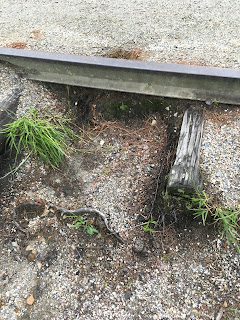
 Sam, you made the ties too wide: These two pictures show the first examples in which the trail is reduced by the protruding tie ends, sometimes covered by vegetation, in other places just hanging out there. It gets worse.
 Oh wait, what's that? Did someone drop something? A hat? A bandanna?
 Nope. It's a rock. Someone kindly painted it orange. It protrudes because the fill has settled or washed away. Spray paint is cheaper than actually doing anything about it.
 This picture shows how much trail width has been lost because ground covering plants have not been controlled. I suppose this is better than having it lathered with carcinogenic defoliants, but then a wider packed trail surface would achieve the same thing without poisoning anyone.
 Even if they didn't remove the rails, the trail would be half again as wide if they just filled and packed up to the near rail.
 Here's how much width they would gain if they got rid of the useless rails.
 This section of protruding tie ends coincides with a retaining wall. An outbound cyclist, trying to accommodate oncoming traffic, can only fade to the right as far as the ends of the ties. An already narrow trail becomes even narrower. Those rude cyclists! Why do they insist on riding?
 Two-way traffic has to get past each other in a space easily spanned by my short little legs.
 Not much farther out, tie protrusion is much worse. Lots of dirty looks from pedestrians there, when the oncoming cyclist doesn't scooch right up against the rail to make room. When it's two cyclists passing, one or both equipped with the currently fashionable absurdly wide handlebars, you have to wonder why they don't get tangled more often. They should dismount, right?
What do you call a bike rider who dismounts? A pedestrian.
 Approaching Mast Landing you get another good look at wasted space and more protruding tie ends. The rail crossing at the boat ramp has been considerably improved. They filled it in so that the rails are flush with the pavement. This makes them useless to the rail car people, but still slippery when wet for the riders. Non-skid tape is applied occasionally... it's one of the better crossings, and yet it wouldn't need to be there at all if the unused rails were removed.
 Just past Mast Landing, the trail goes between the rails to traverse this little residential section. Residential or not, the right of way could support a comfortably wide trail with the rails removed, and it wouldn't turn into the "Cotton Valley Canal" after a heavy rain. Cotton Valley Canal sections are common between here and the Allen A. The rails hold water in the trail bed, just like an aqueduct. If you get there soon enough after a heavy rain, you can ride in water inches deep for many yards. Many, many yards. Riding it during a downpour last week, I was pedaling up a flowing stream for miles, not mere yards.
 Welcome to the jungle. These shade-tolerant shrubs, well-watered by the irrigation provided by the Cotton Valley Canal, are flourishing under the conspicuous lack of maintenance.
 This shot shows how much trail is lost to the plants. My right foot isn't quite at the rail that indicates the already inadequate width of trail available without the incursion of the foliage.
 Here's some trailside erosion on the Crescent Lake causeway. If a rider moves right and wants to put a foot down, it's a long way down. And this is a minor example of erosion compared to the next causeway, across Lake Wentworth.
 Imagine this part of the causeway without rails. There's plenty of width for more trail as well as the trailside benches and fishing spots that users already enjoy.
And then there's this. The erosion is undercutting the trail. The rails may be holding it in, but their long-term, barely utilized presence has prevented anyone from properly stabilizing and grading the causeway for longer-term survival and usability.


Beyond Whitten Neck Road, the trail takes a fun little up-and-over, leading to a level section with some sweeping bends. Nice! Except when it rains.
 See the rails over there? They're on a built up level with ditches on either side. And basically no one uses them. The path, meanwhile, is over here, with a little swale to the left and a slope to the right, channeling runoff into it.
 At the end of this stretch, the path kinks left to launch riders into another section between the rails.
When I walked the path on Sunday, I saw riders coming toward me as I approached that crossing. As a rider myself, I knew what I would want a pedestrian to do. I walked up to the right of the rails rather than stepping between them exactly at the crossing. I had barely taken my first step on the tie ends right next to the path when I felt a burning pain in my left calf. A wasp stung me, because there was a ground nest in the tie end right next to the path.
 That tie end, right there. The pale one with the crack in it. Don't forget your epi pen.



The Cotton Valley Trail has always had more problems than the typical multi-use path, because of the rails left in place for use by the rail car club. The rail car club beat out the non-motorized users when the right of way became available, so all other uses have to bow to them.
Due to the chronic lack of funds for things that actually improve the quality of life for ordinary citizens, there was never enough money to upgrade the trail corridor to safely and pleasantly accommodate the incompatible uses of walkers and riders sharing space with motorized conveyances that of necessity hog the entire width of the rails. In many places, the space between the rails is the only improved surface.
When I was a kid, we used to play on railroad tracks, including bridges. We understood all too well that if we got ourselves killed out there we would be in big trouble for interfering with the smooth operation of the railroad. And if we interfered with the trains and didn't get killed, we would wish that we had. But those were real working railroads.
For years we had noticed that the rail car people seldom put their vehicles on the tracks on the section that runs from Route 109 east down into Wolfeboro. The tracks were removed completely from the mile-long Bridge-Falls Path from downtown Wolfeboro to Center Street in Wolfeboro Falls. From there, the path was sited next to the rails out to the public boat launch at Mast Landing. The path goes between the rails at that point and stays in that nerve-wrackingly narrow space all the way across the first causeway to Whitten Neck Road. After a brief, enjoyable diversion a few yards away from the rails, the path goes back between them for the second, longer causeway across a section of Lake Wentworth.
When you asked the authorities in charge of the trail what could be done to make the crossings safer and the railed sections less stressful, you'd get a mumble of excuses about how the rails had to be there because they were there and to shut up and be grateful. Meanwhile, injuries have piled up, ranging from abrasions and contusions to broken hips, cracked ribs, and the occasional collapsed lung. And the rails almost never see a rail car. In the latest raft of excuses, we were told that the rails are there so that the rail car people can help with mowing and maintenance. The rarity of those work details hardly seems like it's worth the price in damage and injury to bicyclists. But bicyclists come at the bottom of any hierarchy, whether it's on the road or on a path like this. The message is, "suck it up or quit riding."
On Sunday, I left my car at the Allen A Beach parking area and walked to work. It was a rainy day and I didn't feel like riding, but I didn't want to drive into the chronic gridlock of Wolfe City in the summer, or take up scarce parking in our little lot. The walk gave me a chance to document just some of the many unnecessary dangers and inconveniences of the Cotton Valley Trail. It could be entirely great if these were addressed. If some of them aren't addressed, we could lose the whole trail to erosion exacerbated by the presence of the unused rails.

The latest Cotton Valley Trail brochure actually states that rail cars are only used from Fernald Station out to Wakefield. There are many other ways to mow and trim a trail. It is time for the rails to go, and for the trail to be widened and graded for safer use and better drainage.


What do you call a bike rider who dismounts? A pedestrian.


And then there's this. The erosion is undercutting the trail. The rails may be holding it in, but their long-term, barely utilized presence has prevented anyone from properly stabilizing and grading the causeway for longer-term survival and usability.


Beyond Whitten Neck Road, the trail takes a fun little up-and-over, leading to a level section with some sweeping bends. Nice! Except when it rains.


When I walked the path on Sunday, I saw riders coming toward me as I approached that crossing. As a rider myself, I knew what I would want a pedestrian to do. I walked up to the right of the rails rather than stepping between them exactly at the crossing. I had barely taken my first step on the tie ends right next to the path when I felt a burning pain in my left calf. A wasp stung me, because there was a ground nest in the tie end right next to the path.


Next causeway, new erosion issues. Here you can see that the fill has actually started to wash down from between the rails. That can spread quickly.

Here's the outlet and its little gully.
Here are another couple of shots of nasty things for a cyclist to land on if an encounter with oncoming traffic goes wrong. It also shows more of the deterioration of the causeway structure itself.


Looking back toward the causeway, this is just another example of space wasted on the unused rails. On heavy traffic days, riders fan out onto the grass to gain a few places before they get squeezed between the rails again.

This sandy road crossing is usually quite unstable. When the sand is dry, it's very fluffy. The shape of the path going through the crossing does not help a rider set up a good, square angle of attack.

On the plus side, the rails are often covered by the sand, so they're not as much of a crash hazard. On the minus side, on the rare occasions when a rail car user has come through, the rails are freshly dug out and protruding, and the sand is still soft and treacherous. If the rails are only dug out for "maintenance" operations on the non-motorized facilities of the trail, the danger they present is not worth the benefit they confer. That could be achieved in better ways. This spring, trail crews didn't use rail cars. They drove their personal vehicles in and half-blocked the path with them.

Here's more encroaching vegetation on the approach to the diversion into the Allen A Beach parking area.

I call this Pinch Flat Bridge. The edge of it protrudes more and more as fill settles and washes away. It gets refilled maybe once or twice a year. You get used to it.
The diversion into the Allen A isn't wide, but it's fun. For some reason it just works.


When traffic is heavy, a rider can stay on the dirt road outside the trail, dive through a few yards down there at the corner, and bail into the beach parking lot itself to reach another dirt road on the far side.

Just watch out for Thumpy Stump, just before the corner. Thumpy Stump has been there for years. You get used to it. But it does suddenly reduce the available space to maneuver past each other.

The parking lot has a big gate in this fence, which is never closed. The path goes in this little gap. It was supposed to serve some purpose at some time. Now it's just another meaningless obstacle, as far as I can tell.

This fallen tree hasn't become a landmark yet, but it's been down for more than a week.
Because I didn't walk any further, I have no pictures beyond this point. There are railed sections between the Allen A and Route 109, all of which would be improved by the removal of the rails. They're just short bridges, but the sharp turns to get between and move out from the rails make them dangerous. The rails protrude when the fill settles, and minor crossings are more likely to be overlooked in a big list of maintenance tasks.
I do like the zigzag maneuvers that relieve the tedium of straight-ahead riding so common on rail trails. In a rail-less environment, I wouldn't mind seeing the ghosts of the crossings left there just to break the monotony. The trail could still be wider and smoother than it is, with the occasional chicane for entertainment. A wider trail would benefit all non-motorized users in and out of the railed sections.
Beyond Fernald, riders are still stuck with the rails for the foreseeable future. You take what you can get. Bike riders represent a much larger demographic than the rail car club, providing a more consistent economic engine. Accommodating them and encouraging them would make financial sense. But maybe a cost/benefit analysis would show that the returns wouldn't be worth the investment. As the trail is currently built, it does send business to the local hospital, and sometimes all the way to Boston, if the injuries are worth the air lift. We just have to work on attracting riders with good health insurance.
Tuesday, November 28, 2017
Evolved from its environment
As winter comes closer, bicyclists are like birds: a few still flit around, but most have vanished until spring.
The shop where I have spent the last 28 years started out as a cross-country ski shop in 1972, as that sport began a phenomenal boom across the entire country. Throughout the 1970s and much of the 1980s, skinny skis showed up anywhere a heavy frost might occur. People discovered as a result how short and warm the winters really were, in most places, so the sport receded again to what we believed were the more reliably snowy areas.
Many ski shops in snow country developed other business for the snowless seasons. Bikes were a common choice. In the 1970s, the "ten-speed boom" provided a summer counterpart to the cross-country ski boom. As the ten-speed boom mutated into the triathlon boom and the rising tide of mountain biking, some form of bicycle continued to bring in decent money in what ski shops had considered the off season.
Other economic forces in New Hampshire helped to create a year-round local economy for a while. People actually lived here and had disposable income. They raised families and bought equipment for them. It was never sustainable, based as it was on the illusion of prosperity created in the 1980s by ignoring the environmental and social consequences of overpopulation and predatory economic practices. But enough people had what appeared to be a good life that they spent freely on lighthearted recreation. On the fringes of that, a few cranks like me advocated for generally non-motorized lifestyles while deriving our sustenance from the more frivolous majority. We could keep harping on the more practical, larger applications and hope that the message got through. We were all lulled by the sense that things would somehow be okay. Improvement is only gradual at the best of times, because people have to figure things out for themselves. If our species collectively makes the worse choice, we're all goin' down, and there's really nothing you can do about it. It's exactly like being in an airliner that some crazy bastards have decided to fly into the World Trade Center. You may disagree, but the whack jobs at the controls have decided that we gonna die.
Cross-country skis have not been a gold mine for quite a while now. And fragmentation of bicycling into what are essentially warring religions has broken up that revenue stream. It has also made the service side harder. Not only are the machines more complex, the riders in their factions want to go where they hear the familiar liturgy of their respective faith. This is clearest in the road/mountain divide. Look at comment threads on the problems of road cycling and you will see mountain bikers asserting that no one should ride on the road anyway. The smart kids are all hurtling down the trail on hefty beasts, safely away from traffic. It's a strange combination of bravado and fear.
The rivalry between road and mountain bikes was largely made up during the early years of the mountain bike. But it became more real as the technology diverged more and more. Many factors can be manipulated to drive the rider groups further apart. Course design pre-selects for a riding style that will prevail. Cost of the machine makes people choose one or the other. Lack of vigorous industry support for better road conditions leaves road cyclists exposed to a hostile environment while the debate about infrastructure rages. Mountain biking, meanwhile, takes place in constructed environments rather than found environments. Off-road cyclists don't look for trails in their area that they think they can ride. They look for constructed facilities that favor the trick and gravity riding style that makes good videos.
Pure bike shops promote winter service as a way to bring in money and take the edge off of the spring avalanche of service demand. As a ski shop, we can't do that. As long as we cling to the remnants of cross-country skiing, we must convert to cold-weather activities in the hope that the weather and the economy bring us some income.
Even converting to a pure cycling focus would require a lot of advertising and promotion. In the 1990s, when cross-country skiing started to decline, mountain bikers were exploring winter trails. This happened mostly when we didn't have a lot of snow. It was the beginning of the studded tire movement, using existing trails, and frozen lakes. The return of deeper snow would shift the majority back to skiing. As shops dropped out of the cross-country ski business, our shop grew because we had established ourselves in the sport and were too dumb to quit. We drew from a wider and wider geographical area.
Now that winter is much less reliable, cross-country skiing is barely clinging to life, and shoppers can get what little gear they need from internet merchants, we can no longer afford to stock in depth and variety that serves the whole spectrum of the cross-country ski experience. As with bicycling, the different forms have diverged so widely that they are practically different sports entirely. Telemark is just another way to preen on the slopes. Touring can mean anything from a casual trudge around a local golf course to a multi-day trek across the tundra. Performance skiing requires excellent grooming on carefully constructed trails. And the whole thing depends on the arrival of natural snow. The cross-country areas that make snow can only do so on small, closed courses, so only the most dedicated addicts will accept its limitations for the sake of the workout. Racing gear may be expensive, but you don't make a lot of money off of racers.
My last experience in a year-round bike shop was my first experience working in a bike shop at all. Winters in Alexandria, Virginia, were short enough that we did not make a huge effort to solicit winter business. The gap between Christmas sales and the onset of spring was barely three months. That period was hardly dead. The DC area in 1980-'81 had a thriving commuter culture. This new thing called The Ironman brought in runners who suddenly wanted to learn about racing bikes. And new bike inventory had to be assembled well before the fair-weather riders came looking. When I left in May 1981, my job choices took me away from cycling until the spring of 1989, hundreds of miles to the north.
The idea of spending a winter with less direct customer contact and a steady flow of unhurried mechanical work sounds pretty pleasant. But maybe a steady, unhurried flow is not enough to pay the bills. When I left the first bike shop in 1981, I went to a sail loft that made most of its money on winter service. I started in May of '81. Summer business seemed pretty steady to me. But right after the beginning of January the floodgates opened. We were on overtime, 50-60 hours a week with only one day off, until some time in March. If it hadn't been that intense, we would not have had the money to get through the rest of the year. I hadn't thought about the fact that people don't want to give up their sails until the boat's laid up. On top of that we would get orders for racing yachts going south. The first winter was insane. The second winter was not so bad...and half the production staff got laid off by July.
It all depends on your overhead. The owner of the loft had a lifestyle to maintain. It's a luxury business. There's not a lot of transportational sailing in this country. And we did not do small boat sails. The whole production line was geared to large pieces of fabric. Once in a while, as a favor, the owner would take an order for dinghy sails and they would jam things up unbelievably. Dinky sails is more like it. But then a big genoa for a 58-footer would totally blanket a loft built around dinghy sails.
As weird as bikes get, they have not approached the size range of boats and the things that you attach to boats. About the most awkward thing we get in the bike shop is the occasional tandem. Even e-bikes, despite their incredible mass, are not much larger in volume than the biggest upright cruiser.
For this winter, we are working our usual routine. That's the plan, anyway. Because prosperity has been based on flawed concepts for hundreds -- if not thousands -- of years, the cracks run deep. At some point we may have to face the truth, that a civilization in which you need to make a special effort to get healthful exercise in your leisure time is itself so unnatural that it must be dismantled before it destroys everything else. At that point, efficient human-powered transportation will be an asset, combined with public transit and vehicles that derive motive power from external renewable energy sources. But I don't think that will happen in the next few months. We'll spend the winter pretending that weekend recreation and vacation travel are still viable with a shriveling middle class stretching static incomes across widening gaps in their budget.
The shop where I have spent the last 28 years started out as a cross-country ski shop in 1972, as that sport began a phenomenal boom across the entire country. Throughout the 1970s and much of the 1980s, skinny skis showed up anywhere a heavy frost might occur. People discovered as a result how short and warm the winters really were, in most places, so the sport receded again to what we believed were the more reliably snowy areas.
Many ski shops in snow country developed other business for the snowless seasons. Bikes were a common choice. In the 1970s, the "ten-speed boom" provided a summer counterpart to the cross-country ski boom. As the ten-speed boom mutated into the triathlon boom and the rising tide of mountain biking, some form of bicycle continued to bring in decent money in what ski shops had considered the off season.
Other economic forces in New Hampshire helped to create a year-round local economy for a while. People actually lived here and had disposable income. They raised families and bought equipment for them. It was never sustainable, based as it was on the illusion of prosperity created in the 1980s by ignoring the environmental and social consequences of overpopulation and predatory economic practices. But enough people had what appeared to be a good life that they spent freely on lighthearted recreation. On the fringes of that, a few cranks like me advocated for generally non-motorized lifestyles while deriving our sustenance from the more frivolous majority. We could keep harping on the more practical, larger applications and hope that the message got through. We were all lulled by the sense that things would somehow be okay. Improvement is only gradual at the best of times, because people have to figure things out for themselves. If our species collectively makes the worse choice, we're all goin' down, and there's really nothing you can do about it. It's exactly like being in an airliner that some crazy bastards have decided to fly into the World Trade Center. You may disagree, but the whack jobs at the controls have decided that we gonna die.
Cross-country skis have not been a gold mine for quite a while now. And fragmentation of bicycling into what are essentially warring religions has broken up that revenue stream. It has also made the service side harder. Not only are the machines more complex, the riders in their factions want to go where they hear the familiar liturgy of their respective faith. This is clearest in the road/mountain divide. Look at comment threads on the problems of road cycling and you will see mountain bikers asserting that no one should ride on the road anyway. The smart kids are all hurtling down the trail on hefty beasts, safely away from traffic. It's a strange combination of bravado and fear.
The rivalry between road and mountain bikes was largely made up during the early years of the mountain bike. But it became more real as the technology diverged more and more. Many factors can be manipulated to drive the rider groups further apart. Course design pre-selects for a riding style that will prevail. Cost of the machine makes people choose one or the other. Lack of vigorous industry support for better road conditions leaves road cyclists exposed to a hostile environment while the debate about infrastructure rages. Mountain biking, meanwhile, takes place in constructed environments rather than found environments. Off-road cyclists don't look for trails in their area that they think they can ride. They look for constructed facilities that favor the trick and gravity riding style that makes good videos.
Pure bike shops promote winter service as a way to bring in money and take the edge off of the spring avalanche of service demand. As a ski shop, we can't do that. As long as we cling to the remnants of cross-country skiing, we must convert to cold-weather activities in the hope that the weather and the economy bring us some income.
Even converting to a pure cycling focus would require a lot of advertising and promotion. In the 1990s, when cross-country skiing started to decline, mountain bikers were exploring winter trails. This happened mostly when we didn't have a lot of snow. It was the beginning of the studded tire movement, using existing trails, and frozen lakes. The return of deeper snow would shift the majority back to skiing. As shops dropped out of the cross-country ski business, our shop grew because we had established ourselves in the sport and were too dumb to quit. We drew from a wider and wider geographical area.
Now that winter is much less reliable, cross-country skiing is barely clinging to life, and shoppers can get what little gear they need from internet merchants, we can no longer afford to stock in depth and variety that serves the whole spectrum of the cross-country ski experience. As with bicycling, the different forms have diverged so widely that they are practically different sports entirely. Telemark is just another way to preen on the slopes. Touring can mean anything from a casual trudge around a local golf course to a multi-day trek across the tundra. Performance skiing requires excellent grooming on carefully constructed trails. And the whole thing depends on the arrival of natural snow. The cross-country areas that make snow can only do so on small, closed courses, so only the most dedicated addicts will accept its limitations for the sake of the workout. Racing gear may be expensive, but you don't make a lot of money off of racers.
My last experience in a year-round bike shop was my first experience working in a bike shop at all. Winters in Alexandria, Virginia, were short enough that we did not make a huge effort to solicit winter business. The gap between Christmas sales and the onset of spring was barely three months. That period was hardly dead. The DC area in 1980-'81 had a thriving commuter culture. This new thing called The Ironman brought in runners who suddenly wanted to learn about racing bikes. And new bike inventory had to be assembled well before the fair-weather riders came looking. When I left in May 1981, my job choices took me away from cycling until the spring of 1989, hundreds of miles to the north.
The idea of spending a winter with less direct customer contact and a steady flow of unhurried mechanical work sounds pretty pleasant. But maybe a steady, unhurried flow is not enough to pay the bills. When I left the first bike shop in 1981, I went to a sail loft that made most of its money on winter service. I started in May of '81. Summer business seemed pretty steady to me. But right after the beginning of January the floodgates opened. We were on overtime, 50-60 hours a week with only one day off, until some time in March. If it hadn't been that intense, we would not have had the money to get through the rest of the year. I hadn't thought about the fact that people don't want to give up their sails until the boat's laid up. On top of that we would get orders for racing yachts going south. The first winter was insane. The second winter was not so bad...and half the production staff got laid off by July.
It all depends on your overhead. The owner of the loft had a lifestyle to maintain. It's a luxury business. There's not a lot of transportational sailing in this country. And we did not do small boat sails. The whole production line was geared to large pieces of fabric. Once in a while, as a favor, the owner would take an order for dinghy sails and they would jam things up unbelievably. Dinky sails is more like it. But then a big genoa for a 58-footer would totally blanket a loft built around dinghy sails.
As weird as bikes get, they have not approached the size range of boats and the things that you attach to boats. About the most awkward thing we get in the bike shop is the occasional tandem. Even e-bikes, despite their incredible mass, are not much larger in volume than the biggest upright cruiser.
For this winter, we are working our usual routine. That's the plan, anyway. Because prosperity has been based on flawed concepts for hundreds -- if not thousands -- of years, the cracks run deep. At some point we may have to face the truth, that a civilization in which you need to make a special effort to get healthful exercise in your leisure time is itself so unnatural that it must be dismantled before it destroys everything else. At that point, efficient human-powered transportation will be an asset, combined with public transit and vehicles that derive motive power from external renewable energy sources. But I don't think that will happen in the next few months. We'll spend the winter pretending that weekend recreation and vacation travel are still viable with a shriveling middle class stretching static incomes across widening gaps in their budget.
Sunday, July 02, 2017
It's showtime
Wolfeboro's Hollywood heyday is long gone, and the rockin' party of the 1980s and '90s has dispersed. But any summer resort has to put on its act when the season arrives.
The bike shop is a lot like a Disney attraction based on a movie most people have forgotten. When I worked at Walt Disney World in 1977, I was assigned to the Enchanted Tiki Room. The audience consisted of people who didn't know what else to do with a D ticket, grandparents, and couples looking for a dark, air-conditioned place to make out. It was also -- based on analysis of the evidence left behind -- a pretty good place to change the baby's diaper and leave the turd burrito for the servants to pick up. The bike shop, while we have adapted, has a similar feeling of being left behind in a dusty past.
I will admit that segments of the bicycling economy do seem to be proliferating in their separate subcultures. Instead of a single invasion riding on hundreds of muddy beasts, riders arrive on a weird array of machines related only by having pedals attached to a crank. The general configuration is still based on the "safety bicycle" of the 1890s, but from there it can go anywhere. Since Friday we've had a gravel bike with electronic shifting, two smokeless mopeds that crashed on the rail trail, one while-you-wait hydraulic caliper overhaul, and close to 20 rentals. It is still far below the flat-out pace of the 1990s, but on most days we only have two people on duty.
Our new trainee seems to be more of a body shop guy than a mechanic. You know body shop guys, whose cars look stunning and run like shit. He did a restoration-quality cleanup job on an old Schwein, but can't seem to get the hang of basic adjustments to shifting, or the plodding attention to details like tight stem bolts. And he has two or three other endeavors in full swing, so he keeps having to go to another job. Mechanical skill is part nature, part nurture. His nature is hard to assess when his nurture keeps getting interrupted.
The summer to this point has been mediocre. The town seems busy for the Fourth of July weekend. No telling where it will go from there. Wolfeboro's slogan, "The Oldest Summer Resort in America," used to refer to its historical roots as a summer retreat for a colonial governor. Now it aptly describes the graying demographic as the town becomes a big retirement community. Tourists come and do whatever it is that tourists do. We put on our outfits and play our roles, happy that anyone shows up at all.
Places, everyone!
The bike shop is a lot like a Disney attraction based on a movie most people have forgotten. When I worked at Walt Disney World in 1977, I was assigned to the Enchanted Tiki Room. The audience consisted of people who didn't know what else to do with a D ticket, grandparents, and couples looking for a dark, air-conditioned place to make out. It was also -- based on analysis of the evidence left behind -- a pretty good place to change the baby's diaper and leave the turd burrito for the servants to pick up. The bike shop, while we have adapted, has a similar feeling of being left behind in a dusty past.
I will admit that segments of the bicycling economy do seem to be proliferating in their separate subcultures. Instead of a single invasion riding on hundreds of muddy beasts, riders arrive on a weird array of machines related only by having pedals attached to a crank. The general configuration is still based on the "safety bicycle" of the 1890s, but from there it can go anywhere. Since Friday we've had a gravel bike with electronic shifting, two smokeless mopeds that crashed on the rail trail, one while-you-wait hydraulic caliper overhaul, and close to 20 rentals. It is still far below the flat-out pace of the 1990s, but on most days we only have two people on duty.
Our new trainee seems to be more of a body shop guy than a mechanic. You know body shop guys, whose cars look stunning and run like shit. He did a restoration-quality cleanup job on an old Schwein, but can't seem to get the hang of basic adjustments to shifting, or the plodding attention to details like tight stem bolts. And he has two or three other endeavors in full swing, so he keeps having to go to another job. Mechanical skill is part nature, part nurture. His nature is hard to assess when his nurture keeps getting interrupted.
The summer to this point has been mediocre. The town seems busy for the Fourth of July weekend. No telling where it will go from there. Wolfeboro's slogan, "The Oldest Summer Resort in America," used to refer to its historical roots as a summer retreat for a colonial governor. Now it aptly describes the graying demographic as the town becomes a big retirement community. Tourists come and do whatever it is that tourists do. We put on our outfits and play our roles, happy that anyone shows up at all.
Places, everyone!
Tuesday, October 04, 2016
No regrets
As I cleaned up tops and slash on Sunday, I kept waiting for Ed Begley Jr. to fly over in a solar powered plane and shit on my head. But I stand by my reasoning in cutting at all, and then in cutting so much. Since the very best thing you can do for the environment is kill yourself, most of us settle for second and third best and call it exemplary.


The trees won't protect you from the government satellites and the black helicopters. They've got thermal imaging and all kinds of weird heinous classified stuff we can barely imagine.

White pines are a very assertive species. They thrive where the cycle of fire has been interrupted, overspreading the pitch and red pines that need fire to propagate. I've been tempted to torch a few yards of another part of the property to give those other pines a new generation. In the meantime, taking out this stand seems to have excited a lot of the bird life. Insects, too: because we have not had a real frost yet this fall, dragonflies were patrolling today, and cicadas buzzed in the remaining treetops. But for the sun angle and the color of the leaves, it could have been a summer afternoon. It isn't right, but it's how things are.
Pushing the edge as far back as I did, I can put in a margin of spruce to create thick, low screening from the neighbors, whose logging activities precipitated this whole upheaval. The property line shaves surprisingly closely, within the margin of the trees that are still standing. I want to make damn sure we are not looking at each other's stuff when this is all over. I did not move to a place like this just to stare into my neighbor's back yard. If I could put up with that, I could do it someplace that actually has an economy.
Living in a place like this and caring enough about a bunch of stupid trees to shed a tear over them relates directly to my bicycling activities. I hoped to inspire interest in non-motorized transportation and recreation, starting way back in the 1980s, when you actually had to get your stuff printed on paper and physically distributed to readers. The sprawled-on world I left behind has continued to fester, spawning more and more land rape as the human population burgeons. Even here, things are way more built up than they were when I moved into the little shack from which this house has grown. Fortunately, we have few resources for outside interests to extract, and we're not near enough to anywhere for industry to locate here. Unfortunately, we have to trade on our illusion of wildness, combined with our convenient proximity to the northern margins of sprawl. It's a constant battle between commercial interests that want to rape a little more and a little more to bring in more chumps, and the good stewards who have to remind residents over and over that we lose it all a little at a time.
New Hampshire is among the most forested states in the country. However, the reversion of farmland to forest has been offset by heavy development in the more urbanized southern part of the state. When it comes to wildlife management, clearings and fields have an important role alongside forest stands in various stages of succession. It's all part of the big mosaic. The hard part is waiting for stuff to grow, which it won't start to do until next April.
It would be ironic if Hurricane Matthew blasted in here in a few days and took out a bunch of trees. On the plus side, fewer of them are located within falling distance of the house. If the wind diminishes, we could definitely use the rain. But it would wipe out a holiday weekend's tourist influx.
Thursday, July 14, 2016
Wolfe Disney World
The old theme park ain't what it used to be, but summer is trying to get going. Even though only a handful of people come in, they all want what they want right now.
You don't make a living in vacation country by telling people to chill out and wait. Especially now that numbers are way down, you need to score all you can -- ethically, of course.
In the peak years, we could come in an hour early and stay an hour late, and still fall behind. The instant gratification crowd had to be patient because of their own numbers. If someone decided not to wait, someone else was right in line behind them. Even then, that intensity would only last a few days at a time, for a few weeks.
These days, work does not back up enough to demand an extra hour or more, but if things come in late in the day, late in the week, closing time may not be quitting time. The few people who still show up don't seem to have noticed that nearly everyone else is gone. They come in with the same urgency the whole crowd had when the town was a party from late June through Labor Day. Things kept perking fairly briskly to the final peak on Columbus Day weekend.
No more.
Today I could have put in a little extra time, but I wanted to sprint out from under the leading edge of a line of thunderstorms the weather service is calling a cold front. Pretty funny cold front: the high today was in the low to mid 80s, and tomorrow, after the front, it's predicted to hit 90. I guess the key here is the humidity. It will be a relatively dry heat, after a couple of days of jungly mugginess.
I wonder what the town would do for an economy if tourism died out completely? Back in colonial times, when Governor John Wentworth had the summer place that established Wolfeboro as "The Oldest Summer Resort in America," the area was known for timber, furs and fish. Now there's much less demand for wood, people don't wear much fur, and you can't eat more than a little of the fish for fear of mercury contamination.
If we have to rely entirely on the super rich and famous, how many lackeys do they need to keep their toy village looking good enough for the few weeks a year any of them are here?
I wonder if there's a good dystopian fantasy story in this. If I can come up with a screenplay, I can cruise Main Street until I run into someone in the biz.
You don't make a living in vacation country by telling people to chill out and wait. Especially now that numbers are way down, you need to score all you can -- ethically, of course.
In the peak years, we could come in an hour early and stay an hour late, and still fall behind. The instant gratification crowd had to be patient because of their own numbers. If someone decided not to wait, someone else was right in line behind them. Even then, that intensity would only last a few days at a time, for a few weeks.
These days, work does not back up enough to demand an extra hour or more, but if things come in late in the day, late in the week, closing time may not be quitting time. The few people who still show up don't seem to have noticed that nearly everyone else is gone. They come in with the same urgency the whole crowd had when the town was a party from late June through Labor Day. Things kept perking fairly briskly to the final peak on Columbus Day weekend.
No more.
Today I could have put in a little extra time, but I wanted to sprint out from under the leading edge of a line of thunderstorms the weather service is calling a cold front. Pretty funny cold front: the high today was in the low to mid 80s, and tomorrow, after the front, it's predicted to hit 90. I guess the key here is the humidity. It will be a relatively dry heat, after a couple of days of jungly mugginess.
I wonder what the town would do for an economy if tourism died out completely? Back in colonial times, when Governor John Wentworth had the summer place that established Wolfeboro as "The Oldest Summer Resort in America," the area was known for timber, furs and fish. Now there's much less demand for wood, people don't wear much fur, and you can't eat more than a little of the fish for fear of mercury contamination.
If we have to rely entirely on the super rich and famous, how many lackeys do they need to keep their toy village looking good enough for the few weeks a year any of them are here?
I wonder if there's a good dystopian fantasy story in this. If I can come up with a screenplay, I can cruise Main Street until I run into someone in the biz.
Subscribe to:
Comments (Atom)