Showing posts with label ebikes. Show all posts

Friday, October 24, 2025

More e-bike support shenanigans

 You're pedaling along on your e-bike, going to work or coming home, when the pedal assistance just quits. Now you have to power that tank with only your tired legs.

A customer of ours had this happen, along with the plug connection between the handlebar display and the rest of the wiring harness spontaneously disconnecting, and the display unit failing to recognize a charged battery. He bought the bike in April of this year. He's a restaurant worker who has commuted by bike for years.

In simpler times, back last century, bike companies typically offered a lifetime warranty on their (mostly steel) frames, and a year on the parts. The mountain bike era ended that, as more riders beat on their bikes, destroying them rapidly, and the industry moved into aluminum and carbon fiber. Also, with suspension parts like shocks and forks provided by third party companies, the company whose name is on the bike will always hand you off to the suspension manufacturer for warranty through them.

Now, with smokeless mopeds the dominant form of two-wheeled, semi-human-powered vehicle, bike and moped companies fall back on the warranty offered by the specific electric component suppliers as well. This is true whether they are legacy bike companies or a new, moped-only company.

Investigating our customer's options, I read in the booklet provided with his owner's manual that Bafang warrants the motors they make for 30 months, and the other components like controllers for 18 months from the date they leave Bafang's factory. Who knows how long the interval is between that date and the date the bike was assembled, let alone sold to the customer. What a sleazy move. It puts them behind two firewalls: the bike manufacturer's own warranty obstacle course, plus the record keeping between the bike company and Bafang regarding OEM parts deliveries. The consumer's clock starts running out long before they even know they're going to buy the bike.

Fuji customer service initially quoted us a price for replacement, then redirected me to their third-party warranty page when I asked about that. Bafang isn't even listed anymore. When I explained what I had found in the manual from Bafang, the Fuji warranty rep immediately said that they would send the part no charge. So that's nice.

Monday, August 25, 2025

Replacing car trips with e-bikes

 "Replacing car trips with ebikes." That headline greeted me as I skimmed through the ol' inbox a few days ago.

First of all, it's a great idea. It would reduce the volume of large, boxy vehicles in traffic, although it would probably increase the overall number of vehicles. Second, it would reduce fossil fuel consumption. By extension, that would reduce tailpipe emissions. It would drastically alter the parking situation. But it would also drastically complicate the riders' lives in ways that they haven't imagined.

Motor vehicles have been the norm in this country for so long that massive support systems exist to keep them rolling. How many parts store chains can you name? NAPA, O'Reilly, VIP, AutoZone, WalMart... you can get auto parts everywhere. You can go in with pretty fragmentary information about your car and the people behind the counter can usually find what you need in their voluminous cross-reference books. No such network exists for bicycles, e- or otherwise.

Most people drive vehicles that they don't even begin to understand. Car broken! Go to mechanic! Mechanic fix! It costs a lot of money, and we often feel that the mechanic might be shady or not that competent. But at least we have options, and the mechanics -- professional or home DIY -- can get parts, tools, and manuals, as well as the ubiquitous YouTube videos.

Electric bikes have almost none of this. Not only are they a much younger technology, they come in from a scorned and neglected sector by identifying as bicycles. In addition, many companies have abysmal tech support.

Because smokeless mopeds are so popular, independent support will evolve quickly, but it's happening very unevenly. In Wolfe City and the surrounding area, smokeless mopeds have been playthings of the rich for more than a decade. For some of them it's been since the 1990s. As the category has taken off in the past few years, the opposite end of the income scale has taken to it heavily. The wealthy have had resources that the worker bees will never enjoy, including calling up the CEO of an e-bike company and getting parts sent directly as a favor, executive to executive. That ain't the real world.

A local working class e-bike user who grew up working on his own internal combustion vehicles has delved into the inner workings enough that he is considering starting an e-bike service business. We are encouraging him, because smokeless mopeds are not bicycles. They share traits in common, but the motors and electronic aspects demand knowledge that the average bike shop shouldn't be burdened to acquire.

You might say that the competitive economy presents challenges and opportunities, and that anyone unwilling to embrace this new aspect of "bicycle" evolution is a slacker and defeatist, but you would be a dick. Simple economic reality stands in the way of this idealistic vision.

Someone starting a business from scratch can decide how to expend capital to equip that business. Let's assume adequate funding to establish the business. For smokeless mopeds you will want a powered lift, or at least one with some mechanical advantage built in. Depending on your expected volume of business, you might want two or more. I have only the vaguest idea what you would need for tools to service the electrical aspects, but they aren't free.

You will need space for this operation. If you also service regular bicycles, that will probably call for a parallel service area with the usual few thousand dollars in tools and workstands, plus staffing. Smokeless mopeds being a separate genre, you can probably focus solely on them.

My car mechanic has a three-bay setup in a side-street industrial park, for just himself and an occasional assistant. Smokeless mopeds don't take up nearly as much space as cars and SUVs, but they're generally bigger than regular bikes. Just as car repair places tend to accumulate derelict hulks parked here and there around the place, so do bike shops, including smokeless mopeds. Owners abandon them over the bill, or you scavenge them for parts, or you just get tired and go home at the end of day after day and never quite get around to processing the carcasses.

Once a business is mature, and has been operating in a dying industry that went into decline right after a phase of merciless competition between retailers, it has been getting by on slim margins and a shrinking customer base for years. We have no bag of cash to finance an effective expansion into a rapidly changing market sector only vaguely related to our original core strength. It's hard enough to keep up with the ridiculous bullshit produced for pedal-only bikes.

For now, the network of commercial and private e-bike mechanics barely exists. New owners are coming in much faster than support is forming around them. The vehicles are fairly reliable, but when they fail it could leave you stranded. The rider who is considering starting a service business almost lost his storage shed and more when the battery caught fire during charging. Fortunately, someone else spotted the fire in time to knock it down before it really took off. Battery fires are the most spectacular hazard of e-bike ownership, but hardly the most common.

Electric bikes either work or they don't. An internal combustion vehicle will enjoy its youth all shiny and tight, devolving gradually through the various stages of beater car (or truck), probably passing from owner to owner in the process. But electric motors don't generally just run rough and metaphorically burn oil. They either work or they don't. If something is loose, you don't want to let it rattle for too long. If power is intermittent, you need to find out why, or risk having to pedal your 60-pound behemoth with nothing but your li'l legs. Because that's another thing that evolved to support cars and has no comparable service for bikes: towing.

E-bikes are mostly massively heavy. Batteries and motors are heavy. You can buy light e-bikes and you can buy powerful e-bikes, but you can't buy light, powerful e-bikes. This may change, but for now the lightweight materials that might help with that equation are things like titanium and carbon fiber, which have mostly appeared on high-priced bikes. Carbon fiber in particular can suffer from the abuse and neglect that most of us inflict on our daily drivers. Light, thin metal and plastic might serve to lighten cheaper bikes, but with a resulting loss of ruggedness. Things will bend and break more.

You can't blame the industry and its cheerleaders for encouraging as many consumers as possible to become test pilots for generation after generation of failed experiments. The bike industry did it with mountain bikes through the 1990s without a twinge of shame. They also destroyed their market in the process, but they raked in some good bucks for a while before the dropoff. And the evolved product really excites the few people who can afford to buy one and ride in the style that the bikes have been shaped for.

E-bikes probably won't shrink to a niche product the way mountain bikes did, but their wide variety creates a parallel universe to the categories of bicycling. The categories don't line up exactly, because the e-bike spectrum extends from very bike-like all the way to virtual motorcycles. An e-bike is a motor vehicle. Expect costs to reflect that, even if they're lower than for a car. They'll never be as low as for a nice, basic transportation bicycle.

Saturday, July 12, 2025

E-bikes will kill the bike industry as we know it

 We're witnessing the beginning of an evolutionary shift in the bike industry and in popular bike usage. Where people used to talk about the dangers of riding on the streets, now they talk about the dangers of sharing the sidewalk with numbnuts on e-bikes. But that's not what will kill the bike industry. The sheer ease of riding a smokeless moped, combined with the popular misconception that you can neglect them they way you used to neglect your meat-powered bike, have driven sales at a phenomenal rate.

In our shop just this year, a few callers asking about bikes we carry have asked about gravel bikes, and dozens have asked about e-bikes. Then we've had a smattering of calls for kids' bikes. Maybe one or two for technical mountain bikes. Repair business is steady, but it's only enough to overload our understaffing. If we had one more mechanic we would worry about paying them. General retail, mostly clothing, used to cover a lot, but those sales are flat, too.

Yesterday I was working on the firewood piled in my driveway when I heard the buzzing of tires on the road out front. Two riders on fat-tire e-bikes blazed past at full throttle, pulling close to 30 miles per hour. Bareheaded, in shorts and tee shirts, they flashed past, headed north. The only sound was their buzzing tires and Dopplered conversation. Nothing could go wrong. They were only riding bikes after all.

In more congested traffic situations, grim accidents are piling up, but only grumpy outside observers blame the bikes themselves. Guns don't kill people. People kill people. E-bikes don't cause crashes. Unprepared riders on e-bikes cause crashes.

Yes, the mass and speed of the bikes make the crashes worse, but they only combine with the lack of street smarts among the riders.  Bad riding habits lead to more dangerous situations. The motor assistance just makes it easier to get there. People will ride the e-bike who would never consider riding the rapids of a busy street on a bike powered entirely by themselves.

I see riders on e-bikes on the street below the backshop windows. Most of them have bikes with a throttle option, which appears to be their default. Looking across the bay toward the train station where the rail trail terminates, I can see many other moped riders. They jet up effortlessly to a cruising speed a purely pedaling rider would train hard to achieve and maintain.

I pull out of my driveway and warm up at maybe 10-12 miles per hour. The smokeless moped rider hops on and spurts away at 20. Who would put up with the snail's pace of a bike without a motor? What do they gain in the short run by giving up the power assist? There is no long run. People flit from place to place and thought to thought. If the bike is cheap transportation, and a few dollars more gets a faster machine requiring less effort, who will bother to work harder?

Demand for bicycles was already falling fast as the 21st Century began. The decline accelerated, with only a brief plateau when 2020 brought a surge of demand coinciding with a dearth of supply. The bike industry was struggling after its profitable bender through the 1990s. E-bikes will end up being a bigger category than mountain bikes were at their height, but the profits won't go to traditional bike companies unless they seriously retool into motor vehicle companies. How much money will be left over for the far less popular non-motorized bikes?

Legend has it that bike manufacturers in the 1880s and '90s were surprised by the high level of demand from working class people to buy what were considered luxury items. The manufacturers hadn't recognized yet that they had created a revolutionary transportation device that needed very little maintenance for the amount of mobility it provided to people formerly limited only to shoe leather. The same calculation drives the market in e-bikes now.

Change happens faster and faster in the technological world, but pedal-powered bikes won't disappear overnight. Especially if laws and regulations restrict the age of riders on motorized bikes, pedal power will remain the child's first experience on a two-wheeler. However, I have already had to deal with motorized balance bikes for a couple of richie rich little kids whose parents want them to have the latest greatest thing. On private property, anything goes. Buy your 12-year-old a Lamborghini and let them blaze around your private race track. Meanwhile, out in the slums, kids may have to settle for the time-honored ritual of learning to wobble along under their own power until they're old enough to get a real grownup vehicle that doesn't require them to sweat.

My parents, and other adults born between the world wars, recount their experiences riding bikes. Very few people carried the habit into adulthood in the United States. In the 1950s and '60s, the bike was just a step on the way to becoming a driver. You could even buy an accessory for your bike that looked like a motor and made varoom noises. No one knows what the future holds for our species. Maybe we cover the planet with our sprawling cities, through which we dart on our motorized little bikes. The only wide-open spaces will be the ones utterly inhospitable to life. Nature will consist of cockroaches, rats, bacteria, and viruses. So will our diet.

Saturday, June 28, 2025

Motors and mass: ebikes make crashing more expensive

 With ebikes rapidly becoming the vehicle of choice for workers who can't afford a car, these heavier, faster bikes attract riders who still think of them as just bikes: simple, unbounded by many rules, and relatively cheap. The bikes cost more up front, but the purchase price and the price of electricity are the big expenses. This isn't true, especially if you need someone else to work on it for you, but it's a popular perception of bikes in general.

Ebike riders ride them like they ride any bike. Some riders are more vehicular about it than others. Interacting with traffic, some ride at the edge of the lane. Some try to ride on the sidewalk when they can get away with it. Some take the lane and operate like a motorist.

The riders who stay to the right (in the US) expose themselves to the dangers of the Death Slot, stuck against the curb, the ditch, or a line of parked cars. On a pedal bike it's bad enough, but on an ebike the danger is magnified by the mass and speed of the bike.

A rider dragged the carcass of their massive ebike to us last week after a crash that destroyed the front wheel, damaged the fork, and dislodged the left crank arm. The bike has two-wheel drive: hub motors in both wheels. It has fat, 26-inch tires. It's from a company with a strange name written in a nearly undecipherable font.

We heard from the motorist who hit the bike, who described the accident in a way that minimized the motorist's responsibility. We heard from the rider, who described the accident as a pretty typical right hook by the driver. The motorist said that they would pay for repairs "out of the goodness of our hearts, even though the accident wasn't our fault." I didn't say what I was thinking right then, but I did not believe that they were blameless. However, the rider made a serious error at the time: They did not file a formal accident report. The rider and the driver just came to an oral agreement at the scene, when neither of them knew the full extent of the damage and potential costs.

Because so many little companies have jumped into the ebike market, there are dozens of brands with weird names, pumping out superficially similar products with sketchy customer support. Customer support is pretty shabby even from major brands in the bike industry. It's even worse from cheap ebike brands.


That ought to true right out, don't you think?

In addition to the obviously ruined rim, the brake tabs on the fork leg are bent, and so is the brake rotor. The more I looked at the bike, the more things I found. Unfortunately, I can't be sure how much is crash damage and what was simply poor quality control at the cheap ebike factory. For instance, the rear wheel seems to sit closer to the chainstays on the impact side, indicating that the frame got bent as well as the wheel and fork, but I never saw the bike before the crash. The wheel could have been that way to start.

The bike weighs about 80 pounds, so I can't exactly sling it around. With the front wheel smashed like that, I can't wheel it around, either.

As the potential cost of repairs mounted, it fell short of the supposed $900 price of the new bike, but still looked to surpass $400, maybe even $500, with shipping and labor. The driver will likely balk at that amount unless they're either super benevolent or secretly acknowledge that they're at fault. We as a shop don't want to take it on, because we've already gone through a couple of long, expensive slogs this season. Barely breaking even is a bad business model. I feel really bad, because the rider is a worker once again getting screwed by someone else's carelessness, but they did contribute some negligence by riding in the Death Slot. I recall my chess match with an insurance adjuster when I had a serious encounter with a motor vehicle years ago. We negotiated a settlement because I needed money and was willing to barter a little, but I only had the leverage I did because police came and everyone filed a formal report. I had 'em by the insurance, and by the officer's report that the occupants of the car were fundamentally at fault.

As I researched repair options, I also found companies that offer bike insurance, particularly ebike insurance. This rider got a lot of bike for their $900, but this accident may have wiped it all out. They have no safety net. If they can't get the bike fixed for an amount that the motorists will cover, they lost their shot to apply legal leverage because they didn't get a police report to create an official narrative. They're left with a pile of scrap metal that a single human can barely drag around.

So: if you have an ebike, especially if you use it for transportation, insure it. Otherwise, be prepared to lose everything, because drivers will always have the better story. If you ride any kind of bike in traffic, obey the rules as much as possible, so that you have a solid basis if you do get hit. Avoid the Death Slot. I ride to the far right a lot on stretches where I get along better if I let traffic flow past me, but in town I stay out of it. Especially with a powerful ebike, get out there and claim space. Otherwise, crap like this happens.

If you have an insurance company, you have a corporate entity with accountants and lawyers who will be looking for ways to take that money out of your antagonist. Granted, they'll take it out of you as well, if they have to. But at least you have a contract with someone who is supposedly on your side. Your ebike is much more of a vehicle than a pedal bike, even if it costs far less than a top of the line pedal bike. With power comes responsibility and expense.

Tuesday, October 22, 2024

E-bikes are the new Muffy

 Two e-bikes were parked by the entrance to the grocery store yesterday at 7:00 p.m. They were black, heavily built, with brand names that had no connection to the traditional bike industry. I usually see them on the road. Their riders wear regular -- non cycling -- clothing, and ride all year.

Lower income people who for various reasons did not use cars would traditionally buy cheap bikes. These were often in the Muffy category. Muffy was bike shop shorthand to describe bikes in the category with Huffy and Murray, two major brands in the degenerated US bike industry. The category also included Columbia, Kent, and any other department store brands. As department stores faded in prominence with the rise of Walmart, the new category of Walgoose emerged. Walgoose refers to the disgraced Mongoose brand, which left the bike shop channel and moved into the big box channel when Brunswick Outdoor Recreation bought them in the 1990s.

When smokeless mopeds first hit the scene, we only saw them in our shop as playthings of the super wealthy. The earliest proponent of them in our orbit would dispute the title of super wealthy, having modestly settled for only a few hundred million dollars. The others are also small fry, barely in the billionaire category at all. We're not talking Musk and Bezos money here, but certainly quite comfortable. The electric bikes were toys. However, e-bikes eventually reached the takeoff point. The craze has attracted more companies than the mountain bike boom ever did. Prices are tumbling, with quality to match. They still cost way more than a Walgoose, but they provide excellent value to a worker who never aspired to be a cyclist. Well, a motorcyclist, maybe.

A smokeless moped is a fantastic transportation tool for someone whose job is already tiring enough, who gets paid as little as society can get away with to do things society definitely wants done. The ones with a throttle option eliminate pedaling entirely. They're low-powered electric motorcycles, neatly protected from the need for licensing, registration, and insurance by the mere presence of a bicycle crankset and a pair of pedals.

Smokeless mopeds aren't cheap compared to a Walgoose, a Muffy, a Toadmaster, or the current incarnation of Schwein. But they offer a much better ride.

Product support for e-bikes can be bad. Because lots of little companies are slapping these things together from the same limited array of parts suppliers, you will find a lot of cheap, no-name parts. I haven't done more than skimming research into the e-bike community online, but I have picked up snippets from forum threads where enthusiasts talk about substitutions, repairs, and upgrades that a knowledgeable person can do. For anyone who doesn't know how all that stuff works, or have a friend who does, electrical problems in particular can be discouraging. But even if you get just three years out of an $800 moped, you made out better than you would with an $800 car, and took it a lot easier than you would with a cheap non-motorized bike.

The e-bikes I see regularly used for practical journeys around here all have onboard lighting systems. They are configured for transportation. Hunting and fishing stores sell versions configured for those activities. You pay more than $1,000 for a solid transportation vehicle, but it has a lot of what you need to have your best chance of survival in the mosh pit that is the American highway system.

Established bike companies offer electrified versions of sport bikes in road and mountain categories. These adaptive aids for the enfeebled are not transportation bikes, although someone might try to graft attachments to them to make them do some actual work. The same companies have their leisure bike versions with varying degrees of adaptability to daily practicality. The more an e-bike tries to look and act like an analog bike, the less useful it is in the broader moped category.

Gas engine mopeds didn't pretend to be bicycles. They knew their place in the hierarchy of motorcycles. In the 1970s, rising gas prices and periodic fuel shortages led to their surge in popularity. They were equipped like motorcycles. Their engine noise and the blue cloud of oil smoke that often surrounded them identified them readily as something that didn't belong on what passed for bike paths at the time. But it was a free-for-all on the streets. Pedalers, drivers, mopedists, all jostled along on the same network.

Classic gas-powered mopeds mostly died out. But the electric version could be around a while. Aside from battery fires, they make better house pets than gas-engine mopeds do. No drippy fuel or engine oil. Quiet running. The only leakage you might have to worry about is brake fluid. They have limitations in cold and wet weather that an internal combustion machine does not, but they still have many advantages for someone who needs cheap transportation.

Monday, September 23, 2024

Who is this dirtbag?

 We see them all the time, even in our affluent resort town. A sketchy character brings in a bike that no collecting hobbyist or trendy technolemming would ever want, and bargains for the least amount of work we can do to get the machine operational again. It doesn't even have to be safe. Just get it so that the pedals pull the chain around and the bike moves forward. Some of them don't even have brakes. A scuffed work boot or blown out sneaker will suffice.

Then there are the eccentrics with limited finances and one oar in the water. They come in all ages, genders, races. Some are born with challenges that hinder their pursuit of income and housing. Others suffer head injuries, or battle addictions. Some are just on their own track, seeing the world in their own way. Somehow, they have all come to the bicycle, and the bicycle has welcomed them.

Life already wasn't fair when I was a kid, and it has only gotten less fair since then. There are more and more people, many in unstable family settings, or no family setting at all. It's comforting to embrace the lie that they would all be fine if their families were miraculously transformed into the mythical models of the 1950s and '60s, but the cracks were just plastered over back then. The simple fact that we keep cramming more and more people onto the planet while wondering why ecosystems are failing and the climate itself has been buggered never seems to influence the idea that social failure is solely the result of flawed character in at least two generations of strivers.

We deal with riders in each of those categories just in our dinky town. In my previous bike shop job, in 1980-'81 in Alexandria, Virginia, customers ranged from a family who could afford custom built little Eisentrauts for the kids, down to Moped David, who loved his yellow Motobecane "Yellow Bird." Location matters, so we had more from the affluent end of the scale back then, but in Annapolis I saw the bike hierarchy laid out as well. I only worked in a backpacking and mountaineering store there, but we had one customer who had lost his marriage and home and pickup truck to alcoholism, and now went everywhere on his bike. Two of the town's bike shops were on West Street, an artery that stretched from the heart of downtown at Church Circle all the way out to the edge of town at Parole, where it split into several two-lane highways (at that time) headed generally westward. There were many riders and few cyclists among the commuters along that corridor.

Annapolis was mutilated  through the 1990s and the beginning of the 21st Century by car-centric transportation decisions that made cycling much more dangerous and unpleasant, and didn't really do all that much for motorists either. The areas that grew large buildings and sprawling parking lots drove the development. Road builders just did what they could to throw down pavement in straight lines to connect everything. Some of it reamed out existing roads, adding lanes and traffic lights. Some of it added roads to slam traffic into the existing corridors whether they were ready for it or not. Don't even ask whether they ever really could have been ready for it. All this makes life less pleasant for the recreational rider, and exponentially more dangerous for the cyclist of necessity.

One customer in Wolfeboro now, whose backstory and physical appearance indicate that he may have native Alaskan ancestry, bought a used bike from us to commute to his kitchen job at a local restaurant. A little while later he said that he had gotten a construction job for more money. But then he showed up again at the restaurant job, because the contractor he worked for required him to have a motor vehicle, but his income -- increased though it was -- wouldn't support the purchase and routine expenses of car ownership. Economically, the restaurant job was a better deal, because he could continue to use the affordable bicycle. It's not a great deal, but it's more survivable.

I ran the same calculation numerous times in my own life. I might have made a fraction more money in various editing jobs during the decline and fall of print media, but it would have required owning and using a car every working day, driving as much as a hundred commuting miles each day. The little bit more money would be absorbed and then some by the expenses required to go fetch it. Or I could sell out where I was living and go rent in the more expensive area where the jobs were, probably never able to scrape together the funds to buy back into the real estate market. The real estate market itself is a problem: I don't think I'm unique because I bought a house as a place to live, not as an investment. I didn't -- and don't -- care whether it appreciates in value. I just want it to shelter me. The built-in inflation of a capitalist mindset screws the lower end of the income scale even as it devours their lives for necessities they provide. The same is true of any growth mindset rather than a maintenance mindset.

Transportation riders who have to wait weeks to have worn out tires replaced don't get any help except from a charitable friend if they happen to have one. No one gets "bike stamps" to help them keep rolling. The people who get any subsidy have been in jobs where the company health plan pays them to buy fitness equipment so that their prosperity doesn't make them sick with the expensive ailments brought on by forced sitting and boredom snacking. The HMO reasons that subsidizing equipment now will mean that they don't have to fork out for costly medical care later. It's not benevolence, it's cost accounting.

The rise of e-bikes has led many cyclists of necessity to choose the motor vehicle over one powered by meat alone. It makes sense: they didn't want to be pedalers in the first place. We fix what we can for those riders as well, just as the shop in Virginia fixed The Yellow Bird. 1980 was the waning days of the 1970s moped boom that accompanied the bike boom. That shop had a dedicated moped department with its own mechanics, who enjoyed the motorized aspects. Now, as the smokeless moped has slipped in through the side door solely by forgoing internal combustion, bike shops are expected to embrace and understand them. And the worker bees who choose them don't even give them that much thought. It's just a bicycle, right? But with a motor! How cool is that? It's - like - perfect!

People are accustomed to the failure of their devices. The steady reduction of quality in every appliance has led to a culture that replaces rather than repairs. The "right to repair" movement runs hard into the fact that most things haven't been made to be fixed. Assemblies snap together in ways that break when you try to open them. The people who do fix things have to charge an amount of money that will support them, making the services too expensive for many of the people who need them the most: consumers of used equipment, nursing it through its declining years -- or months -- because it was all they could afford.

The bike industry embraced the disposable model within the first decade of this century.  Parts are gradually being withdrawn for what had been ubiquitous standards throughout the 1980s and '90s. Up until the past couple of years I could confidently tell a rider that an older bike could be maintained and modified relatively easily to suit individual tastes and needs. It's still true, but the options are narrowing. As a low-budget rider my whole life, I appreciated the fact that I could put together a high-quality, nice handling bike from scrounged parts. They might be scrounged new, but they were not bound to any other parts so closely that I had to buy an entire drivetrain to match. Working in a bike shop has given me the advantage of buying things at cost, but the disadvantage of a meager income. But even when I worked outside the bike industry I could shop sales, buy used items, and make targeted purchases of new stuff. The incremental upgrades to my primary bike led to the parts stash that would adorn the next bike. Tools and knowledge put me in a position to help other riders to put together and maintain their bikes for as long as they were interested. That wasn't usually very long.

The bike industry of the 1970s and most of the 1980s built bikes for the long term. Twenty years was a goal. It was a selling point. Same was true in backpacking and hiking gear. Buy good boots, take good care of them, and you could resole them for decades. It offset the discomforts some people experienced when breaking in a sturdy pair of leather boots. But industry observers figured out that most people don't stick with anything for that long. Products can be flashy and flimsier, sell better in the short term and head straight to the landfill. It clears the way for more products to roll out to enthusiasts who decide to reenlist, and newbies looking for the state of the art. Old gear doesn't mark you as a veteran, it stains you as a cheap old geezer too dumb to evolve with the times.

Sometimes, change really does represent improvement. This is certainly true in both cycling and outdoor gear. But in both cases the majority of change seems to be driven by the marketing and accounting departments more than by long-term users who want to spend more time out doing the thing rather than shopping to replace whatever just wore out or broke after a few months or a year. It puts us all on the conveyor belt of expensive replacement, not just the poor idiots who can't afford good boots. The upper echelons of consumers can still support the expense of replacement better than anyone struggling to stay equipped at all.

Without a car, I depended on my bike to get to whatever job I had. Even now, with a car, I depend on the significant amount of money I save by not using it. I have the car when I absolutely need it. And my life has been propped up by several lucky breaks. See earlier reference to how life isn't fair. The person who presents as a dirtbag or a weirdo and doesn't have the backstop of a few strokes of luck is not a lesser person solely based on that.

Assholes inhabit every level of socioeconomic status. This is why I don't embrace any automatic standards of brotherhood on that basis. And, oftentimes, the downtrodden are scarier people because of the ways in which they might act out their frustrations. The psychopathy of the rich tends to be more impersonal, perhaps even unconscious, in perpetuating the systems that create and maintain an underclass that might drag a beat up bike into a shop in search of aid. That "underclass" rider might not expect brotherhood from a place that serves an activity forced more and more into recreational areas, using ridiculously expensive machines to go stupidly slowly compared to motorcycles and ATVs.

We've had a few young guys put full suspension mountain bikes on layaway after they worked with a cheerful trail builder who tried and failed around here before packing up and moving on. He presented a welcoming and hopeful scenario to the kids who helped him lay out the first professionally designed and meticulously built trails in the area. But his business acumen didn't match his cheerful personality and artistic standards. The young guys failed to complete their layaways, and have not returned to try again. Perhaps they have been lured to other attractions. Perhaps they would come back if they could scrape up what it costs for a trailworthy bike.

Back in those 1950s and '60s of golden memory, even through the '70s, kids rode bikes until they could qualify for motor vehicles. The surge of adult cycling in the 1970s recast bike riding as potentially a lifetime activity for more people than the enthusiast base that existed before then. Changes in development through the 1980s progressively reduced the habitat of youth cyclists whose parents were being fed increasingly scary possibilities by media coverage of crimes both real and imagined.

I rode my bike on the streets wherever we lived, from about the age of six or seven. I was never hit by a car or even seriously honked at, from central Maryland to Rhode Island to mid-coast Maine and back to Maryland. The Miami area was a little hairier, but still overrun with riders. It wasn't until the later '70s that motorist hostility went from startling to expected. Others had worse luck. One of my cousins reported getting drilled in the back with a full beer can while riding in the Philadelphia area in the late '60s or early '70s. There were more than 100,000,000 fewer people in the country when I was a kid, and kids riding their bike to get around were a common feature.

We were supposed to outgrow it. That was the accepted model. Then grownups started filling the streets that were increasingly filling with the mere mass of assembled humanity. We were bound to piss each other off.This is the environment that riders of necessity are thrust into and that idiots like me choose to stay in. We may not share a common love of the machine and its simulation of flight, but we do share a common hope to survive each trip.

Friday, July 07, 2023

E-bikes aren't bikes

 What has two wheels, handlebars, a crankset with pedals, and weighs fifty pounds? The answer could have been one of the first "safety bicycles," but these days it's a smokeless moped, aka an electric bicycle.

The first e-bikes we saw in our shop had throttles. I don't recall that they had pedal assist. Pedal assist required more sophisticated electronics than anyone had been bothered to design. Just as with a gas powered moped, the pedals were a technicality, and largely decorative. On the original moped, you needed them to spin up the engine to start it. On the smokeless version, you didn't even need to do that. Theoretically, a rider might pedal the hefty beast on the flats and down hill, using the throttle for quick acceleration and hill climbing. In reality, the pedals were used as foot rests as the riders buzzed around on battery power alone. 

The machine evolved. Now all of the classes have pedal assist, and the lowest category has no throttle override.

The first e-bikes we saw did not look like conventional bikes. The designers made no attempt to mask its difference. Later, Tidal Force came out with a line that was much more based on standard bike configuration, using a lot of available parts. If nothing else, it proved that most of those parts were completely inadequate on a vehicle that weighed about twice as much as a meat-powered bike. Brakes and suspension forks in particular flexed alarmingly. Engineers learn through failure. Tidal Force soon sank.

Motorized bicycles have a place in the transportation mix. But for bike shops they represent a trap. A big shop, perhaps controlled by a big company, can support that company's offerings as well as the parent corporation is willing to provide, but that is only a tiny fraction of the wide selection seeking to attract consumers. The different brands use a lot of parts in common, but a bike shop will need to gear up with a complete electrical department to be able to service them. In the meantime, all of the different shapes and sizes of e-bike demand a huge investment and vast floor space to present them to potential customers. 

Two smokeless mopeds I worked on yesterday had stickers from Electric Bikes of New England on them. I have not been there, but I've known about them for years. Places like that represent the best retail channel for consumers who want to buy in person, rather than roll the dice to buy online and have the bike shipped to them. These things arrive now almost fully assembled, along with instructions that have the words "Don't Panic" in large, friendly letters on the cover. Well, maybe not those exact words, but written to coax the reader through the remaining simple processes to put their vehicle on the road. We get to assemble a lot of those for people who still could not be convinced to take up the tools provided and follow the steps in the manual or the assembly video that a QR code links to.

We work on just about anything vaguely resembling a bike that someone brings us. This has included pedal-powered outboard motors, scooters, and actual bikes covering a span of more than 70 years. But we can no longer sell a decent representation of everything that falls under the general heading of bicycles. The categorization of purely pedal powered bikes already exceeded the capacity of any small shop. E-bikes represent another whole division, not just a category. They have to be designed around their motorized nature, not just modified from the roughly 150-year-old pattern of the evolved bike frame. All that remains is the basic premise of a two-wheeled vehicle straddled by a rider. The parts are connected in the same orientation as on a conventional bicycle, but the frame they're hung on is more of a fuselage. The form has evolved to the needs of the actual vehicle.

Tuesday, June 06, 2023

Poodles, canaries, and cows

 A few years back, a local farmer referred to a local veterinarian as, "a poodle and canary vet." He needed someone who was trained, equipped, and inclined to put her arm into the back end of a cow up to the shoulder, and otherwise take on the heavy lifting and industrial-size details of large animal practice.

In a similar vein, the expanding popularity of smokeless mopeds has turned us into large animal vets in our line of work. We're not real mechanics in the eyes of the internally combusted, particularly four-wheeled and up, but the gross vehicle weight and motors of the new favorite "bike" have pushed us to grapple with larger beasts with more complex anatomy.

In predictable irony, we were asked almost daily if we carried ebikes and now that the answer is "yes," the comeback is "Oh, not those ebikes!" However, we did have one for a local man who had decided that he wasn't satisfied with the support for the ebike he had bought online. He wanted to buy locally. He made a point to ask whether we would service the bike, unlike the online source that wanted him to send things back and pay upwards of $100 just to have it diagnosed, because they have no dealer or service network. Incidentally, no ebike specialist in our region would work on his bike either, so apparently the owners of these vehicles are being abandoned in the wilderness. I've seen online forums in which tinkerers and whiz kids are getting right into the deep details of their sparky steeds, but it's only simple to the adept. 

I told him that we would open up the hub motor on his bike and learn as we go, but it wouldn't be quick, it probably wouldn't be cheap, and it might not work at all. We're still buried in repairs to conventional bikes, and the electric motor would take up a lot of bench space while we dissected it.

This particular customer elicits a higher level of concern from us because of a gruesome family tragedy a few years ago. It has long since dropped from the news cycle, but I doubt if it's ever far from his mind. Therefore, we can't let it slip ours when we deal with him. He's always easygoing and pleasant, but his nightmares must be brutal. For him I will make an extra effort to learn about something that in most other respects doesn't interest me that much.

On the plus side, I don't think that the evolution of the ebike has spawned as much variety in tools as the suspension sector, as much ridiculous speciation as bottom brackets, or the tweaky sensitivities of drivetrains. Fingers crossed, but I think that when we tool up we won't have to turn right around and tool up again in a year or two and every couple of years thereafter. We can concentrate on concepts instead of hardware. In the end, it will probably come in handy to know.

Monday, August 09, 2021

With power comes confidence

 As I rolled into town one day this week, I saw three riders coming toward me on Center Street.

Center Street is also Route 28 coming north out of Wolfeboro. Thus, it channels not only local traffic, but through traffic as well. Because Wolfeboro is off the direct line to much of anywhere, the volume of things like truck traffic and through travelers is fairly small, compared to a hell run like Route 25 on the other side of the lake. But Center Street is one of Wolfeboro's arteries. I do not ride it northbound to get out of the downtown area, because the slope, the lane width, and the temperament of the drivers make it one of the more stressful and unpleasant stretches, and it can be avoided. The Cotton Valley Trail lies to the right of the corridor, easily entered and exited when headed out of town. For anyone who doesn't want to ride the trail and can handle a bit more of a diversion, a road route goes out Route 109A to Beech Pond Road to Trotting Track Road, which intersects Center Street/Route 28 North just beyond the narrow bendy bit.

When I see riders coming out on Center Street, I always want to explain their other options to them, but I never can. We're both in the flow, paying attention to our survival. They're virtually always roadies or the odd occasional misdirected mountain biker. 

In the shop, I hear from many people that they avoid the road at all, let alone intimidating stretches like that part of Center Street, because they're afraid of motor vehicles. That's probably the biggest deterrent to riders. Imagine my surprise then when the riders I saw tooling merrily up the slight grade, taking the narrow lane in a chatting, amorphous formation were three women on upright comfort bikes. But they were on e-bikes. They were not blazing along at 30 miles per hour, but they had considerable assistance to maintain a speed that looked to be no higher than the low 20s. They felt like they were moving well, so they didn't worry about going at about half of the average motoring speed through there. Their demeanor might have changed if some irritable asshole had harassed them. But they looked completely at ease in that moment. Motorists were handling it well, for the brief time in which I could observe.

I will get glimpses of other smokeless moped riders on Main Street, which is also a state highway, and Wolfeboro's other artery. Most of them probably have summer homes outside of the downtown area. Some of them used to ride bikes powered by muscle alone, but age or convenience have persuaded them to accept assistance. The people best able to afford a car alternative around here also can afford -- and do own -- multiple cars. The e-bike is only a baby step toward a future that actually has fewer full-sized motor vehicles in it.

From a motorist standpoint, it matters little whether the pedaler in their lane has electric assistance or not. The riders are no more maneuverable than someone relying solely on their legs. A bike moving faster up a hill actually takes longer to pass, making it marginally more inconvenient for drivers to get around. Someone in the mood to go faster than 40 mph will find 25 just as aggravating as 20. They might even find 12 or 15 more acceptable, because they can get by more quickly.

With motor-assisted riders occupying a bicyclist-shaped space on the road, all riders gain as more motorists get used to dealing with more riders. It backfires if too many of the riders blaze around like no laws apply to them, but if the increase is mostly riders behaving more or less vehicularly it might serve to shift the balance of power as a beneficial but unintended consequence.

If the percentage of riders to motorists shifts in favor of riders, the pressure to have separated infrastructure drops, because pedaling on the existing system becomes more of a norm. If pedalers become the majority, all infrastructure becomes bike infrastructure. Then we will no doubt end up fighting among ourselves based on who goes faster with less effort. You could have some little old lady beating you with her umbrella as she paces you on her pedelec. It's a bright future indeed.

Monday, June 07, 2021

Some dildo on a road bike, and other workshop trivia

 I had not yet had occasion to unwrap a set of these bars. Be the "envy" of your ride group. This manufacturer has an eccentric way of securing the bar tape at the end of the drops.

The mushroom cap is permanently affixed. After you make the first wrap at the end of the bar on your way to spiral up to the tops, the flexible cap flips down into the position you see here. Below shows the cap in the open position as I prepared to remove the old bar wrap.


In no particular order, here are other observations and problems solved:
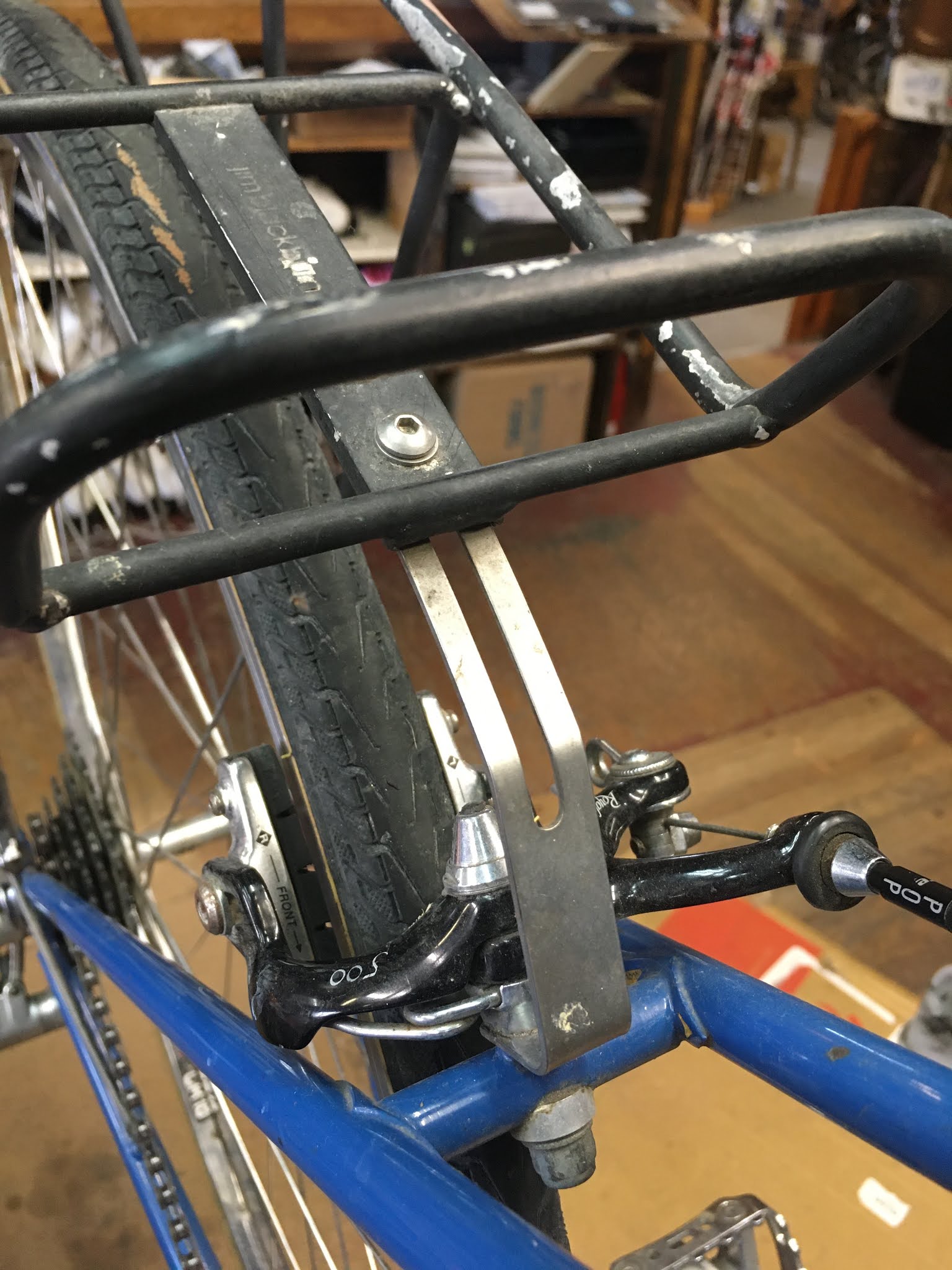
Short rider with small frame complained about her basket dragging on the tire. I remembered that we'd salvaged this little front rack that attaches to the cantilever brake bosses. It actually fit without interference from some other component. Always nice when something works as intended. Advantage to rim brakes.

Here's a rarity: Back when Shimano first entered the rotating shifter market, they actually made changing a cable easy. They soon spotted their error, and the later models are almost impossible to open at all. They love to make puzzle boxes out of their shifters.

And now a reminder of why I hated crank arm dust caps. They almost invariably ended up bonded to the crank arm so thoroughly that they needed to be chiseled out. Or, if you were lucky, one or both of them fell out and disappeared. Good riddance. Especially in the early mountain bike era, anything that stood between you and checking your crank arm bolts was a bad idea. From the late 1980s through much of the 1990s, we replaced an uncounted multitude of left crank arms for riders who hadn't kept up with that vital bit of regular maintenance. The coming of socket-head crank bolts with no dust cap significantly reduced the problem, which freed up the bike industry to devote more attention to creating many other problems for their addicts loyal customers.

While we're in the neighborhood of the crank, this Shimano replacement crank displays a copious application of the pus-like grease that congeals into earwax in early versions of their under-bar pod shifters for mountain bikes.

A little grease on the threads of a crank bolt and under the flange of the head of it is a good idea to help torque it down. But this much grease is way too much. It will get onto the flats of the square tapered bottom bracket axle, compromising the security of the crank arm. Shimano started advising techs to grease the drive side flats of their cartridge BBs in the 1990s during The Great Cheapening, because over-tightening the crank arm against the face of the BB bearings  -- while bad for the crank arm and less secure overall -- helped hold the basically defective design of the bearings in place. While the design of the cartridge BBs has been quietly improved without acknowledging fault, the practice of over-greasing right crank arms remains. Left crank arms -- the ones that fall off more often if bolts aren't properly torqued -- remain completely neglected by them. It falls to individual mechanics to clean up after them and install things correctly to survive for as long as possible in a throwaway society. Do not grease the flats of square tapered bottom bracket axles. Do grease the threads of crank arm bolts. That is all.

A customer attempting to keep a used bike in service brought in his $25 great thrift store find. It was a Schwein mountain bike from the last few moments when Schwinn almost pulled back from the brink of collapse with some decent and well-reviewed machines. The bike he bought was one of the lower-end models, but still a decent platform to fix up and use for a bit of fun cruising and retro trail riding. There was just this mysterious bit of duct tape wrapped around one fork leg...

You may have spotted the guilty secret concealed in a sliver-gray wrapper, but below it is shown fully revealed:

 The fork leg was completely broken. All that held things together was the tape around the outside and the internal parts of the cheap suspension. Silver tape. What can't it do? 

Specialized was kind enough to send us one of the three ebikes we had ordered prepaid back in January. 

What do you think? Do they want me to update the firmware? They have a groovy website where we're supposed to connect with all of the electronic brain stuff. After we updated that interface as directed, the screens we got in the firmware updating process didn't look like the examples in their help and guidance area, and it was never clear whether we had actually succeeded, or if the bike didn't really need it after the hysterical admonitions of the included printed material. 

To compound the annoyance, this expensive machine came in a smudge-attracting matte mint green. Matte finishes are stupid. Light-colored matte finishes are downright sadistic.

The workshop continues to be buried in repairs. El Queso Grande declares that he's never seen anything like it in his almost 50 years in the business. I still wonder if it only seems worse because we can't fill our staffing needs. Leafing through a journal from 2005, when we still had Ralph, I found an entry referring to how buried the workshop was during the early summer rush. EQG likes to go on short conservative rants about the corrosive effects of government generosity and the shabby work ethic of teenagers, but the reason that we can't hire people right now is that they think the work is dirty, complicated, and boring. And they're right. Any youngster thrilled by the new stuff will have no patience for the old stuff. Anyone not thrilled by some aspects of bikes or the bike business won't be lured in by the awesome salary, high prestige, and sex appeal.

 REMEMBER: THIS NEVER HAPPENS

EQG is undefinably agitated by the incentives some employers are offering to entice people to sign on with them. He mentions seeing reports on the news of college tuition incentives, bonuses, and prizes. He rightly asserts that a little place like ours can't compete with inducements like that. But once the novelty of the perqs wears off, you're still left having to do the actual job. And I don't think anyone in our immediate area is offering anything like that anyway.

The young whiz kids are great and all, but a fully functioning bike shop still needs some poor old gray-haired bastard who's pissed away his life at this, and has simply seen a lot of stuff. Or the bike business in general has to cut its ties to its past and leave the maintenance of the derelict hulks still in service to the back street and home garage outfits where someone has the tools and knowledge and can be bothered to use them.

The good news, if you could call it that, is that the pandemic bike boom is already winding down. The lack of bikes to buy has now become widely known, so anyone whose interest was marginal already will be looking for something else to do. Anyone who remains interested still faces a treasure hunt that could yield nothing. No bike means no new participant. It may not be the bike industry's fault exactly, but it's still their loss. Also, with the reopening of many activities and venues that had been unavailable during the height of pandemic restrictions, people are returning to their established preferences as much as possible. Those preferences had verifiably not included biking. With the exception of ebikes, which are really a low level of motor vehicle, the bike industry was not growing, regardless of what the evangelists of mountain biking will tell you.

A low-end ebike will provide more satisfactory performance to a budget-minded customer than a low-end mountain bike will. Neither is a particularly good investment, but the low-end mountain bike is pretty well guaranteed to be beaten into junk within a couple of months of vigorous trail riding. A cheap ebike, with care, might last for years. Thus the two categories belong pretty exclusively to the higher income brackets. It remains to be seen how long higher income brackets will remain viable in the face of all the balancing factors that are increasingly hard to hold back. These include both natural and social forces.

An article I read recently about the social, economic, and environmental impact of mountain biking referred to riders coming not only from the traditional high earning professions, but also from workers in occupations like construction and landscaping. Participation in an expensive activity lasts as long as you are willing to devote your funds to it. The fact that no one disses you for being a dirt worker as long as you can hold your own on the trail does not make the activity egalitarian. Anything with a buy-in of thousands of dollars up front, followed by ongoing consumption costs is not open to all. One section referred to a study that showed that 2/3 of mountain biking tourists in a particular area had annual incomes of $70,000 or greater. Another reference listed average household income as $100,000. You gotta bang a lot of nails and mow a lot of lawns to play in that league. You also can't afford it if you make your living fixing bikes. Not for long, anyway.

Sunday, April 25, 2021

The benefits of neglect and obscurity

 Being forgotten by the technological world for decades was one of the best things to happen to bicycling. The machinery evolved very slowly, which made bicycles a reliable device and a reassuring piece of stability in a changing world.

 When I started paying attention, in the mid 1970s, no one seemed to be clamoring for space-age advancements. Kids born in the 1950s received their bikes as something their parents had received in almost the same form. Some kids born even later received the same actual bikes. My older brother wanted an "English racer" three-speed because our family had been introduced to the works of Arthur Ransome as soon as we were old enough to read. The characters in those books, when they weren't on the water, were likely to be getting around the English countryside on classic black bikes that you could still buy at a shop near you in the 1960s. Much might change in the world, but bikes were your living connection to history. Not only that, they worked perfectly well as personal transportation.

When the "ten speed" came on the scene, it didn't strike me as a wild new concept, only a more advanced existing concept of which I had been previously unaware. It also seemed like risky magic to encourage your chain to jump off the sprockets, after all my years when chains popping off was a greasy nuisance. I was very slow to adopt. However, as with other vices from which I initially shied, I embraced this one emphatically when I was finally corrupted by the right exposure. Indeed, the derailleur had existed in the form we would recognize for almost as long as Arthur Ransome's children's books. Whatever prompted the 1970s bike boom merely thrust it into the American public's eye, somewhat the same way cross-country skiing became the cool new thing around the same time.

Bikes through the 1980s -- meaning mostly road bikes -- had an aesthetic that seemed to span the 20th Century. Steel frames held together with lugged joints might have elaborate curlicues and cutouts or showcase the precision of smooth spear points, but at a distance the general configuration would convey instantly the bike's purpose and connect it to its heritage. By the 1990s, essayists like Maynard Hershon might gripe about its "19th Century" technology, but the stuff still works.

Check out some of the details on this Richard Sachs. The bike's owner is the real deal. She's been touring on it since she bought it new in the early 1980s (or earlier).

These cutouts are on the inside of the fork. 

Downtube friction shifters pull the derailleur across  a five-speed freewheel.

The rear wheel sits in long horizontal dropouts. This allows for all sorts of modifications and improvisations that you can't do with VD (vertical dropouts).


 Check out the original Blackburn rack from when the original Blackburn guy still had anything to do with the original small company by the same name.

Even the saddle is original.

I wore out several Avocet saddles until you couldn't get them anymore. I know she's logged some serious miles, but she probably hasn't crashed as much as I did, and perhaps has a smoother style. Her gearing is realistically low for a load-carrying bike.

The cam on these Gran Compe brakes actually opens up wide enough to get the tire through the brake pads, unlike the token range of much newer -- and not cheap -- offerings here in the dying days of the Age of Rim Brakes.

Old plastic Silca frame pumps tend to crack at the threads. You can repair a minor crack by wrapping the barrel with filament tape. This pump has that repair. I don't know how much she's had to use it in that condition. I finally gave up on mine and got a Lezyne mini pump.

Before the Sachs I had a bike called a Sketchy on the stand. In a color strikingly similar to Surly's "Beef Gravy Brown," which was one of the Cross Check colors around 2011, this bike was apparently a hip item around that time. Made of lighter weight, more upscale tubing, it completely lacks the touches that make the Cross Check such a great basic platform on which to build a wide variety of bikes, such as the above-mentioned long horizontal dropouts. The Sketchy had VD, and shapely but highly inefficient curvaceous chainstays that would completely prevent the use of fenders with plump tires.


What's a nine-letter (two-word) phrase meaning "overrated?"

Until FSA got rid of the needle bearing version of the Orbit UF headset, that was the answer, at a tiny fraction of the cost, to the issues that the CK headset purports to fix. The CKs are serviceable, but what a pain in the ass to get in there, just to have ball bearings  -- albeit in a sealed cartridge -- anyway. Tapered roller bearings were the best for headsets, which is probably why they disappear almost as quickly as they appear when a company offers them. The Orbit UF stayed on the market for several years before they went on the angular contact bandwagon. So they're still a good deal for the price, but not as good a deal.

Despite its unfortunate modernist touches, the Sketchy at least used a steel frame with basically round tubes. The aesthetic is not at all classical. It doesn't look like art, the way lugged frames did. The Cross Check has a welded fame, but the dropouts have a classic shape, and the forks have an external crown that gives them a classic look as well. The Sketchy fork looks like an old suspension bridge tower. It's kind of cool in its way, but it looks heavy.

The bike business seems to be able to support a number of limited-edition boutique builders who do their thing for a while and then move on. As long as they build to fit off-the-shelf componentry, you can keep the frame going almost indefinitely. Whatever it is, if it works for you, it's a good bike. 

This old Manitou fork showed really bold marketing in naming a new model (at the time) for what planned obsolescence would soon turn it into:

As we charge forward into the battery-powered future, a category called "hunting bikes" is on the rise. Camouflaged smokeless mopeds are becoming a popular vehicle for some hunters to use to get into the woods and fields in pursuit of their quarry. Back in the 1990s we had a customer or two who embraced the mountain bike as a silent approach vehicle for hunting, because they were quieter than ATVs and didn't produce stinky exhaust. But you had to be willing and able to pedal. Now a wider range of hunter can take advantage of not only pedal assistance but also pure motor power on some models. They're being sold through hunting and fishing stores, assembled by people who may not have a lot of familiarity with the basics of bike mechanics. Or the customer might have bought it online and had to assemble it themselves. Such was the case with this behemoth:

What have we gained by junking reliable simplicity? I still prepare for hostility and negligence before every time I venture out on the roads. This is true even in a car. Are the few riders retained or recruited by electric motors or enticed by technological ephemera enough to offset the general loss of people who don't grow up with bicycles as a normal part of their life, with the option to continue into adulthood?

Bike categories have forever altered the concept of what is possible under pedal power. Mountain bikes started out as just bikes. Modification piled onto modification in rapid evolution, but it was only the same process by which bicycles had developed from the beginning: largely trial and error. Only when the type was firmly established did the engineers really focus on seriously designing the machines of today.

As for the road, the demand for technology is more driven by fashion than function. Shifting systems since the onset of indexing have increased precision when they work, but also increased the demand for precision in their construction and adjustment. Road riding could still thrive if all of that went away, just as road riding could thrive if disc brakes went away, along with carbon fiber frames and 52 different bottom bracket standards. Mountain biking, on the other hand, is entirely dependent on its suspension technology and gearing systems to make the preferred style of riding possible. Some mavericks might sing the praises of a hardtail versus full suspension, but almost no one -- and perhaps no one at all -- is extolling the virtues of a fully rigid frame and fork. Fully rigid bikes have been relegated to another category, like bikepacking, in which they are still the weirder option, or fat bikes, which have always been a weird option.

Millions of riders logged millions of miles before there were through-axles, disc brakes, electronic shifters, and 1X drivetrains dragging tinfoil chains across 12 cogs (or more) spanning a range from 10 or 11 to 52 teeth. Some things could safely be rolled back and advanced along different lines with only gains for the riding public.

Monday, September 28, 2020

Fifty years of bike technology in a typical day

 This scrappy old street dog is actually only 48 years old, according to its owner, but fifty is a nice round number. And on any day we might see stuff at least that old, or older.

Looking at the Nishiki head tube badge, I didn't notice for a while that the bike was actually "Produced for American Eagle." 


Interestingly, little color accents on the fork blades are German colors, not American. There's nothing red, white, and blue anywhere on this bike, at least not all together in one spot.

Für deutschen adler?

The bike is designed for touring. Lots of people were happy to ride something like this across the continent in the 1970s. The owner said that it came with fenders and a set of lights. He did not keep those, but the bike still has its randonneur handlebars.

Randonneur bars are kind of brilliant. The tops rise from the center and are sometimes swept slightly back. This provides higher hand positions and back angles for the rider, but still mounts to a stem with a negative rise, for better handling overall.

Because the steering axis of a bicycle is not vertical, stem angle changes how the steering feels. The shape of the connection changes how your weight controls the system. A stem that drops forward of the steering axis tends to center itself better than one in which the stem rises above 90 degrees to the steering axis. The steeper the rise, the more noticeable the effect. You can get used to anything, but once you know you can't overlook it. It's very annoying. That's why on so many of my bike builds after the advent of threadless headsets I left the steerer tubes long, piled up the spacers, and mounted stems with an angle of 90 degrees or less.

The bike industry reinvented the randonneur bar, as seen on some Specialized Roubaix models and elsewhere. The newer version has a wing top for more comfortable hand support, and rises more abruptly. They can do this because stems almost all have open clamps to allow for more weirdly-shaped handlebars that no longer have to thread the needle of an old-style single-bolt clamp.

You could really go on a Safari with this bike, or so the name implies.

Double eyelets on the fork would take fender stays and either a front rack or the more common handlebar bag with bungee cord stabilizers that hooked in down at the dropout.

The crank says American Flyer


The rear derailleur was bent. This was repairable in the Dark Ages of friction shifting:

Less repairable was the Suntour freewheel.


 I liked Suntour freewheels, but they had a tendency on occasion to disassemble themselves while you were riding, allowing the innumerable tiny ball bearings to fall out along many yards of highway. You could theoretically purchase replacement ball bearings and spend a meticulous hour putting the freewheel back together, provided that the pawls hadn't also escaped, but more often you would just buy a new freewheel and graunch down on the outer plate that held the whole apparatus together before trusting it. But the failure could be catastrophic. The worst case I saw was on a climb in Northern California, near Rockport. The rider's freewheel on his loaded touring bike came apart and cracked the flange of his nice Campagnolo Record hub. He and his riding companion had to camp on the side of the road for the night and hitchhike back to the nearest bike shop the next day, to get a wheel and freewheel so that they could resume their northward journey.

Time traveling forward to the present, the 21st Century is represented by this tubeless road wheel:

Tubeless tires for bikes barely make the slightest bit of sense for mountain bikers who could be riding on serrated ledges and over a certain size of angular stones while running fashionably low pressures, but even there I hear them lament that they burped a tire on one of those hazards and ended up with a flat tire anyway, often harder to reinflate in the field than a stupid old inner tube would have been. Your magic juice can leak out, making a seal to the rim difficult or impossible to attain. This is why tubeless riders carry a tube with them.

Setting up a rim and tire for high road pressures really highlights the absurdity of applying the latest fad to every category of bicycling. Road pressures severely challenge the sealing technology that evolved at very low off-road pressures. The process makes gluing tubulars look almost casual.

Gluing tubulars is potentially very messy, but at least you can see what you're doing. Move deliberately and methodically and you will succeed. 

Mounting road tubeless puts you at the mercy of microscopic discrepancies that somehow manage to be immune to the properties of the drippy sealant you have to pour into the casing. The setup shown in the picture, on the first attempt, was okay up to about 60 psi. It would not hold anything above that, no matter how I waved the wheel around to distribute the sealant. It was leaking into the rim somewhere. 

The original stem looked cool, but the rubber seal area at the base of it was rectangular, meaning that it covered less rim along one dimension than the other. Also, the rim tape had not bonded well enough, even though that was hard to judge by looking. I replaced the stem and peeled the tape, deep-cleaned the rim with alcohol, and then baked the wheel in the convection oven we use to heat-treat skis for glide waxing, to dry it absolutely thoroughly. That seemed to do the trick. The tire settled in at 90-100 psi and held it to the end of that day. I declared victory and called the customer. He said someone would be in to pick it up for him. My work week ended, and I left for three days.

When I returned to the shop, the bike was still hanging there. I pinched the front tire. It had gone down to squeezably soft. I reinflated it and heard hissing into the rim. Resisting an urge to take a fire ax to the goddam thing, I tried tightening the lock nut at the base of the stem. The hissing worsened. I removed the groovy plastic shim included with the wheel and went straight for lock nut against rim. Before tightening that, I removed the lock nut and pushed the stem into the rim so I could inject sealant around it to coat the base of it. Then I tightened the stem, re-seated the beads, and inflated the tire. It eventually seemed to hold quietly. I had barely walked away from this when the customer's father came in to get the bike. I said nothing to him or to El Queso Grande, who was handling the transaction. The tire was rock hard and seemed ready to ride, but I guarantee it will be back within a day or two. I can decide then whether to go for the tire levers or the fire ax.

The tubeless department had been getting a little chaotic, so I found a bigger receptacle for our tubeless paraphernalia.

The three-speed that this rim tape came out of may have been much older than fifty years.

I could barely make out some inscriptions in Aramaic on these scroll fragments.

A smokeless moped with a flat tire provided official acknowledgment that ebikes are mopeds:


An old Cannondale showcases the destructive interaction of human sweat and aluminum:

When I attempted to coax a stuck ferrule out of the cable stop on the frame, the stop popped off instead, because the aluminum was so oxidized. The deterioration is eating into the frame itself.

The frame also has some nasty dents from chain suck. It is now destined to be recycled into beer cans. Cheers!

The parts shortage this season led us to farm old inner tubes when common sizes went out of stock and would vanish instantly from suppliers' shelves when they became available again.


On to the next thing: This visiting rider said that he was having a heck of a time getting his gears to stay adjusted. At first he focused our attention on the front derailleur, because it's one of those Shimano models where you have to follow a six-page PDF of instructions to hook up the cable and set the tension. Eventually, though, he also mentioned that the rear shifting was incorrigible, too. Shimano's higher end mechanical shifting systems seem designed primarily to make people want electronic shifters.

The bike wins the award for Worst Internal Cable Routing, but that's a highly competitive category. I don't expect this entry to hold the crown for long.

The bike had those crappy brown-coated cables that get abraded almost immediately. Cable fuzz causes drag, especially inside the standard undersized 4mm shift housing.


This bike did have a full cover over the bottom bracket cable guides, protecting against a major entry point for dirt and water in internally-routed cable systems. The hatch cover was full of carbon dust from the cables abrading the cable guides, and a thick dusting of cable fuzz that had worn off of the wires themselves. 

Step one is always to yank out the brown cables and get some 1.1mm stainless wires in there. Step two is often to replace the housing with 5mm if the frame will allow. But when I was trying to thread the new cables I discovered that he had a bigger problem than cable fuzz and skinny housing.

The problem turned out to be the cable stop on the top tube, where the shift wires enter the frame for their dark journey through the mysterious interior.

 
That little doohickey inside the tube is supposed to be on top of the tube. It managed to fall inside, but would not come back out the same way. I had to remove the fork, which fortunately gave me access to the inside of the top tube. 

If you own a bike like this, expect to fork out a lot for repairs.
 
Someone had wrapped Teflon tape around the cable stop to try to wedge it into the hole in the top tube, but that merely reduced the width of the flange that is supposed to keep the stop from dropping in. I peeled the tape away, and reduced the size of the opening from the back edge, where the stop has a longer flange, to enhance the overlap of the narrower flange across the front. It was a bit of a hack job, but much of what we do is meatball surgery for riders who not only need a bike repair, but have limited time. This is bike service in a resort town.

We do have our year-round residents. I believe the doting Dad who wanted us to change the grip-style shifter on his daughter's 24-inch mountain bike to a trigger-style shifter endures the winters with us and doesn't just cherry-pick the summers.

The close-reach kid levers on the brakes don't leave a lot of room for the index-finger lever of the shifter pod.

Finger trap made in China.

Fortunately, kid fingers are small enough to work in the space available, and the pivot of the brake lever keeps it from pinching down on the upshifting finger. A larger lever, shut down to accommodate the daughter's diminutive digits, would end up just as close.

Two department store bikes came in at separate times for separate things and I noticed these helpful stickers on the fork:

We have frequently seen cheaper bikes with the forks mounted backwards, either by the owner or by a disinterested grunt at a big box store who was numbing his way through the assemblies for a management and clientele that don't know the difference. This sticker may help to reduce the frequency of that error.

After a brief hiatus immediately after Labor Day, repairs have picked up again, though not to the flooding volume of spring and summer. And many of the problems continue to be weird and time consuming on top of the lottery odds of finding parts that you need.