Showing posts with label practicality. Show all posts

Tuesday, May 30, 2023

The Overhead Paradox

Customers will say that a high repair estimate is more than they paid for their bike. This implies that the bike is not worth fixing. But if you bought a good bike and took good care of it, it should last you fifteen, twenty years or more. If you have been paying someone else to work on it, of course you will end up paying more in service than you paid for the bike originally. But, given the general deterioration in quality and a rate of price inflation that has been romping merrily past the general consumer inflation rate since long before it was fashionable to bitch about it, the bike you buy for the same number of now-inflated dollars will be absolute trash compared to your old bike.

The exception, of course, is if your old bike was trash in the first place. The real trash tends to take itself out of the running just by wearing out completely, or dying of exposure as it's dumped out in the weather. But even a modest bike is worth fixing if you like it and it meets your needs.

Our first impulse at the shop is to figure out how to fix whatever anyone brings in. We've learned over the years to identify the few that can't be made good because they never were good, but anything with a shred of quality triggers the impulse to bring it back. Unfortunately, the shop itself costs a certain amount to run. I guarantee you that I see a tiny fraction of our hourly labor charge, but the rest of it goes to the keep the whole business solvent. More or less solvent, anyway. We have overhead. This leads to the paradox. A well established bike shop provides a meager living to a technician smart enough to do the work and stupid enough to keep doing it for a long time. Experience lives here. We've accumulated tools and parts so that we can work on anything back to about the 1950s, but we're still in the game, so we have co-evolved to deal with the whole time line through the decades to the ridiculously over-engineered bullshit of today. 

The ideal bike mechanic is also a highly skilled machinist, like my friend and mentor in Florida. She grew up in a machine shop and did time in retail bike shops in the Orlando area. She and her late husband set up a machine shop at their own home and withdrew from the retail scene. This meant that they could offer all kinds of specialty services without the overhead of a store front. Shops in the area still use her as a resource for the jobs that would tie up a work stand for too long and call for skills that the average transitory young bike mechanic will never even have known about.

I am not a skilled machinist. I grew up moving constantly, reading books and wondering what it would be like to live in one place long enough to have roots. We were not going to have a Bridgeport, a band saw, lathes, and other heavy, stationary tools in the garage. And my father was an officer, the military equivalent of white collar management. We were herded toward careers with cleaner fingernails. I was not a tinkerer. We engaged in some tool use, but only to repair or refurbish something we owned, not just for the sake of working on it. This mostly meant paint and planking on a wooden sailing dinghy more than working with metal and grease and oil. My gateway to mechanics was the used 10-speed I bought in 1975. It held no secrets, wearing its drive train on the outside.

I like classic bikes because they don't require a lot of work. The type evolved through the 1990s, gaining some actual improvements even as the technofascist complexities came to dominate. If I think about it long enough I can pinpoint the last change that really was an improvement. Probably interrupter brake levers. Just about everything since the early years of the 21st Century has been mostly either to make a previous bad decision work a little less badly or a classic example of "just because you can doesn't mean you should."

The overhead paradox mostly affects owners of older bikes and cheaper bikes. I've had customers go ahead with an expensive repair even after I told them it was a poor investment, because they had some attachment to the bike. I've had customers abandon a decent candidate for repair because they didn't want to spend the money on it, preferring in some cases to buy a new bike of lower quality just because it was new.

Most new bikes today have some form of the same features at every price point. Cheap bikes have flimsy derailleurs, stamped sheet metal chain rings, way off brand cable disc brakes, and heavy, floppy suspension. Bikes that still have rim brakes might have stamped sheet metal brake arms that shouldn't even be legal. To get reasonably robust examples of the modern idea of componentry, count on spending more than $1,000.00. If you're really going to try to ride like you see in the videos, spend more than twice that. Working on any of that will take time and require treasure hunts for parts, but less of the old-school skills that will die with my generation. And how much does it really matter when civilization itself may coincidentally die about the time my generation does anyway? The Baby Boomers lived as if they would be the last generation to need the Earth's resources, and it's looking like a self-fulfilling prophecy. Sure, other generations have followed and reproduced copiously, while guzzling a large share of what's left, but the Boomers set the tone in the 1980s. The values have been passed down long after they should have been replaced with more thoughtful progress.

Meanwhile, we're still here, and riders are bringing in beloved old steeds in need. One rider brought in his old Puch road bike from the 1970s.

                                                     It was 100 years 50 years ago
He's been riding it more or less like a "gravel bike." It will do it, because the roadier end of gravel bike geometry is basically like a general purpose touring bike from the 1970s: a little slack, a little long, with room for a somewhat plump tire. Of course the modern form has evolved into more specific geometry suited to loose surfaces, allowing for wider tires, and designed around the current ridiculous 1X drivetrains. But his old rod would do what he wanted for far, far less than a new bike with modern problems. I put on interrupter brake levers and aero primary levers, along with 27X1 3/8 knobby tires. Off he went, happy with the improvements.

On Sunday, I volunteered at the Makers Mill, a community "makerspace" that hopes eventually to offer a work space for community members to make and repair things. They offer classes in various skills ranging from textiles to woodworking to welding to jewelry making, as well as art classes. I helped them a little with their initial planning for the bike work area. With all of the YouTube experts in town who smugly avoid our shop, I figured that there was a deep pool of expertise waiting to bury them in helpful mechanics. Turns out that those people are apparently too busy elsewhere.

The problem with something that inexperienced people think is really simple is that they meet someone who knows a little about it and they assume that's all there is to know. Thus the person who knows a little must know more than enough. Volunteer organizations are staffed by whoever is willing to show up on a regular basis. Who has the time and the desire? That's who will be there. I am not the one with the most time. But I have been there enough to rip the lid off of the crypt of horrors that is the true depth of arcane bike knowledge. And they have hardly seen any of the really demonic new crap.

Late in the afternoon on Sunday, the owner of the Puch arrived at the Mill, hoping that we could snug up his brakes (I had had to fabricate cable knarps to make new bridge wires for his vintage Weinmann center-pulls)

The brake adjustment was simple enough. And oh, by the way, his seatpost seemed to be kind of stuck.

I had not messed with his seat position when I worked on the bike before. I clamped it in the work stand around the seat tube of the frame itself, suspecting that the OEM seatpost was probably too short to extend far enough to hold the work stand clamp anyway. I had not determined that the post was rusted into the frame, but the news did not surprise me. I might even have dripped a little penetrating oil down along it so that he could try to dislodge it later. 

Later had now arrived. I had advised him to go after the seatpost with a pipe wrench and not worry about destroying it. He'd chewed into it, but had not moved it. These struggles don't usually end well for the seatpost. We crushed this one in a big vise as we tried to twist it loose. Then we sawed off the protruding part before attacking what remained in the seat tube.

Stuck seatpost removal is always like trying to dig your way out of a jail cell with the handle of a spoon you stole from the dining hall. It's a grim, long process of scraping. We enlisted the Mill's machinist, but he's not a bike guy. I provided some guardrails to protect vulnerable parts of the bike while he addressed the generic problem of an aluminum tube stuck inside a steel tube, cemented by rust. We were hampered by the fact that the machine shop there has mostly a motley assortment of donated tools with lots of duplications of things that were not the right size for the job at hand. We managed to cut down and chisel away some of it, but more remained beyond the reach of the tools we had. The machinist took the frame to his home lair where he will work on it with his more extensive resources.

Because the Sunday event was free, the owner of the bike was not paying for the two or three people working for almost two hours on his soluble but time-consuming problem. Thus we sidestepped the overhead paradox. The cost was borne by the volunteers working for free. I did get some food and social credit for it, and I was happy to help keep a worthy old bike on the road, but I would starve to death if I did it all the time.

Used bikes can be great if you know what you're looking at. Prices fluctuate depending on demand. A seller who knows what they have, dealing with a buyer who accurately assesses the bike's value, are liable to settle on a higher price than if a generic scavenger just sells it as "a bike" to some random rube. But even then, the buyer might be a hard chiseler who doesn't know the value, but is determined to hold down the price, or a knowledgeable enthusiast who is also determined to hold down the price. Or the generic scavenger might have an inflated idea of the price, aided by a time in which used bike prices are running high, like in the demand surge of 2020.

The overhead paradox affects modern stuff as well. We had a jammed 11-speed pod shifter that I might have unjammed, given enough time, but a new pod cost less than my time. New shifter pods for seven speeds and up cost about as much as we charge to open up an old pod and clean out the congealed grease, which is usually all that is wrong with them. But the procedure takes longer than yanking the old pod off and slapping in a new one, so when the shop is buried it's a better option if we have the part in stock. The unfortunate consequence is that a fixable shifter pod goes to the landfill. The small businesses at the bottom of the economy end up bearing the major responsibility for stemming the avalanche of waste getting dumped into the environment. The bicycle industry doesn't support the activity of bicycling, it supports itself. Bicycling is just a side effect.

For the moment, we're too dumb to quit trying to fix things that people want fixed, but upper management can no longer ignore the mounting costs. We have no handy off-site magician like my friend in Orlando, but we can't afford to be that magician as much as we used to. I have a lot of tools at my own secret headquarters, but the shop still has a few more tricks that I haven't invested in, and I don't want to burn too many of my days off doing what I do on my days on. I would much rather teach skills (and a jaundiced attitude toward tech-weenie bullshit) than be a servant to the willfully ignorant. The owner of the bike should make at least part of the journey with me. At the end of it, they should come out more independent than when they started. If I can learn this crap, anyone can, but knowing it does make you more valuable. No, any idiot can't just do it, but any regular person can learn it if they can bring themselves to focus on it. The citizen rider becomes the citizen mechanic and a freer person as a result.

Monday, November 01, 2021

Trailbuilding as commercial art

 Our energetic trail builder has a creative past, with forays into music and design. His other traits, which sustained him through a hitch in the Coast Guard and other adventurous occupations, also include considerable organizational ability if the subject interests him in some way. Thus his career has included a lot that was not overtly artistic. But an artistic sensibility shapes his actions rather than mere soulless athleticism or mercenary pursuit of maximum monetary gain.

While the trails are built to technical standards using proven designs, lines have to be chosen based on observation of the local terrain. Mountain biking is unnatural, and a consumerist activity, but its environmental impact is low because the features have to coexist with the natural forces at work on them. And animals like finding easy passageways through the vegetation, as any trail builder soon sees. Ancestral routes often used game trails, as humans evolved from slightly removed to dangerously removed from the natural order of things. Game uses human corridors now, as well as their own herd paths. Nature just keeps going on as best it can, in spite of or in step with human activities.

Art, in cultures that don't make it central and therefore don't understand it, is presented as touchy-feely, and the province of flakes, charlatans, and generally impractical people. This is a disservice both to art and to the generations of young people who eschew practicality if they feel an attraction to their imagined world of art. Art needs to be presented as a practical subject and used not just to develop powers of observation, but to address in the same way that reading, writing, and arithmetic are addressed, the basic skills of construction that go into creating a work of art. Don't wait for expressed interest. Just put it out there and see who runs with it.

Maybe they're doing that now, but they weren't doing it when I was a kid. Art classes dealt with important things like perspective and composition, but didn't get into the actual handling of the tools. And art was an elective, so you had to decide -- before you were old enough to know how much it might matter to you -- to ask for it.

One book I read around 1979-1980, as I was first trying to launch a career drawing pictures and writing stories, stressed the fact that an artist can benefit significantly from being businesslike, and that artists through history had done so, although exceptions abound among the famous names whose birth and death dates turn out to be depressingly close together. A lot depends on luck. I don't mean the luck of finding work and getting compensated for it. I mean the luck of having innate personality traits that aid a person's curiosity in finding the right questions to ask. Nature and nurture come together to shape a young person.

The trail builder's crew commands a decent price, but it's not going to propel any of them to fortunes. They take pride in their skill and in their product, born largely of experience as riders, even if some of them have aged out of the most risky maneuvers. It's art, but commercial art. It's a kinetic sculpture that the viewer enters and forms a part of. It's more than that, of  course. But it's all inspired by creativity and expression through movement.

Sunday, April 25, 2021

The benefits of neglect and obscurity

 Being forgotten by the technological world for decades was one of the best things to happen to bicycling. The machinery evolved very slowly, which made bicycles a reliable device and a reassuring piece of stability in a changing world.

 When I started paying attention, in the mid 1970s, no one seemed to be clamoring for space-age advancements. Kids born in the 1950s received their bikes as something their parents had received in almost the same form. Some kids born even later received the same actual bikes. My older brother wanted an "English racer" three-speed because our family had been introduced to the works of Arthur Ransome as soon as we were old enough to read. The characters in those books, when they weren't on the water, were likely to be getting around the English countryside on classic black bikes that you could still buy at a shop near you in the 1960s. Much might change in the world, but bikes were your living connection to history. Not only that, they worked perfectly well as personal transportation.

When the "ten speed" came on the scene, it didn't strike me as a wild new concept, only a more advanced existing concept of which I had been previously unaware. It also seemed like risky magic to encourage your chain to jump off the sprockets, after all my years when chains popping off was a greasy nuisance. I was very slow to adopt. However, as with other vices from which I initially shied, I embraced this one emphatically when I was finally corrupted by the right exposure. Indeed, the derailleur had existed in the form we would recognize for almost as long as Arthur Ransome's children's books. Whatever prompted the 1970s bike boom merely thrust it into the American public's eye, somewhat the same way cross-country skiing became the cool new thing around the same time.

Bikes through the 1980s -- meaning mostly road bikes -- had an aesthetic that seemed to span the 20th Century. Steel frames held together with lugged joints might have elaborate curlicues and cutouts or showcase the precision of smooth spear points, but at a distance the general configuration would convey instantly the bike's purpose and connect it to its heritage. By the 1990s, essayists like Maynard Hershon might gripe about its "19th Century" technology, but the stuff still works.

Check out some of the details on this Richard Sachs. The bike's owner is the real deal. She's been touring on it since she bought it new in the early 1980s (or earlier).

These cutouts are on the inside of the fork. 

Downtube friction shifters pull the derailleur across  a five-speed freewheel.

The rear wheel sits in long horizontal dropouts. This allows for all sorts of modifications and improvisations that you can't do with VD (vertical dropouts).


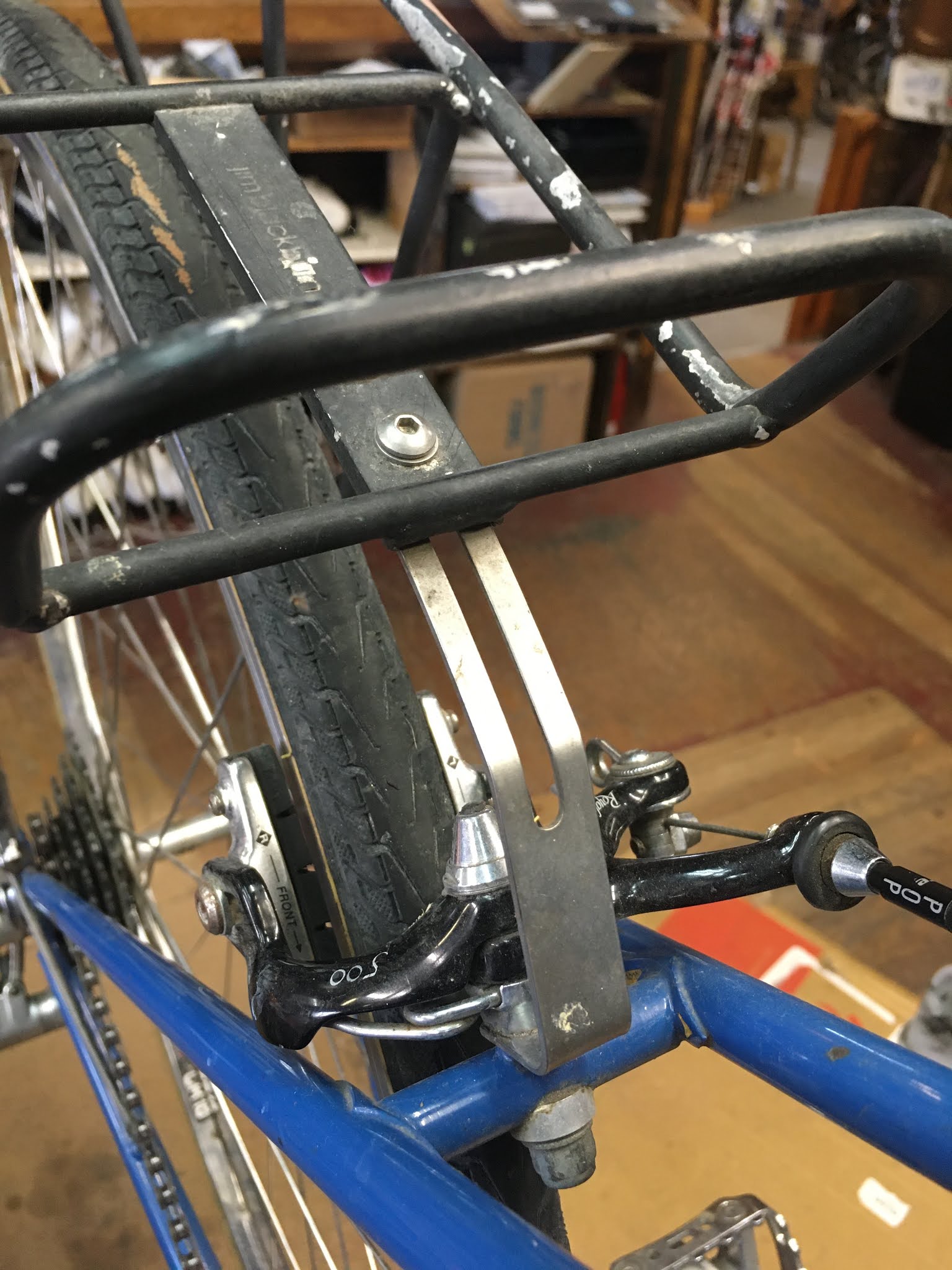
 Check out the original Blackburn rack from when the original Blackburn guy still had anything to do with the original small company by the same name.

Even the saddle is original.

I wore out several Avocet saddles until you couldn't get them anymore. I know she's logged some serious miles, but she probably hasn't crashed as much as I did, and perhaps has a smoother style. Her gearing is realistically low for a load-carrying bike.

The cam on these Gran Compe brakes actually opens up wide enough to get the tire through the brake pads, unlike the token range of much newer -- and not cheap -- offerings here in the dying days of the Age of Rim Brakes.

Old plastic Silca frame pumps tend to crack at the threads. You can repair a minor crack by wrapping the barrel with filament tape. This pump has that repair. I don't know how much she's had to use it in that condition. I finally gave up on mine and got a Lezyne mini pump.

Before the Sachs I had a bike called a Sketchy on the stand. In a color strikingly similar to Surly's "Beef Gravy Brown," which was one of the Cross Check colors around 2011, this bike was apparently a hip item around that time. Made of lighter weight, more upscale tubing, it completely lacks the touches that make the Cross Check such a great basic platform on which to build a wide variety of bikes, such as the above-mentioned long horizontal dropouts. The Sketchy had VD, and shapely but highly inefficient curvaceous chainstays that would completely prevent the use of fenders with plump tires.


What's a nine-letter (two-word) phrase meaning "overrated?"

Until FSA got rid of the needle bearing version of the Orbit UF headset, that was the answer, at a tiny fraction of the cost, to the issues that the CK headset purports to fix. The CKs are serviceable, but what a pain in the ass to get in there, just to have ball bearings  -- albeit in a sealed cartridge -- anyway. Tapered roller bearings were the best for headsets, which is probably why they disappear almost as quickly as they appear when a company offers them. The Orbit UF stayed on the market for several years before they went on the angular contact bandwagon. So they're still a good deal for the price, but not as good a deal.

Despite its unfortunate modernist touches, the Sketchy at least used a steel frame with basically round tubes. The aesthetic is not at all classical. It doesn't look like art, the way lugged frames did. The Cross Check has a welded fame, but the dropouts have a classic shape, and the forks have an external crown that gives them a classic look as well. The Sketchy fork looks like an old suspension bridge tower. It's kind of cool in its way, but it looks heavy.

The bike business seems to be able to support a number of limited-edition boutique builders who do their thing for a while and then move on. As long as they build to fit off-the-shelf componentry, you can keep the frame going almost indefinitely. Whatever it is, if it works for you, it's a good bike. 

This old Manitou fork showed really bold marketing in naming a new model (at the time) for what planned obsolescence would soon turn it into:

As we charge forward into the battery-powered future, a category called "hunting bikes" is on the rise. Camouflaged smokeless mopeds are becoming a popular vehicle for some hunters to use to get into the woods and fields in pursuit of their quarry. Back in the 1990s we had a customer or two who embraced the mountain bike as a silent approach vehicle for hunting, because they were quieter than ATVs and didn't produce stinky exhaust. But you had to be willing and able to pedal. Now a wider range of hunter can take advantage of not only pedal assistance but also pure motor power on some models. They're being sold through hunting and fishing stores, assembled by people who may not have a lot of familiarity with the basics of bike mechanics. Or the customer might have bought it online and had to assemble it themselves. Such was the case with this behemoth:

What have we gained by junking reliable simplicity? I still prepare for hostility and negligence before every time I venture out on the roads. This is true even in a car. Are the few riders retained or recruited by electric motors or enticed by technological ephemera enough to offset the general loss of people who don't grow up with bicycles as a normal part of their life, with the option to continue into adulthood?

Bike categories have forever altered the concept of what is possible under pedal power. Mountain bikes started out as just bikes. Modification piled onto modification in rapid evolution, but it was only the same process by which bicycles had developed from the beginning: largely trial and error. Only when the type was firmly established did the engineers really focus on seriously designing the machines of today.

As for the road, the demand for technology is more driven by fashion than function. Shifting systems since the onset of indexing have increased precision when they work, but also increased the demand for precision in their construction and adjustment. Road riding could still thrive if all of that went away, just as road riding could thrive if disc brakes went away, along with carbon fiber frames and 52 different bottom bracket standards. Mountain biking, on the other hand, is entirely dependent on its suspension technology and gearing systems to make the preferred style of riding possible. Some mavericks might sing the praises of a hardtail versus full suspension, but almost no one -- and perhaps no one at all -- is extolling the virtues of a fully rigid frame and fork. Fully rigid bikes have been relegated to another category, like bikepacking, in which they are still the weirder option, or fat bikes, which have always been a weird option.

Millions of riders logged millions of miles before there were through-axles, disc brakes, electronic shifters, and 1X drivetrains dragging tinfoil chains across 12 cogs (or more) spanning a range from 10 or 11 to 52 teeth. Some things could safely be rolled back and advanced along different lines with only gains for the riding public.

Monday, March 18, 2019

Extravagance

One question has been at the back or the middle of my mind since the 1970s: What is the morally justifiable average lifestyle worldwide? Given that we keep lining up more people to consume pieces of the Earth pie, the slices have gotten steadily smaller.

Technology has helped us somewhat in the past, but never as much as we thought. It was easy to accept creature comforts and entertaining diversions affordably marketed in your technologically advanced society, and take a soft-focused view of those other countries where people still lived in more primitive circumstances. What did we owe them? Not much. And that may be true by some measures. Some genuinely primitive tribes famously repel attempts by modernists to come in and upset their balanced lives. In other cases, the locals would welcome a bit more in the way of comfort and respect.

From primitive to modern is another continuum. Unfortunately, once you accept some technology, you rely on whatever spawned it, and you will feel pressure to go further, even if you were satisfied at the previous level. And our technology has failed to make us better people, even though it hasn't really made us worse. Except that it has, in the critical sense that it makes us more voracious consumers of resources, while numbing us to the awareness of that fact.

A lot of technology uses resources more efficiently, reducing waste. But a growing population in developed nations consumes more resources in basic lifestyle amenities than a smaller, more stable population living off of more direct use of natural resources: hunting and gathering, and small-scale agriculture.

If I had to live at a primitive level, I would definitely do it where I didn't have to wear wool next to the skin. I'd be down in loincloth territory, preferably near some nice beaches, too.

When I got into bikes, and later into the bike business, I considered it a benign use of technology, infinitely expandable without negative consequences. Any number can play, and it only makes things better. It was true then, and it's still true, of basic cycling and a limited amount of recreational riding. Bicycling as it is practiced today has moved away from that. It is now an extravagance of the developed world, fed by glossy magazines, up-to-date websites, social media, and partnerships with other consumer pleasures, like beer and coffee.

Beer and coffee are food groups. My perfect world includes them. Even in primitive cultures, most of them have developed some kind of recreational beverages. I'll defend that one. But the performance side of bike culture has become increasingly resource-intensive, not just in its use of materials and substances to make a functional modern bike, but in the demand on riders to be able to afford it. What do you have to do for a living to generate enough income to spend it on each of the expensive category bikes you will need to fully enjoy "cycling?"

Some economist will point out that prices adjusted for inflation end up coming out the same as, or lower than, prices for what passed for performance equipment in decades past. Pick your decade. There's an economic index to show that things are no worse now. The critical difference is not the up-front cost of equipment, it's the cost of properly maintaining that equipment in all of its complexity. You'll go through a lot of tire sealant, brake fluid, cartridge bearings, and shock oil if you follow the instructions that came in all of the owner's manuals you got with your new bike. Parts you wear out, like chains, cassettes, and tires, are all more expensive, and the chains and cassettes are more prone to wear because there is less metal in links and cogs. And I defy an economist to tell me that a $45 dollar chain today is equivalent to a $9 Sedisport chain from 1982. As of 2018, the inflated price of a $10 chain would be just over $26.  I added a buck because the price of the Sedisport did creep upward gradually during its long and glorious reign as the best deal in the chain industry.

You can say that the Sedisport only worked on the drive trains of the time, but the same width chain works from six cogs on up through eight. I could piece together a Sedisport from old links in my chain stash and run it on any of my bikes today. Along with price inflation comes the reduction in versatility, and the decreased service life of the crowded drive trains of today.

Years ago, on a group road ride, we were discussing Shimano's new STI road shifting. Several of the riders had leaped to adopt that innovation. "If you truly love cycling, you'll pay whatever it costs to participate," one rider asserted.

"If you truly love cycling, you won't need gimmicky modern bullshit to enjoy it," I replied.

Racing is another matter. Racing is an arms race. You need equipment equivalent to the weaponry your competitors will be using. Racing equipment has one job: increase your efficiency in tight competition with other riders whose only goal is to keep you from winning. Maybe they're working to help a teammate. Maybe they are the aspiring champion who wants to cross the line first, with arms upraised. It's a series of short term goals embedded in the long term goal of a successful racing season.

We who pedal fall into the trap of comparing our activities to worse activities: "It's better than tearing around on ATVs. It's not as bad as street racing little sports cars and hot rods." And so on. Cycling used to be able to say that it was not only not as bad, it was definitely an improvement on wasteful and polluting forms of transportation and recreation. Human powered recreation in general is much better for our species and our world. But resistance is strong. Persuasion is difficult. There's a long list of things you can't say, or ways you can't say the things you might dare to express. This is why real social progress is so agonizingly gradual. We meander and sidle and murmur and nudge, getting basically nowhere until grievances erupt into an outright war. The smoke and flame and blood spatter from that ends up obscuring a lot of what we were fighting about in the first place. The mere end of hostilities is such a relief that we call it good. Perhaps slightly improved after the experience, we go back to our previous piecemeal advancement of the things that really weren't solved at all by the orgy of violence.

The mountain bike boom was started by idealistic bike nerds who had stayed on after the road bike boom faded out. We all kept hoping that the hints of social acceptance in things like the movies Breaking Away, American Flyers, and Quicksilver indicated a growing public understanding of our worthy goals. Bikes even got a nod from Doonesbury:


Of course mellowness fell out of favor during the early 1980s, and militarism regained popularity. It was easy to back a strong military when no one was required to join it. The volunteer force was already evolving into a separate warrior caste, while the general public could enjoy the Hollywood portrayal of our brave fighters in comfort and safety.

As mountain biking evolved through the 1990s, police departments adopted bike patrols, usually on modified versions of the simple and versatile mountain bike platform. Some jurisdictions have actually continued the practice. There was even a television show about bike cops. It was done on the Baywatch format, right down to the California setting. It did little to advance transportation cycling or bolster the longevity of the bike patrol concept. The average citizen's sense of safety and desire to try riding on the public streets has steadily eroded even as the average price of a bike has steadily risen.

Bike advocacy does advance. We make incremental improvements even as the need to make massive adjustments grows more urgent. It's better than nothing, in the same way that a single cotton ball stuffed into an arterial wound is something. We could save the situation if we had enough balls.

Tuesday, September 05, 2017

Fixing the unfixable

As I was picking congealed grease out of a Shimano Rapidfire shifter pod dating from about 1991,
I actually appreciated how solidly it was made, and how reliably it worked compared to its temperamental descendants. Early versions of a product, even one with lots of conceptual flaws, will be made much better than later versions, because the promoter doesn't want it to self destruct before establishing itself among the uninformed as a solid product. Only then do the manufacturers start watering it down to increase profits.

I hated the underlying concept, and still do. Shimano announced Rapidfire in a triumphant video that they sent out to shops before the 1990 season. We watched our copy in horror, anticipating in full detail the hell that it would unleash on mechanics and riders. We could do nothing to stop it, despite my best subversive efforts. It included the admonition that there was nothing we could fix inside these pods, so don't even try. Word in the cycling press was that intrepid mechanics had disassembled brand new units and reassembled them exactly as they had been, and they mysteriously failed to function. Whether this was true or was disinformation planted by Shimano I never found out. It implied that there was some magic Shinto pixie dust inside these units that would fall out if barbarians profaned the interior.

I plastered these cartoons all over Interbike's Philadelphia show for a couple of years:


It was, of course, to no avail. The technofascists won, leading the technolemmings off of cliff after cliff. But I digress.

The 1991 pod clicks solidly into gear as soon as you flush out the pus that they used for grease. It congeals into a substance we call earwax. My colleague Ralph came up with that one. He was an excellent wrench who was smart enough to get out of the business. It's been bad for his waistline, but probably good for his bottom line, to pursue his interest in computers instead of the 19th Century technology of the bicycle, dolled up with 21st Century materials as it is today.

When hackers and their malware finally make the Internet untenable, bicycles will be waiting to receive the refugees of the Digital Age.

Back to the pod from '91: it felt weird to have so few clicks. I've had to clean out many later versions, chasing more gears, so an original six-speed feels very short. But the wider spacing with fewer stops provides more margin for error. Cable tension has to be relatively accurate, but not neurosurgically precise.

Within a couple of years, the Japanese Buggernaut had enclosed the pods more completely and nearly doubled the number of parts inside. This made them less vulnerable to invading grit and mud, and generally more reliable. It also concealed the insidious activities of earwax under a Darth Vader-like black mask.

In the 1990s, the bike industry, led by Shimano, used the customers mercilessly as test pilots. You might expect such shenanigans from small companies making boutique componentry, but you saw more of it from the big players with lots of leverage. You see it today as manufacturers hump their customers in vulnerable "enthusiast" categories with model year changes intended to make addicts want another hit. There are no white hats in the big componentry business. With the coming of the Electrical Age, batteries are all the rage in everything one might electrify.

Honestly, how did any of us survive the 1970s and '80s on the paleolithic crap we had to ride? In his book, Four Against the Arctic, author David Roberts told the story of four Russian hunters in the 18th Century who survived on an island near Svalbard for six years before being rescued. He and other members of his research team observed that people from a later time, less inured to routine hardship, probably would not have survived. Indeed, look how many perished on Arctic exploration trips when their technological cocoon ripped, dumping them into the elements where Inuit survived and thrived.

We're not Arctic explorers, but we are certainly allowing ourselves to be increasingly isolated and softened by accepting more and more technological intermediaries between us and the realities of the tasks we choose to tackle. Some of these can enhance safety and functionality, but an awful lot, particularly in cycling, pander to riders in search of marginal gains at more than marginal increases in cost, and drive perfectly functional older stuff underground.

Would I miss my outlaw bravado if the stuff I use was totally mainstream? Against what would I rebel in Biketopia, with beautiful routes and intermodal interfaces everywhere? Why don't we build it and find out?

Monday, August 08, 2016

Put a fork in it...it's done

A friend had a mid-1990s Iron Horse with a blown-out Marzocchi fork. After brief consideration of rebuilding or replacing the suspension fork, he went for a basic rigid fork.

Step one: prepare the mechanic.


The frame has some classic 1990s bullshit frame details


"Innovation" was the word of the decade. Setting aside the innovations that were actually from the 1890s, there was a lot of weird looking stuff marketed as technical advancement. Before the suspension revolution obliterated the old world, mountain bikes were a lot like any bike. They started out as beater bikes, after all. So the facade of innovation was decorated with tweaks to the traditional diamond frame, some of which did enhance strength and performance. Others either did nothing or were outright wrong turns. In any case, their days were numbered, as the spring-and-linkage crowd worked in their secret labs on the new species that would change the sport forever.

With a fork in it, it's done.


The new mountain bikes can take more pounding and eat up gnarlier terrain, at the cost of more moving parts and more systems to maintain: hydraulic brakes, pivots pivots pivots, shock absorbers, seals seals seals... Yes, the riding experience is either more comfortable or more rad. You also need a heftier budget in both money and time to keep one in top shape...or even just functional. Or you can ride it into the ground, as many people do, and replace it -- or abandon the activity -- when the bike finally fails completely.

Thursday, July 28, 2016

Make fun what needs to be done

The Big Lake, driver of our region's economy, can be a real pain in the ass sometimes. It attracts hordes of motorists. The roads around it are not consistently well designed for safe cycling. Its sheer size and convoluted shoreline create meandering routes in the finest "can't get there from here" tradition. But it retains some of its primordial beauty, if you can look past the houses. There are loons and stuff.

I had to get past that big wet spot this evening after work, to get my car back from the most excellent mechanic. I'd hoped to make it a multi-modal trip, hitching a ride on a friend's boat, but a threatening forecast scared the skipper.

The ride can be a little intimidating. I doped for it: ibuprofen and the last of my afternoon coffee.

The route has some scary nasty parts, but a lot of it is pretty and fun, like the rolling descent to Alton Bay.

After I rounded the bottom of the bay, I turned the camera toward the water to catch a bit of the lake scenery.
From there, it gets pretty grueling after a long day of work. But the cloudy evening kept solar glare from being a problem. The threatening storms never arrived. I felt pretty thrashed when I finally got to the mechanic's shop. Feeling good when you stop is still feeling good.

Sunday, April 03, 2016

A service economy

An economy based on stuff cannot last. This was obvious to a few people several decades ago, but in a society where success is measured by money and possessions, the few early adopters of more simplified lifestyles were simply plowed under by the economic and social trends of the 1980s.

I am no Mother Earth News cover boy for self reliant homesteading. I believed the grid could be saved. I believed that some level of consolidation was actually beneficial. There isn't enough land and water for every individual to establish a subsistence farm anyway, and not everyone has a green thumb. We'll always be trading skills to complement whatever each of us might lack.

When the majority of people buy fewer things and make them last, manufacturers need to retool their thinking as well as their production lines. Manufacturers are notoriously slow to do this, but the realities of cash flow bring it to their attention eventually. The nice thing about the bike industry is that no company is too big to fail. If one or more of them make bad judgments about the near and farther future of bike riding, other companies will rise to provide the products that real people in the real world want to buy.

From the "ten speed" boom in the 1970s through the mountain bike boom of the 1990s there were a lot of companies providing small-to-medium lines of product. The industry consolidated around the collapse of the mountain bike boom, so now we have a handful of companies with bewildering product lines offering immense variety under a few big brand names. Not every company is huge, but the biggies try to use the weight of their name to make their offerings in a small niche seem like a better choice. It actually makes product research harder for a consumer, and harder for a retailer who cares for consumers, to figure out what the best choice might be. And Big Bicycle caters to big dealers. They depend on that faltering model, moving large quantities of product outward from the factory and harvesting dollars inward. We'd all be better off if they did collapse.

Mass manufacturing and marketing just creates mass quantities of rubbish. I'm not talking about the long run, either. Consequences accumulate blindingly quickly these days. From the factory floor to the Great Pacific Garbage Patch might be only a matter of weeks or months. Perhaps not so much for bike stuff, but even there it's a challenge to keep something going for more than a couple or three years.

The emerging economy sells experience. This is true whether the experience is wolfing down a Big Mac or taking a Viking River Cruise. The economics of experience are trickier to manage than the bean counting of manufacturing and distribution. There will still be products involved. But the underlying principle is that the average person will be better off owning less and doing more, and saving a little money for later, which means that, overall, less money circulates at a given time. It will all circulate eventually. Think of the overheated economy of stuff as suffering from high blood pressure and all the ills that go with it, and the experience economy as the leisurely heartbeat of someone moderately athletic.

The experience-based economy makes us all entertainers and hosts and counselors and healers and teachers. It makes us interact. It brings us together much more than the acquisition of money and stuff ever did. I'm not the warmest guy you'll ever meet. Probably nearer the other end of the spectrum, actually. Even so, I would rather help someone than hurt them; help them and get them the heck away from me, but help, nonetheless. So the idealized experience economy does not have to turn us into a uniform mob of hugging hippie freaks. Fear not, and forge ahead. And if you like hugging hippie freaks, that's fine, too. We each groove in our own way. The experience economy has a place for all sorts.

Wednesday, April 01, 2015

A life of sport vs. the sport of life

As money gets tighter for more and more people -- as more and more people keep making more and more and more people -- consumer civilization will not last much longer. There's no way a bloated population can find enough things to do that earn enough money to buy enough things so that the majority of them can enjoy the kind of lifestyle that leads to obesity and the diseases of idleness.

A society where exertion is optional develops sports as ways to entice some people to get out of their recliners for a while and build up a healthy sweat. Recreational athletes go for personal records and measure themselves against their fellow competitors. Some of them spend more money than I make in a year on their gear and trips and entry fees.

Sport is seductive. It is such an accepted element of civilized life that one can dip into it without questioning its value. Obviously, exercise is good. Pick an activity or a set of activities, buy the gear and perform the requisite exercises. As an added bonus, some activities seem to have less environmental impact than others.

Humans seem to decide a lot of things on the basis of lesser harm rather than greater good. "Could be worse! I could drive a bigger SUV." "Could be worse. I could be towing a trailer full of ATVs instead of a trailer full of mountain bikes." All true as far as it goes, but it just delays the reckoning. It does not avoid it.

The mobility afforded by the automobile opened up the the countryside to travelers like nothing before. It became so normal that no one could imagine life any other way. The same mobility that allows someone to drive a 2000-pound tank half a mile to a grocery store for a quart of milk and a loaf of bread also opens up the 100-mile super commute from a distant suburb to a commercial center. But this normalization of speed and cruising radius makes people forget how to live where they live.

I admit I have been part of the problem. Even though my self-propelled recreational activities have all been part of my working life, only a few of them have practical applications. Bicycling and walking head the list. Then, because of my rural environment and seasonal snow cover, cross-country skis figure in the mix because I use them to gather useful items from the winter forest. Take away the snow, I walk. And I still feel it's acceptable to propel yourself on land or water just to groove on the surroundings. No motor, a natural pace. Sometimes these jaunts can have an added purpose, like trying to find a bobcat den or a heron rookery as part of a wildlife survey.

Over the years in the gear business I have made money on peak baggers and braggarts and high-strung athletes whose personal demons prod them to set their bodies on fire with fatigue, over and over in search of some sort of purification. They could change their minds and go outside at a more measured pace and still benefit from my services. I don't need anyone to be a tech-worshipping gear addict. And the tightly-wound types who need constant validation move on sooner or later because I have trouble keeping up the pace, shoveling emotional coal under their never-resting boiler.

Competitive athletes live from finite event to finite event. Competition is an arms race, requiring constant investment. It's a luxury. The sport of life, on the other hand, requires far less investment in equipment and you're on the course all the time. The entry fee is already covered. You're here. It's your choice how much you slave away to participate in the Machine Age. Some is good. Too much will definitely take you down.