Showing posts with label history. Show all posts

Sunday, September 10, 2023

Ignorance is Economical

 When I returned to the bike business in 1989, the mountain bike boom was still billowing upward into the mushroom cloud that peaked in the 1990s before collapsing on itself to leave the toxic landscape of mutants in which we live today. My scavenging style of low-budget problem solving was a perfect fit for the mechanical challenges of the day. I thought about this during a repair this summer as I pieced together a couple of ferrules and some cable housing to fix a cheap pod shifter on a bike, rather than throw away a mechanism that still had some life in it.

Years ago I developed the method of salvaging shifters that had broken housings, but functioning inner workings. It started with one goofy kid who would beat the absolute crap out of his bike about once a week. We tried to keep a full selection of replacement parts on hand, but the industry was shifting rapidly to the dispos-a-bike concept, starting with the continuous mutation of things like shifting systems. Also, I could slap together one of these improvised cable nozzles in a few minutes, saving the customer a welcome couple of bucks on a bill that regularly exceeded $100.

Replacement shifters are now more available, but my reflex to fix what can be fixed kicks in first. Changing the shifter pod completely might take a little less time, but it wastes the life left in the old shifter, sending it to the landfill. Some other customer might really need that complete replacement shifter later.

In a shop more devoted to serving obsolescence than resisting it, the well trained technician will spec the new shifter. A shop like that might also turn away a lot of the ancient and weird things that we take in. 

Because time is money, and some old shifters never quite come back, even after a deep cleaning, we keep pods on hand. The industry is pulling up the lifeline, however. They're steadily reducing the options for index shifters for six and seven speeds. The key to future proofing lies in the past: switch to friction shifting and you can keep a bike going indefinitely.

We're rapidly running out of mechanics who remember any portion of the bike world in the 1970s and '80s. Most people who work in the business only do so for a few years at most before they have the sense to move on to something that actually pays a living wage. I hear that some technicians can command princely sums to work on the latest technological marvels, but each of those marvels only exists for a couple of years at most before it is tossed aside for the more and more marvelous offerings desperately pimped by an industry still wondering how to bring back the feeding frenzy of the 1990s at the price points of the maturing 21st Century.

The elders of the younger generation came in with index-only shifting and ubiquitous suspension as the baseline norm. Fortunately, an archive is being created for mechanics who witnessed little or nothing of simple bikes firsthand, in places like Sheldon Brown's website and elsewhere, and in early editions of bike repair manuals floating around. Still, it's not the same as living with it all as the state of the art and standard model. I will assess an innovation compared to its simple ancestor, and decide whether it really meets the need better, or just more expensively. I also disagreed with Sheldon on some points, which a student might not know how to do without their own life experience.

Speaking of need, the bike industry begs the consumer to accept that something is a need, like disc brakes, inset headsets, and press fit bottom brackets. And don't even get me started on tubeless tires. I need to scrape up the coin to stockpile non-tubeless rims while I can still get them, so that when the industry finally discontinues them I can at least keep building and rebuilding my wheels until I am too old to use them.

Everything that the bike industry has done during the last 20 years has only made bikes more expensive to buy and maintain. The price hides within the general inflation that has afflicted the capitalist consumer economy throughout my lifetime. Inflation is built into the business model in the form of profit. There's overhead, and there's a little something extra to cover unexpected challenges or to fund genuine innovation that leads to better products. But there's always an extra gouge, and that gouge drives inflation. Also, a steadily increasing population makes a dollar smaller so that a specific number of them can be given to new players joining the game, masking the fact that the finite pie really is being cut into smaller and smaller pieces. We have no handy messiah making five loaves and two fishes feed the assembled multitude. We have only economic sleight of hand, and theft of resources from future generations. It's way bigger than the bike industry, although the bike industry embraced it in a big way when easy money poured in during the 1990s.

Bikes made since the early 2000s defy attempts to improvise repairs and modifications as freely as we did as the 20th Century drew to a close. You can do it, but it either takes tools and facilities well beyond the average home mechanic or it exposes the rider to considerable risk of catastrophic failures.

When things get better, they only get relatively less worse and it feels like a relief. Bikes really could be part of the solution, but only if they're durable and fixable, simple to work on. Future prosperity can't be based on anything close to the current level of consumer spending, let alone ramping it up. And the industry had better get busy promoting that while there are still a few fools left with hands-on knowledge to share with a rising generation finally interested in learning it.

Sunday, April 25, 2021

The benefits of neglect and obscurity

 Being forgotten by the technological world for decades was one of the best things to happen to bicycling. The machinery evolved very slowly, which made bicycles a reliable device and a reassuring piece of stability in a changing world.

 When I started paying attention, in the mid 1970s, no one seemed to be clamoring for space-age advancements. Kids born in the 1950s received their bikes as something their parents had received in almost the same form. Some kids born even later received the same actual bikes. My older brother wanted an "English racer" three-speed because our family had been introduced to the works of Arthur Ransome as soon as we were old enough to read. The characters in those books, when they weren't on the water, were likely to be getting around the English countryside on classic black bikes that you could still buy at a shop near you in the 1960s. Much might change in the world, but bikes were your living connection to history. Not only that, they worked perfectly well as personal transportation.

When the "ten speed" came on the scene, it didn't strike me as a wild new concept, only a more advanced existing concept of which I had been previously unaware. It also seemed like risky magic to encourage your chain to jump off the sprockets, after all my years when chains popping off was a greasy nuisance. I was very slow to adopt. However, as with other vices from which I initially shied, I embraced this one emphatically when I was finally corrupted by the right exposure. Indeed, the derailleur had existed in the form we would recognize for almost as long as Arthur Ransome's children's books. Whatever prompted the 1970s bike boom merely thrust it into the American public's eye, somewhat the same way cross-country skiing became the cool new thing around the same time.

Bikes through the 1980s -- meaning mostly road bikes -- had an aesthetic that seemed to span the 20th Century. Steel frames held together with lugged joints might have elaborate curlicues and cutouts or showcase the precision of smooth spear points, but at a distance the general configuration would convey instantly the bike's purpose and connect it to its heritage. By the 1990s, essayists like Maynard Hershon might gripe about its "19th Century" technology, but the stuff still works.

Check out some of the details on this Richard Sachs. The bike's owner is the real deal. She's been touring on it since she bought it new in the early 1980s (or earlier).

These cutouts are on the inside of the fork. 

Downtube friction shifters pull the derailleur across  a five-speed freewheel.

The rear wheel sits in long horizontal dropouts. This allows for all sorts of modifications and improvisations that you can't do with VD (vertical dropouts).


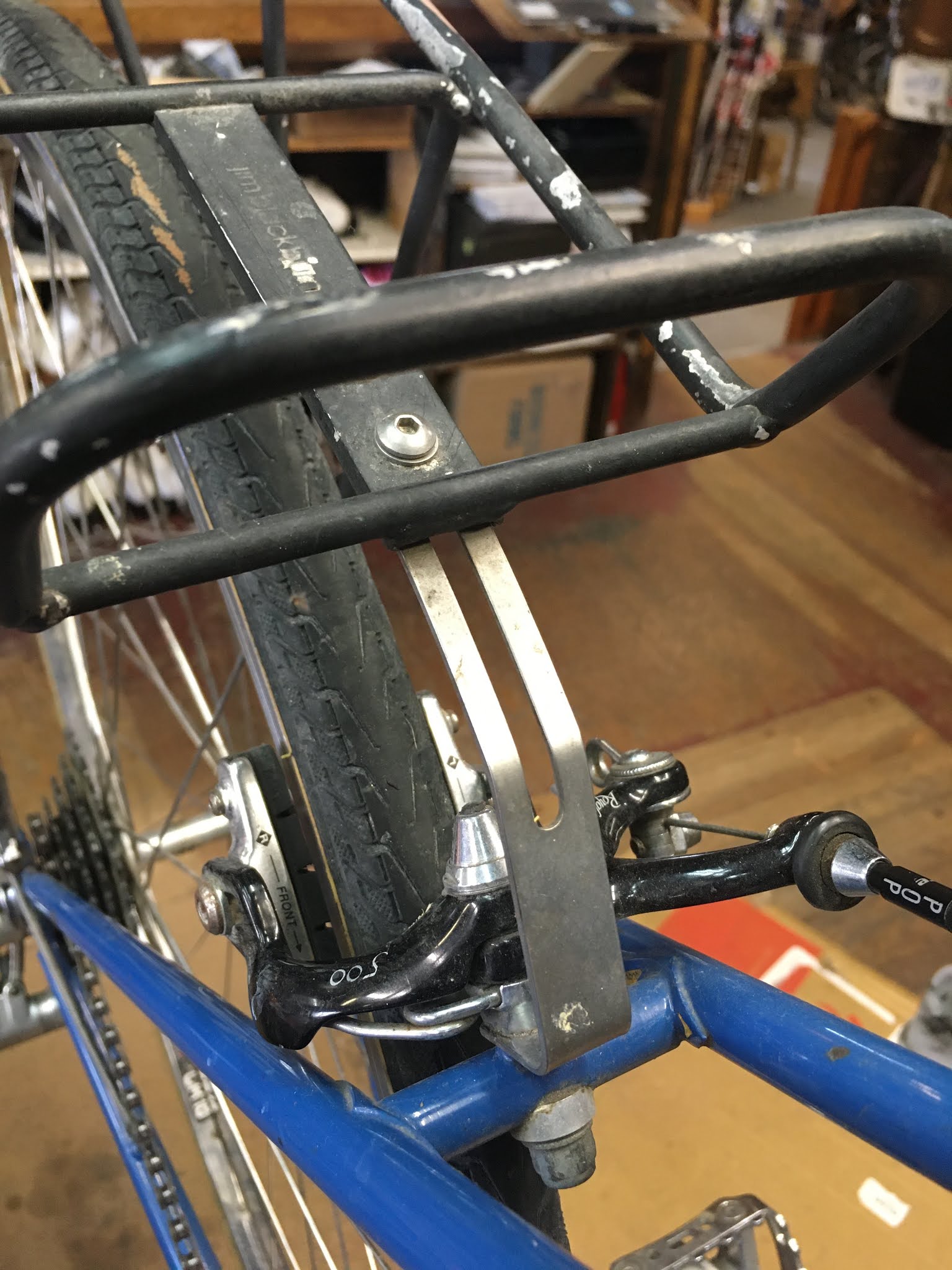
 Check out the original Blackburn rack from when the original Blackburn guy still had anything to do with the original small company by the same name.

Even the saddle is original.

I wore out several Avocet saddles until you couldn't get them anymore. I know she's logged some serious miles, but she probably hasn't crashed as much as I did, and perhaps has a smoother style. Her gearing is realistically low for a load-carrying bike.

The cam on these Gran Compe brakes actually opens up wide enough to get the tire through the brake pads, unlike the token range of much newer -- and not cheap -- offerings here in the dying days of the Age of Rim Brakes.

Old plastic Silca frame pumps tend to crack at the threads. You can repair a minor crack by wrapping the barrel with filament tape. This pump has that repair. I don't know how much she's had to use it in that condition. I finally gave up on mine and got a Lezyne mini pump.

Before the Sachs I had a bike called a Sketchy on the stand. In a color strikingly similar to Surly's "Beef Gravy Brown," which was one of the Cross Check colors around 2011, this bike was apparently a hip item around that time. Made of lighter weight, more upscale tubing, it completely lacks the touches that make the Cross Check such a great basic platform on which to build a wide variety of bikes, such as the above-mentioned long horizontal dropouts. The Sketchy had VD, and shapely but highly inefficient curvaceous chainstays that would completely prevent the use of fenders with plump tires.


What's a nine-letter (two-word) phrase meaning "overrated?"

Until FSA got rid of the needle bearing version of the Orbit UF headset, that was the answer, at a tiny fraction of the cost, to the issues that the CK headset purports to fix. The CKs are serviceable, but what a pain in the ass to get in there, just to have ball bearings  -- albeit in a sealed cartridge -- anyway. Tapered roller bearings were the best for headsets, which is probably why they disappear almost as quickly as they appear when a company offers them. The Orbit UF stayed on the market for several years before they went on the angular contact bandwagon. So they're still a good deal for the price, but not as good a deal.

Despite its unfortunate modernist touches, the Sketchy at least used a steel frame with basically round tubes. The aesthetic is not at all classical. It doesn't look like art, the way lugged frames did. The Cross Check has a welded fame, but the dropouts have a classic shape, and the forks have an external crown that gives them a classic look as well. The Sketchy fork looks like an old suspension bridge tower. It's kind of cool in its way, but it looks heavy.

The bike business seems to be able to support a number of limited-edition boutique builders who do their thing for a while and then move on. As long as they build to fit off-the-shelf componentry, you can keep the frame going almost indefinitely. Whatever it is, if it works for you, it's a good bike. 

This old Manitou fork showed really bold marketing in naming a new model (at the time) for what planned obsolescence would soon turn it into:

As we charge forward into the battery-powered future, a category called "hunting bikes" is on the rise. Camouflaged smokeless mopeds are becoming a popular vehicle for some hunters to use to get into the woods and fields in pursuit of their quarry. Back in the 1990s we had a customer or two who embraced the mountain bike as a silent approach vehicle for hunting, because they were quieter than ATVs and didn't produce stinky exhaust. But you had to be willing and able to pedal. Now a wider range of hunter can take advantage of not only pedal assistance but also pure motor power on some models. They're being sold through hunting and fishing stores, assembled by people who may not have a lot of familiarity with the basics of bike mechanics. Or the customer might have bought it online and had to assemble it themselves. Such was the case with this behemoth:

What have we gained by junking reliable simplicity? I still prepare for hostility and negligence before every time I venture out on the roads. This is true even in a car. Are the few riders retained or recruited by electric motors or enticed by technological ephemera enough to offset the general loss of people who don't grow up with bicycles as a normal part of their life, with the option to continue into adulthood?

Bike categories have forever altered the concept of what is possible under pedal power. Mountain bikes started out as just bikes. Modification piled onto modification in rapid evolution, but it was only the same process by which bicycles had developed from the beginning: largely trial and error. Only when the type was firmly established did the engineers really focus on seriously designing the machines of today.

As for the road, the demand for technology is more driven by fashion than function. Shifting systems since the onset of indexing have increased precision when they work, but also increased the demand for precision in their construction and adjustment. Road riding could still thrive if all of that went away, just as road riding could thrive if disc brakes went away, along with carbon fiber frames and 52 different bottom bracket standards. Mountain biking, on the other hand, is entirely dependent on its suspension technology and gearing systems to make the preferred style of riding possible. Some mavericks might sing the praises of a hardtail versus full suspension, but almost no one -- and perhaps no one at all -- is extolling the virtues of a fully rigid frame and fork. Fully rigid bikes have been relegated to another category, like bikepacking, in which they are still the weirder option, or fat bikes, which have always been a weird option.

Millions of riders logged millions of miles before there were through-axles, disc brakes, electronic shifters, and 1X drivetrains dragging tinfoil chains across 12 cogs (or more) spanning a range from 10 or 11 to 52 teeth. Some things could safely be rolled back and advanced along different lines with only gains for the riding public.

Sunday, September 02, 2018

Naive bike nerds

At lunch one day I was leafing through a book that Specialized put out to commemorate the 25th anniversary of the Stumpjumper mountain bike.

The copy in one of their early ads caught my eye. It was pure biketopian dreaming.

See where it says, "...you'll find you're riding more and driving less." Bike nerds still believed that they could entice Americans out of their automobiles. The leaders of the industry had come through the ten-speed boom of the 1970s. A national organization promoting bike touring had sprung up in 1976 under the name Bikecentennial, which lives on today as Adventure Cycling. Bike nerds knew, we just knew, that if we could just get enough people to try riding that they would abandon their cars en masse and join us in the fresh air and sunshine of a cleaner, more humane world.

Oh, and we're all probably faster than you are, but don't let that discourage you. Just ride more!

Each boom did see a rise in cycling participation in the real world. Mountain bikes, ostensibly designed for trail riding, were based on road designs because the early ones were improvised on road frames. They were not racing frames, but all bikes were a product of the roads and roads were a product of bikes. Once the genre was separated, mutation followed, but it took a while. All life traces to a common ancestor, but a giraffe is not a weasel and a fish is not a bird.

The bike nerds were up against sheer population growth and an economy devoted to the pursuit of wealth powered by an internal combustion engine. Even if wealth meant mere survival at a grub job, of course you would drive to it. And when you got a better job, you'd get a better car. Duh! If you couldn't afford a car, you'd take a bus or maybe ride a bike until you could afford a car. It's called being normal.

The Chinese were famous for their herds of thousands of bike commuters before they embraced creeping capitalism and their economy revved up. The first thing they did was ditch the bikes and get cars. Pollution and traffic deaths soared. But people were getting rich.

It's nice to see the Chinese now taking steps to reverse the environmental damage of their surge of industrialization. Bike sharing has become a major social and economic experiment there. We'll see how it plays out. The level of damage, loss, and wear and tear on the share-bike fleets may have people pining to own their own bikes again because they can control the use and care that they get. But then they're back to the problem of theft.

The lack of safe riding routes and secure parking present probably the two biggest deterrents to transportation cycling. You're as free as a bird on your bike, but whole populations of birds have been wiped out by people with shotguns or nest-plundering predators. Or you get sucked into the engine of a jet.

Humans have a tendency to project the future. The ability to imagine consequences has helped us over the eons, but the problems we create demonstrate the limits of those powers of prediction. We might not know for years or decades whether we've made things fundamentally better or worse by doing something that seemed initially helpful. And every generation judges a future it won't live to see by the standards of its past and present. To the extent that humans have hit a plateau in physical evolution and that our mental and emotional responses seem fairly firmly set, perhaps a generation can suggest standards by which its descendants should live. But the descendants are the ones who will actually be living under those standards, so it's really their call.

I still believe that the bike nerd view was a good one, and that our species has suffered by pushing it aside. But no one can control the outcome. The bike industry itself is the aggregate total of mostly bad decisions. It is a microcosm of society in that way. As an industry, it has to try to survive in the reality of its times.

Friday, March 23, 2018

The misunderstanders write the history books

Dredging around on the interwebs for a certain specific mutant mountain bike from the 1990s, I found a site depicting bikes of that period, viewed through the perception of young modernists. Discussing the flat, narrow handlebars we ran back then, these analysts said that we did it to reduce weight. This is entirely inaccurate.

The mountain bikes of the early ‘90s had short top tubes and long stems. We cut the bars down for better clearance on narrow trails, and to reduce unnecessary steering leverage. No one today understands bar ends, either. I don’t miss bar ends, because I bought a late ‘90s frame with a longer top tube, and put wider bars with more sweep on it, but I also don’t ride off-road in the 1990s cruising style anymore. Back then our rides were little journeys, not a series of linked stunts. We actually chose to challenge ourselves with long climbs, and liked riding cross-country.

The inheritors of mountain biking, the children of parks, ramps, moto-style courses and highly evolved suspension, have come up with their own narrative about a world they never knew. It doesn’t matter. Mountain bikers can pick and choose which antecedents to honor. It’s a young person’s game, so it will always exist in the present and recent past. The machines of history will be judged by the standards of modern riders who have not had to fumble through the period of discovery and refinement.

The older I get, the younger I realize the ages are that I once thought of as old. But if your sport is highly likely to tax your body’s ability to heal quickly, it is a young person’s game.

Back when cycling was just cycling, riders pedaled as best they could over whatever surfaces they had. The first bike ride across the United States predated the first official transcontinental road by about 30 years. And that was on a bike with skinny tires and no suspension. Really differentiated speciation didn't afflict us until the late 20th Century.

Granted, bicycling innovators experimented relentlessly, and forms of suspension can be seen from the beginning. At the start, roads themselves were often little more than trails in some places, or a set of ruts that would be dusty or muddy depending on the season.

The first mountain bikes continued that time line of branching but still related lines. The basic objective was the same: get from point A to point B over a given type of terrain. Riders in different regions, with different backgrounds, took the basic form and mutated it to suit their local conditions and tastes. Are your trees close together? Cut your bars down.

Commuting in the city, I had 38cm drop bars on my fixed gear so that I could slip through skinny gaps. On my open-road bike I had 44cm drop bars. When I started commuting over longer distances of open road, and didn't need to thread the needle in a tight cityscape with close traffic and parked cars, I put wider bars on all my bikes. It's called adaptation. Riders who adopted the mountain bike as an urban platform also modified their bars based on those considerations. Riders who visited our rugged, forested part of New England from the wide-open spaces of the golden West often had bikes adapted to plush singletrack through open range and meadows. But even they exhibited slightly narrower bars than the current norm, because of the top-tube-to-stem ratio I already cited.

Different brands adopted the longer cockpit gradually, taking a couple or three years to shift every company's offerings to the format now viewed as normal. Stems shortened. Bars widened. Riders wanted to sit up a little higher for better weight distribution and a better view down the trail. With suspension, you don't want to risk being way out over the front end of the bike. With full suspension, you can  and should stay more neutral on the bike anyway. And of course suspension has bred its own nuances of kinetics to propel the bike. Once you embrace the expense and complexity of a fully modern mountain bike, you might as well take advantage of everything it has to offer in return for its need for maintenance.

The website also dismissed threaded headsets as a misguided carryover from road biking. The article states that the pounding of mountain biking would make the locknut and top cone loosen up. If the headset had been properly adjusted and secured, it would not loosen. The major problem is that the explosion of bike business led to an explosion of shops, and a need to hire lots of "mechanics" while still trying to pay them dirt. Legions of inexperienced people came in who had no idea how a locknut works, and no patience. And why should they, when they just took the job to get the employee discount on schwag, and their employer was trying to nickel and dime them?

I ran threaded headsets without a problem until the turn of the century, when you could hardly find good quality product in quill stems and threaded headsets. The threadless headset is very convenient to work on, but it makes adjustment of bar height an awkward yank a lot of the time. Young riders on their stunt machines don't mind being locked in at an aggressive angle. Riders looking for a little more relaxation end up with a stack of spacers or a stem with a dorky rise that makes the bike steer funny.

Their picture shows someone adjusting the threaded headset without a stem in place, which will result in a headset that binds once the stem is installed and tightened. That kind of makes my point that the vast majority of people getting into the game in the 1990s knew the latest thing, but they didn't know everything. And now the current archaeologists look back from what they know and guess about what they see.