Sunday, January 15, 2023

"Road Biking is so dangerous!"

The road is the least popular place to ride a bicycle. We don't bother to stock road bikes anymore. I am the last person associated with our shop who does ride on the road. This may include former employees as well as the current staff. Among our clientele, road riders are a minority. Some converted to gravel. Some shifted their concentration to mountain biking. Many only ever mountain biked. And we have lots of path riders. Some of the path riders used to ride the road and gave it up because of age-related deterioration, or traffic fear.

I've said before that Wolfeboro is not a nice place to ride a road bike. When the summer people aren't here, some of the local drivers like to be reckless with the clear running room. The major arteries of the town are state highways, so there's some amount of through traffic all year. Lake season adds thousands of seasonal residents and visitors, some of whom arrive already hostile to cyclists. You can sneak past some of this to escape to the north and west, but you have to go farther and farther to get to a bit of peace before you head back into it. I'm sure that lots of towns have their own discouraging aspects.

Road riding is somewhat dangerous, though not as dangerous as it seems. We are "vulnerable road users," at the mercy of the drivers around us. But those drivers present a far more gruesome hazard to each other.

Last week, a northbound driver on Route 16 over in Wakefield crossed the center line and hit a southbound vehicle, killing the driver and sending the passenger to the hospital. The offending driver also ended up in the hospital, but has not died. The accident is under investigation. State police have asked for witnesses and any dashcam footage that someone might have caught. It sounds pretty forlorn. Did anyone see? Did anyone happen to capture the grim event on camera? What could any of that tell us about why some numbnut crossed the centerline at highway speed and smashed into some poor idiot just driving along? Route 16 is notorious for this type of crash. One back in the 1980s was attributed to a yellowjacket that flew in through the driver's open window and stung him in the crotch. That grim bit of slapstick cost several lives.

Crumple zones, air bags, passenger compartment reinforcement and restraints all improve the survivability of a motorist blunder, but the death toll is still in the tens of thousands every year. It's really easy to hit combined impact speeds of 80, 100, 120 mph when vehicles collide on two-lane roads, or someone ploughs through the median on a divided highway to visit the opposite lanes. In the course of a normal day of driving you pass thousands of people. Any one of them could be The One.

Then there are motorcycles. I thought about getting one back in the late 1990s, when a friend was selling a nice vintage BMW. It might be nice for those days when I was too tired to pedal, but I didn't want to be stuck in a car and have to take up a full parking space at work. But that got me thinking about what I was really gaining. Not much, actually. On a motor vehicle I would be obligated to keep up with the other traffic, without the easy option to pull off and get out of the way, the way a bicyclist can. It seemed like all of the vulnerability with none of the best advantages.

Lots of people love riding motorcycles. Everyone acknowledges the danger compared to being in a car, but I'll bet that most people think that a motorcycle conscientiously operated by a properly dressed and helmeted rider is safer than a bicycle in traffic. Maybe yes, maybe no. In stop and go traffic where the vehicles can accelerate to 30 mph or more between slowdowns or stops, the motorized cycle will be able to keep up, while the bicyclist will have to deal with motorists who are probably already impatient squeezing past in the faster sections. But just in the general run of things, the motorcyclist is exposed to impacts at higher speeds, and is in danger not only from the mass of other vehicles, but from the mass of the motorcycle itself.

A lot of road bike safety depends on traffic volume and speed, topography, and the design of the road itself. I don't think that heavily urban areas offer road biking as such. Streets call for different strategy and tactics. It's the difference between a road race and a criterium, only with a full-on tank battle superimposed on it. There are definitely places I would avoid on my bike, but I would also look for ways to circumvent them so that I could continue riding.

If nothing else, when I'm pedaling along the highway on my way to work, if someone wants to come across the centerline and peen me, they're going to have to come a lot further to reach me than if they come at me when I'm trapped in the lane in my car, winging along at 60.

Tuesday, January 10, 2023

It ain't really winter 'til your nose hairs freeze

 Every time we get a weak winter, I compare it to my memories of 1990-'91 and 1991-'92, the two that stood out for late arrival of snow, little accumulation, and overall mildness. The winter of 2005-'06 was another disaster for winter-based industries in New England, in which I recall doing more riding than skiing or other winter-specific activities. But a check of the records shows that in all of those winters we had at least some short periods of usable winter, and a few nights of nose hair freezing cold.

Your results may vary, but I find that nose hairs begin to freeze as the temperature nears 0°F, and intensifies as the temperature continues to drop. For instance, someone misread our digital thermometer and told me that it was 17°F one morning, but I knew as soon as I walked out and breathed in that it was 1.7°. 

When I'm stacking firewood into the shed in the summer, I often think about what conditions will be like when I reach that part of the pile during the dark and frigid months. I can recall many images of shivering under the cold LED light in the shed, pulling down an armload of logs to keep the wood stoves cranking against the implacable cold of the universe, toward which our end of the planet is pointed during the northern hemisphere's turn to aim away from the sun. This winter, just about every trip to the woodshed has been more like late March, or even April, except for the sun angle and day length.

I could post this as a ski column on Explore Cross-Country, but there is no skiing, and there might never be. It should surprise no one that this is the warmest, wettest, least useful winter on record, at least until the next one. We're already getting calls about bike service, not from winter riders, but from people who want to get a jump on their spring tuneups. We still have demand for ski services, so we don't want to reconfigure the workshop for grease, but we may need the income soon. It's still too early for full bike shop efficiency, so the wise rider will wait until at least mid-March, but that could change if winter-specific demand dries up.

I did notice in my training diaries from the 1990s, that I took more opportunistic rides back then. The training diary is also my daily quick summary of weather conditions, which I started adding right around that time, to give my other activity entries more context. Now I find that I really miss the hour or so that I carve out for a ride or a hike, when I have so much other stuff to get done on a day off. From the perspective of age, it seems that the people who get things done are the ones who long ago sacrificed their health, and fitness to the priorities of work. It shouldn't have to be that way, but any better way takes too much thought and care for each other's well being, to make sure that anyone who wants it can have a balanced existence.

The other argument against too much riding is that a rider needs weight-bearing exercise for bone density, and to use the body in different ways that relieve the muscles and joints from the limited range of motion provided by pedaling. You can do weight training, and definitely should stretch in some way, but for the unscientific trainer it's easiest to go do something else. Yesterday, I hiked up the mountain behind my house. I probably won't do it again, because the logged areas are now choked with brambles and sweet fern, and the uncut swaths are filling in with bushy little saplings flourishing because so much sunlight can get in. With decent snow, the brambles and sweet fern are at least somewhat covered and separated by it. Yesterday, I was either wading through the thorns or pushing through the beech thickets to try to gain a few yards on the remnants of the old forest floor.

Because I started late, I did not gain a summit, only one of the intermediate steps that offered a view westerly. To the north I saw that Ossipee Lake is not fully frozen. That is not a deep lake. I know that the big lake, Winnipesaukee, isn't frozen shut, but it is deeper and much larger, requiring a longer, harder freeze. Even giant mud puddles like Province Lake had such thin ice that the ferocious winds of the storm on December 23 broke it all up and piled it on the leeward end, where it refroze into a surface useless for skating. I remember a hike in about 1997, on a small range just over the border in Maine, from which I saw the startling blue of Sebago Lake, unfrozen in a landscape of white. We did have some snow that winter, although as climate change really started to sink its claws into the region, the weird sight of open water provided a warning to the few who cared to acknowledge it.

A native of the area used to say that he hadn't noticed much change in the climate, even up to a couple of years ago, but he has been pretty quiet about it recently. I doubt if his nose hairs have frozen any more than mine have, even if he does live in one of the colder little valleys. And, as a logger, he knows darn well that the wetlands haven't firmed up to allow the normal amount of winter cutting.

No matter how much the temperature warms, the sun angle and day length won't change. There will be more losses than gains, from many economic sectors. People have already reported ticks. Various unpleasant insects are expanding their ranges. The purifying freeze, as hard as it might feel at the time, serves a purpose for the overall health of the ecosystem. Unfrozen lakes in winter warm sooner and reach higher temperatures, aiding things like cyanobacteria, which ruins summer recreation after a warm winter ruined that season's recreation. Cyanobacteria can kill your dog. And it's not that great for humans.

We're only at the beginning of winter's July. There's plenty ahead. Averages are made of highs and lows, so we could get slapped with a little cold snap. The longer it takes to get here, the harder it will bite, because we can't help instinctively feeling like spring when the temperature mimics it. As the sun launches more and more steeply up the morning sky, the first half of a mild day will make you forget how much winter still lies ahead, until the instant shift to late afternoon light reminds you. The sunset is getting noticeably later, but it darn sure isn't late.

Tuesday, January 03, 2023

Ride in the New


Thanks to climate change, I had New Year's Day off for a change. The snow had been obliterated by rain in a storm right before Christmas. The lake and pond ice had been obliterated by a later surge of warmth. The local indoor rink would be closed for extensive remodeling through January 3. With nothing to stay open for, upper management opted to give us all the day off.

While lows had dipped below freezing most nights, every day ran well above. On New Year's Eve, the temperature never went below freezing, after a midday high pushing 50F. So once I got the morning chores out of the way on Sunday I suited up to head out for my first ride in almost a month, and my first purposeful exercise in 15 days. There's always a bit of wood splitting, and snow removal as it happens, but snow hadn't happened since December 16-17. That stuff had been the most heinous cement imaginable: disc-rupturing, hernia-ripping heart attack snow. It broke a lot of trees and took the power out for hours in places, and days in others. Only a few piles and patches of it remain. Like a horrendous battle, a storm can seem like it's never going to end, as it wounds and kills, but it does end, and the signs that it ever happened grow fainter and fainter. The lost are still lost, though, for whatever it was worth.

With the roads fully clear and a mild day, the only discouraging factor was the gusty wind. A rider learns how to manage the local winds. Around here there aren't too many attractive routes to take advantage of an upwind start and a downwind finish when a strong westerly blows, but I can ride a good few variations to the east that take the flying tailwind early and then tack back upwind on roads largely sheltered by trees.

Keenly aware of my advancing age, I wonder after any layoff how much fitness I will have lost. Coming out of a commuting season into the late fall and early winter, will the body remember the strength of the regular season or already have slumped into off-season sloth?

The first few pedal strokes on the trusty fixed gear didn't feel too ominous, although the mysterious aches that have plagued me for years teamed up with the rapid atrophy that pounces on aging, unused quads. It was manageable, but not a glorious hammerfest, joyously reuniting with the bike in exquisite synergy of muscle and machine. Nope. Just trudging doggedly to get to the real tailwind stretch on Route 25.

With gusts to 30, the elderly cyclist spun along at 20-plus for much of the three miles to the next turn. The next turn is onto a dirt road called Loon Lake Road. That's about a mile and a half unless I take a diversion onto a longer section of mostly dirt, that goes along the Ossipee River for a while before connecting to pavement again to head out of Freedom Village to hit Route 153.

The freezing and thawing had softened Loon Lake Road an inch deep in places -- mostly inconvenient places, like climbs. The route is basically flat, but there's this one little jumper that has a southern exposure... The dirt felt like a glue trap. But embedded in it were sections of ice, so I might be grinding hard just to keep moving forward upright, and risk hitting well-lubed compacted snow. When a dirt road is well frozen or only slightly thawed, sand kicked onto the icy stretches often provides more than adequate traction. With the road more softened, the icy parts looked like they had been rinsed fairly clear. They lay as traps that I had to avoid wobbling into as I slithered toward the next paved road. I skipped the river run in favor of a quicker return to pavement.

With a mild forecast for the second day of 2023 after a frozen night, I went out again to get a few more miles before the weather reverts to more wintry offerings. I wondered whether the saddle would punish me for my month of idleness or if I had retained saddle conditioning from the season that didn't seem so long ago.

I hadn't. Oh yeah. I resolved to ride rollers two or three nights a week for the rest of the winter, just to keep my sittin' parts in shape. We'll see how that really turns out.

Because the dirt road had stiffened up somewhat from the freezing night before, the river route provided a scenic variation with only one glue trap. Of course that was on the climb from river level to the paved road.

On the New Year's Day ride it struck me that I might not have ridden on New Year's Day since 1980. If I had, it probably was before I moved to New Hampshire, where weather and priorities would have made riding on that particular day less common. This was especially true once I had a job where New Year's Day is often one of the most busy, and what passes for lucrative, in the cross-country ski business. When I dredged through old training diaries I discovered that I recorded a New Year's Day ride in 1986 in Maryland, as well as a couple or three on January 2 in various years up here when time and weather allowed. I never wrote down the tequila-fueled fixed-gear slither through the outer environs of Alexandria, Virginia, that spanned midnight as 1981 came in on a light snowstorm.

I never cared much what I did on the first day of any year, aside from still being alive. But sometimes it's almost interesting to review how one has spent time.

Friday, December 16, 2022

Sliding into Winter

 One job is two jobs when you work for a shop with dual specialties. The cross-country ski business has been doomed in the Lower 48 states of the USA for decades, but a few of us keep on out of force of habit and our loyalty to our aging customer base. A trickle of younger participants comes in, but never in great enough numbers to bring us younger coworkers.

As with cycling, cross-country ski racers are somehow viewed as elite even though they will never be enough to support an industry and an economic sector. They are the most impressive athletic specimens, but their competition requires a level of commitment to physical abuse that is beyond healthy.

 Racing makes a beneficial activity pathological. That being said, racing equipment can be very fun to operate at a more survivable level of exertion. This may be more true of ski equipment, because there's less mechanical complexity to suck money out of you in repetitive repair and maintenance costs. And a full-on racing bike feels the most nimble and effective when the rider is in a position that is frankly painful over the long haul. The fact that racers grow accustomed to it does not make it less damaging to a rider who hasn't agreed to trade the physical abuse for the glory of victory, or even the mere consolation of participation. "Comfortable" is relative.

Transportation cycling offers plenty of opportunity for lung-hucking sprints and death-defying maneuvers in a tight field of ruthless adversaries. And you get to save lots of money and eat whatever you like. You don't have to drive yourself to a race venue and pay club memberships and entry fees. Just hop on outside your home and slide into the nonstop Madison flowing past on the streets.

The arrival of snow brings other options. When I lived in Annapolis, Maryland, snowstorms would bring the city to a halt. Cross-country skiers would appear among the other pedestrians enjoying the forced break from the daily churn. For a couple of days the city might be bright and friendly before plows and salt trucks turned the streets into rivers of grimy brine that splattered onto the neglected sidewalks as the citizenry climbed back into their capsules to pass each other with the usual indifference verging into hostility. Up here in New Hampshire, the scene is the same, only there's a snow-based tourist industry operating alongside the imperative to have the streets cleared for normal motor traffic. Cross-country skiers seldom get a chance to slide along unplowed streets, because the snow removal is so well organized and prompt. Residents on side and back roads roll their eyes a bit at this, but everyone gets cleared out within a couple of days.

Roads cleared for motor travel are not necessarily in the best shape for a cyclist. In a dry or warm winter, the edges might thaw back far enough to expose the shoulder, but in a normal or colder year the snowbanks narrow the road and cut off emergency bailouts. I'd rather use the snow for snow activities than fight it to remain on two wheels. Even in a bad snow year, lack of daylight combines with the winter stupor that afflicts many drivers, to limit riding opportunities.

Bad snow years have become the rule more than the exception in New England. The terrain creates variation across the region, so maybe the far north or the western half lie in the snow zone, while to the south and east we forget what winter ever looked like. It's easy to forget that about half of the United States lies to the south of most of Europe. Our north seems so far north to us and Canada is just three blocks south of the tundra.

The last ice age did tilt oddly toward northeastern North America. Weather and climate don't uniformly march across lines of latitude. Without human interference, the glaciers would have sent their ghostly reminders year after year to the areas once buried beneath thousands of feet of compacted snow and ice. Not so much anymore, though. Increasingly, we have to figure out what to do with months of slush, ice, and mud.

Monday, November 21, 2022

Miles per gallon

 As someone with a conflicted relationship with motor vehicles, I have tried to spend as little as possible to buy one. But I need one because of the distances I have to cover in challenging conditions, so they can't just be thrashed pieces of junk.

For the past several cars, I've picked up ones that various members of my family were discarding as they contributed to the used car market by buying new ones. It was an agreeable parade of small Ford station wagons, which mostly succumbed to the long months sitting in the dirt driveway while I'm using the bike for transportation, and the inexorable rust that consumes all New England vehicles that face the tide of brine flooding our roads every winter. The price tended to be pretty affordable, which suited my underlying reluctance to chip in much of anything to the moto-centric culture and polluting, speeding, jostling, sprawling environmental disaster that is transportation in America.

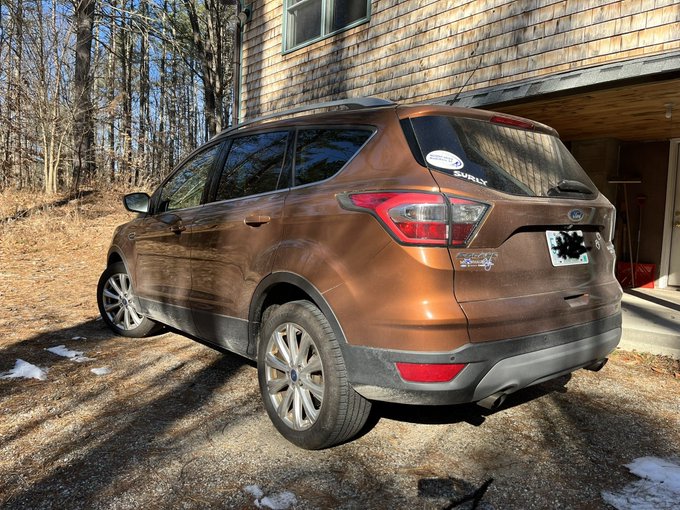
The latest -- and last -- of this line sits in the driveway now. It's far more car than I would ever buy, but the gas mileage is as good as the last Ford Focus that finally rotted out underneath the bodywork. Behold The Shuttlecraft:

"Nice car," a friend and colleague said as we headed out after the last zoning board meeting.

"Thanks. I had to kill my father to get it," I said. Dad was a Ford man. He died at the end of May. My mother is 93, and has decided to quit driving because, as she says, "I'm 93 years old. If anything happens, it will be my fault even if it isn't my fault." My sister is on hand to drive the two of them around. So this car, this space craft full of electronics and automated features, was available for ...really cheap... just as my mechanic was telling me that he couldn't sticker my old car anymore because the frame was almost gone.

There's a lot to get used to.  The speedo and tach are analog, but all other data comes at the driver through two screens. One is a small one centered above the steering wheel. The other is the now ubiquitous touch screen in the middle of the dash.

In the cellist's Honda CR-V, she can punch up a readout that tells her about fuel consumption: miles remaining at current rate, and miles per gallon. She has to ask for it. In The Shuttlecraft, that display is constant. I suppose I could turn it off, but I find it fascinating.

Miles per gallon tells you about the energy required to accelerate a mass against the force of gravity and the other factors that inhibit forward motion. As a cyclist, you have an intuitive -- and very tactile -- awareness of the toll that hills and headwinds demand. Through the readout in The Shuttlecraft, I can see the dramatic difference between uphill and down, and any acceleration. Going down a hill, the mpg readout will max out at 99.9. Woo hoo! Going up a hill it drops to lows like 11, 9, 7, or sometimes 3. It just drains. And any short hops or stop and go driving drops the total from a creditable 30-31 down into the "sorta might be okay" upper 20s. The Focus was surprisingly no better, especially with snow tires, but the Shuttlecraft is undeniably more of a bourgeois armored personnel carrier. It's really hard to find a nice small station wagon these days but I still wish Dad had had a bit more varied taste in cars. A nice Passat wagon logging 40 mpg, perhaps.

Well, po' folks can't be choosers. In an alternate timeline, I stayed in a more built-up area and never bought a car at all. But then I'd have to live in a more built up area. Nature called.

Around here, I've fallen in with the tree huggers to try to defend a natural environment where there still is one. When I moved here, it was the country. Now, 35 years later, it's more like heavily wooded suburbia. That makes our efforts all the more important, because the economy depends increasingly on subdividing large parcels of land and increasing population density. More roads aren't being built, but the ones we have are getting a lot busier all year. Residential development is piecemeal for the most part, a house here and a house there, but larger tracts are proposed as the state grapples with a lack of "workforce housing." Workforce housing is a nice way of saying shacks for the scantily paid grunts who perform the essential but disregarded tasks of actually making civilization and the economy run. If it had existed in Annapolis in the 1980s, I might never have moved away. But Annapolis was obliterated by explosive, poorly planned development. I saw it coming and ran for the hills, literally.

Ironically, the tree huggers do a lot of driving. It's the norm. In rural areas, the distances demand it. In winter country, however degraded the winter might be, the weather favors a heated, enclosed vehicle, too. Some of the environmental folk have electric or hybrid vehicles, but most of us drive used, internal combustion vehicles. Their designs reflect the American norm. Mine is hardly the largest. You can only be so much of the change you want to see before you are so far beyond the leading edge of societal evolution that you're just a freak out there, with no infrastructure and no momentum of social change behind you. So for now, the environmentalists drive to work and drive to public hearings and educational presentations and off to their environmentally appreciative recreational activities.

When I get out of the car every spring, I immediately have less time for other things. Commuting takes at least twice as long. It provides beneficial exercise, but cycling is not complete exercise. A bike rider needs to do weight bearing, stretching, and resistance exercise to preserve bone density and avoid muscle imbalance. And the route takes me longer and leaves me more tired than it did when I was in my 30s and 40s, or even early 50s. Freedom isn't free. It's an investment decision no matter what type of freedom you choose.

Thursday, November 03, 2022

Cause of death: snake bite. Or was it?

 A regular customer brought his bike in to be checked after he’d had a flat tire out on the road. He’d put in his spare tube and pumped it up to full pressure at a nearby friend’s house before he made his way home, but wanted a professional eye to make sure that he hadn’t missed anything.

By his account, he’d done all the right things. But the holes in his punctured inner tube were a classic snake bite, when he is conscientious about proper tire pressure, and did not recall hitting anything like a stone or a pothole.

It was the rear tire, as usual. I pulled the wheel out and examined it carefully. He had not perfectly noted which way the tube was oriented, so I had to look in both directions from the valve stem. There was a faint scratch on one end of the arc and an almost imaginary ding at the other end, corroborating a snake bite either way.

No debris showed on the outside of the tire. The twin holes that we’d all seen would have needed a thin but long object, like a finishing nail, to have gone and and fallen out again before he stopped. Yep. This had to be the snake bite that it appeared to be.

A responsible mechanic always checks the casing, regardless of the cause of the flat. It takes maybe an extra minute. I was perfunctorily sweeping my fingers through the tire when I felt like telltale poke of sharp debris. Wire? Thorn? I had to pull it down through the casing because absolutely nothing stood up above the tread. It was pointy, dark, and ferrous. Not the usual skinny wire fragment, but possibly thicker wire in its youth.

Because the rider had traveled 13 miles home after fixing the flat, he could have picked up this little ninja on that part of his ride, and just been lucky that he didn’t flat again.

Feeling like a crime scene investigator, I clamped the snake bite holes in his old tube and pumped it up. After a careful search, feeling for the faintest breath of escaping air, I found the tiny pinhole of the initial puncture that started his misadventure. It was like one of those crime shows where the cops find a victim with obvious wounds and build a scenario based only on those and then the smarty pants detective finds the other thing that reveals the true perpetrator.

My theory is that the rider hit the poky debris without realizing it. Air very gradually escaped until pressure was low enough to get the obvious and faster-acting snake bite from a surface hazard that might not have imperiled a fully inflated tire.

It’s only trivial bullshit, but it provided a bit more entertainment than your average flat tire.

Tuesday, September 13, 2022

Don't confuse your shark

 A rider in traffic can use motor vehicles the way the pilot fish uses a shark. We can hover near the larger beast and let it make holes for us that we would have trouble making for ourselves. It's a way to improve our flow through the system, which helps everyone, whether they realize it or not.

Most of the time, the motorized shark doesn't notice the pedaled escort fish. It's vital to remember this. The big vehicle helps you the most when it maneuvers without worrying about you. As long as you remember this, the technique is as safe as any traffic riding, and actually safer than squeezing along in the door zone out of the way of the motorists.

In faster traffic, in high density and moderately high speed flow, pilot fish technique is no longer reliable. One recently reported accident involved a cyclist maintaining traffic speed in the lane who was right-hooked catastrophically by a vehicle that passed anyway. You must use your judgement at all times. I almost had a bad encounter this summer when I was rolling in on Center Street at traffic speed, and laid into the corner onto Lehner Street just as a local tourist trolley decided to push out into the lane from the gas station on the corner to force an entry into a line of stopped traffic at the stop sign on Lehner to enter Center Street. I had the right of way, and momentum, but the driver still yelled that I was a "fuckin' idiot," because I was on a bike and should have been able to stop in an instant to let his barge pull out and cut me off. We are the lowest on the traffic totem pole.

Downtown Wolfeboro in the summer is mostly perfect for pilot fish technique. But sometimes the sharks are too aware. Last week, for example, I was coming down into the area near the train station building that marks the start of the Bridge-Falls Path/Cotton Valley Trail, as a huge, shiny, black Suburban came around the end of the block from Railroad Avenue to loop around and head out the short but grandly named Central Avenue past the Post Office to Main Street. Whenever a motor vehicle comes through there as I am coming down to make my left, I maintain speed, but swing right to get them to complete their turn, so I can then loop back to the left to settle in behind them. Whether I wait behind them or filter through to get onto Main Street ahead of them depends on how choked up the intersection is at Main Street.

The driver of the SUV did not look over at me as she came around and into Central Avenue. But I had a front blinky light still operating from the trip down Center Street. Also, as I assessed the clot at the intersection ahead, I slid up on the right before drifting back to let her take the lead onto Main Street. Main Street was backed up, and drivers there were not consistent about letting side traffic join them.

Once on Main Street, we accelerated nicely to a quick but accessible pace. We slowed at the crosswalks, but did not have to stop. Approaching Mill Street, the shark put on its right turn signal. No problem, I was turning right, too. But the confused shark, aware of my presence but oblivious to my hand signal for the right turn, stopped short and offered me the Death Hole on the right. All she had to do was drive up to the corner and turn it, and whether I was going straight or right it was up to me to keep myself out from under her wheels. But she might have thought that I had been trying to get past her, rather than scavenge a bit of draft. With the best of intentions, she was trying to avoid hooking me. I stopped short in a track stand until she made the turn and I could follow her. She went on down Mill Street while I kept swinging right to enter the parking lot behind the shop.

Sometimes a shark will be vindictive, brake checking or making other moves to kill the pilot fish in its buffer zone. You have to learn to read the body language of the vehicle. For most drivers, the vehicle is an extension of their body and personal space. This ability is what allows us safely to pilot our large machines, but it also extends the area of sensitivity for operators who are protective of their personal bubble. Remember that the vast majority of drivers don't want to hurt you, even though absolutely none of them would be sorry to see cyclists banished completely from the public roads. This doesn't protect you from the careless or distracted driver, but it's some tiny consolation.

Meanwhile, in the "I mountain bike because it's safer" crowd, the casualty list includes one separated shoulder, one busted collarbone, and one rider who fractured two vertebrae and busted the top off of his femur.  And the Cotton Valley Trail continues to claim numerous victims with its numerous rail crossings. Wherever you ride, your own judgement is always your most important defense.