Saturday, May 13, 2006

What's in That Fork?

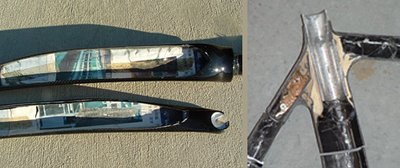
James at Bicycle Design posted this photo with an entry on funny things found inside some carbon fiber frames Trek engineers had cut open to study competitors' designs.

The image “http://photos1.blogger.com/blogger/4881/1620/400/carbon_filler.jpg” cannot be displayed, because it contains errors.

According to James, the Trek newsletter said the fork was lined with Chinese newspapers. Further examination has shown they're not newspapers. They're fortunes.

Friday, May 12, 2006

This is Perfect

I'm on hold for Cannondale tech Support and the hold music is The Police singing "sendin' out an SOS, sendin' out an SOS..." over and over.

Tuesday, May 09, 2006

One Short Commute

The poster put out by the League of Amercian Bicyclists and Shimano for this year's Bike to Work Week really bothers me. Didn't anyone really look at this thing (link opens a pdf) and check it out?

The rider in the picture is going to pile into that gate unless the sensor is abnormally sensitive and will detect a bicyclist. The first impression it gives is that the rider is an idiot who is about to clothesline himself on the barrier.

Way to build our image.

Even when I could still afford to be a member of the League, I found them unresponsive to individual members. I wrote to them a few times about issues and never got a response. All I got were letters asking for more money.

I don't necessarily agree that more money to the League will put more riders on the streets. We all as cyclists need to work on local initiatives and the local cycling climate.

My congressman pointed out that the federal government can provide funds, but it is up to the states and local governments to put those funds to work. States make the laws under which you ride. If you want facilities, work locally. If you want to create a positive image for cycling, be the change.

Don't go riding exuberantly into any closed gates, even if a leading manufacturer and a supposed advocacy organization seem to be recommending it.

Monday, May 08, 2006

SRAM tech note

Between good and bad, this is slightly to the good side:

A young customer, barely driving age and without a car, crashed his mountain bike and kneecapped his SRAM X-7 trigger shifter for the rear derailleur. The impact snapped off the return lever that releases the derailleur down to higher gears. While repairing the bike I discovered that the shifter would still operate using the nub of the broken lever as a push button.

If the rider had not snapped off his derailleur hanger and disemboweled the derailleur in the same incident, he would have been able to limp around. The ergonomics couldn't be any worse than they were when the shifter was new. Those return levers are tucked inconveniently up under the outer lever.

In other SRAM-related news, we were setting up this year's crop of F600 Cannondales when Ralph discovered that the Shimano LX derailleurs did not seem to want to work with the SRAM shifters.

A charming man named Ed, at SRAM, dismissively told Ralph that there could not possibly be a compatibility issue between a front shifter and derailleur.

"You could shift it with a two-by-four," he snapped.

Look for the SRAM 2X4 Gruppo some time in 2008.

This is the same SRAM that likes to make a big time about their 1:1 actuation ratio and all the precise engineering that goes into their products.

A SRAM derailleur eliminated the problem, which was that the shifter did not seem to be able to pull enough cable to keep the derailleur cage from rubbing the chain in a number of gears.

Subsequently, when I assembled an F600 and confirmed Ralph's findings, we tried to take the matter up with Cannondale. They, too, discounted my couple of decades of wrenching and Ralph's ten years of it, referring to us in an internal email as "that ski shop" that's having trouble adjusting the front derailleurs.

We did indeed get the Shimano derailleur to work with the SRAM shifter once we hung our full body weight on the cable to get as much tension as we could. The results we consider barely adequate, but the corporations involved don't seem inclined to issue any different parts. Once those cables settle in, and any time they loosen up the slightest bit thereafter, the front derailleur cages will rub. Be prepared to use a lot of barrel adjuster to maintain the needed tension.

When riders have to use a lot of barrel adjuster, that means the adjusters are run out far enough to be vulnerable to bending. Inattentive riders may even run them out to the end of the threads. At that point the adjusters wiggle back and forth, damaging the threads of the shifter body itself. This damage can make it impossible to thread the adjuster back in.

Measuring the arms on either side of the pivot of both the SRAM and Shimano derailleur, we found that the arms of the Shimano derailleur were every so slightly asymmetrical. The more speeds you add to a drive train, the more tiny differences make a difference.

But what do we know? We're just idiots in "a ski shop."

Built for the Ages

The old Silca Track Pump was showing its 26 years at last. The check valve was sluggish, so the gauge would drop as soon as I finished a downstroke. I had to notice and remember the high point the needle had hit, to see if I had put enough pressure in the tire.

Most people don't seem to have the patience I do for nursing aging equipment along. My wife simply refused to use the Silca anymore. I picked up a Planet Bike Ozone ST to get us through the crisis until I could get parts for the Silca.

Gotta love the Italians. Campagnolo has been dragged into the ethically murky world of completely proprietary drive trains, but even there they try to maintain repairability and cross-compatibility of small parts as much as they can. As for the Silca, certamente, parts are available.

The new check valve parts don't look quite like the old ones, but they fit the space available and work as well or better.

That, my Asian friends, is what change for improvement really means.

Work is the Time Between Rides

With a route just under an hour inbound and more than an hour outbound, riding makes up a good chunk of my workday. The work itself just becomes the time between rides.

Working in the bike shop gives it all a unified theme, but I have not always worked in the industry. Wherever I worked, I rode my bike to it.

For a while I worked three days a week at a newspaper and two to four days a week at the bike shop. The contrast was interesting.

At the newspaper I would arrive, change into the work clothes I kept on the premises, go to my computer terminal and sit. I might have to go downstairs to the front office a few times, but generally I spent the working hours sitting on my butt, correcting people's writing. Sometimes, faced with the same wad of errors from the same writers week after week, I would simply pass out, my head falling to the desk in front of me.

At the bike shop I spent most of the day on my feet at a repair stand. I had to lift and lug things. As the years have passed I have welcomed opportunities to sit.

At the end of the day I was either tired and butt-sore from sitting or tired and footsore from standing. The best part of the day was the ride.

Because I have ridden my bike to every job I've had since I graduated from college in 1979, I tend to rate life based in large measure on how the ride is. True, I use the car now for the dark months, particularly with a winter commute of 70 miles, but I know I will get back on the bike as soon as conditions remotely permit it. I have almost a thousand commuting miles already this year. That does include base miles to prepare for commuting, but those tend to be minimal because passable riding conditions and sufficient daylight for the commute usually arrive together.

As a practical matter, my wife and I will do a half-carpool sort of thing on certain days. She goes to town at a different time, with more stuff, requiring a car. If we happen to be headed home at the same time, I can hitch a lift with her to keep from pounding out the same 30 miles at the same commuting pace day after day. I know a pedaling purist would never get off the bike. I used to be that way myself.

There are two ways to vary your ride length if you do the same route every day. You can shorten the route by taking other transportation on some days or you can lengthen it by adding extra distance to either half.

My average commute is 30-33 miles. In the past, I might run that up to 50 or more on some days, making the basic 30 feel shorter. That works, but it takes time. At least once while I was training to race I rode the full 30-mile commute, followed by a 50-mile training ride with another rider after I got home. More frequently I would run the day up to 48 miles by diverting to the newspaper's parent company to pick up the payroll to deliver to our office. I did not get extra pay for courier duty.

On a recent trip to Boston I was reminded that bike commuting encompasses a huge variety of routes, riders and machines. It requires only one vital ingredient, the urge to incorporate a bicycle into the process. People ride to their carpools, ride to the train station, or ride the whole distance. That distance can be long or short.

We're well into National Bike Month. For those of us who ride it's just another month of riding. But don't forget to talk it up to people who might be teetering, inclined to ride but in need of an extra nudge. Stress that riders create their own style from all the options available.
Saturday, May 06, 2006

Retail Fantasies

Do chiseling customers pestering us for discounts realize they are telling us they think we don't deserve our paychecks? If they did realize it, would it change their behavior?

Years of dealing with pushy bargain hunters has inspired a couple of formats for sales we could hold.

How about the Cup of Phlegm Sale? Drink this eight-ounce cup of phlegm and you can have all your purchases at 70% off for that visit. If you want to play again on a subsequent visit, be ready to down another eight ounces.

No vomiting on the premises. Do that and pay full price plus a penalty and pull your own mop duty.

Here's one I'd like to actually try: The No Questions Asked Sale. You think the shop staff doesn't add any value to the product? Fine. Come in, locate and select your merchandise all by yourself, take it to the register and pay half the ticketed price. For every question you ask, add 15% to that discounted price. If you have to ask three or more questions, give up and admit that you need us and pay what we were asking in the first place.

Neither approach screens out the people who just drag us through the mud for an hour or so and then go buy on line.